

If you're dealing with storm season, private well questions, or just inconsistent water at home, it's easy to see why a gravity water system sounds appealing. No pump. No complicated controls. Water moves because it flows downhill.
That basic idea is why gravity systems have stayed relevant for a very long time. But for a Central Florida homeowner, the crucial question isn't whether gravity works. It does. The pertinent question is whether it fits your house, your water source, and the problems you're trying to solve.
Table of Contents
- What Is a Gravity Water System
- Two Types of Gravity Water Systems Explained
- Gravity Systems vs Pressurized Whole-Home Filtration
- Are Gravity Systems Right for Your Central Florida Home
- Sizing Maintenance and Professional Installation
- The Best Water System Starts with a Water Test
What Is a Gravity Water System
A gravity water system is any water setup that relies on elevation instead of a powered pump to move water. If the water source or storage tank sits higher than the place where you use the water, gravity pulls it downward through the system.
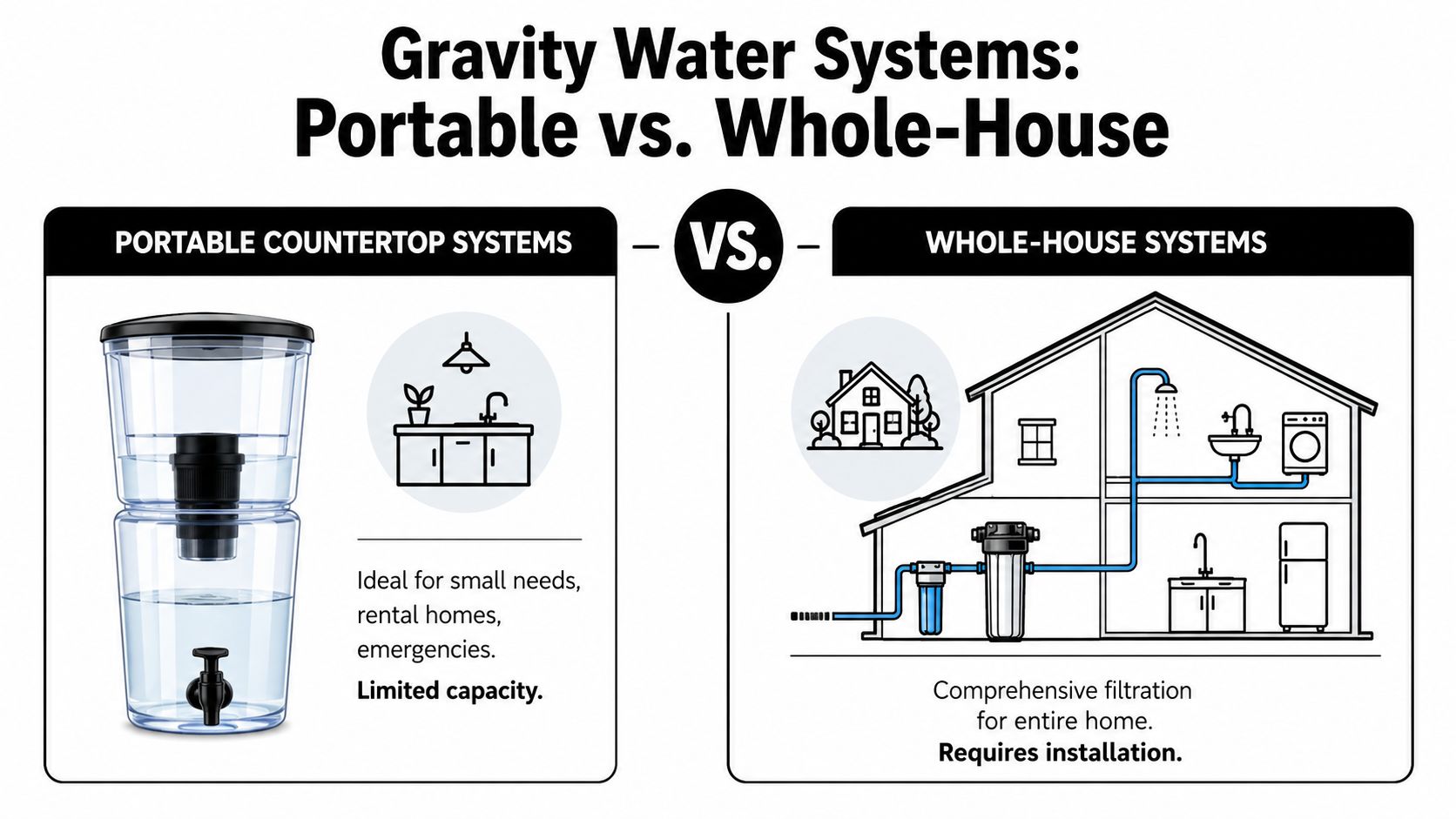
For most homeowners, that idea shows up in two very different ways. One is a small countertop drinking water filter that lets water pass through filter elements slowly. The other is a larger storage-and-delivery setup where a raised tank supplies water to parts of the home.
The simplest way to think about it
Think of a cup of water poured from a second-story balcony to the ground. It doesn't need a motor to move. It only needs height. A gravity water system works on that same principle, just in a controlled way through tanks, pipes, and filters.
That simplicity is a big reason people like these systems. They can still function when power is out, and they don't depend on the same equipment as a fully pressurized treatment system.
Practical rule: Gravity can move water reliably, but it can't ignore layout, elevation, or water quality problems.
Why this idea has lasted so long
Gravity-fed systems aren't new or experimental. Ancient qanats in Persia date to around 700 BC, and Roman aqueducts later served entire cities, according to this history of water supply and distribution. That long history matters because it shows the core principle is dependable when the system is designed correctly.
Homeowners sometimes get confused because the phrase "gravity water system" sounds like one product. It isn't. It's a category.
A countertop unit for drinking water and a raised tank feeding a house both use gravity, but they solve very different problems. One is about small-batch filtration. The other is about water delivery.
Where people usually misjudge it
Few overestimate gravity itself. However, the capabilities of a single gravity system in a modern home are frequently exaggerated.
A simple gravity setup may help with drinking water access or emergency planning. That doesn't automatically mean it will give you comfortable showers, protect appliances, or solve ongoing water quality issues throughout the whole house.
Two Types of Gravity Water Systems Explained
Homeowners usually mean one of two things when they ask about a gravity water system. The difference matters because the right choice depends on whether you're trying to improve a few gallons of drinking water or supply water to a whole house.
Portable countertop gravity filters
A countertop gravity filter usually has an upper chamber, a lower chamber, and filter elements between them. You pour water into the top. Gravity pulls that water through the filter media and into the bottom chamber, where it's stored for drinking.
These systems are popular because they're simple to use and don't require plumbing changes. They can make sense for:
- Rental homes: You can use them without changing the property's plumbing.
- Emergency backup: They still work when electricity is unavailable.
- Small drinking water needs: They focus on water for cooking and drinking, not full-house demand.
The limitation is capacity. They work in batches, and they don't behave like a household plumbing system. You don't connect one and suddenly improve every faucet, shower, appliance, and toilet in the home.
Gravity-fed tank systems
A larger gravity-fed tank system works more like a small private water tower. Water is stored in a tank that sits above the fixtures it serves. Because the tank is higher than the faucets, gravity creates the force that pushes water through the pipes.
The key design term is static head, which means the pressure created by height. For every 10 feet of elevation difference between the tank and the faucet, the system generates about 4.3 PSI, as explained in this guide to gravity-fed water systems.
That sounds straightforward, but it creates a practical challenge. If the tank isn't high enough, the water may flow too weakly for normal household use. If the piping is too restrictive, friction reduces performance further.
A gravity-fed tank system only works as well as its elevation, pipe size, and layout allow.
Side-by-side difference
| Type | Best fit | Main strength | Main limitation |
|---|---|---|---|
| Countertop gravity filter | Drinking water for a few people | Simple, portable, no plumbing changes | Small volume and slow batch processing |
| Gravity-fed tank system | Off-grid use, backup supply, certain rural properties | Can move water without a powered pump | Pressure depends on height and pipe design |
A lot of confusion comes from mixing these two categories together. Someone reads about a portable filter and assumes it can solve a whole-home issue. Or they see a gravity-fed tank and assume it will feel like city water pressure indoors.
It won't, unless the system is designed around that goal from the start.
Gravity Systems vs Pressurized Whole-Home Filtration
For a modern home, the comparison usually isn't gravity versus no water treatment. It's gravity versus a pressurized whole-home system.
Gravity systems have one major advantage. They can work without the same dependence on electrical pumping. That's useful for backup planning, remote properties, and specific off-grid situations.
But daily living in a full-time home puts different demands on water. You want steady pressure at the shower. You want consistent flow at multiple fixtures. You want treatment that addresses the water entering the house, not just a small amount stored in a countertop chamber.
Where gravity starts to struggle
The biggest issue isn't the idea of gravity. It's the effect of pipe friction, bends, narrow lines, and blockages. This technical overview of gravity-fed water performance notes that long or narrow pipes, layout inefficiencies, and blockages can reduce flow significantly.
That matters in actual homes because plumbing isn't a straight downhill pipe. Water often has to move through turns, valves, varying fixture demands, and long runs. In those conditions, a gravity-based setup can feel slow or inconsistent.
Here is a practical comparison.
System comparison
| Feature | Countertop Gravity Filter | Gravity-Fed Tank System | Pressurized Whole-Home System |
|---|---|---|---|
| Primary purpose | Drinking water in small batches | Water delivery where elevation is available | Treat and deliver water throughout the house |
| Pressure at fixtures | Not applicable to household plumbing | Depends on tank height and pipe layout | Stronger and more consistent for everyday use |
| Capacity | Limited to stored batch volume | Better than countertop units, but design-dependent | Built for whole-home demand |
| Installation complexity | Low | Moderate to high | Moderate to high |
| Best use case | Rentals, travel, emergency drinking water | Off-grid or backup scenarios | Full-time homes with ongoing water quality issues |
For homeowners evaluating long-term options, a whole-home water filtration system is usually the better fit when the goal is comfort, appliance protection, and broad water treatment across the property.
Why pressurized systems fit modern homes better
Pressurized systems are designed for normal household behavior. Someone turns on a shower while the washing machine is running. A dishwasher starts. Another sink is in use. The system is built around delivering treated water under pressure through the home's plumbing.
That matters even more in Central Florida, where homeowners often need a combination of treatment methods rather than a simple point-of-use solution. A gravity filter may improve the drinking water experience at one location, but it doesn't usually address the larger house-wide concerns that affect plumbing, fixtures, and daily convenience.
If your goal is whole-home performance, pressure isn't a luxury. It's part of the solution.
The balanced view
Gravity systems still have a place. They're sensible for emergency preparedness, selective drinking water use, and certain rural setups. They are not universally outdated.
But for most occupied homes, especially homes with active water quality issues, pressurized whole-home treatment gives you broader coverage and more usable performance. That's why many homeowners use gravity for backup and pressurized treatment for everyday life.
Are Gravity Systems Right for Your Central Florida Home
Central Florida homes have a different water conversation than cabins, campsites, or off-grid retreats. The issue often isn't just access to water. It's what that water contains and how it behaves across the whole property.

If you're in Sebring, Winter Haven, Lake Wales, Avon Park, Frostproof, or surrounding areas, you may already be dealing with familiar problems. Hard water can leave scale. Iron can stain fixtures and laundry. Sulfur can create unpleasant odor issues, especially on private wells.
What a small gravity system can and can't do
A countertop gravity filter may help with drinking water taste and odor at the kitchen counter. That's a narrow job, and for that purpose it may be perfectly reasonable.
What it doesn't do is treat every faucet, shower, appliance, and plumbing line in the home. It also doesn't solve the mechanical consequences of untreated water moving through your household system.
If your water is affecting bathing, laundry, dishwashing, or fixture condition, you're dealing with a whole-house issue, not just a drinking water issue.
Why local water challenges change the decision
Central Florida homeowners often need treatment chosen around the actual chemistry of their water. One home may need help with hardness. Another may need sulfur odor control. A well-water property may need a very different setup than a home on municipal supply.
That's one reason water infrastructure kept evolving over time. The history of water distribution and treatment notes that public systems progressed from early pipe networks in the 1800s to the Safe Drinking Water Act in 1974, reflecting the push toward higher water quality standards. Modern pressurized treatment grew out of that same need for reliable, scalable performance in everyday life.
A better question to ask
Instead of asking, "Does a gravity water system work?" ask these questions:
- What problem am I solving: Drinking water taste, emergency backup, or full-house treatment?
- What type of water do I have: Municipal water and private well water don't present the same treatment needs.
- Where do I notice the problem: At one tap, or throughout the house?
- What happens to appliances and plumbing: If water is leaving buildup, stains, or odor behind, the treatment choice needs to address more than one faucet.
For homeowners on a private well, it helps to understand the broader options for well water treatment in Central Florida, especially when odor, staining, sediment, or mineral content are part of the complaint.
A gravity system can be the right tool. It just isn't the right tool for every Florida water problem.
Sizing Maintenance and Professional Installation
A gravity water system looks simple from the outside. Owning one isn't always simple.
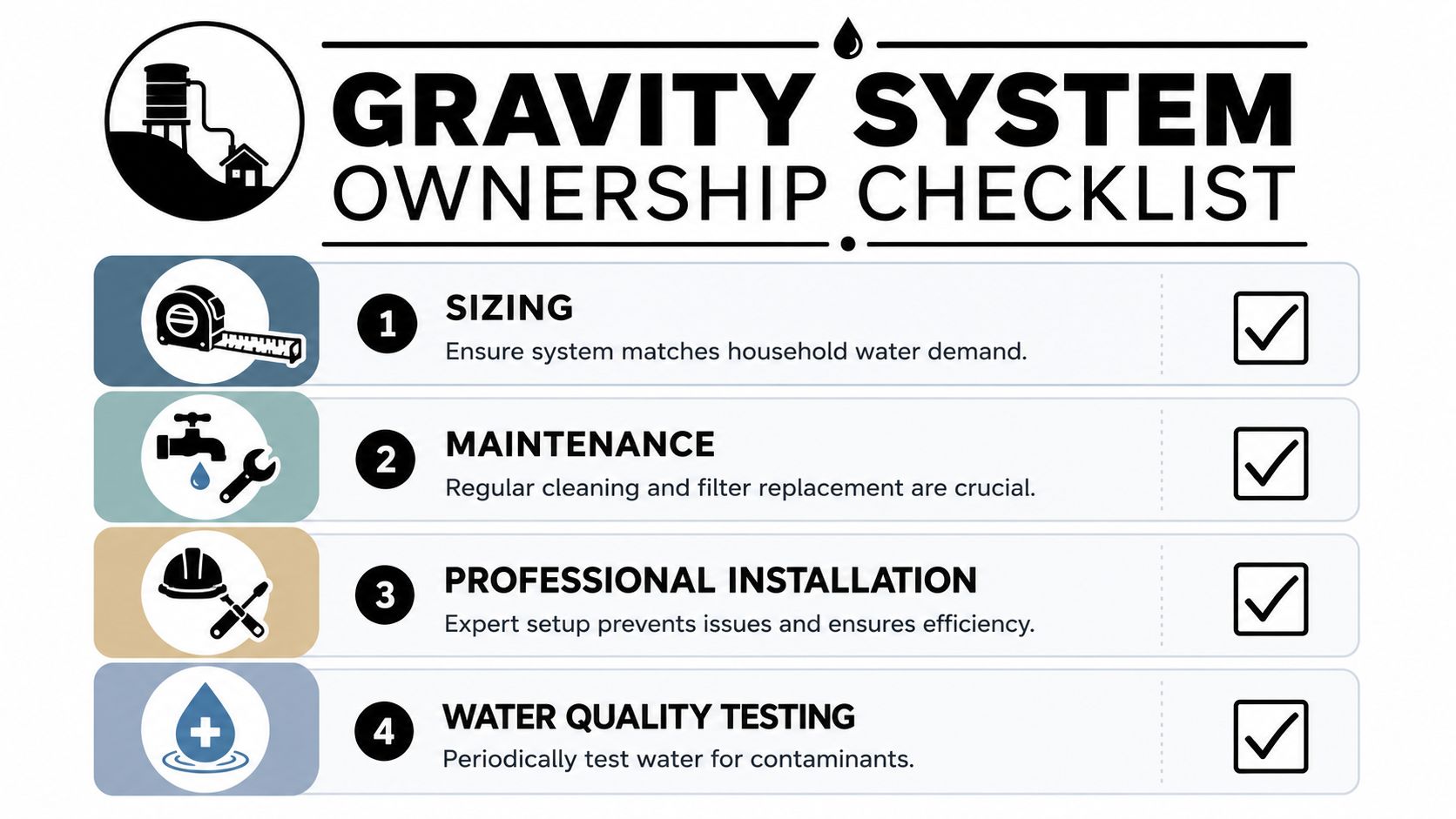
Countertop units need regular cleaning, routine filter replacement, and attention to storage hygiene. If you ignore maintenance, flow slows down and water quality confidence drops.
Larger gravity-fed systems add more responsibility. Tanks can collect sediment. Plumbing layouts can create weak flow points. Outdoor or exposed storage introduces added maintenance concerns that homeowners don't always anticipate at purchase time.
Sizing is where many projects go wrong
With a whole-home gravity-fed setup, tank placement isn't just a convenience issue. It's the engine of the system.
Design guidance for gravity-flow pipelines recommends pressure head at or above about 10 m and target water velocity around 0.7 to 3.0 m/s, while avoiding negative pressure, according to this gravity-flow design reference. When a design falls outside those conditions, systems can experience poor service, air blockages, and added wear.
For a homeowner, that means the following:
- Tank height matters: If elevation is insufficient, fixture performance suffers.
- Pipe sizing matters: Pipes that are too small increase friction loss.
- Layout matters: Long runs, sharp changes, and poor routing reduce usable flow.
Maintenance checklist for real homes
- Clean filter elements on schedule: Countertop systems don't stay effective if sediment and residue build up.
- Inspect storage conditions: Tanks and stored water need protection from contamination and sediment accumulation.
- Watch for declining flow: A drop in flow often points to blockage, scaling, fouling, or a layout issue.
- Get professional design help: Whole-home water delivery shouldn't depend on guesswork.
Professional installation isn't about making a simple system sound complicated. It's about preventing expensive disappointment. If the system is undersized, badly located, or mismatched to the home's water quality, you'll feel the problem every day.
The Best Water System Starts with a Water Test
A gravity water system can be a smart solution in the right setting. It can provide emergency drinking water, support off-grid planning, or offer a simple non-electric option for specific needs.
For most Central Florida homeowners, though, the better long-term decision starts with diagnosis, not equipment. If your home has hard water symptoms, sulfur odor, iron staining, sediment, or whole-house water complaints, the right answer depends on the water itself.
The smartest next step
Buying a system before testing the water is like replacing plumbing parts before finding the leak. You might get lucky. You might also spend money on a setup that solves the wrong problem.
If you're comparing your options, it's worth reviewing local water filtration system solutions in Sebring and surrounding areas with the understanding that the best system is the one matched to your water source, household demand, and property layout.
Good water treatment starts with evidence. Not assumptions.
A countertop gravity filter, a gravity-fed storage approach, and a pressurized whole-home system all have legitimate uses. The right one depends on whether you need better drinking water, backup capability, or complete household treatment.
If you want clear answers about your home's water, Florida Water Management offers a free water test to help you identify what's in your water and which treatment option makes sense for your home and budget. The easiest next step is to reach out through the Florida Water Management contact page.