

If you're dealing with cloudy glassware, white buildup on fixtures, rough-feeling towels, or that rotten-egg smell that often shows up on private wells around Central Florida, you're probably asking the same question most homeowners ask after a few bad months with their water: what size softener do I need?
That question matters more than is commonly understood. A softener that looks right on paper can still leave hard water in the house if it isn't matched to your water chemistry and your home's real demand. Around Sebring, Frostproof, Lake Wales, Winter Haven, and Lakeland, I see the same pattern over and over. People buy by label size, tank height, or a rough guess from a big-box aisle, then end up with a system that regenerates too often, struggles at busy times of day, or never fully handles the iron load coming from a well.
The right way to handle how to size a water softener is simple in principle and easy to get wrong in practice. You need tested water, realistic household usage, and one more factor many guides skip entirely: flow demand when several fixtures are running at once. That last part is often where trouble starts.
Table of Contents
- Why "Close Enough" Is Never Good Enough for Your Water Softener
- Finding Your Two Critical Sizing Numbers
- Calculating Your Home's Daily Hardness Load
- Choosing Grain Capacity and Regeneration Frequency
- The Overlooked Factor Peak Flow Rate
- Your Final Sizing Checklist and Professional Path Forward
Why "Close Enough" Is Never Good Enough for Your Water Softener
A lot of water problems in Central Florida don't look dramatic at first. The dishes spot a little more. Soap doesn't rinse clean. The water heater starts building scale. Then the complaints stack up. Laundry gets stiff, shower doors haze over, faucets crust up, and if you're on a well, iron or sulfur can make the whole system feel worse than it should.
A softener only fixes that if it's sized correctly. Close enough doesn't hold up for long. If the system is too small, it can run out of softened water capacity before it regenerates. If it's too large for the actual job, you can end up wasting salt, water, and money on a setup that isn't tuned to the home.
In practice, the sizing mistakes usually come from one of three places:
- Guessing from house size: Square footage doesn't tell you hardness, iron, manganese, or real water use.
- Buying by label only: A grain label alone doesn't tell you how the unit will behave in daily use.
- Ignoring local water conditions: Central Florida well water often brings extra complications that city-water sizing charts don't capture.
Practical rule: A water softener should be sized for the water you actually have, not the water you assume you have.
There's also a comfort issue people don't talk about enough. An undersized unit often works just well enough to confuse the homeowner. Some days the water feels fine. Other days it doesn't. That inconsistency is a sizing clue.
If you're still deciding whether a softener is the right fit for your home, it's worth reviewing the benefits of a home water softening system before you choose equipment. But once you've decided to move forward, the next step isn't shopping. It's testing.
Finding Your Two Critical Sizing Numbers
The first part of sizing a softener is not picking a tank. It's getting two numbers you can trust: water hardness and daily water use. Without those, every other decision is a guess.
Start with hardness, not assumptions
Hardness is usually expressed in grains per gallon, or GPG. That's the number used to estimate how much mineral load your softener has to remove. If you're on city water, a utility report may give you a starting point. If you're on a private well, that isn't enough. Wells can vary from property to property, and around Central Florida it's common to see hardness paired with iron, manganese, sulfur odor, or sediment.
That local detail matters. A home near Sebring may not have the same profile as one in Winter Haven or Frostproof, even when the two houses look nearly identical on paper. That's why field testing is the only dependable starting point.
Use tested results, not a neighbor's experience, and not an online average.
Estimate daily water use realistically
Once hardness is known, the next number is daily water consumption. For planning, household water use commonly falls in the 75 to 82 gallons per person per day range, and a 4-person home using 80 gallons per person per day would use about 320 gallons daily, as outlined in this water softener sizing guidance from Culligan.
That planning range is useful because it gets homeowners out of the habit of undercounting. Homeowners often remember showers and forget laundry, dishwashing, faucet use, guest bathrooms, and outside cleanup that may still pull from the same supply.
Two mistakes that throw off the whole calculation
The most common sizing errors happen before the math even starts:
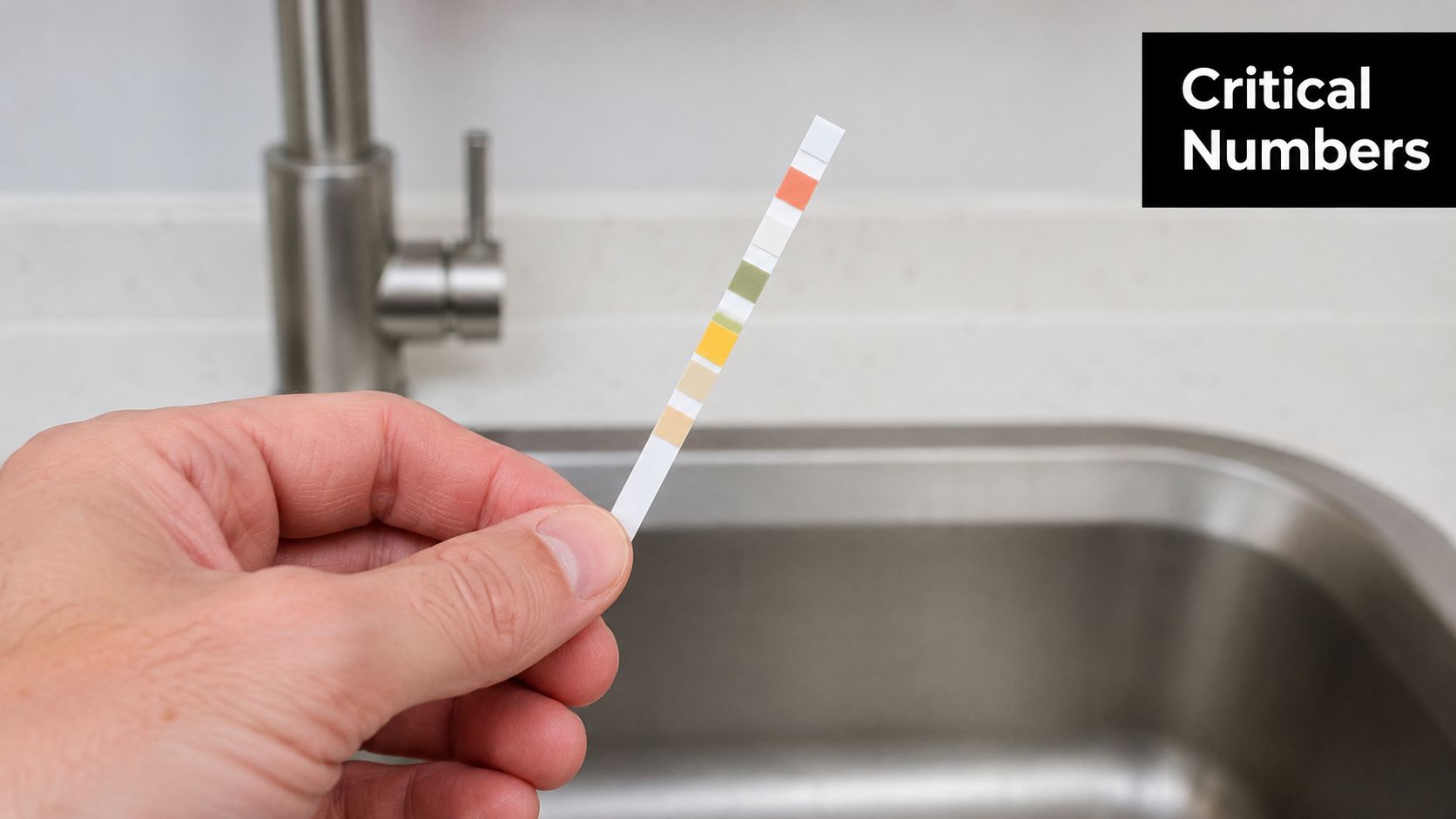
Using a rough hardness strip result as the final answer
A strip can be a helpful signal, but it doesn't replace a proper water analysis, especially on well water.Counting only the people in the house today
If the home regularly has visitors, children who are home seasonally, or heavy laundry use, plan for normal real-life demand.Ignoring nuisance minerals
Hardness alone doesn't tell the whole story when iron or manganese are in the water.
Tested water is the foundation. If the starting numbers are wrong, the softener size will be wrong too.
What to collect before you size anything
Before you move on to calculations, gather these basics:
- Hardness result in GPG: This is the core load your softener must remove.
- Water source: City water and private wells create very different design concerns.
- Household size and usage habits: Daily demand affects grain removal needs.
- Any signs of iron or sulfur: Rust staining and odor usually mean hardness isn't the only issue.
This is the point where a professional water test saves time. It gives you real numbers instead of estimates and prevents you from sizing a system around incomplete information.
Calculating Your Home's Daily Hardness Load
Once you know your water use and you've tested the water itself, the next job is calculating the amount of mineral load the softener must remove each day. This is the number that separates a rough guess from an actual sizing method.
Use effective hardness, not raw hardness
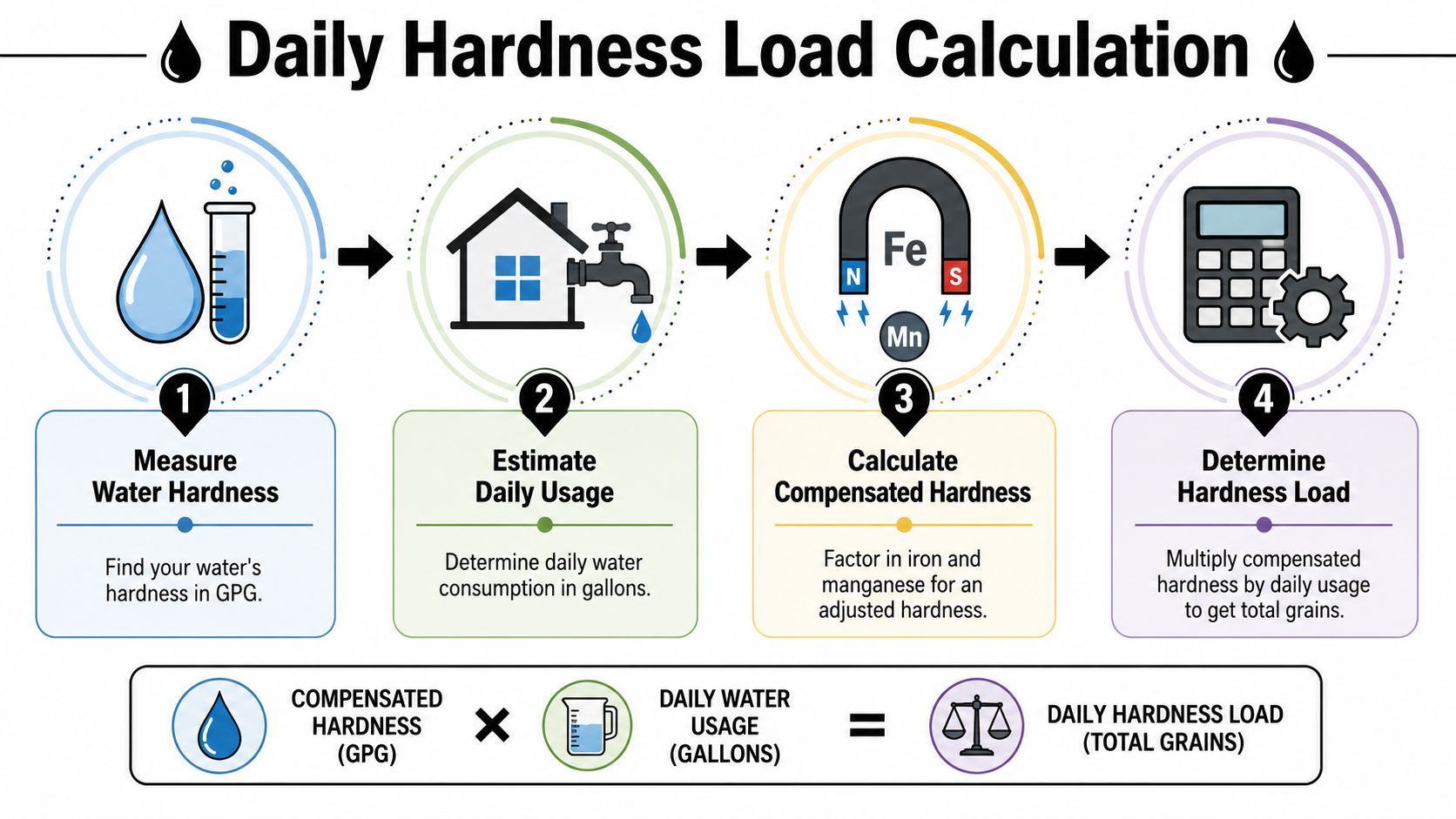
If your water contains iron or manganese, the softener doesn't ignore them. Those minerals add to the treatment burden, especially on well systems. A more precise formula uses effective hardness instead of just the raw hardness reading.
Chemstar Water defines it this way: Effective gpg = hardness + (3 × Fe ppm) + (2 × Mn ppm) in its guidance on how to size an industrial softener.
That formula matters in Central Florida because plenty of well-water homes don't just have hard water. They have hard water plus iron staining, dark buildup, or odor complaints that suggest a broader treatment load.
The basic daily load formula
After you have effective hardness, the next step is straightforward:
- Daily hardness load = effective hardness × daily gallons used
That gives you the total grains the unit needs to remove per day.
If there is no iron or manganese, effective hardness is just your hardness number. If those minerals are present, the adjusted figure can climb fast, which is exactly why rule-of-thumb sizing often fails on wells.
A softener sized only for hardness can struggle when iron is part of the job.
A worked Central Florida example
Take a family in Frostproof on a private well. Their tested water shows hardness, and the lab work also confirms iron and manganese. The family uses a realistic daily gallon estimate based on occupancy and normal routines, not just a low guess.
Here is how the math works when you apply the tested inputs.
| Variable | Value | Calculation |
|---|---|---|
| Hardness | 10 GPG | Tested hardness |
| Iron | 1 ppm | 3 × 1 = 3 GPG equivalent |
| Manganese | 1 ppm | 2 × 1 = 2 GPG equivalent |
| Effective hardness | 15 GPG | 10 + 3 + 2 |
| Daily water use | 320 gallons | Household estimate |
| Daily hardness load | 4,800 grains | 15 × 320 |
This is why raw hardness alone can be misleading. A homeowner who sized only from 10 GPG would undershoot the actual treatment load in this example. Once iron and manganese are included, the effective hardness rises to 15 GPG, and the daily load changes with it.
Why this number is so useful
The daily hardness load tells you what the softener has to keep up with during normal life. It doesn't tell you the final model yet, but it gives you the performance target.
That number helps you answer practical questions such as:
Will this unit regenerate too often?
If capacity is too close to daily demand, the system will cycle more than it should.Will the home see hard water breakthrough?
If the unit runs out of working capacity before regeneration, the water quality drops.Is a basic off-the-shelf size enough?
Sometimes yes. On many well systems, not without compensation for iron and manganese.
One caution about DIY sizing
A lot of homeowners can handle the math. The harder part is trusting the inputs. If the iron result is off, if manganese wasn't tested, or if the household uses more water than expected, the final softener choice can still miss the mark.
That's why I don't recommend building a system around a strip test and a guess. In this part of Florida, the chemistry often has enough going on that proper testing changes the answer.
Choosing Grain Capacity and Regeneration Frequency
Once you know the daily hardness load, you can choose a softener capacity that carries that load for a practical number of days between regenerations. At this point, the grain rating starts to mean something.
A useful target is a regeneration interval of about 7 to 10 days. For a home removing 3,200 grains per day, that works out to roughly 22,400 to 32,000 grains of working capacity, as described in the earlier sizing guidance and in this residential water softening overview.
What the grain number should tell you
The grain label should connect to real operating behavior. It should answer one question: how long can this softener carry your home's daily mineral load before it needs to recharge?
That's different from shopping by the biggest number available. Bigger isn't automatically better if the system isn't configured well for the home, the valve, or the actual flow demand.
The trade-off homeowners feel over time
Sizing is a balancing act between consistency and efficiency.
| Choice | What usually happens |
|---|---|
| Smaller than needed | More frequent regeneration, higher salt use pattern, greater risk of hard water showing up before the cycle runs |
| Larger than needed | More equipment than the house may need, and the setup may not be optimized for everyday use |
| Properly matched size | Predictable soft water with a regeneration pattern that fits normal household demand |
The best softener size is rarely the biggest unit. It's the one that matches the home's load and operating pattern.
How to think about weekly performance
A practical way to size the system is to take the daily hardness load and choose a capacity that gives you a comfortable operating window. That weekly rhythm matters. A unit that has to regenerate too often usually feels inefficient. A unit stretched too far can let hardness leak through before the cycle happens.
For homeowners, that shows up in very ordinary ways:
- Soap performance changes
- Scale begins returning to fixtures
- Water feels different near the end of a cycle
- Salt use doesn't match expectations
Those are operating symptoms, not just comfort complaints. They often point back to sizing.
Why the label alone doesn't settle it
The market likes neat labels such as 32,000-grain or 48,000-grain systems. Those labels are useful shorthand, but they don't replace a full sizing process. The right choice depends on your home's grain demand, the desired regeneration interval, and whether the system can also meet the way your family uses water throughout the day.
That last part leads to the factor many homeowners never hear about until after installation.
The Overlooked Factor Peak Flow Rate
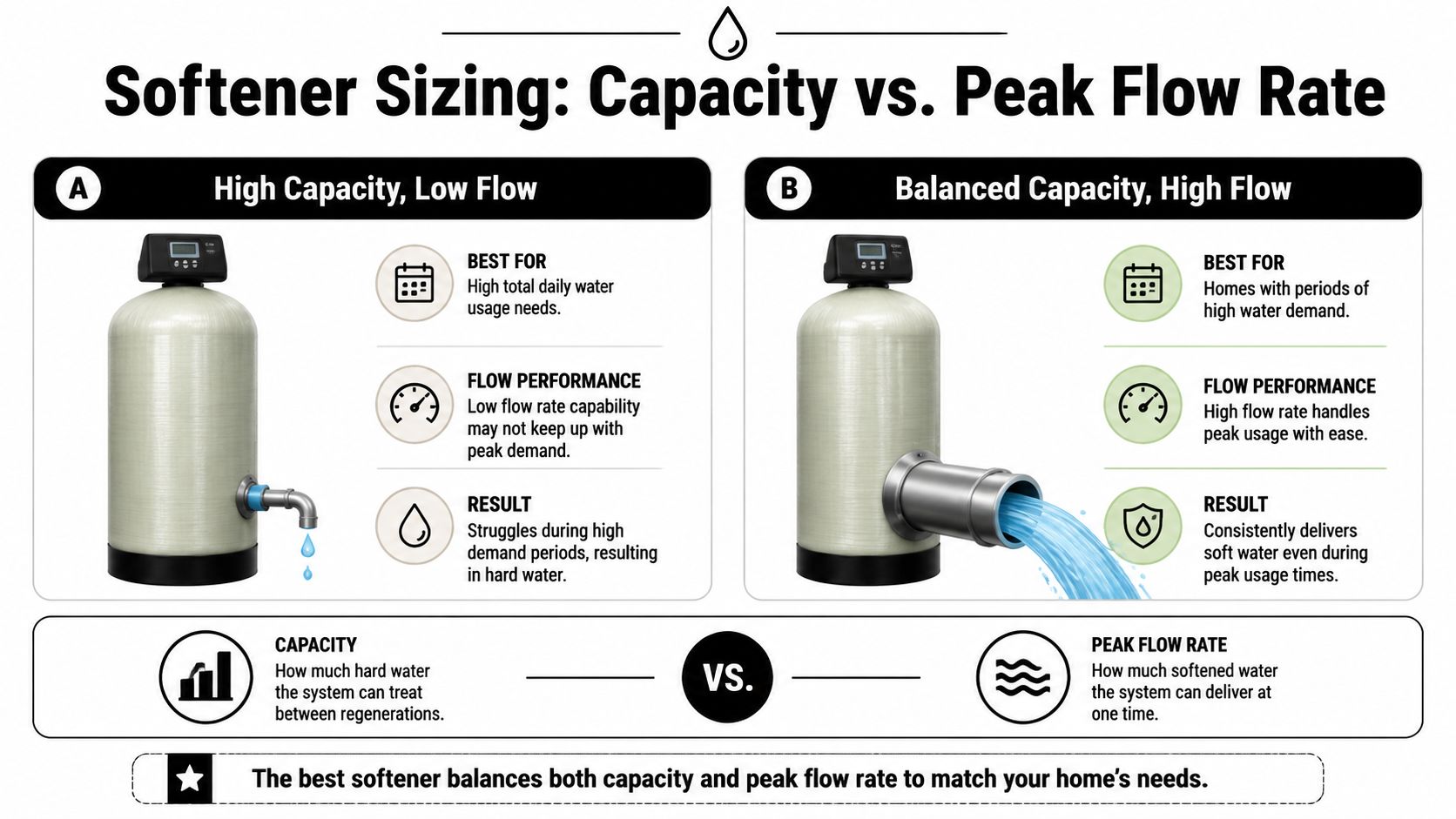
A softener can be large enough on grain capacity and still perform poorly. That surprises a lot of homeowners, but it's one of the most common field issues. Capacity tells you how much hardness the unit can remove over time. Peak flow rate tells you whether it can keep up when the house gets busy.
What peak flow looks like in a real house
Peak flow isn't a technical lab concept. It's what happens when someone is in the shower, the washing machine is filling, and another faucet opens in the kitchen. In larger homes, homes with multiple bathrooms, or houses on private wells with added treatment equipment, that demand matters.
Chem-Aqua notes that a softener must meet both average and peak service flow, and some systems require 2 to 12 gallons per minute depending on the tank and application in its article on properly sizing an industrial water softener.
For a homeowner, the takeaway is simple. A unit can look fine on daily load calculations and still choke during busy periods if the valve, tank, or media bed can't deliver enough softened water fast enough.
Signs the system is failing on flow, not capacity
This is the part many DIY guides miss. If the system is wrong for peak flow, the symptoms can look like a hardness problem even when the capacity number seemed correct.
Watch for patterns like these:
- Soft water feels inconsistent at busy times
- Pressure drops when multiple fixtures run
- Appliances and showers seem fine alone but not together
- Hard water complaints show up during morning and evening routines
Those clues often point to service flow limitations, not just grain sizing.
A softener has to win two separate jobs. It must carry the load over time, and it must deliver softened water fast enough when the house asks for it.
Why this matters so much in Central Florida
Central Florida homes often have combinations that stress flow demand. Multiple bathrooms, irrigation-related plumbing layouts, private wells, prefilters, sulfur treatment, and iron handling equipment all affect the way water moves through the system.
That doesn't automatically mean you need a huge softener. It means the design has to be balanced. A well-sized setup accounts for the household's demand pattern, not just the total grains calculated on paper.
For landlords and small commercial properties, this issue becomes even more important. Shared laundry, clustered morning use, and simultaneous fixture demand can push a system beyond what a basic residential sizing chart anticipates. That's why professional design usually looks at both the mineral load and the service flow requirement before a final recommendation is made.
Your Final Sizing Checklist and Professional Path Forward
By the time you've worked through the math, most homeowners realize the hard part isn't multiplying numbers. It's getting the right numbers in the first place and making sure the final unit is balanced for real household use.
The checklist that actually matters
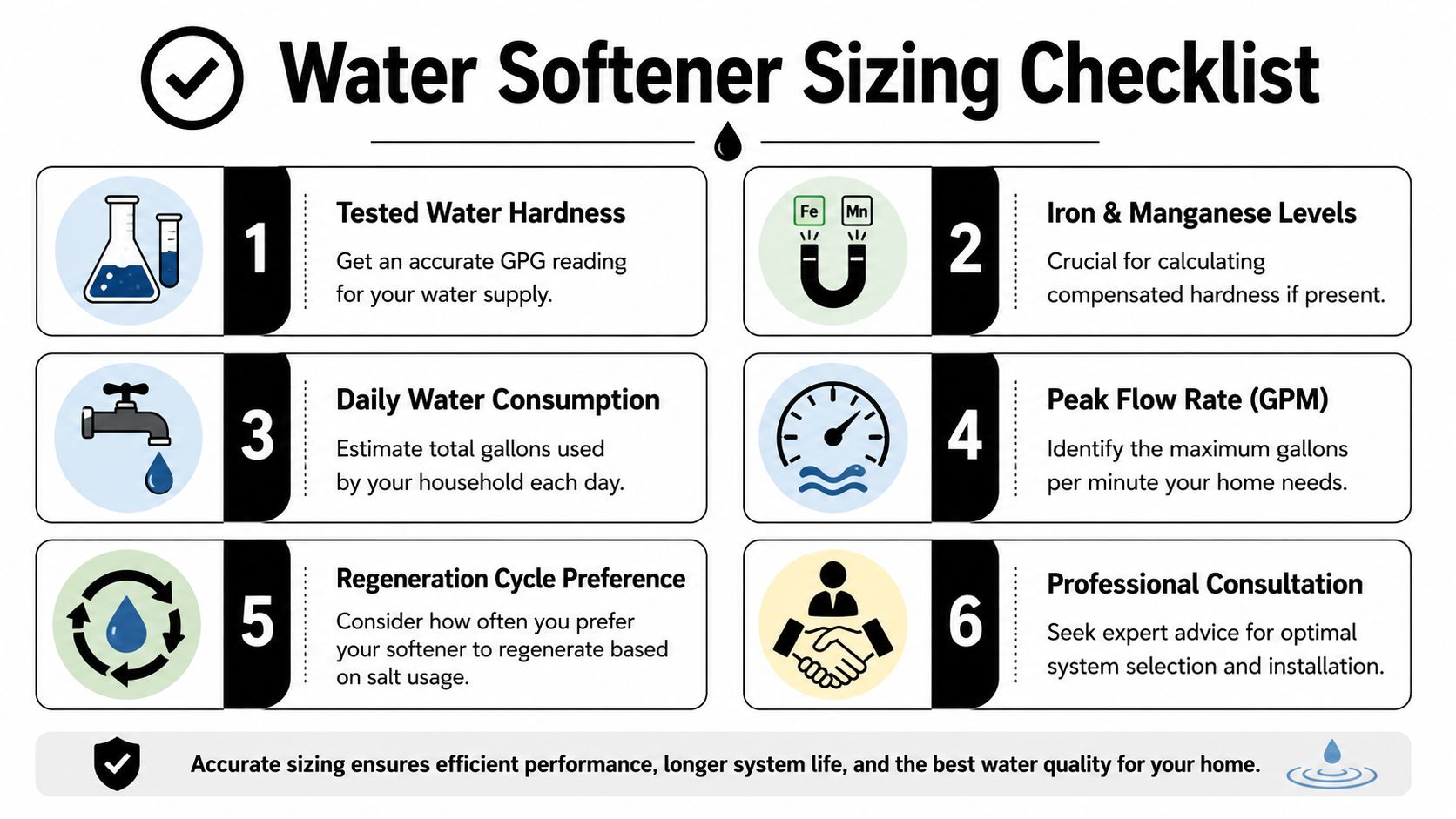
Before choosing a system, confirm each of these items:
Tested water hardness
You need an actual hardness reading, not a guess based on local reputation.Iron and manganese levels
If they're present, they change the treatment load and can change the equipment choice.Daily household water use
This should reflect how your home really uses water, not an unrealistically low estimate.Daily hardness load
This is the calculation that links your water profile to the unit's working job.Regeneration preference
A practical operating interval helps avoid waste on one side and breakthrough on the other.Peak flow demand
If the system can't keep up during simultaneous use, the home won't get consistent results.
What usually works and what usually doesn't
The sizing jobs that go well have one thing in common. They start with water testing and end with a system selected around the home's actual demand.
The jobs that go poorly usually follow a different path:
| What works | What causes trouble |
|---|---|
| Testing first | Buying first |
| Accounting for iron and manganese | Sizing from hardness alone on a well |
| Matching capacity and flow | Focusing only on grain label |
| Checking real household demand | Using a generic online chart without verification |
If you want the shortest path to the right answer, use a professional water analysis and an on-site review. That's the cleanest way to avoid paying for the wrong unit, living with weak performance, or chasing symptoms after installation.
For a professional review of your water and your home's actual treatment needs, use the contact page to schedule a free water test.
If you want a clear answer on how to size a water softener for your Central Florida home, Florida Water Management can help with a free water test and a system recommendation based on your actual water, not a guess.