

You're probably reading this because your softener is running, there's salt in the tank, and your water still doesn't feel right. Glasses come out spotted. Towels feel rough. Soap won't rinse the way you expected. In Central Florida, that usually doesn't mean the unit is bad. It means the water softener hardness settings were never dialed in for the water coming into the house.
That matters even more on private well water. Around Sebring, Lake Wales, Frostproof, and the surrounding area, I regularly see homes where the raw hardness number was entered, but the iron and manganese were ignored. On paper the system looks set up. In practice, the resin gets loaded down early and hard water sneaks through.
Table of Contents
- Why Your Water Softener Settings Matter
- Finding Your True Water Hardness Number
- Calculating Compensated Hardness for Florida Well Water
- Programming Your Control Valve
- Optimizing Regeneration for Peak Efficiency
- Maintenance and When to Call a Pro
Why Your Water Softener Settings Matter
You step into the shower, the soap feels sticky, and by the end of the week the faucets already have a light scale ring again. Meanwhile, the salt tank is dropping faster than it should. Around Central Florida, I see that pattern all the time. The softener is running, but the setting in the control valve does not match the water going into it.
That setting drives the softener's regeneration schedule. It tells the valve how much hardness load the resin can handle before it needs to recharge. If the number is too low, hard water slips through before the next cycle. If it is too high, the unit regenerates too often and burns through salt and water for no good reason.
On well water, the considerations are more complex because hardness is only part of the load. Iron and manganese take up resin capacity too, and both show up often in this area. A softener programmed to raw hardness alone can look fine on paper and still perform poorly in the house.
The setting is a calibration number
Homeowners sometimes raise the hardness setting hoping to get softer water. The valve does not work that way. It uses that number to estimate resin capacity and timing.
Set it wrong, and the symptoms can point you in the wrong direction. People blame the resin, add extra salt, or assume they need a replacement unit. Many times, the fix is proper setup, especially on systems treating Florida well water with nuisance minerals.
Practical rule: Enter the number that matches your water chemistry, not the number that sounds safer.
Signs the setting is off
Bad programming usually shows up at the fixtures first.
- Spotting on dishes and glass: The resin is running out of capacity before regeneration.
- Stiff towels and scratchy laundry: Hardness is getting through during daily use.
- Soap that feels slippery one day and ineffective the next: Soft water quality is inconsistent.
- Heavy salt use: The unit is regenerating more often than the water conditions require.
- Orange, brown, or dark staining on a well: Iron or manganese was not accounted for in the setting.
This is why the hardness number in the manual is only a starting point. The ultimate target is compensated hardness, which adjusts for the extra mineral load your resin sees. That one calculation makes the difference between a softener that just runs and one that runs correctly.
Finding Your True Water Hardness Number
Before changing anything on the softener, get the incoming water data. That sounds obvious, but a lot of homeowners skip it and work from old paperwork, a neighbor's number, or whatever the installer punched in years ago.
That's risky on both city water and well water. Municipal reports can be useful, but they aren't always written in the unit your softener needs. Well water can shift enough that an old test doesn't tell the full story.
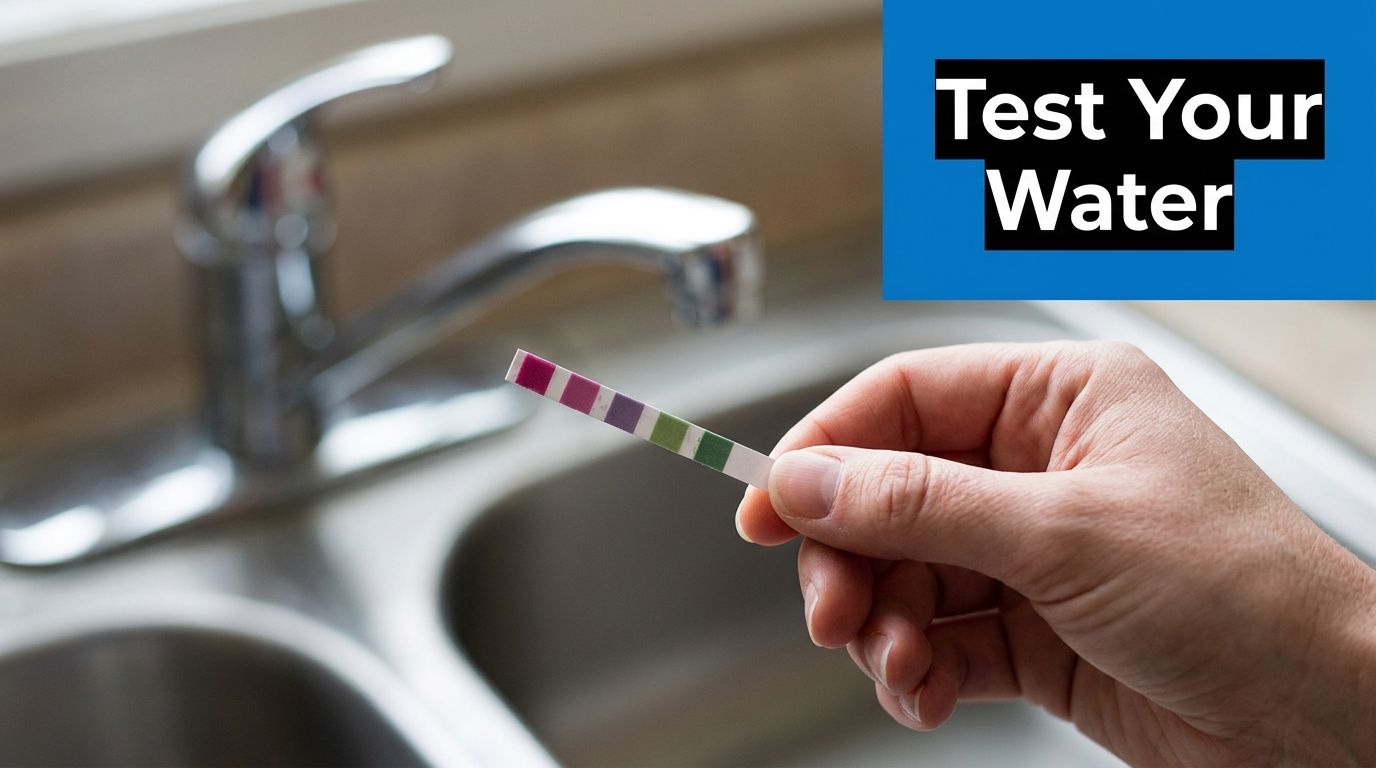
Three ways to get the number
There are three practical ways to find your hardness number.
Municipal water report
If you're on city water, start with the annual utility report. Areas like Lakeland and Winter Haven often publish hardness in mg/L or ppm, not gpg. That's usable, but you'll need to convert it before entering anything into the softener.DIY test strips or drop kits
These are useful for a quick check and good for confirming whether your current setup is even close. They're convenient, but they don't always catch the full picture on water with multiple nuisance minerals.Professional water analysis
This is the method I trust most, especially for Central Florida wells. It gives you the hardness number you need for programming and helps identify whether iron, manganese, sulfur, or other issues are changing how the system should be set up. If your home uses well water and you're also looking at broader treatment options, this overview of well and home filtration solutions in Sebring is a helpful starting point.
Converting mg/L or ppm to gpg
Most softeners want the hardness entered in grains per gallon, or gpg. Water reports often use milligrams per liter, or mg/L, which is the same as ppm for this purpose.
According to the BCMUD hardness conversion guide, 1 gpg equals 17.1 mg/L, so to convert mg/L to gpg, divide by 17.1. The same source gives a clear example: 195 mg/L ÷ 17.1 = 11.4 gpg, which should be rounded up to 12 gpg for the softener setting.
A simple reference looks like this:
| Report shows | Do this | Enter in softener |
|---|---|---|
| Hardness in gpg | Use that number | Same number |
| Hardness in mg/L or ppm | Divide by 17.1 | Round up to the next whole gpg if needed |
A lot of setup mistakes happen before anyone even touches the control valve. The math from the water report is where the trouble starts.
If you're on municipal water, that conversion may be all you need. If you're on a well, don't stop here. Raw hardness alone usually isn't enough.
Calculating Compensated Hardness for Florida Well Water
Well owners in Central Florida run into a different problem. The hardness test may be correct, but the number entered into the softener still isn't. That happens because iron and manganese also load the resin, and many homeowners never factor them in.
This is the part most generic guides miss. They tell you to enter the hardness and move on. On well water, that can leave the system under-programmed from day one.
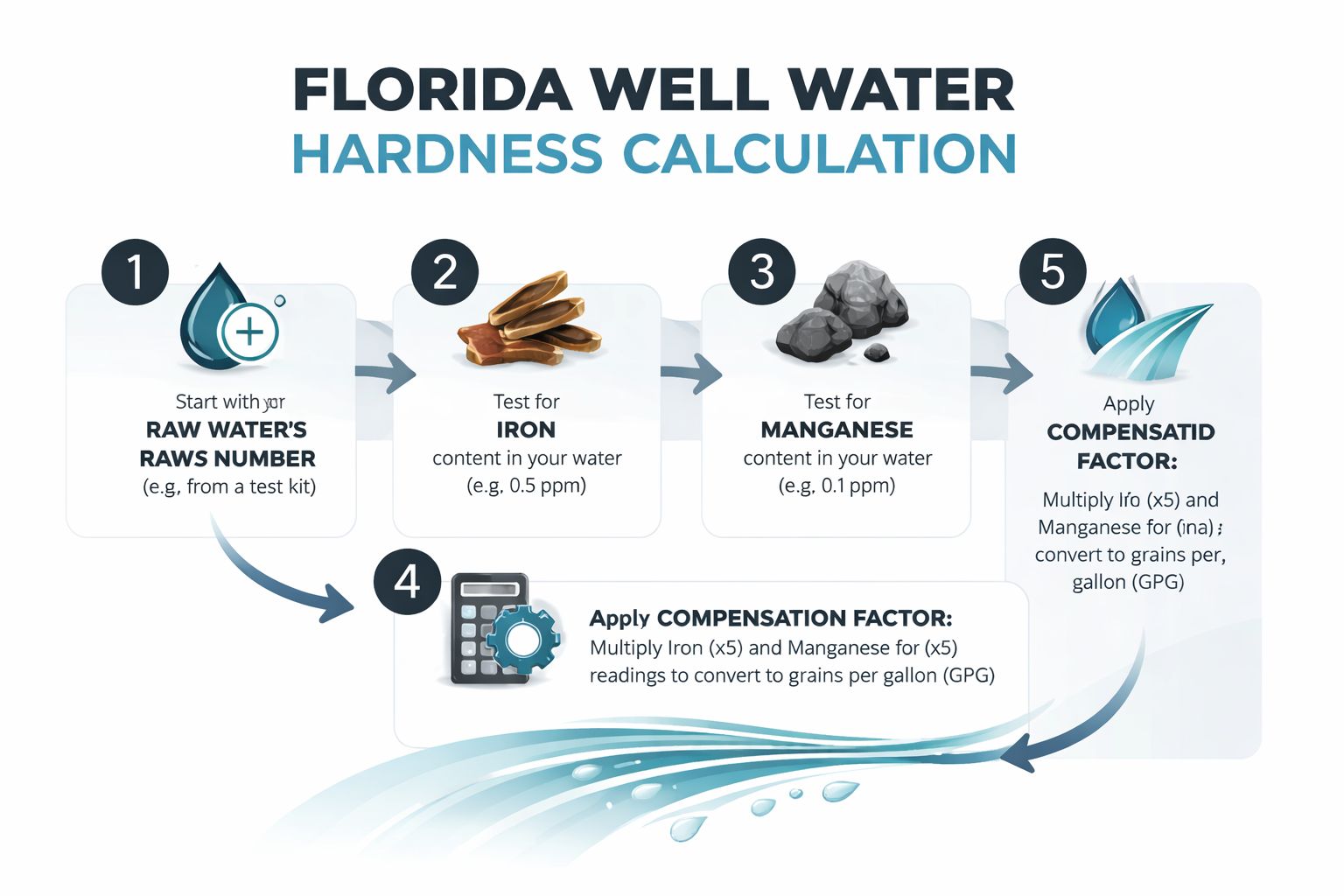
Why raw hardness isn't enough on a well
Iron and manganese act like hardness imposters inside the softener. They aren't the same minerals as calcium and magnesium, but the resin still has to deal with them. If you only enter the raw hardness number, the control valve thinks the resin has more capacity left than it has.
That usually shows up as a system that seems fine at first, then starts letting hardness through before the next regeneration. Homeowners often describe that as inconsistent water. The softener works some days and not others.
If you're on private well water and dealing with staining, metallic taste, or nuisance minerals along with hardness, a full well water treatment approach then becomes important.
The compensated hardness formula
For Florida well water, the most useful field calculation is this:
Compensated Hardness = Raw Hardness in gpg + (Iron in ppm × 4) + (Manganese in ppm × 6)
The HUM Water Care video on hardness setting calculations gives this exact method and example: if the water has 12 gpg hardness, 1.5 ppm iron, and 0.5 ppm manganese, the compensated hardness is 12 + (1.5 × 4) + (0.5 × 6) = 21 gpg. That means 21 gpg is the number to enter into the softener settings.
Here's that same calculation broken into steps:
- Start with raw hardness: 12 gpg
- Add iron compensation: 1.5 × 4 = 6
- Add manganese compensation: 0.5 × 6 = 3
- Total compensated hardness: 12 + 6 + 3 = 21 gpg
That final number is what the softener needs to see if it's going to regenerate on time.
On well water, the softener doesn't care what caused the resin to load up. It only knows the bed is getting used.
One note about the infographic above: the process flow is useful, but when I'm setting up Central Florida well systems, I use the ×4 for iron and ×6 for manganese calculation shown in the cited formula and example.
A few practical observations from the field:
- Clear water iron still counts: If the water looks clean, don't assume iron isn't present.
- Manganese gets missed often: Homeowners tend to focus on orange staining and ignore the darker nuisance minerals.
- The control setting should reflect the total burden on the resin: That's why compensated hardness matters more than the raw hardness number alone.
If you have well water and haven't tested for iron and manganese separately, you don't have the full programming number yet.
Programming Your Control Valve
Once you've got the right number, the actual programming step is usually straightforward. Most modern softeners use a digital faceplate with a menu button and a setting labeled Hardness, H, or sometimes just a numeric parameter tied to incoming water hardness.
The screen design varies, but the logic is the same across brands. You're telling the valve how much mineral load to expect so it can calculate when to regenerate.
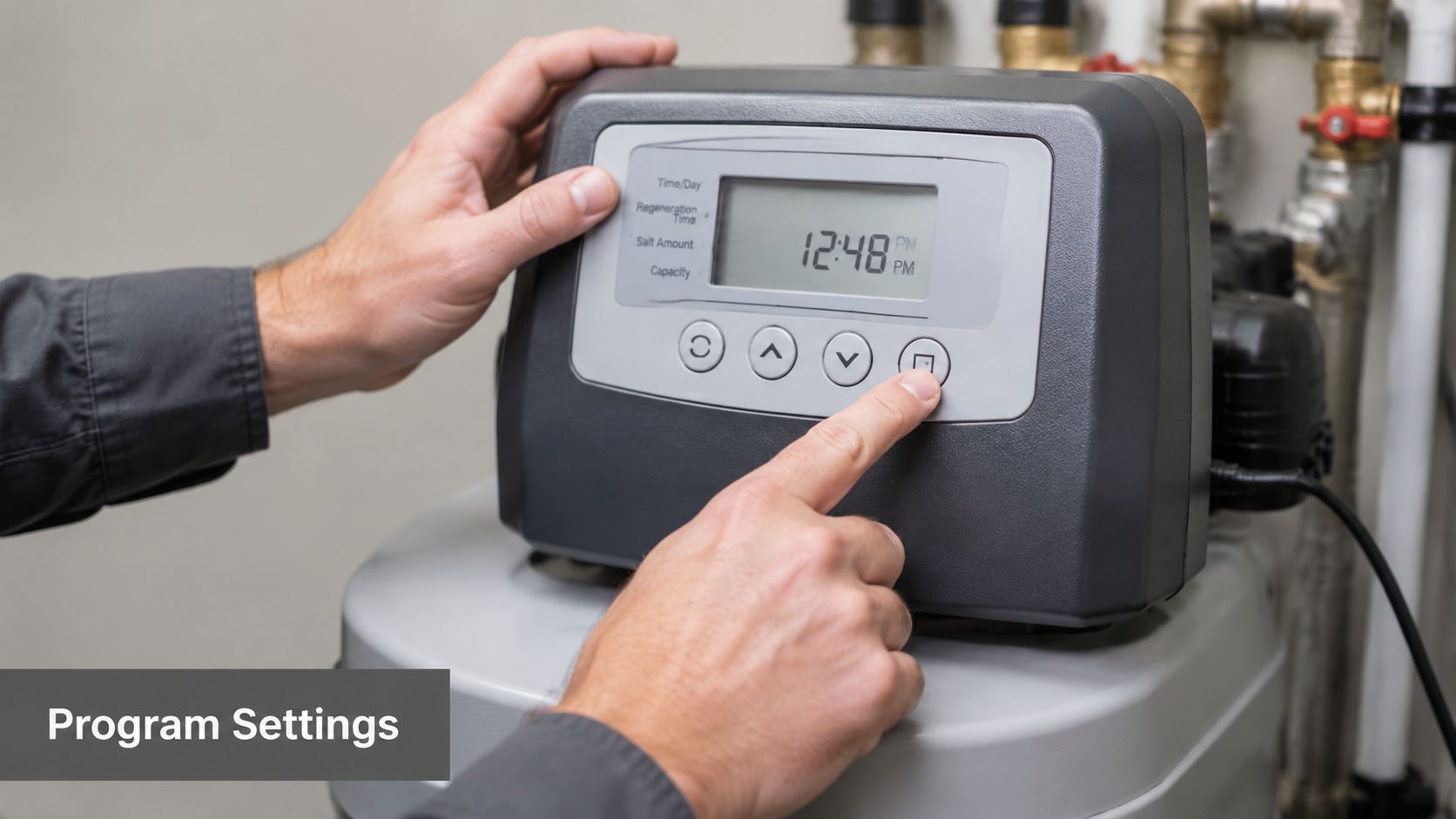
What the hardness setting actually does
The Facebook technical discussion on softener hardness programming states that the hardness setting must match the incoming gpg hardness count. It also explains that setting the value incorrectly, such as higher than the actual hardness, does not produce softer water. Instead, the unit uses that number to calculate how much water it can treat before recharge.
That's the key point homeowners need to understand. The hardness number is a scheduling input.
If you're on city water, use the converted number from your report. If you're on well water, use the compensated hardness from the prior section instead of the raw hardness test.
A simple way to enter the setting
Use this sequence on most digital systems:
Find the programming menu
Look for “Menu,” “Set,” or “Program.”Locate the hardness field
It may show as Hardness, H, or GPG.Enter the correct number
City water users enter the converted gpg value. Well water users enter the compensated hardness value.Save the change
Some valves save automatically. Others require pressing “Set” again.Check the clock and regeneration time while you're there
If the clock is wrong, the unit can regenerate at the wrong hour.
A few things that don't work:
- Guessing high to be safe: That skews the softener's treatment calculations.
- Leaving the installer default: Factory or old installer values may have nothing to do with your current water.
- Changing multiple settings blindly: If you change hardness, salt dose, and cycle timing all at once, troubleshooting gets harder.
If the control valve asks for one number and your water has several problems, the number you enter still has to reflect the full load the resin sees.
Optimizing Regeneration for Peak Efficiency
A lot of Central Florida service calls come down to one problem. The softener is regenerating at the wrong interval for the water it is treating.
Once the hardness setting is correct, efficiency depends on how the unit decides to recharge. That matters even more on well water with iron or manganese, because resin that is carrying those minerals can foul faster and lose working capacity before the tank is deemed "empty" on paper.
Choose the right regeneration method
Two softeners can have the same compensated hardness setting and still perform very differently. The difference is the trigger.
| Softener style | How it regenerates | Real-world result |
|---|---|---|
| Time-clock unit | On a fixed schedule | Often recharges too early or too late as household use changes |
| Metered unit | Based on actual water use | Usually uses salt and water more efficiently |
Metered regeneration is the better setup in most homes. If weekend guests show up, irrigation habits change, or school schedules shift, a demand-initiated valve adjusts with the house instead of following a rigid calendar. Homeowners comparing residential water softening system options should pay close attention to that feature, because it affects operating cost as much as the equipment itself.
Time-clock systems still work. They just need closer supervision, especially on wells where raw water quality is less predictable.
Fine-tune the schedule without wasting salt
Regeneration timing is where small mistakes show up on the salt bill.
Set the cycle for overnight or another low-use period so the house is not calling for soft water while the unit is in backwash or brine draw. Keep the control clock accurate after storms or power outages. In Florida, that simple check prevents a lot of complaints about the system running at breakfast or during showers.
For well owners, there is another layer to watch. If your compensated hardness included iron and manganese, the resin may still need more frequent cleaning than a straight hardness calculation suggests. That does not mean you should randomly raise the hardness setting. It means you should watch for warning signs such as orange staining returning, black specks, metallic taste, or salt use climbing without a matching increase in water use.
A few practical rules help:
- Use metered mode if your valve allows it: It tracks real demand better than a fixed-day schedule.
- Do not force extra regenerations unless you have a reason: More cycles mean more salt, more water use, and more wear.
- Check reserve settings if your valve has them: Too much reserve cuts efficiency. Too little can let hardness break through before recharge.
- Treat recurring iron problems as an iron problem, not just a hardness problem: Softener settings help, but badly iron-fouled resin may need cleaning or a prefilter.
On service calls, I often find units blamed for high salt use when the issue lies in a mismatch between the compensated hardness, the reserve, and the regeneration mode. Get those three working together and the softener usually settles into a much cleaner pattern.
Maintenance and When to Call a Pro
A softener that was programmed correctly on day one can still drift out of tune over time, especially on Central Florida well water. Iron, manganese, storm-related power interruptions, and plain old salt problems all change how the unit behaves. I see plenty of systems that are mechanically fine but still deliver hard water because the upkeep was ignored.
After setup, the goal is simple. Keep the treated water soft enough to stop scale and spotting, without chasing settings every week. As noted earlier, finished water should test in the low hardness range, and if it starts climbing, that is a sign to check the system instead of assuming the original programming still matches your water.
What to watch after setup
Start with the brine tank. If the salt level looks normal but the tank has a hard crust under the surface, the unit may not be making proper brine. That is one of the fastest ways to lose soft water and blame the valve when the actual problem is in the tank.
Then look at what the house is telling you.
- White scale or spotting coming back: Often means hardness is breaking through before regeneration.
- Orange staining: Usually points to iron loading or fouled resin, which is common on Florida wells.
- Black staining or dark specks: Often tied to manganese and may mean your compensated hardness number no longer reflects current raw water.
- Salt disappearing too fast: Can mean a setting issue, a leaking valve, or a unit that is regenerating more often than the household needs.
- Water feel changing suddenly: Retest the softened water and the raw water before changing programming.
I also tell homeowners to retest well water once in a while, especially after pump work, plumbing changes, or a noticeable shift in taste or staining. In this part of Florida, iron and manganese can move enough to matter. If those levels change, the compensated hardness you used during setup may need to be recalculated. That is the part many generic online guides skip, and it is why a softener can look correctly programmed on paper but still perform poorly in a real well-water home.
When expert service saves time
Some service calls are cheaper than weeks of guessing.
Call a pro if:
- Hard water symptoms continue after you confirmed the salt, time, and basic settings
- The valve programming is locked, confusing, or missing key values
- You do not know your current iron or manganese levels
- The unit is using abnormal amounts of salt or water
- Resin fouling is suspected because staining returns quickly after regeneration
- You want the softener checked as part of a larger water softening system service
On well-water jobs, I usually test the raw water again before changing anything major. That avoids the common mistake of treating an iron or manganese problem like a simple hardness problem. If the compensated hardness number is wrong, every setting downstream of it is off too.