

If you live in Central Florida, you've probably wiped white crust off a faucet, run vinegar through a coffee maker, or stared at cloudy shower glass that never looks clean for long. In well water areas, that hard water problem often shows up with iron staining and sulfur odor too, which makes choosing the right treatment a lot less simple than most national roundup articles make it sound.
That's why the best salt free water conditioner isn't just the one with the loudest marketing. It's the one that matches your water. In this part of Florida, hardness matters, but so do iron, sulfur, sediment, and whether you're on a municipal supply or a private well. A system that works fine in one house in Winter Haven can be the wrong fit for a well-fed home in Frostproof.
A salt-free conditioner can be a very smart choice. It can also be the wrong standalone solution if your water has the wrong profile. The first step is always testing the water so you know what you're treating.
Table of Contents
- The Central Florida Hard Water Dilemma
- How Salt Free Water Conditioners Actually Work
- Salt Free Conditioner vs Salt Based Softener
- Benefits and Limitations for Florida Homes
- Choosing Your System for Central Florida Water
- Installation Costs and Long Term Maintenance
- Your Next Step for Better Florida Water
The Central Florida Hard Water Dilemma
A lot of homeowners start in the same place. The dishwasher leaves a film. The water heater starts collecting scale. Faucet aerators clog faster than they should. Soap doesn't rinse the way you expect, and laundry feels stiff even when it's fresh out of the wash.
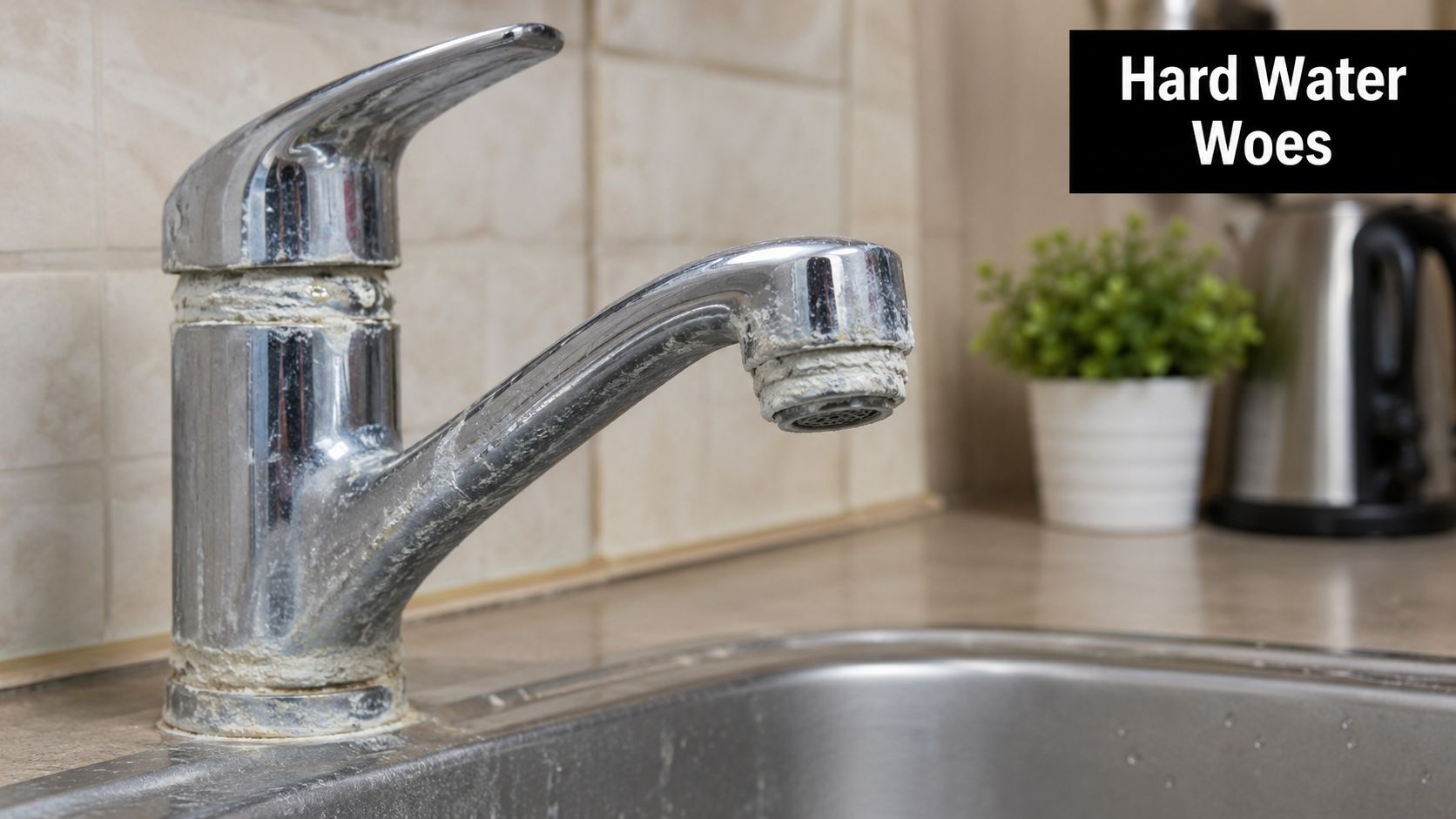
In Central Florida, that frustration gets worse because many homes aren't dealing with hardness alone. Private wells often bring a mix of hardness, iron, sulfur odor, and sediment. City water homes usually have a cleaner profile, but scale can still be a constant issue. That's the part many homeowners miss when they search for the best salt free water conditioner. They're shopping for one problem, but their house may have three.
Why people look beyond salt systems
Traditional salt-based softeners still have a place. They remove hardness minerals. But plenty of homeowners don't want the salt bags, brine discharge, regeneration cycle, or extra upkeep. That's why interest in salt-free systems has grown. According to Aquasana's overview of salt-free conditioner market growth and residential performance, non-ion-exchange water conditioners accounted for roughly 12 to 15% of the global residential water softening and conditioning market in 2021, up from about 5 to 7% in 2015. The same source notes that about 18 to 22% of U.S. homeowners facing hard water considered salt-free conditioners as their primary option.
That shift makes sense. A lot of homeowners don't need slippery soft water as much as they need less scale on fixtures, less buildup in the water heater, and less maintenance overall.
Practical rule: If your main complaint is scale, a salt-free conditioner may fit. If your main complaint is iron stains, sulfur smell, or severe hardness, you need a broader treatment plan.
What Florida homeowners usually need to decide
The question isn't whether salt-free technology works. It's whether it works for your water.
- City water homes: Often good candidates when the goal is scale control and lower maintenance.
- Well water homes: Need more caution because iron, sulfur, and sediment can interfere with treatment.
- Homes with stubborn scale: May benefit from salt-free conditioning if hardness is moderate and the equipment is sized properly.
- Homes expecting “soft water” feel: Usually need a true softener, not a conditioner.
That's why a free water test is the smartest place to start. Without it, you're guessing.
How Salt Free Water Conditioners Actually Work
The most useful salt-free technology for whole-house scale control is Template Assisted Crystallization, usually called TAC. Many product descriptions become imprecise when discussing TAC, so being direct is helpful. TAC doesn't remove calcium and magnesium from the water. It changes how those minerals behave.
Think of TAC media like a surface that encourages minerals to form tiny crystals before they stick to your plumbing. Those microscopic crystals stay suspended in the water instead of plating out on heat elements, fixtures, and pipe walls.
The simple version of TAC
Here's what happens inside the tank:
- Hard water enters the conditioner. The water still contains dissolved calcium and magnesium.
- The water passes through TAC media. That media provides nucleation sites where minerals begin forming stable crystals.
- The crystals break free and continue downstream. They remain in the water instead of bonding tightly to surfaces.
- Scale buildup is reduced. You still have hardness minerals, but they're less likely to form stubborn deposits in the places that matter most.
That's why a homeowner may see less crust on fixtures and better protection for a water heater, while a hardness test still looks almost the same.
Conditioner and softener are not the same thing
This distinction matters. A salt-free conditioner is not a true softener.
According to Kettle Moraine Heating's explanation of TAC performance and maintenance, TAC salt-free conditioners can reduce limescale buildup on heating surfaces by roughly 70 to 90% compared with untreated hard water, and they require no salt or brine regeneration, use no wastewater, and typically need media replacement every 3 to 5 years. That same source makes the key point: no hardness minerals are removed, so the water is not technically softened.
A salt-free unit protects against scale. It doesn't turn hard water into soft water.
That one sentence clears up most homeowner confusion.
What makes TAC the best salt free water conditioner option for many homes
Not all salt-free technologies are equal. TAC has the strongest practical case for whole-home residential use because it addresses the main problem most homeowners want fixed, which is scale control.
Independent testing summarized in the verified data shows TAC can achieve over 90% reduction in mineral scale formation under controlled conditions, with some setups reaching close to 95 to 97%, and it can be effective up to roughly 75 GPG, though performance may plateau or require closer attention above 25 to 30 GPG in aggressive scaling conditions.
That doesn't mean every Florida home should get TAC. It means TAC is usually the first salt-free technology worth serious consideration. The catch is that the water feeding it must be suitable. If the incoming water carries fouling contaminants, the media won't perform the way the brochure suggests.
Salt Free Conditioner vs Salt Based Softener
A lot of confusion disappears when you compare the two systems by what they do in a house. One is a scale-control device. The other is a hardness-removal device. Both can be useful. They just solve different versions of the problem.
What the trade-off looks like in real life
If a homeowner tells me they want lower maintenance, no salt handling, and less scale inside equipment, a salt-free conditioner belongs in the conversation. If they say they want true soft water, no hard water spotting, and the classic slick feel at the sink and shower, they're describing an ion-exchange softener.
A 2023 review summarized by SpringWell's TAC versus ion-exchange comparison notes that high-end TAC products typically prevent 80 to 95% of scale formation, while a properly sized ion-exchange softener can reach 99%+. The same review notes this difference can lead to noticeably more lime deposits over 5 to 10 years in high-hardness areas such as Central Florida's 10 to 20 GPG zones.
That's the decision in plain terms. TAC gives you convenience and no brine discharge. Ion exchange gives you more complete hardness removal.
Salt-Free Conditioner vs. Salt-Based Softener
| Feature | Salt-Free Conditioner (TAC) | Salt-Based Softener (Ion Exchange) |
|---|---|---|
| Primary job | Reduces scale formation | Removes hardness minerals |
| Hardness removal | No | Yes |
| Water feel | Usually won't create the classic soft, slippery feel | Yes, typically creates that soft-water feel |
| Scale prevention | Strong, but not complete in severe conditions | Strongest option for full hardness control |
| Salt use | None | Requires salt |
| Wastewater | None during normal operation | Produces brine discharge during regeneration |
| Electricity | Typically not required for the conditioner itself | Commonly part of normal operation |
| Maintenance style | Media replacement on a longer interval | Ongoing salt loading and regeneration monitoring |
| Best fit | Moderate hardness, scale-focused households | Homes wanting true soft water or stronger hardness removal |
| Common Florida caution | Doesn't fix iron or sulfur by itself | May still need separate filtration for other contaminants |
Which one is better
For some homes, the better answer is salt-free. For others, it isn't.
A few practical checks help:
- Choose salt-free if: your goal is mostly scale control, your hardness is manageable, and you want low maintenance.
- Choose ion exchange if: you want actual soft water and the strongest possible hardness removal.
- Be careful with either option if: you're on well water with iron, sulfur, or sediment and haven't tested first.
If you want a broader breakdown of what a softener can do in a house, this guide on the benefits of a home water softening system is a useful companion read.
Don't shop by label alone. “Salt-free softener” sounds appealing, but the real question is whether you need conditioning or actual softening.
Benefits and Limitations for Florida Homes
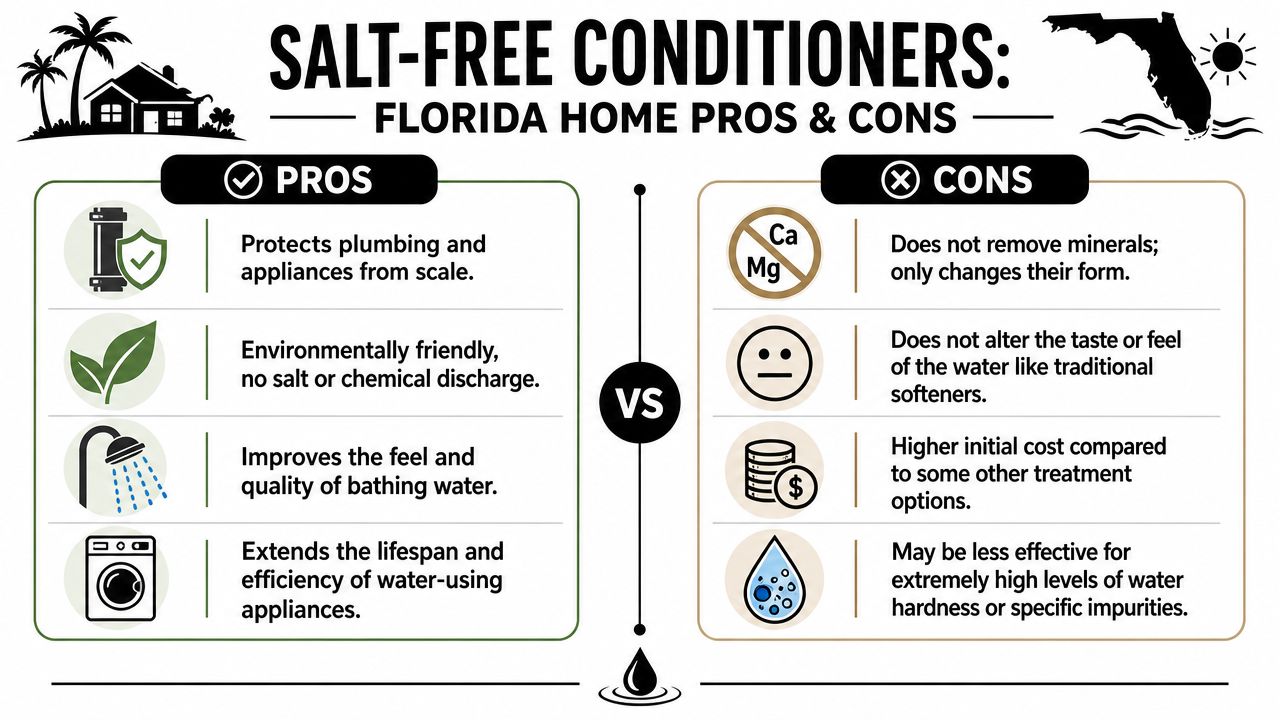
Salt-free systems make a lot of sense in Florida, but only when you stay honest about what they can and can't do. They're strongest when the main target is scale. They're weaker when the water has multiple issues layered together.
Where salt-free systems shine
For a Central Florida home on city water, or a well-managed well system with moderate hardness, salt-free conditioning can be a clean solution.
- Scale protection: It helps protect water heaters, fixtures, shower glass, and appliances from mineral buildup.
- No salt handling: You don't have to buy, store, or haul salt.
- No brine discharge: That matters for homeowners who want a cleaner setup for septic or environmental reasons.
- Lower routine upkeep: Once installed properly, maintenance is lighter than with a regenerating softener.
This is also why many homeowners searching for the best salt free water conditioner are really searching for the least annoying way to control scale.
Where people get disappointed
The biggest mistake is expecting a conditioner to act like a softener, iron filter, and sulfur treatment unit all at once. It won't.
According to Tap Water Data's review of the term salt-free water softener and TAC performance, standards groups have criticized the term “salt-free water softener” as misleading because only ion-exchange systems reduce hardness. That same review notes third-party testing has found post-treatment hardness in TAC-style systems usually remains within ±5% of inlet hardness, while scale-reduction tests showed reductions in scale mass of roughly 30 to 70% depending on conditions.
That's exactly why some homeowners think a system “didn't work.” They test the water, still see hardness, and assume nothing changed. In reality, they may get less scale while the hardness reading stays nearly the same.
The Florida-specific catch
Well water changes the equation.
If your water has iron staining, rotten-egg sulfur odor, or visible sediment, a salt-free conditioner should never be chosen as if it's the whole answer.
A few common limitations matter here:
- Iron: Salt-free conditioning doesn't remove iron.
- Sulfur: It won't eliminate sulfur odor.
- Heavy sediment: Dirty feed water can interfere with downstream equipment.
- Very aggressive hardness: Extremely hard water may need a different strategy or a more carefully built system.
That's why local water conditions matter more than generic product rankings.
Choosing Your System for Central Florida Water
The best setup starts with one question. What's in your water?
That sounds obvious, but many people still buy a unit online before they know whether the home has hardness alone or a mix of hardness, iron, sulfur, oxidants, and sediment. In Central Florida, that's a gamble. Two homes a few miles apart can need very different equipment.
Start with the water source
City water and well water should not be evaluated the same way.
City water homes often have a cleaner starting point for a salt-free conditioner. If the main complaint is scale, TAC can be a practical fit.
Private well homes require more caution. Hardness may be only part of the problem. Iron, sulfur, and fine sediment can all change what system should go in first.
The order of equipment matters
Many off-the-shelf recommendations fall apart in such cases. System sequencing matters, especially on well water.
According to Quality Water Lab's discussion of TAC performance in multi-stage systems, real-world installations in hard-water regions such as Florida often combine whole-house conditioners with point-of-use reverse osmosis or UV disinfection. That same source notes TAC effectiveness drops significantly if feed water contains oxidants or particulates that foul the media, and improper sequencing can undermine the advertised 90 to 99% scale reduction.
That's a major point for Florida homes. A TAC unit installed on dirty or poorly prepared water won't perform the way it should.
What to evaluate before buying
A proper recommendation should look at several things at once:
- Measured hardness level: Moderate hardness is one conversation. Severe hardness is another.
- Iron presence: Even a good conditioner won't remove orange staining minerals.
- Sulfur odor: If the water smells like rotten eggs, you need separate treatment.
- Sediment load: Fine particles can foul media and shorten performance.
- Existing treatment equipment: If the house already has filtration, UV, or drinking water treatment, the layout matters.
For homes that need cleaner drinking water at the kitchen sink after whole-house treatment, a point-of-use system such as reverse osmosis for Florida homes often becomes part of the complete plan.
Why one-size-fits-all advice fails here
The best salt free water conditioner for a municipal-water home in Lakeland may be the wrong choice for a well-water property in Sebring. A landlord trying to reduce scale on water heaters has different priorities than a homeowner trying to solve odor, staining, and appliance buildup at the same time.
The right system isn't the one with the most features. It's the one that matches the feed water and the way the home uses water.
That's also why free water testing matters so much. It removes the guesswork before money gets spent.
Installation Costs and Long Term Maintenance
Salt-free systems appeal to a lot of homeowners because they're simpler to live with. From an installation standpoint, they usually avoid the extra demands that come with regenerating equipment.
A typical whole-house TAC conditioner is generally easier to place than a salt-based softener because it doesn't need salt storage and usually doesn't need the same kind of drain connection for regeneration. The final installation scope still depends on pipe layout, available space, flow demands, and whether the house also needs prefiltration for well water issues.
What affects installation work
The labor involved usually comes down to a few practical factors:
- Pipe access: Tight mechanical rooms and older plumbing layouts can slow the job down.
- Home size and fixture count: The system has to match household flow demands.
- Pretreatment needs: If the home has iron, sulfur, or sediment, the conditioner may only be one part of the install.
- Bypass and service access: Good installation leaves room for maintenance later.
For homeowners comparing options, it helps to understand what professional water softener installation in Lake Wales and nearby areas typically involves, especially when deciding between conditioning and true softening equipment.
Maintenance is where salt-free gets attractive
This is usually the strongest day-to-day advantage. You're not loading salt, checking brine levels, or managing regeneration behavior. TAC media commonly needs replacement every few years, and otherwise the system is relatively hands-off when the incoming water is suitable.
That said, not every salt-free technology is equally effective. Sequestering systems that use polyphosphate or citrate are more dependent on operating conditions. Verified data notes that their performance can degrade if water temperature exceeds 140 to 160°F, and in practice they're better suited for localized appliance protection than as a whole-house answer for very hard water. That's one reason TAC is often the more dependable whole-home salt-free path for many Central Florida homes.
The long-term view
The cheapest unit to buy isn't always the smartest system to own. If a low-cost device doesn't fit the water profile, you can still end up with scale, heater problems, fixture buildup, and a replacement purchase later.
A properly matched salt-free conditioner can be a low-hassle ownership experience. A poorly matched one becomes an expensive lesson.
Your Next Step for Better Florida Water
A homeowner in Central Florida usually notices the problem in stages. White buildup shows up on faucets first. Then the water heater starts working harder, the shower glass stays spotted, and if the home is on a well, iron staining or sulfur odor may be part of the same call.
The right salt-free water conditioner depends on what is in the water.
For city water with hardness as the main issue, a TAC-based conditioner can be a practical way to reduce scale without salt, regeneration, or added wastewater. For many well-water homes, that answer changes fast. Iron, sulfur, and sediment can interfere with performance, which means a salt-free unit may need pretreatment in front of it or may not be the right primary system at all. Homes that want the feel of soft water still need to consider a salt-based softener.
That is the part generic national roundups usually miss. Central Florida water is rarely just "hard" in a simple, clean way. One house may be dealing with moderate municipal hardness. Another may have well water with hardness, iron fouling, sulfur smell, and fine grit hitting the plumbing at the same time.
Start with a real water test. That gives you a clear answer on whether a salt-free conditioner can handle the job by itself, whether iron or sulfur treatment needs to come first, or whether a different setup will cost less trouble over the long run.
If you want a straight recommendation based on your home's water, schedule a free water test and review the results with a local treatment professional.
Florida Water Management works with homeowners and small businesses across Central Florida to match equipment to actual water conditions. If you want a free water test and practical guidance on hardness, iron, sulfur, well water, or whole-home treatment options, contact them through the contact us page.