

You notice it in small ways first. Glassware comes out cloudy. Soap feels weak in the shower. White crust starts building around faucets. Then the heavier clue shows up in the garage or utility room. You're hauling salt bags more often than you think you should, and your softener still doesn't seem to be keeping up.
That's usually when homeowners in Central Florida start asking the right question. Not “Do I have hard water?” but “Why is my system using so much and giving me so little back?” That's the core issue behind water softener efficiency. A softener can be running every day and still be wasting salt, wasting water, and leaving hardness in the house.
In this part of Florida, that problem gets more complicated fast. City water, private wells, iron, sediment, and changing usage patterns can all push a softener off its sweet spot. If you want better performance, lower upkeep, and cleaner water throughout the home, you need to know whether the unit is matched to the water you have. If you're already seeing the everyday signs of hard water, it also helps to understand the benefits of a home water softening system before you start changing settings or shopping for a replacement.
Table of Contents
- Is Your Water Softener Wasting Salt and Money
- What Exactly Is Water Softener Efficiency
- How to Measure Your Softeners Efficiency at Home
- Common Florida Water Issues That Kill Efficiency
- Step-by-Step Guide to Optimizing Your System
- Choosing a Truly High-Efficiency Water Softener
- When to DIY and When to Call a Professional
Is Your Water Softener Wasting Salt and Money
A softener doesn't have to fail completely to become expensive. Most inefficient systems still produce some soft water. They just do it poorly. They regenerate too often, use more salt than necessary, and let hardness slip through before the next cycle. In a Central Florida home, that usually means you're paying for softening twice. Once in salt and water use, and again in scale buildup on fixtures, heaters, and appliances.
The frustrating part is that many homeowners assume heavy salt use means the unit is working hard. Sometimes it is. Often it isn't. A softener that burns through salt can be badly programmed, poorly sized, fouled by iron, clogged with sediment, or outdated.
Practical rule: If you're adding salt often but still seeing spots, scale, or soap issues, the problem usually isn't “more salt needed.” It's usually an efficiency problem.
Central Florida adds its own twist. The region's water profiles aren't one-size-fits-all. A house on municipal water may be dealing with hardness and chlorine. A house on a private well may be fighting hardness, iron, and fine sediment at the same time. Two homes on the same road can need different treatment strategies.
That's why broad online advice often misses the mark. The useful question isn't whether softeners help. It's whether your specific system is operating efficiently for your specific water. Once you know that, you can make smarter decisions about settings, maintenance, prefiltration, or replacement.
What Exactly Is Water Softener Efficiency
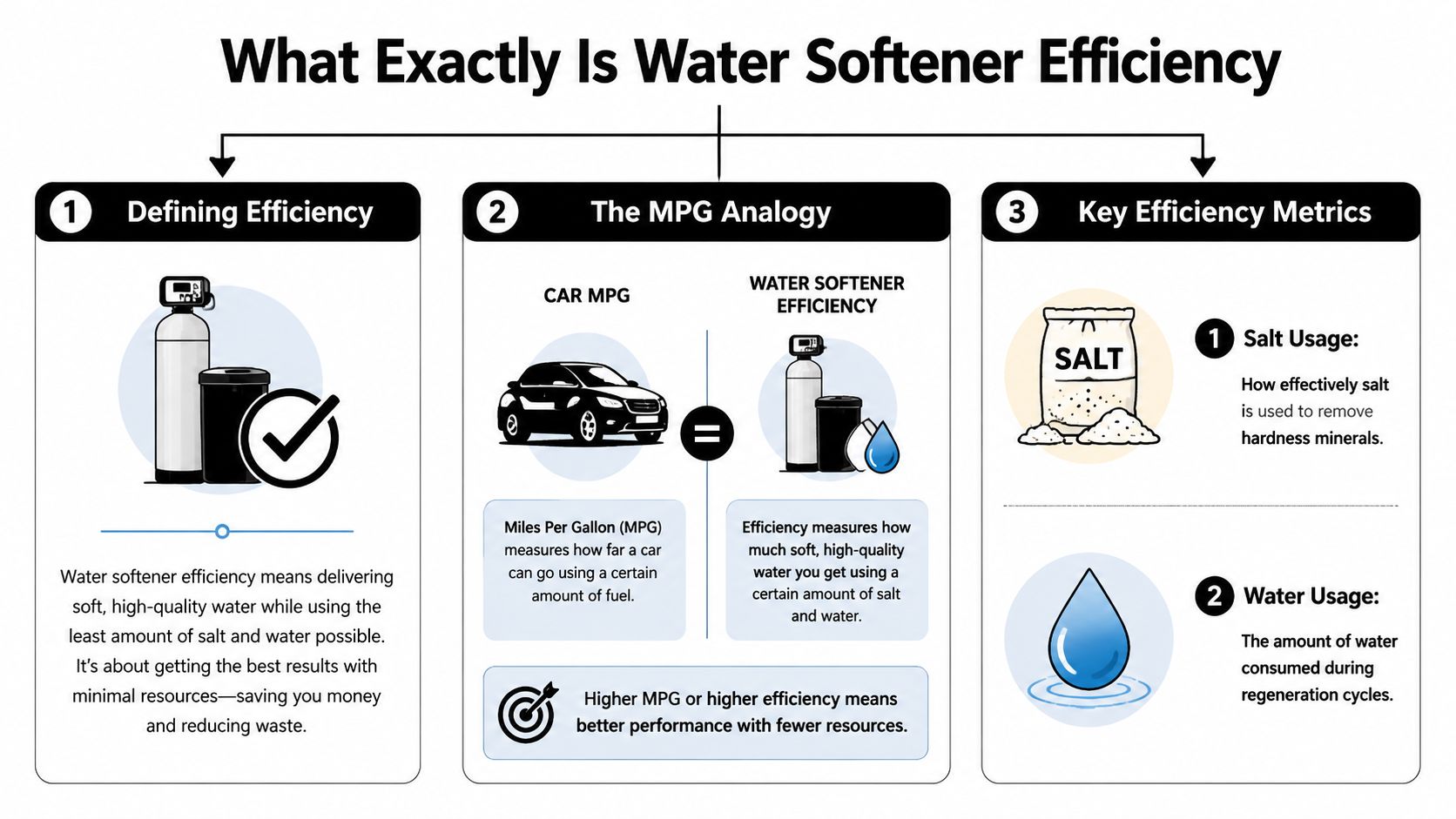
Most homeowners hear “efficient” and think it means a unit that uses less salt. That's only half the picture. A better way to think about water softener efficiency is the same way you'd think about fuel economy in a vehicle. It's not just about how much fuel goes in. It's about how much useful work you get from it.
For a softener, that useful work is hardness removal.
Two measurements matter
The first is salt efficiency. That means how many grains of hardness the system removes for each pound of salt used during regeneration.
The second is water efficiency. That means how much water the system sends through regeneration to remove a given amount of hardness.
Those two measurements matter because a softener can look good in one area and perform badly in the other. A unit might soften water effectively but use too much regeneration water. Another might limit water use but burn through salt because the settings are too aggressive.
The benchmark worth knowing
There is a recognized efficiency benchmark for residential softeners. Under the voluntary NSF/ANSI 44 efficiency benchmark for residential water softeners, an efficiency rated unit must achieve at least 3,350 grains of hardness removed per pound of salt and use no more than 5.0 gallons of regeneration water per 1,000 grains of hardness removed.
That matters because it gives you a real line between “marketed as efficient” and “meets a measurable efficiency standard.”
A lot of homeowners also miss one practical point. The control method affects efficiency just as much as the tank and resin. Demand-initiated systems regenerate based on actual water use. Older time-clock units regenerate on schedule whether the home needed it or not. That difference shows up in salt use, water use, and how often the system sends water to drain.
If you want a clearer sense of how different softening setups work in a whole-home treatment plan, this overview of water softening systems for Florida homes is a useful reference point.
A softener isn't efficient because the brochure says so. It's efficient when the settings, resin condition, and regeneration pattern match the water coming into the house.
How to Measure Your Softeners Efficiency at Home
You don't need to be a technician to do a basic efficiency check. You do need the right inputs. Most bad conclusions come from bad starting numbers, especially in Central Florida where well water can swing quite a bit from one property to the next.
Start with the right numbers
Three pieces of information matter most:
- Your raw water hardness
- Your softener's usable grain capacity
- How much salt the unit uses between regenerations
The first number is the one homeowners most often guess at. Don't. Hardness has to be tested. If you're on a private well, test for iron and sediment too, because both can distort what looks like a pure hardness problem. Homes comparing treatment options in this area often end up looking beyond softening alone, especially when they're also dealing with staining, taste, or particulates. That's one reason many local homeowners research whole-home water filtration in Sebring and nearby areas before making changes.
Here's a simple reference table for the region. These are common planning ranges, not a substitute for a property-specific test.
| City/Area | Average Hardness (GPG) |
|---|---|
| Sebring | Often hard to very hard |
| Avon Park | Often hard to very hard |
| Lake Wales | Often hard to very hard |
| Winter Haven | Often hard to very hard |
| Frostproof | Often hard to very hard |
| Private well homes in Central Florida | Often variable, commonly hard with other contaminants present |
A simple home check
Use your manual or control head information to find the unit's programmed capacity and salt setting. Then track how often the system regenerates and how quickly you go through salt.
A practical home audit looks like this:
- Verify hardness input: Compare the control setting to your current water test. If the setting is too high, the unit may regenerate too early. If it's too low, hardness can leak through before regeneration.
- Check regeneration frequency: If the unit is cycling unusually often for your household use, efficiency is already suspect.
- Watch salt consumption: If bags disappear quickly but hard water signs remain, the system is likely wasting resources or struggling with fouled resin.
- Inspect water quality after the softener: Spotting on dishes, scale at fixtures, and soap performance tell you whether the system is delivering finished water consistently.
You can also do a rough performance comparison against the recognized benchmark discussed earlier. If your unit is an older design, especially a timer-based model, it may be operating below what newer systems can achieve.
Don't judge a softener by whether it runs. Judge it by whether it softens consistently without over-regenerating.
For homes on well water, DIY solutions frequently reach their limit. If iron is present, your “hardness problem” may instead be a resin fouling problem. If sediment is present, a valve or injector issue may be making the unit look undersized when its flow is being restricted upstream.
Common Florida Water Issues That Kill Efficiency
Generic softener advice usually assumes a clean hardness-only water profile. That's not what many Central Florida homeowners have.
Hardness is only part of the story
The region pulls much of its water through limestone-influenced geology. That means hard water is common, and a softener often has a real workload from day one. Heavy hardness by itself increases regeneration demand. If the system isn't sized and programmed well, efficiency drops quickly because the unit keeps cycling to keep up.
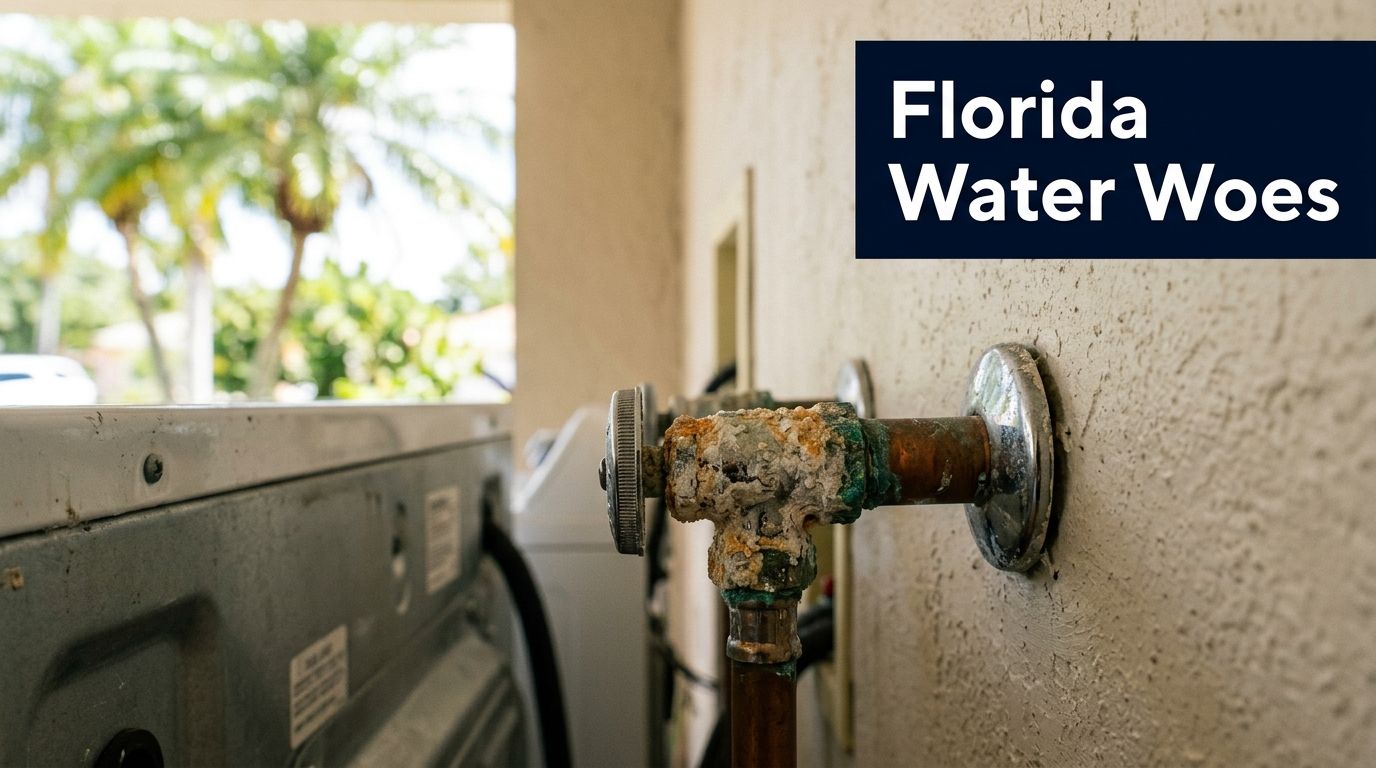
Iron is the next big problem, especially on private wells. Iron doesn't just pass through the system politely. It can foul the resin bed. Once that happens, the resin doesn't exchange hardness minerals the way it should. Homeowners often react by adding more salt or forcing extra regenerations, but that doesn't fix fouled resin. It just adds waste.
Sediment is another common issue on wells. Fine grit, sand, or suspended particles can clog injectors, screens, and moving parts inside the valve. When that happens, the softener may draw brine poorly or rinse improperly. The system can still appear to be working while its efficiency falls off.
City water and well water fail in different ways
Municipal water usually presents a different challenge. Chlorine helps with disinfection, but over time it can be hard on softener resin. Resin doesn't fail all at once. It gradually loses effectiveness. The homeowner sees more spotting, shorter soft-water runs, and more frequent regeneration.
Well water problems are less uniform. One property may have hardness and iron. Another may have sulfur odor, sediment, and variable mineral levels. That's why two houses with the same softener model can have very different results.
A few warning signs point to local water conditions, not just bad settings:
- Rust staining: Often suggests iron is contributing to resin fouling.
- Black or gritty residue in fixtures: Often points to sediment or media breakdown.
- Softener that suddenly seems “too small”: Often means changed water quality, fouled resin, or a blocked valve path.
- Recurring bridge or mush in the brine tank: Often signals humidity, salt quality issues, or inconsistent draw.
If a softener keeps losing performance after you reprogram it, look at the incoming water before you blame the machine.
Step-by-Step Guide to Optimizing Your System
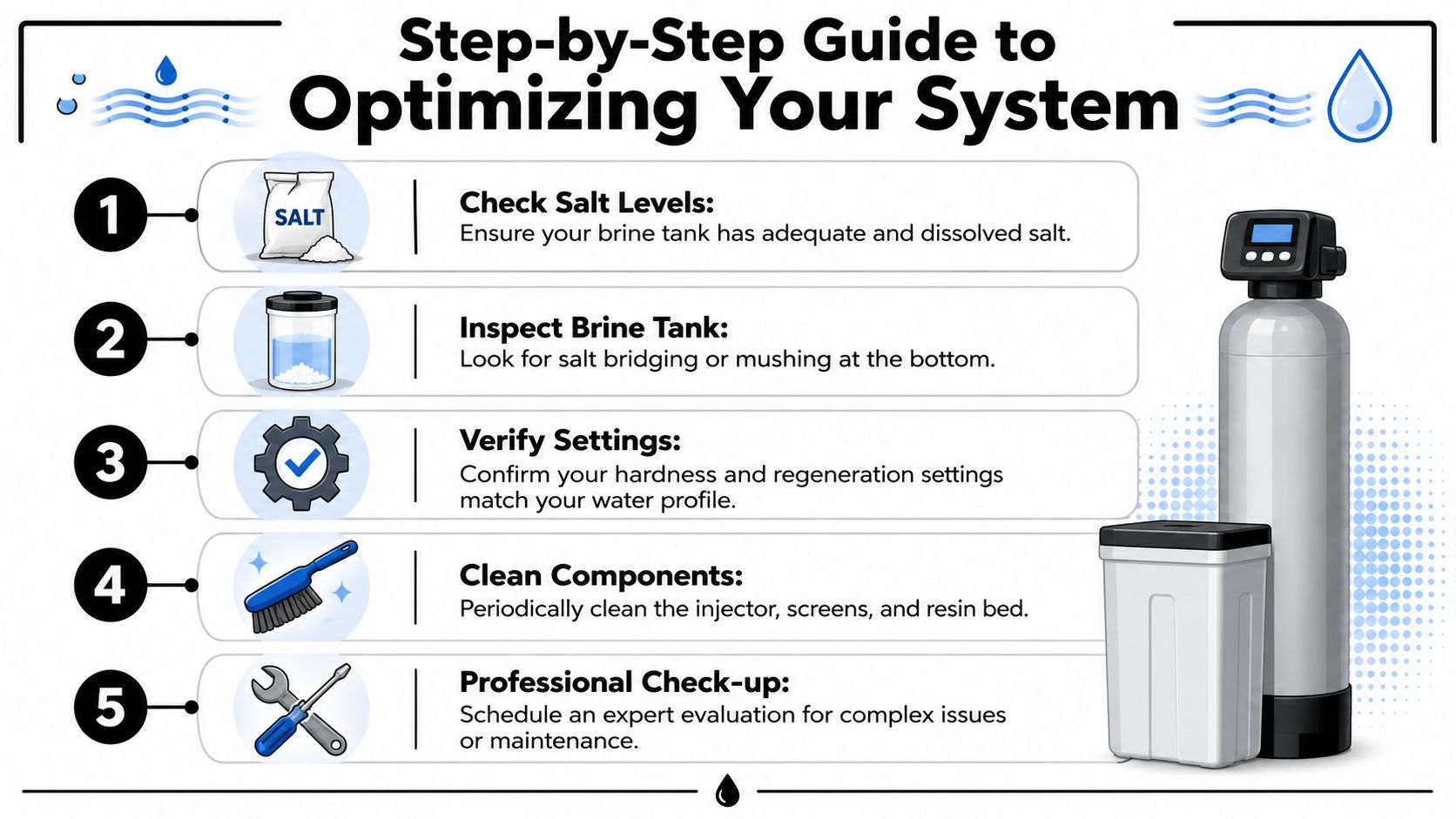
Most efficiency problems can be improved in stages. Start with the control settings. Then move to cleaning and maintenance. Then protect the softener from the raw water conditions that are shortening its life.
Check the control settings first
A lot of softeners in Florida are never adjusted after installation, even when occupancy changes or water conditions shift. If the unit is programmed for the wrong hardness, the rest of your troubleshooting gets skewed.
Work through these basics:
- Confirm the hardness setting: Use a current water test, not an old sticker on the tank or a guess from a neighbor.
- Review regeneration mode: If your system can run as demand-initiated, make sure it's set up that way.
- Check reserve assumptions: Too much reserve can force early regeneration. Too little can let hardness break through.
- Look at the salt dose: More salt doesn't automatically mean better regeneration. It can indicate lower efficiency.
If you're not comfortable moving through the valve menu, stop there rather than entering random values. Incorrect programming causes more service calls than worn-out hardware.
Clean the parts homeowners can safely maintain
A neglected brine tank can drag down performance even when the main resin tank is still in decent shape. Salt can form a hard bridge across the top or turn to mush at the bottom. Either condition interferes with proper brine production.
A sensible maintenance routine includes:
- Break up salt bridging carefully if a hard crust has formed.
- Remove sludge from the bottom of the brine tank if you find mushy buildup.
- Use a clean, appropriate salt product and avoid mixing different leftover types casually.
- Inspect screens and visible serviceable components if your system design allows safe access.
- Use a resin cleaner when iron is part of the water profile and the product is approved for your unit.
Some homes need more than salt maintenance. If iron has been coating the resin for a while, the system may need a deliberate cleaning cycle rather than another routine regeneration.
A brine tank can be full of salt and still fail to produce strong brine. Homeowners often mistake “full” for “working.”
Protect the softener from the water ahead of it
If raw water is carrying sediment, chlorine, or iron, the softener shouldn't be the first and only line of defense. Under these conditions, long-term efficiency is won or lost.
Consider the treatment train, not just the softener itself:
- Sediment prefiltration: Helps protect injectors, seals, and valve passages from grit and clogging.
- Carbon filtration on city water: Can reduce chlorine exposure to the resin bed.
- Iron-specific pretreatment: Often makes sense when staining or resin fouling keeps returning.
- Routine service checks: Catch brine draw issues, resin fouling, and valve wear before the unit starts wasting salt.
This is the part many homeowners skip because the softener is still “kind of” working. But if the incoming water is rough on the equipment, the machine keeps compensating with more regeneration. That drives up salt use and shortens component life.
Choosing a Truly High-Efficiency Water Softener
If your current unit is older, badly matched to the house, or constantly struggling with local water conditions, replacement may be the more efficient move. The key is knowing what to look for.
What separates a better system from a wasteful one
The first divide is between metered demand-initiated systems and older time-clock systems. A timer-based unit regenerates on schedule whether the family used the capacity or not. That approach is simple, but it's rarely the most efficient fit for real household use.
Extension guidance notes that conventional ion exchange remains the most common softening method while also discussing alternatives such as salt-free options, reverse osmosis, distillation, template-assisted crystallization, and electrically induced precipitation. It also notes that magnetic treatment lacks scientific consensus and should be treated as unproven. In the same guidance, University of Nebraska Extension material on softening options and efficiency states that modern high-efficiency softeners can reach about 4,000 grains per pound, compared with roughly 3,000 grains per pound for older models.
That's a meaningful difference, but buying “high-efficiency” on a label still isn't enough. In Central Florida, the right system depends on more than hardness. It depends on whether the water also carries iron, sediment, chlorine, sulfur odor, or other conditions that affect the treatment sequence.
A good selection process usually comes down to these questions:
- Is the system metered or timer-based
- Is it sized for actual household demand
- Can it be configured for local water conditions
- Does the home need pretreatment before the softener
- Will the valve and media setup be serviceable over time
Big-box systems often struggle because they assume an average water profile. Central Florida water often isn't average.
When to DIY and When to Call a Professional
A Central Florida softener can look like it has a simple settings problem when the underlying issue is upstream. I see this a lot on well systems around Ocala, Deland, and the rural edges of Orange and Lake County. The homeowner adds salt, tweaks hardness numbers, runs a cleaner through the resin, and the unit still leaves spotting or burns through salt faster than it should because iron, sediment, or a failing control valve is the actual problem.
A good DIY check makes sense if the job stays at the maintenance level. Confirm the hardness setting matches a recent water test. Break up a salt bridge if the tank has one. Clean the brine tank if it is packed with sludge or mushy salt. If the manufacturer approves it, use the correct resin cleaner for light iron fouling.
Stop there if the symptoms point to diagnosis instead of maintenance.
Call a professional when any of these apply:
- You're on a private well: Central Florida well water often changes by location and season. Hardness is only part of the picture if the water also carries iron, tannins, sulfur odor, or fine sand.
- Salt use is high but hardness bleed-through continues: That usually means the unit is undersized, misprogrammed, fouled, or not drawing brine correctly.
- Iron staining keeps coming back: Repeated orange or brown staining often means the resin bed is fouled, or the softener is being asked to handle iron that should be treated ahead of it.
- You see sediment in toilets, filters, or faucet screens: Sediment can damage injectors, pistons, and seals, which cuts efficiency even if the resin itself is still usable.
- The control valve is acting up: Short cycling, constant running to drain, failed regeneration, or weak brine draw needs hands-on testing.
- You're replacing equipment: Proper sizing in this area depends on actual hardness, iron level, household use, and whether pretreatment is needed before the softener.
The trade-off is simple. DIY saves money when the fix is obvious and low risk. It gets expensive fast when trial and error leads to extra salt use, damaged resin, or the wrong replacement unit.
The best approach is to test the water, verify the programming, and handle basic cleaning first. If the system still is not performing, get it evaluated before you spend another month buying salt for a softener that is treating the wrong problem.
If your softener is using too much salt, leaving scale behind, or struggling with well water conditions, Florida Water Management can help you get a clearer answer with a free water test. Their team works with Central Florida homeowners every day and can identify the hardness, iron, sediment, chlorine, and system-matching issues that generic advice misses. Schedule a free water analysis to find out what your water needs.