

You notice it first on the glass shower door, then on the faucets, then on the dishes that come out of the dishwasher looking dull instead of clean. In Riverview, that usually starts the search for a water softener. The part many homeowners miss is that a softener may solve only part of the problem.
A proper water softener installation in Riverview, FL starts before anyone cuts into a pipe. The first job is figuring out what's in your water, what the house demands every day, and whether softening alone will fix the issues you're seeing. That's where professional planning changes the outcome. A system that's sized and configured from real water data performs better, lasts longer, and creates fewer headaches after install day.
Table of Contents
- Why Riverview Homes Need More Than Just Soft Water
- Assessing Your Home's Water Before You Buy
- Choosing the Right Water Softener for Riverview
- The Professional Installation Process Explained
- Budgeting for Your Water Softener in Riverview FL
- Long-Term Care and Answering Your Top Questions
Why Riverview Homes Need More Than Just Soft Water
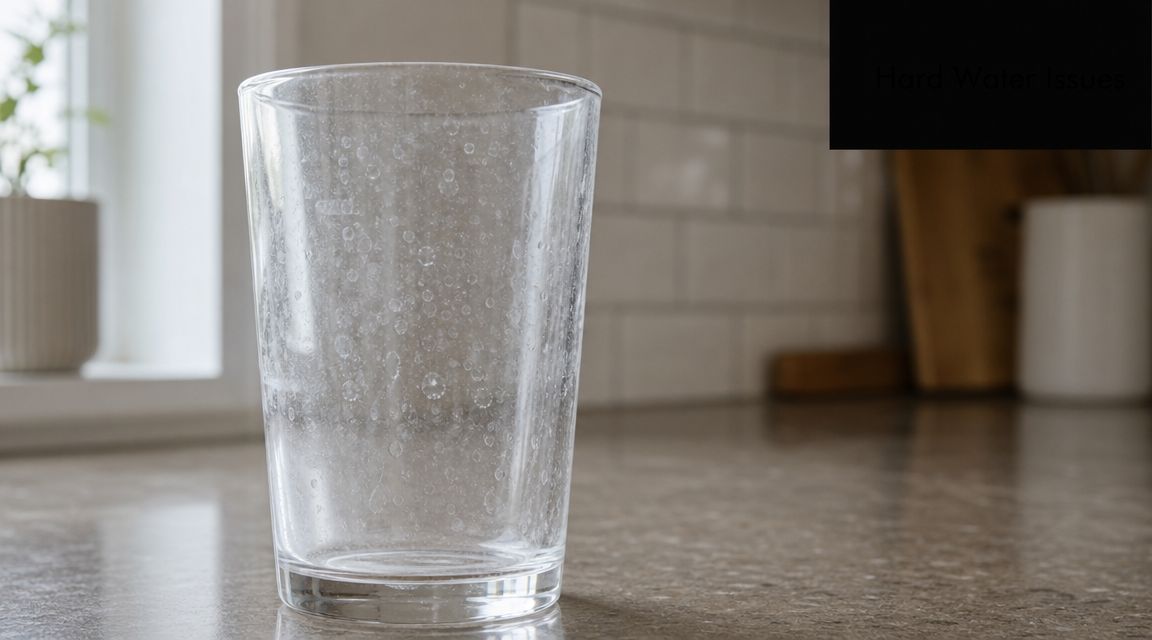
You notice the usual hard water signs first. Glasses come out cloudy, soap leaves a film, towels feel rough, and scale starts building around faucets. In Riverview, those symptoms often point to only part of the problem.
What matters here is the reason a system gets installed in the first place. A softener treats hardness, but Riverview homes can also deal with chlorine, sediment, iron, manganese, sulfur odor, and, in some areas, water quality changes tied to local supply conditions. As noted in these notes from a local water treatment provider, many homes in South and Central Florida need a treatment plan that combines softening with filtration or other equipment. That is why a proper water test comes first. It shows whether hardness is the main issue or just one part of a larger setup.
A standard ion-exchange softener does one job well. It removes calcium and magnesium, which cuts down scale on pipes, fixtures, water heaters, and appliances. For a house dealing mainly with mineral buildup, that can solve the complaint that started the search.
The daily improvements are real. Spots on dishes usually decrease, soaps rinse better, and appliances that heat water tend to stay cleaner longer. This guide on the day-to-day benefits of a home water softening system covers those practical gains.
The part many Riverview homeowners miss is system matching. I see this often with store-bought units. The box may promise softer water, but it does not account for iron that can foul resin, chlorine that may call for carbon ahead of the softener, or a plumbing layout that affects flow rate and drain routing. A private well and a municipal supply may both test hard, yet the right installation can look very different.
Orange staining, rotten-egg odor, or a sharp chlorine taste usually mean the house needs more than a softener alone. Those clues should push the decision back to testing, not forward to checkout.
Professional installation starts with that test for a reason. It determines the right equipment, resin capacity, regeneration settings, pretreatment needs, and where the system should tie into the home. DIY installations often stop at getting the unit connected. A professional setup accounts for what the water is doing, how the home uses it, and what will keep the system working correctly in Riverview conditions.
Assessing Your Home's Water Before You Buy
The right system starts with the right measurements. Homeowners often buy based on a neighbor's recommendation, a store display, or a rough online calculator. That approach works only when the water profile is simple, and many Riverview homes aren't simple.
What a proper test needs to answer
A useful assessment looks at more than “hard” or “not hard.” It should identify the issues that change system design, such as hardness level, whether iron or manganese is present, the water's pH, and overall dissolved mineral load. Those details shape both the equipment choice and how that equipment needs to be programmed.
Here's why each category matters in practice:
- Hardness level: This determines whether a softener is appropriate and how aggressively it will need to regenerate.
- Iron or manganese: These can interfere with softening performance and may call for pretreatment rather than a softener alone.
- pH: Water chemistry affects how treatment media perform and whether corrosion or staining may also be part of the problem.
- Overall dissolved solids: This helps explain taste, scaling behavior, and whether additional treatment at a drinking tap makes sense.
DIY strips versus a real diagnosis
DIY strips can be useful as a rough first look. They're not enough to specify a whole-house treatment system with confidence. They don't tell you much about the plumbing layout, actual household demand, or how multiple water issues interact.
That's especially important for properties using well water or mixed treatment setups. If your home has a private well, the decision process often needs to account for additional variables covered in well water treatment planning, not just mineral hardness.
A water test isn't paperwork. It's the blueprint for the installation.
Why household demand matters
A softener can be good on paper and still fail in the house if it's sized wrong. Capacity and flow have to match how the home uses water. A smaller household with steady usage patterns needs something different from a larger family running showers, laundry, and dishwasher cycles close together.
A technician usually looks at factors such as:
- How many people live in the home
- Whether the home has large tubs, multiple showers, or irrigation bypass needs
- How often water is used at the same time
- Whether the house needs treatment only for scale, or for other water issues too
An undersized system tends to run too hard. An oversized system can be wasteful or poorly matched. In both cases, the homeowner ends up blaming the equipment when the core problem was the initial specification.
The non-negotiable first step
The biggest mistake I see is treating the softener as the starting point. It isn't. The water test is. Once you know what the water contains and how the house uses it, the equipment decision becomes much more straightforward.
Choosing the Right Water Softener for Riverview
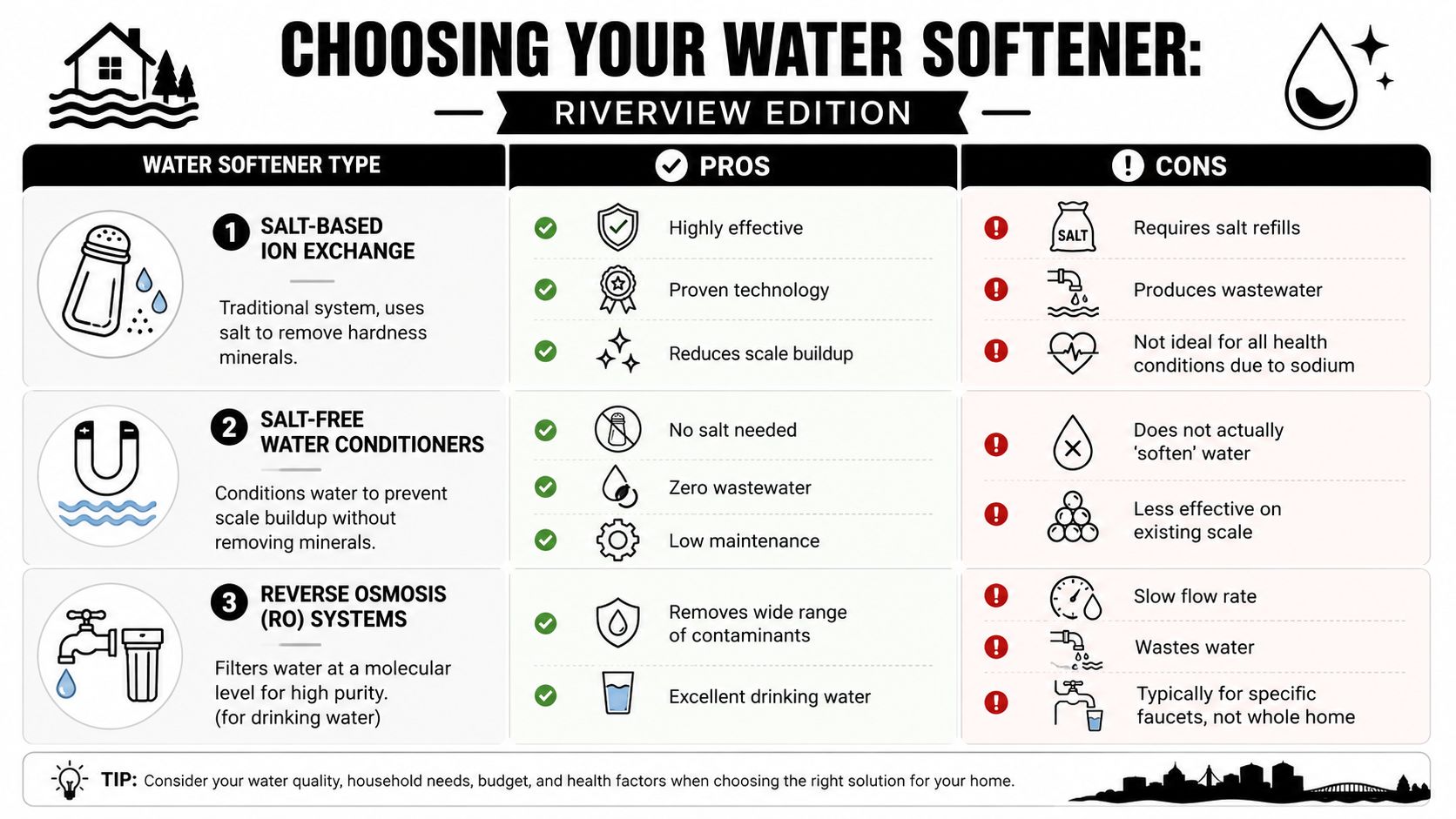
Once the water profile is clear, the equipment conversation gets easier. Most Riverview homeowners are comparing two whole-house directions. A salt-based ion-exchange softener or a salt-free conditioner. They aren't equal, and they don't solve the same problems.
When ion exchange is the right answer
If you want to remove hardness minerals, a salt-based softener is the standard solution. It exchanges hardness minerals for sodium and directly addresses the scaling problems that damage fixtures and leave that familiar chalky residue around the house.
For homeowners comparing treatment options, Florida Water Management offers water softening systems and installation as one type of whole-home treatment option among broader water treatment setups. The important point isn't the label on the tank. It's whether the system has been chosen for your specific water chemistry and demand.
Where salt-free systems fit, and where they don't
Salt-free units are often marketed as if they're interchangeable with softeners. They aren't. A conditioner may help reduce scale formation, but it does not remove hardness minerals from the water.
That can make them a reasonable fit in narrow situations, such as homeowners who want low maintenance and are mainly concerned with light scale prevention. They're a poor substitute when the home already has obvious hard-water symptoms, persistent buildup, or appliances that are suffering from mineral load.
A simple comparison helps:
| System type | What it does | Best fit | Limitation |
|---|---|---|---|
| Salt-based ion exchange | Removes hardness minerals | Homes with clear hard-water problems | Needs salt refills and routine upkeep |
| Salt-free conditioner | Conditions water to reduce scale tendency | Homes with mild scaling concerns | Doesn't truly soften water |
| Reverse osmosis | Purifies water at a point of use | Drinking water applications | Not a whole-house softening system |
Don't confuse whole-house softening with drinking-water filtration
Reverse osmosis is excellent for drinking water, but it's not a substitute for whole-home softening. If the house has scale on faucets, residue on shower doors, and mineral stress on the water heater, an under-sink RO unit won't solve those issues. It handles a different job.
If your goal is better drinking water, think reverse osmosis. If your goal is less scale on plumbing and fixtures, think whole-house softening.
Why generic store models often disappoint
The biggest gap between a professionally specified system and a shelf model is fit. A generic unit is sold to a broad audience. A proper installation accounts for your hardness load, your flow requirements, where the equipment will sit, what drain options exist, and whether the house needs pretreatment or additional filtration.
What works in Riverview is usually a configured solution, not a carton with a marketing promise on the outside. When homeowners say a softener “didn't work,” it's often because the system type was wrong, the sizing was off, or another water problem was never addressed.
The Professional Installation Process Explained
A clean installation looks simple when it's done well. Under the surface, there are several decisions that affect performance, serviceability, and code compliance. That's why water softener installation in Riverview, FL is more than setting a tank in the garage and hooking up two pipes.
Placement comes first
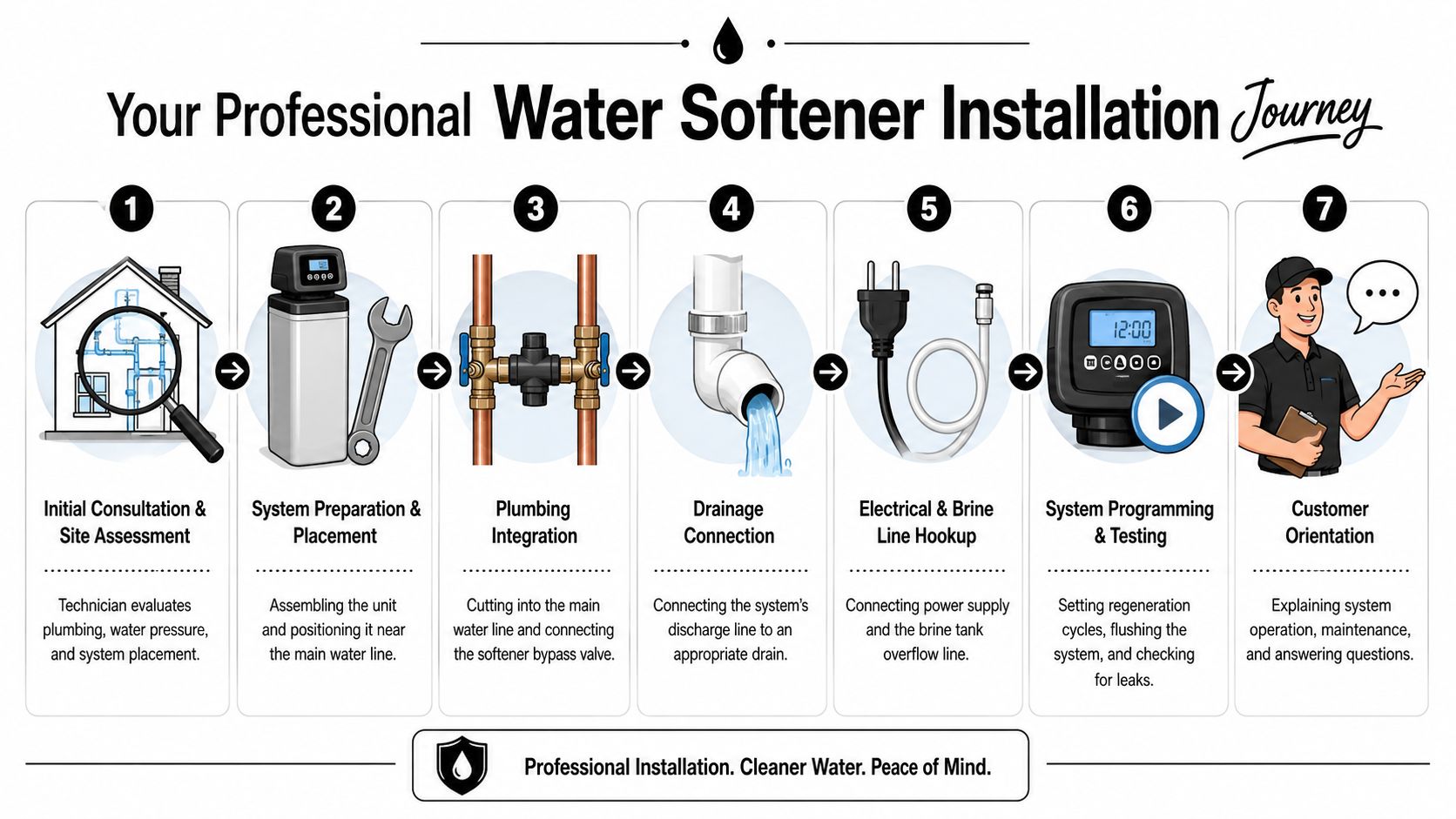
The system should be located where it can treat the home effectively and be serviced without hassle later. For a whole-house setup in a Florida home, the unit should be plumbed on the main cold-water line after water service enters the house but before the water heater, based on this installation guidance for whole-house softeners. That arrangement allows both hot and cold indoor fixtures to receive softened water while outdoor hose bibs may remain untreated if desired.
A technician also checks for:
- Drain access: The unit needs a proper place for discharge.
- Power nearby: Most control valves need power.
- Physical clearance: You need room to load salt, service the valve, and access the bypass.
- Stable placement: Tanks should sit level and secure.
The plumbing sequence that matters
The standard workflow is straightforward, but every step has a reason. The main water valve is shut off. Residual water is drained. The installer cuts in a bypass valve, connects the control valve inlet and outlet, adds the drain line to proper drainage, restores flow slowly, and checks carefully for leaks.
That bypass valve is one of the most important parts of the install. It lets the system be isolated for maintenance, troubleshooting, or future service without shutting water off to the whole house.
Field note: The bypass is what turns a water softener from a plumbing interruption into a serviceable appliance.
What professionals account for that DIY installs often miss
A do-it-yourself install can connect pipes. That doesn't mean it produces a durable water treatment setup. The common misses aren't dramatic. They're small details that create problems later.
Those details include:
- Drain line security: A loose or poorly routed discharge line can create messes or code problems.
- Slow startup and air purge: Restoring flow too quickly can stress fittings and leave air in the plumbing.
- Leak checks at every joint: Threaded and compression connections need deliberate inspection.
- Programming based on actual water conditions: The control valve should be set to the home's needs, not left at a default menu setting.
The final checks homeowners should expect
A professional install shouldn't end when the tanks are standing upright and the water is back on. The final stage matters just as much as the first cut into the pipe.
A homeowner should expect the technician to verify that:
- The unit is in service, not accidentally left in bypass
- The drain line is secure and discharging properly
- The brine tank is set up correctly
- All treated fixtures inside the home are receiving conditioned water
- The control settings match the water test and the home's use pattern
The last part is homeowner orientation. You should know how to add salt, how to identify bypass position, what sounds and cycles are normal, and when to call for service. If that handoff doesn't happen, the installation isn't finished.
Budgeting for Your Water Softener in Riverview FL
Most homeowners ask the cost question early, and that makes sense. Water softener installation in Riverview, FL has a real local pricing range, and the spread exists for a reason. Equipment, home size, plumbing layout, and any extra treatment all change the final number.
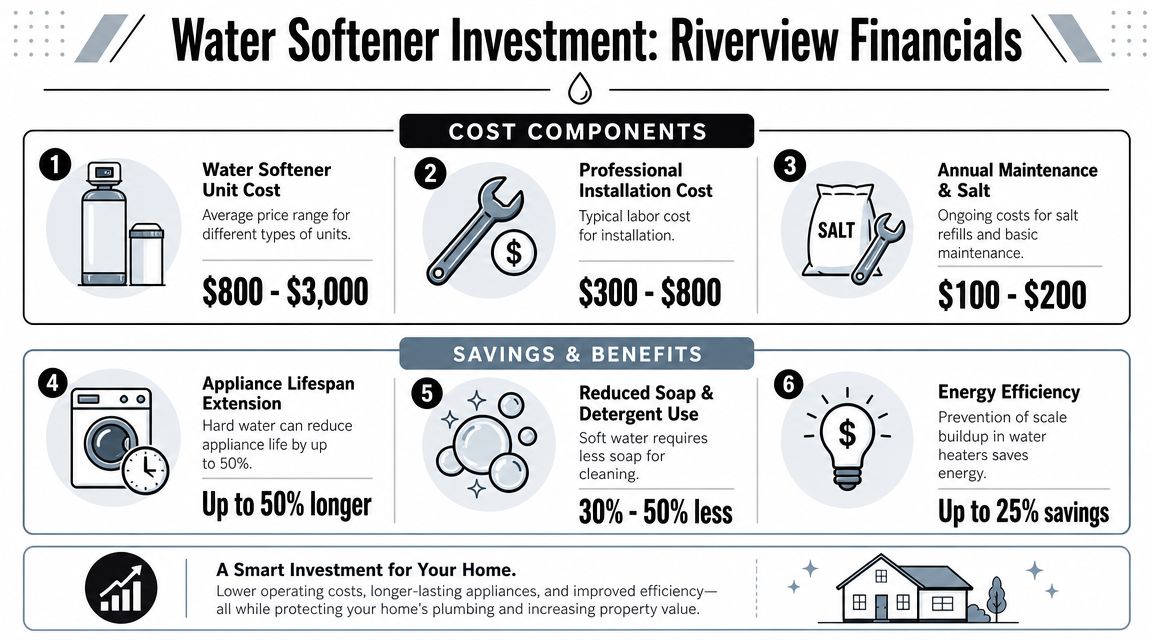
According to HomeAdvisor's Riverview water softener installation cost data, the average installed cost is $1,748, with a typical range of $1,080 to $2,336. The same local pricing reference notes that project costs can range from $600 to over $6,000 depending on system capacity, home size, and plumbing complexity.
Why the price range is so wide
A straightforward install in a home with accessible plumbing is one thing. A custom setup with limited space, added pretreatment, or more demanding water conditions is another.
The final price usually moves based on factors like:
- System capacity: Larger homes and heavier usage may need a larger or more capable unit.
- Water chemistry: If the home needs filtration or specialty treatment beyond softening, costs rise.
- Plumbing access: Tight garages, finished walls, or unusual line routing add labor.
- Installation complexity: Drain location, electrical access, and bypass integration all matter.
A simple way to think about the budget
Instead of asking “What does a water softener cost?” ask two better questions.
First, what problem am I paying to solve? If it's only hardness, the scope is usually more limited. If it's hardness plus odor, staining, or sediment, the equipment package changes.
Second, what will this system require after install? A lower upfront price can be less attractive if the unit is poorly matched and needs frequent attention.
| Budget area | What it covers |
|---|---|
| Equipment | The softener itself and any paired treatment components |
| Installation labor | Plumbing integration, drain setup, testing, and startup |
| Ongoing ownership | Salt, service visits, and periodic maintenance items |
Cheap quotes often leave out the details that determine whether the system will perform well after the installer leaves.
The quote that matters most
Online averages are useful for setting expectations. They don't replace an on-site look at the plumbing, water conditions, and system goals. Two Riverview homes on the same street can need very different solutions.
The most accurate number comes from a real inspection and water test. That's where you find out whether you need a straightforward softener, a softener with filtration, or a broader treatment setup.
Long-Term Care and Answering Your Top Questions
A water softener isn't a one-time purchase you forget about. It's a treatment appliance, and like any treatment appliance, it needs some owner attention to keep performing properly. That long-term care is one of the biggest differences between a system that keeps operating smoothly and one that slowly falls off.
Guidance from The GOAT Plumbing Company's water treatment overview makes the key point well. The best-fit solution depends on water chemistry and long-term upkeep, not just the initial installation. Water softeners require ongoing management, including salt refills and periodic service.
What regular ownership looks like
Most homeowners can handle the basic routine once the system is set up correctly. That usually means checking the salt level, making sure the unit isn't left in bypass, and paying attention to signs that performance has changed.
Professional maintenance usually focuses on things homeowners shouldn't have to guess at, such as:
- Control valve inspection: Confirming the system is cycling correctly
- Brine tank condition: Looking for buildup or other issues that interfere with regeneration
- System performance checks: Verifying the softener is still delivering the expected result
- Related equipment service: If the home also has filters, UV, or drinking-water treatment, those need their own maintenance schedule
Common questions homeowners ask
Will softened water taste salty?
Not in the way many people fear. A properly functioning whole-house softener isn't the same thing as drinking brine. If taste at the kitchen tap is a priority, many homeowners pair whole-house treatment with a drinking-water system designed for that purpose.
Does a softener purify drinking water?
No. Softening and purification are different jobs. Softening targets hardness minerals. Purification or contaminant reduction usually calls for other treatment equipment.
Can I install one myself?
Some homeowners can physically connect the unit. The bigger risk is misdiagnosis, poor sizing, bad drain setup, improper placement, or incorrect programming. Most of the expensive problems I see begin before the first regeneration cycle, not after it.
How do I know the system is underperforming?
Watch for the return of scale, soap not lathering the way it used to, spotting on fixtures, or water that feels like it did before treatment. Those signs usually mean it's time to check settings, salt supply, or service condition.
Good softener ownership is simple once the original system choice is correct. Most problems start with a mismatch between the water and the equipment.
A Riverview installation should leave you with more than softer water. It should leave you with a system you understand, can maintain, and can rely on when local water conditions change. The part that makes that possible is still the first step: test the water, then build the system around the results.
If you're dealing with scale, spotting, odor, staining, or you're not sure whether a softener alone is the right answer, Florida Water Management can help you start with the part that matters most: a free water test and a practical recommendation based on your home's actual water and plumbing layout. Use the contact page to request an appointment.