

You notice it first on the little things. Glassware comes out of the dishwasher with a haze. The shower door never looks fully clean. Towels feel stiff, soap doesn't lather the way it should, and the water heater seems to work harder than it ought to. In Tampa, that pattern usually isn't bad housekeeping or old fixtures. It's hard water.
Most homeowners don't need a chemistry lesson. They need a clear answer to a practical question: what hard water solution makes sense for this house, this water source, and this budget? That's where Tampa homes need a more local approach. Water here picks up minerals before it ever reaches your plumbing, so the right fix depends on measured hardness, how much of the home you want to protect, and whether you're solving scale problems, drinking water concerns, or both.
Table of Contents
- The Telltale Signs of Hard Water in Your Tampa Home
- What Causes Hard Water in Tampa A Look Underground
- Your Guide to Hard Water Treatment Technologies
- Choosing the Right Solution for Your Tampa Home
- Working with a Tampa Water Treatment Professional
- Your Hard Water Questions Answered
The Telltale Signs of Hard Water in Your Tampa Home
You clean the shower door on Saturday, run the dishwasher, wash a load of towels, and by midweek the film is back. In Tampa homes, that pattern usually points to the water itself, not a cleaning product that suddenly stopped working.
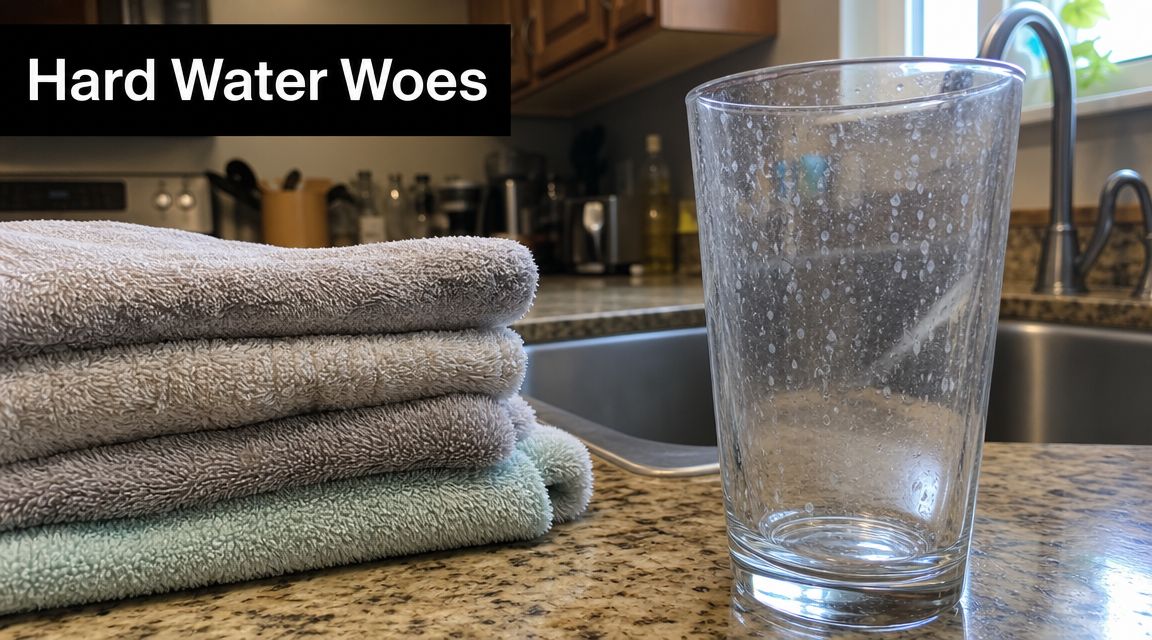
What homeowners usually notice first
Hard water tends to show up in small, repeat problems across the house:
- In the kitchen: glasses turn cloudy, dishes spot after a wash cycle, and kettles or coffee makers collect chalky residue.
- In the bathroom: faucets build a white crust, shower glass gets hazy, and soap scum returns quickly.
- In the laundry: towels feel stiff, dark clothes can look dull, and detergent never seems to rinse quite right.
- On skin and hair: showers leave many people feeling dry, and hair often feels flat, rough, or harder to manage.
I see homeowners treat each of these as a separate issue. They change detergent, replace fixtures, or buy another cleaner. The symptoms improve for a short time, then come right back because the minerals are still entering the home with every gallon of water.
Why these signs point to a measurable water problem
In Tampa, hard water is common enough that these symptoms deserve a real test, not guesswork. Tampa's municipal water hardness averages around 186 mg/L, or 10.9 grains per gallon, and treatment is commonly recommended once hardness exceeds 10.5 gpg, according to Aquatell's Florida hardness summary.
A practical rule helps here. If white buildup keeps returning on fixtures and appliances despite regular cleaning, the water likely needs attention.
Only a true water analysis tells you what type of system makes sense. Some homes need a softener sized to actual daily use. Others, especially properties with private wells, may have hardness plus iron, sulfur, or staining issues that call for a different setup. Homeowners dealing with private supply problems often start by reviewing well water treatment options for Florida homes.
For real hard water solutions in Tampa, FL, the process should start with a measured answer. A free water test through Florida Water Management gives you a baseline for hardness and helps confirm whether hard water is the full problem or only one part of it.
What Causes Hard Water in Tampa A Look Underground
Tampa's hard water starts long before the water reaches a faucet. The source is underground geology, not anything unusual happening inside your plumbing.
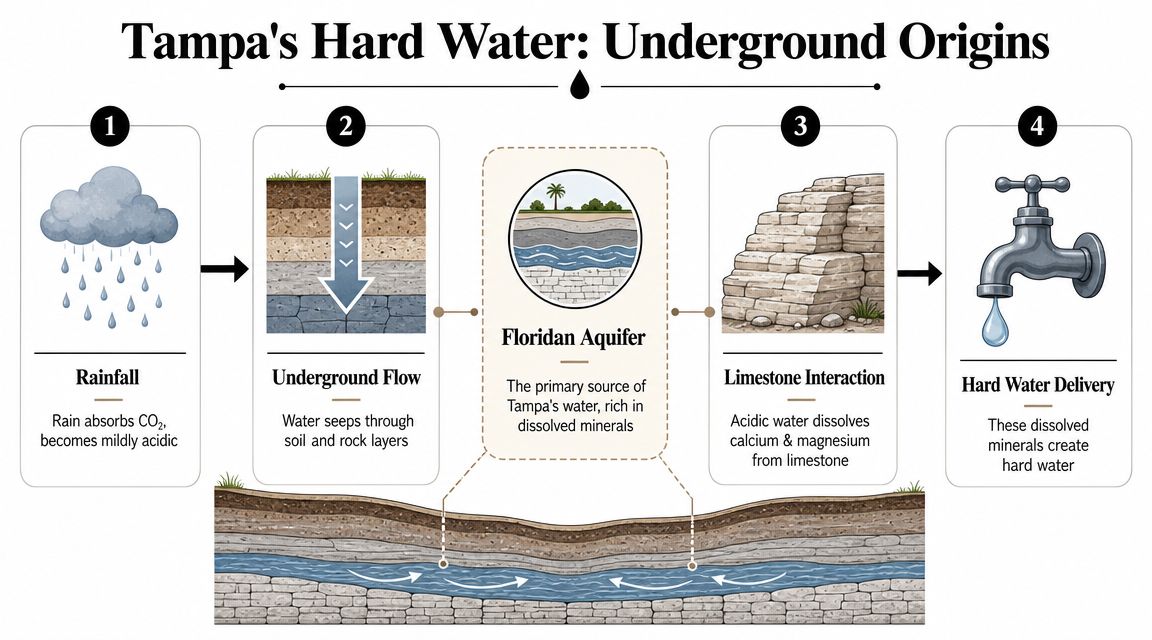
How the aquifer creates hard water
Florida's hard water problem is tied to limestone aquifers. As groundwater moves through carbonate rock, it dissolves calcium and magnesium. Those minerals stay in the water until they later show up as scale in plumbing, water heaters, and dishwashers. That process is what reduces efficiency and raises energy costs, as described in this overview of managing hard water in Florida.
A simple way to think about it is this. Water moving underground acts like a slow mineral pickup system. By the time that water reaches a home, it already carries the ingredients that create limescale.
Why Tampa homes feel the effects indoors
That local geology matters because it affects what kind of treatment works. If the issue is calcium and magnesium from the water source itself, wiping fixtures more often won't solve it. Stronger soaps won't solve it either. At best, those steps only manage symptoms at the surface.
This is also why testing matters more on private wells. A well can have hardness plus iron, sulfur, sediment, or other water quality issues that need more than one treatment step. If your home uses a well, it helps to review options for well water treatment in Central Florida before assuming a softener alone will handle everything.
Water chemistry decides the equipment. Not the label on the box.
For Tampa homeowners on municipal water, the cause is usually straightforward hard water from the regional source. For well owners, the same mineral background can come with extra complications. That's why local hard water solutions in Tampa, FL should start with source water and measured conditions, not with a one-size-fits-all recommendation.
Your Guide to Hard Water Treatment Technologies
Not every water treatment product solves the same problem. That's where many homeowners get tripped up. A system can improve taste and still do nothing for scale. Another can handle hardness well but won't address odor or sediment. The right choice starts with matching the technology to the problem.
Salt-based water softeners
A salt-based ion-exchange softener is the standard technical solution for true hard water. It removes calcium and magnesium and exchanges them for sodium or potassium, which prevents limescale from forming in pipes and appliances, as explained by Tampa Culligan's overview of how water softeners work.
That matters because only a true softener removes the hardness minerals causing scale. If your main goal is protecting a water heater, dishwasher, plumbing fixtures, and soap performance throughout the home, this is the technology that directly addresses the problem.
A properly sized softener should be based on measured hardness, household water use, and peak demand. If you're reviewing system types, whole-home water softening options are the category to focus on.
Salt-free water conditioners
Salt-free conditioners are often misunderstood. They don't remove hardness minerals the way an ion-exchange softener does. In some homes, they may help reduce how strongly minerals adhere to surfaces, but they are not the same as softening.
That distinction matters in Tampa. If a homeowner expects soft-feeling water, easier soap lather, and the same scale-control performance as a true softener, a conditioner may not meet that expectation. They can make sense in narrower situations, especially where someone wants to avoid salt handling, but they're not the default answer for mineral-heavy water when scale protection is the priority.
If the goal is to remove hardness, use equipment designed to remove hardness.
Reverse osmosis for drinking water
Reverse osmosis, usually called RO, works best as a point-of-use drinking water system. It's installed at a specific tap, typically the kitchen sink, and is meant for water you drink and cook with.
RO is not a whole-house hard water solution. It's too targeted for that role. Where it does fit well is in homes where people care about drinking water quality and want a separate answer for the kitchen. It can also be a smart addition when a household wants plumbing protection from one system and cleaner drinking water from another.
This is especially relevant when someone is concerned about sodium from ion-exchange softening for dietary reasons. In that case, a homeowner may choose one system for household water and another for the water they drink.
Whole-home filtration for non-hardness issues
Whole-home filtration handles problems that a softener does not. Depending on the water profile, that can include sediment, chlorine-related taste and odor, sulfur smells, iron, or other nuisance contaminants.
Homeowners often make a costly mistake. They buy a softener to solve every complaint, then find out the home still has odor, staining, or cloudy water because those issues weren't caused by hardness alone. A softener is excellent at what it's designed to do. It is not a universal filter.
For many Tampa-area homes, especially private wells, the right setup is layered:
- Sediment stage first: protects downstream equipment from grit and debris.
- Softening stage next: handles calcium and magnesium if hardness is present.
- Additional filtration where needed: addresses taste, odor, staining, or other specific water problems.
- RO at the sink: improves drinking and cooking water when that's a separate priority.
Homeowners searching for hard water solutions in Tampa, FL usually get better results when they stop looking for one magic box and start thinking in terms of treatment roles. Remove hardness where hardness is the problem. Filter where filtration is needed. Use RO where point-of-use water quality matters.
Choosing the Right Solution for Your Tampa Home
The best system for one Tampa home can be the wrong system for the next one. The decision usually comes down to water source, what you're trying to protect, and how the household uses water.
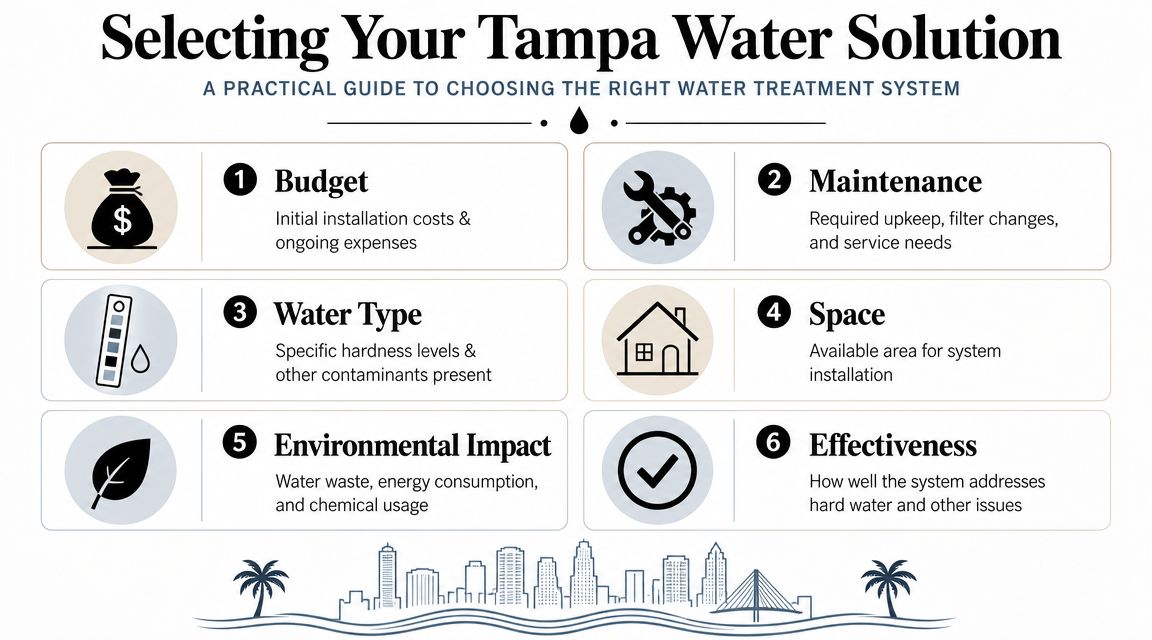
Municipal water vs well water
If you're on municipal water, the issue is often more predictable. Hardness may still vary, but the treatment path is usually simpler if the main concern is scale, soap performance, and appliance protection.
If you're on a private well, don't assume the same equipment will cover the whole picture. Wells can bring hardness together with iron, sulfur, or sediment. In those cases, a softener may be one part of the solution, not the entire solution.
Whole-home vs point-of-use
Homeowners require a practical cost-benefit mindset.
A whole-home softener protects plumbing, water heaters, dishwashers, laundry, fixtures, and bathing water. It addresses the mineral issue where it enters the house. A point-of-use system, such as reverse osmosis at the kitchen sink, treats only the water you drink and cook with.
Many Tampa homeowners ask whether they really need soft water throughout the house. That's a fair question. Sodium from ion-exchange softening is typically a minor concern, but it can matter for those on low-sodium diets, which is why a point-of-use reverse osmosis system can be a better fit for drinking water in some homes, according to Florida Water Treatment's discussion of whole-home vs targeted treatment choices.
So the decision often looks like this:
- Protect the house: whole-home softener
- Improve drinking and cooking water: point-of-use RO
- Need both outcomes: combine them
Household size and daily use
Two homes can test the same for hardness and still need different equipment. A house with heavier laundry use, more bathrooms, or higher simultaneous demand needs a system sized for actual living conditions, not just a generic label.
Look at the household realistically:
- Number of people: more people means more daily water demand.
- Fixture use: multiple showers running at once changes peak demand.
- Appliance exposure: tank and tankless heaters, dishwashers, and washing machines all benefit from scale control.
- Lifestyle priorities: some homeowners care most about shower comfort, others about plumbing protection, and others about drinking water only.
The right system isn't the biggest one. It's the one matched to your water and your daily load.
Comparing Hard Water Treatment Options
| Technology | Primary Use | Pros | Cons |
|---|---|---|---|
| Salt-based water softener | Removes hardness minerals for whole-home scale control | Directly addresses calcium and magnesium, protects appliances and plumbing, improves soap performance | Requires regular maintenance and salt or potassium replenishment |
| Salt-free conditioner | Attempts to reduce hardness-related surface effects without removing minerals | Appeals to homeowners who want a lower-touch approach | Doesn't remove hardness like a true softener, may not meet expectations where scale is severe |
| Reverse osmosis | Improves drinking and cooking water at a specific tap | Strong fit for point-of-use water quality needs, useful where dietary concerns affect drinking water choices | Not a whole-home hard water solution |
| Whole-home filtration | Targets non-hardness problems like sediment, odor, or staining | Can be paired with softening for broader treatment | Doesn't replace a softener when hardness removal is needed |
One practical option for homeowners who want a custom setup is to have a local provider match technologies to the water profile. Florida Water Management installs and services combinations such as softeners, filtration, and reverse osmosis based on the home's measured conditions rather than a single preset package.
Working with a Tampa Water Treatment Professional
A good consultation should feel like a diagnosis, not a sales script. If someone recommends equipment before testing your water and asking how the home uses water, that's a warning sign.
What a proper water assessment should include
A professional visit should start with the basics. What is the water source. What symptoms are you seeing. Which appliances are affected. Are you trying to protect the whole home, improve drinking water, or solve both issues.
From there, the recommendation should connect directly to the water findings and your priorities. For some homes, the answer is a softener. For others, it's a softener plus filtration. For some households, the kitchen needs reverse osmosis because drinking water priorities are different from whole-home plumbing protection.
If you're evaluating full-system options for the house, it helps to understand how a whole-house water filtration system in Tampa can be combined with other treatment stages when hardness isn't the only issue.
Questions worth asking before you buy
Ask direct questions and listen for direct answers:
- What exactly are you testing for: hardness alone, or also iron, sulfur, sediment, and other common issues?
- How are you sizing the system: by actual household use and water conditions, or by a generic home-size estimate?
- What maintenance does this system need: salt refills, filter changes, service intervals, and what happens if maintenance is skipped?
- What problem will this system not solve: every honest water professional should tell you where the limits are.
- Can this system be expanded later: useful if your current need is scale control but you may add RO or filtration later.
A solid provider should also explain trade-offs clearly. Salt-based softening is effective for hardness. It also comes with upkeep. Filtration can improve other water quality concerns. It does not replace hardness removal when scale is the central issue.
A trustworthy recommendation sounds specific. It ties the equipment to your water, your fixtures, and your goals.
That's what homeowners should expect before signing anything. The process should leave you with clarity, not pressure.
Your Hard Water Questions Answered
Will a softener make my water taste salty
Not in the way many people assume. A softener works by exchanging hardness minerals for sodium or potassium, but that doesn't mean your tap water should taste like saltwater. The more practical concern is whether sodium matters for your household's dietary needs. If it does, many homeowners separate the decision. They soften the home's water for scale control and use reverse osmosis at the kitchen sink for drinking and cooking.
Is hard water treatment worth it for rentals
For many landlords and property managers, yes. Hard water isn't considered a health hazard by itself, but scale buildup can shorten the life of appliances like water heaters and dishwashers, reduce plumbing efficiency, increase maintenance costs, and affect tenant satisfaction over time, as noted by Titan Water Solutions in its discussion of operational tradeoffs for property owners.
That matters in rentals because repeated service calls, appliance replacement, and turnover cleaning all cost time and money. In those situations, treatment becomes an operations decision, not just a comfort upgrade.
Do I need a whole-home system or just better drinking water
That depends on what problem you're trying to solve. If you want to stop scale in pipes, fixtures, water heaters, dishwashers, and laundry, you're looking at whole-home treatment. If your main concern is what comes out of the kitchen tap for drinking and cooking, a point-of-use system may be enough.
Some homes need both. One system protects the house. Another improves the water you consume directly.
What usually doesn't work well
Quick fixes rarely solve true hard water. Descaling one fixture at a time is temporary. Changing soaps and detergents may reduce annoyance but won't remove hardness minerals. Buying equipment without a water test often leads to a mismatch between the problem and the system.
The most reliable path is straightforward. Test the water. Match the technology to the actual issue. Size the equipment to the home.
Hard water solutions in Tampa, FL don't need to be confusing, but they do need to be specific to the property. If you want a clear recommendation based on your home's actual water, the next move is to get your water tested and reviewed by a professional.
Florida Water Management helps homeowners and small businesses across Central Florida identify the right treatment approach for their actual water conditions. If you want a free water test and a practical recommendation for your Tampa home, visit the Florida Water Management contact page to schedule your assessment.