

You load the dishwasher, open it later, and the glasses still look cloudy. Your towels feel stiff instead of soft. Soap takes forever to lather in the shower, and the faucets keep growing that white crust no matter how often you wipe them down. If that sounds familiar in Central Florida, your water hardness level may be the quiet problem behind a long list of daily frustrations.
For a lot of homeowners, hard water doesn't show up as one dramatic failure. It shows up as small annoyances that keep repeating. Spots on dishes. Dry skin after bathing. Laundry that never feels fully clean. Appliances that seem to age faster than they should. And if you're on a private well in places like Sebring, Avon Park, or Lake Wales, there's another wrinkle. Iron can muddy the picture and make simple at-home tests harder to trust.
Table of Contents
- The Unseen Culprit Behind Your Home's Water Woes
- What Is Water Hardness and How Is It Measured
- The Real Impacts of Hard Water on Your Home and Health
- How to Accurately Test Your Water Hardness Level
- Water Hardness in Central Florida What to Expect
- Choosing the Right Treatment for Hard Water
- Frequently Asked Questions About Water Hardness
The Unseen Culprit Behind Your Home's Water Woes
A homeowner in Central Florida often starts with symptoms, not a diagnosis. Maybe the first clue is the ring around the shower drain. Maybe it's the water heater that seems to struggle, or the shirts that come out of the wash feeling rough. Many people blame the detergent, the dishwasher, or the age of the house before they ever think about the water itself.
That's understandable because hard water is invisible when it first comes out of the tap. It looks clean. It tastes normal to many people. But once it dries, heats up, or mixes with soap, it leaves evidence all over the house. You see it on glassware, on fixtures, on shower doors, and sometimes on your own skin.
In Central Florida, this issue is especially easy to underestimate. City water can be hard. Well water can be even trickier. Two homes a short drive apart can have very different water behavior because the local geology and water source aren't exactly the same.
Hard water rarely announces itself with one big warning. Most homeowners notice a pattern of smaller problems that don't seem connected until someone tests the water.
That's why it helps to look at water hardness level the same way you'd look at blood pressure or tire pressure. You need the actual reading, not a guess. Once you know where your water falls, the rest gets much easier. You can tell whether you're dealing with a mild inconvenience, a serious scaling problem, or a well-water mix that needs more than a basic softener.
What Is Water Hardness and How Is It Measured
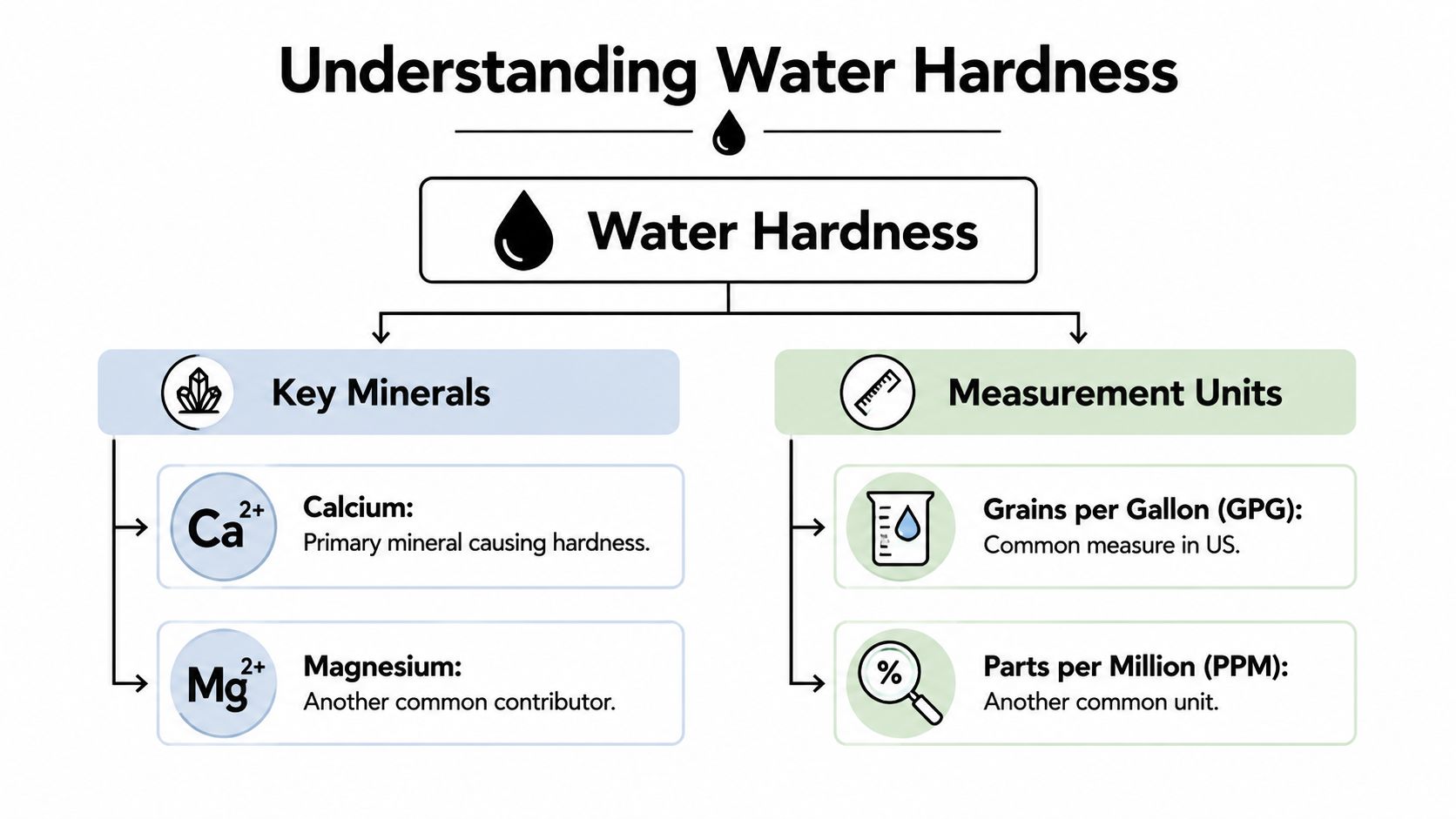
Water hardness is a measure of how much dissolved calcium and magnesium is in your water. In Central Florida, that usually starts underground. Water moves through limestone and other mineral-rich layers, then carries some of those minerals into your plumbing.
A simple way to picture it is this. Every gallon can carry a small mineral load, and over time that load shows up on fixtures, heating elements, and anything water touches often.
What hardness actually means
Hardness is about mineral content, not whether the water looks clean or dirty. Clear water can still be very hard. The issue is what those minerals do after the water leaves the tap. Once water is heated, evaporates, or mixes with soap, calcium and magnesium are more likely to create scale and soap scum.
That behavior confuses a lot of homeowners because hard water and contaminated water are not the same thing. Hardness is usually a water chemistry issue, not a sign that the water is unsafe. It is better understood as a performance problem. Your soap does not rinse the same way, your fixtures collect buildup faster, and equipment that heats water has a tougher job.
There are also two forms of hardness. Temporary hardness is linked to bicarbonate minerals and can be reduced by boiling. Permanent hardness comes from calcium and magnesium tied to sulfates or chlorides, and boiling does not remove it, as described in the Scientific Reports study on hardness in Japan and global water characteristics.
The units that confuse most homeowners
Water tests and municipal reports usually express hardness in mg/L, ppm, or gpg.
- mg/L means milligrams per liter.
- ppm means parts per million.
- gpg means grains per gallon.
For household water, mg/L and ppm are treated as roughly equivalent, so those two numbers are usually read the same way. Grains per gallon is the unit many softener companies use, and the standard conversion is 1 gpg = 17.1 mg/L.
That conversion matters more than people expect. If your report says 171 mg/L, that is about 10 gpg. If a softener quote says 7 gpg, that is roughly 120 mg/L. Once you can switch between those two units, a lab report and a treatment estimate start speaking the same language.
Water hardness classification scale
Most residential water falls into a few practical ranges:
| Classification | mg/L (or ppm) | Grains per Gallon (gpg) |
|---|---|---|
| Soft | 0–60 | 0–3.5 |
| Moderately hard | 61–120 | 3.6–7.0 |
| Hard | 121–180 | 7.1–10.5 |
| Very hard | ≥181 | 10.6+ |
For a homeowner, the labels matter less than the pattern behind them. Once water moves into the hard or very hard range, mineral buildup usually becomes easier to notice in daily use.
Central Florida adds one more layer that many general articles miss. On private wells, hardness is often not the only mineral issue in play. Iron can show up alongside calcium and magnesium, and that creates what I call the Private Well Hardness Paradox. The water may stain fixtures orange or brown, yet a quick DIY strip test can give a muddy or incomplete picture of what is really going on. Iron can interfere with the homeowner's interpretation of the result, which is one reason a well sample sometimes needs a fuller lab analysis instead of a basic hardness check.
That is also why an exact hardness number matters. A home with city water and a home on a nearby well can both have “hard water,” but the treatment path may be very different once iron enters the mix.
As a general rule, water in the moderate range is often manageable. Higher readings are more likely to leave visible scale, reduce soap performance, and push homeowners toward treatment.
The Real Impacts of Hard Water on Your Home and Health
You notice it on a busy weekday morning. The shower glass looks hazy again. Your skin feels tight after rinsing off. The dishwasher finishes a cycle, but the glasses still come out spotted. In Central Florida, those small frustrations often trace back to one source. Hard water changes how water behaves in your home, and the effects show up both where you can see them and where you cannot.
What hard water does inside the house
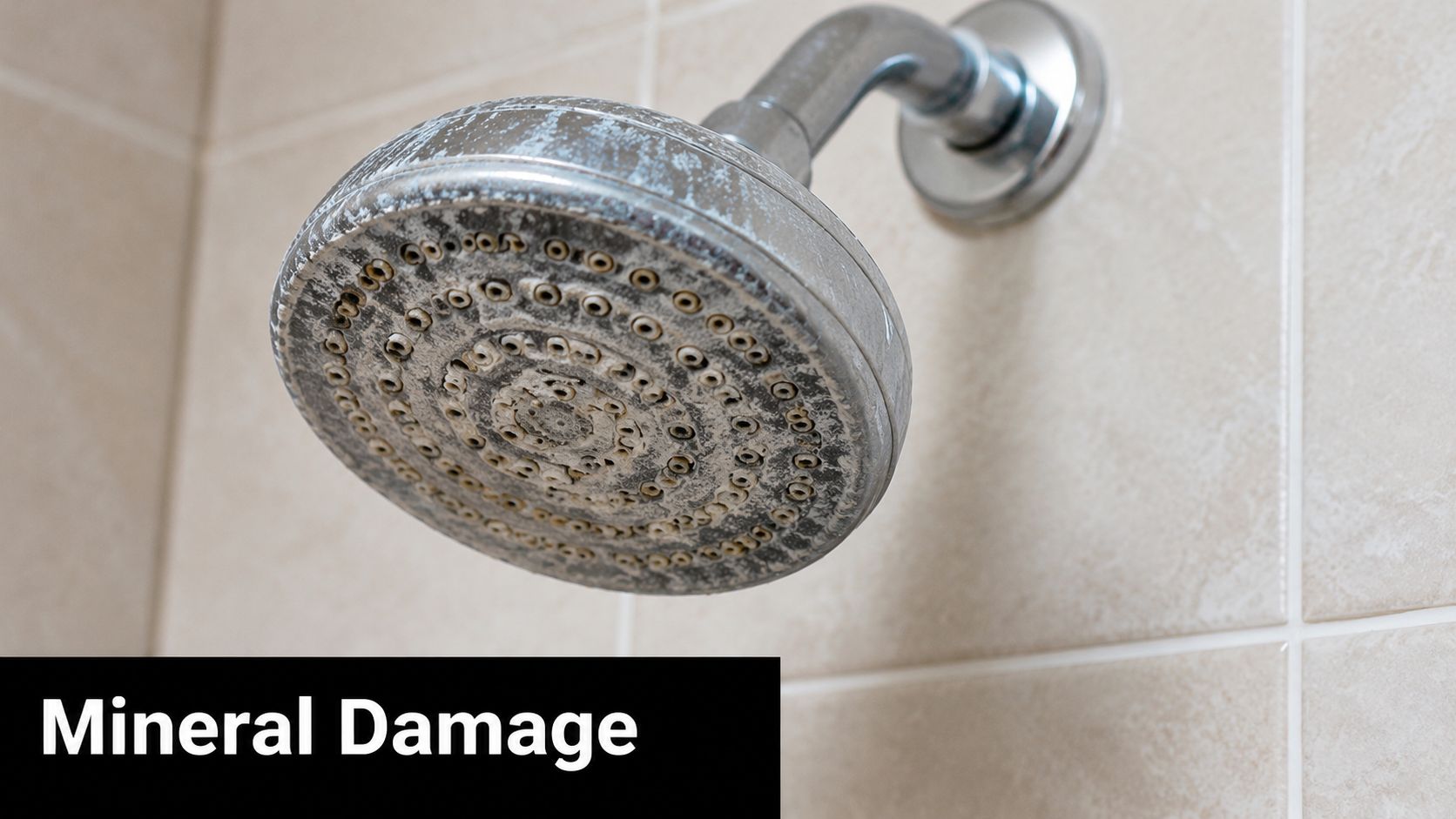
Hard water leaves behind minerals as water dries or heats up. You can picture it like a thin chalk film that keeps returning. At first, it shows up as white crust on a faucet or around a shower head. Over time, that same buildup can collect inside appliances and plumbing where you never see it directly.
Water heaters usually feel the effect early. Their job is to move heat into water efficiently. A mineral coating gets in the way, much like a layer of scale on the bottom of a cooking pot slows heat transfer. Dishwashers, coffee makers, ice makers, and washing machines can run into the same problem. They still work, but often with more strain and less efficiency.
In homes with older plumbing, mineral scale can also narrow the inside of pipes. That does not happen overnight, but it can slowly reduce flow and add wear to fixtures and valves.
Common signs around the house include:
- Cloudy dishes and glassware: Minerals dry on the surface and leave spots or haze.
- Soap scum in tubs and showers: Soap reacts with calcium and magnesium, then sticks to surfaces instead of rinsing away cleanly.
- Crust on fixtures: Aerators and shower heads can clog as deposits build up.
- Reduced appliance performance: Water-using equipment may need more cleaning, more repairs, or earlier replacement.
Central Florida homes on private wells can run into an extra layer of confusion. Calcium hardness may be only part of the story. Iron often tags along, especially in well water, and that combination can mean both chalky scale and orange or brown staining. Homeowners sometimes assume they are dealing with one problem when two are present. That is the Private Well Hardness Paradox in everyday life. The water can look like an iron problem while hardness is still steadily shortening appliance life in the background.
What you notice on skin, hair, and laundry
Hard water also changes the feel of daily routines. Soap and shampoo do not rinse the same way in mineral-heavy water. Instead of a clean, slick rinse, you may feel a film on your skin or a coated texture in your hair. People often describe it as “I just showered, so why do I still feel dry?”
Dermatological data discussed in this hard water and household effects article links harder water with worse skin irritation in some households and poorer cleaning performance in laundry. That helps explain why children with sensitive skin, adults with dry skin, and families washing lots of towels or athletic wear may notice problems first.
Laundry is a good example because the effect is easy to miss at first. Clothes may come out looking clean, but colors can seem flatter, whites may lose brightness, and towels often feel stiff. Many homeowners respond by adding more detergent or fabric softener. Usually that just leaves more residue behind because the minerals are still interfering with the wash.
Hair can act the same way. Shampoo lathers less easily, rinsing takes longer, and styling can become harder because mineral residue weighs strands down. If your hair feels dull or your scalp feels dry even after changing products, your water may be part of the problem.
Water can be safe to use and still be hard on your home. Safety and performance are different issues.
If these signs sound familiar, a properly matched treatment system can make everyday water use feel noticeably different. Homeowners comparing options often start with a local water filtration system in Sebring, FL to sort out whether they need softening, iron reduction, or both. In Central Florida, that distinction matters. A city-water home and a private-well home may both have hard water, but they rarely need the exact same fix.
How to Accurately Test Your Water Hardness Level
If you want a useful answer, you need the right test. Guessing from soap lather or a little faucet buildup can point you in the right direction, but it won't tell you the actual water hardness level or whether another water issue is getting mixed into the picture.
The common ways homeowners test water
Homeowners usually start with one of three options.
DIY test strips
These are quick and inexpensive. You dip the strip, compare the color, and get a rough hardness range. They're fine for a first look, but they can be hard to read accurately, especially when your water has multiple mineral issues.Drop-count titration kits
These take a little more time but usually give a clearer hardness reading than a simple strip. They're better for people who want a more hands-on measurement and don't mind following instructions carefully.Utility reports and professional analysis
If you're on municipal water, a local report can provide a general picture. But your house may still behave differently depending on plumbing conditions, treatment devices, and local variation. A professional test looks at your actual water at the point of use.
A lot of homeowners also ask about TDS meters. Those meters measure total dissolved solids, not hardness by itself. They can show that minerals are present, but they don't tell you how much of that number is specifically calcium and magnesium.
Why Central Florida well water needs extra caution
In Central Florida, private wells deserve extra care because iron often complicates the picture. A test that appears straightforward may not be telling the whole story. If you're using well water, especially in the Sebring and Lake Wales area, it's smart to treat a quick DIY result as a clue, not a final answer.
That's one reason many homeowners who start by researching a water filtration system in Sebring eventually find that hardness isn't the only issue involved. Iron, sulfur odor, and sediment can overlap with hardness symptoms and change the treatment plan.
A solid testing approach looks like this:
- Start simple: Use visible signs and a basic test to confirm whether hardness is likely.
- Check your water source: City water and private wells often require different assumptions.
- Look for overlap: Orange staining, odor, or sediment can point to iron or sulfur, not hardness alone.
- Get a full reading before buying equipment: That step helps prevent choosing the wrong system.
A strip test can tell you something is going on. It can't always tell you exactly what.
Water Hardness in Central Florida What to Expect
You move into a home near Lake Wales or Sebring, scrub the shower, and a few days later the white film is back. The dishwasher leaves spots. Soap does not lather the way you expect. In Central Florida, that pattern is common because the water here often carries a heavy mineral load from the limestone-rich ground below us.
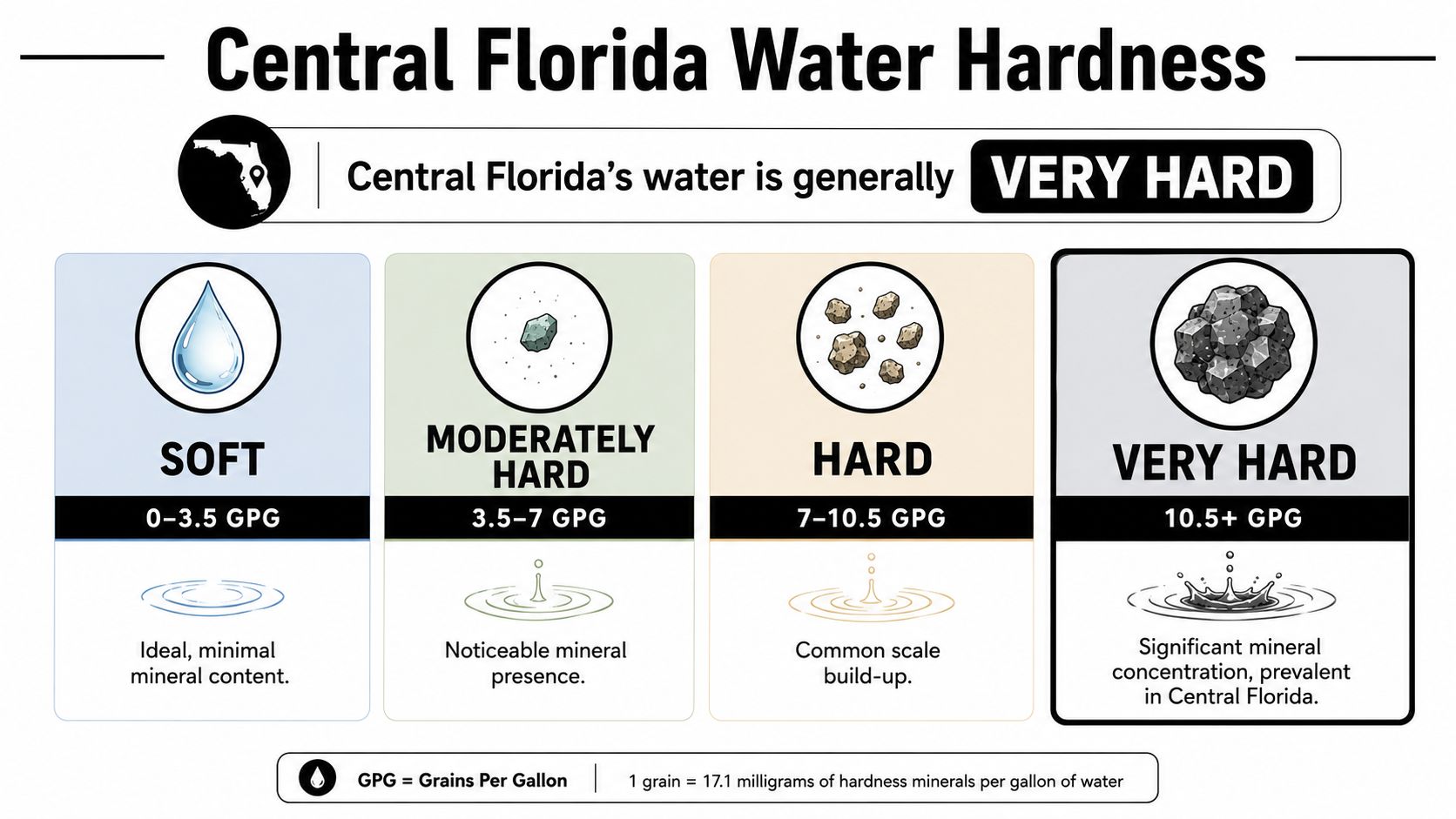
Statewide, Florida water is often on the hard side. The University of South Florida water hardness reference for Florida shows average hardness in many parts of the state ranging from 200 to 400 ppm, which falls into the very hard range. That broad state picture helps explain why scale buildup is such a familiar complaint in this part of Florida.
City water in Central Florida can still be hard enough to cause daily nuisance problems, even when it is not at the top of the chart. Orlando municipal water averages 129 ppm, which is considered hard, based on this Orlando hard water guide. Nearby Gulf Coast cities also run high. Tampa measures 186.0 ppm and St. Petersburg 166.0 ppm, according to this Florida city hardness breakdown. Those numbers are high enough to leave spotting on fixtures, shorten the cleaning life of appliances, and make laundry feel rougher.
Private wells add another layer.
The Hardness Paradox in Private Wells
In many Central Florida wells, hardness is only part of the story. Iron often shows up alongside calcium and magnesium. That combination can confuse homeowners because the symptoms overlap. White scale points toward hardness. Orange staining points toward iron. Sometimes you get both at once, and a quick DIY result does not sort them out clearly.
That is the local wrinkle many national articles miss. A strip test may suggest hard water, but iron can muddy the reading and push a homeowner toward the wrong equipment. It works a lot like trying to judge the depth of a lake when the water is cloudy. You can see enough to know something is there, but not enough to measure it well.
For homeowners comparing options such as water softener installation in Lake Wales, that distinction matters. A softener may be the right answer for hardness, but some well systems also need iron treatment ahead of or alongside softening. If the test misses that second problem, the treatment plan can fall short.
In city water, hardness is often the main issue. In private well water, hardness may be sharing the stage with iron, sulfur, sediment, or all three. That is what makes Central Florida different, and why local testing and local interpretation matter so much.
Choosing the Right Treatment for Hard Water
You test the water, see the spots on the glass shower door, and start shopping. Then the confusion starts. One product says it “conditions” water. Another says it “softens” it. A third promises better-tasting drinking water. In Central Florida, that choice gets harder because a well may be dealing with hardness and iron at the same time.
The first step is to match the equipment to the job.
Whole home softening compared with conditioning
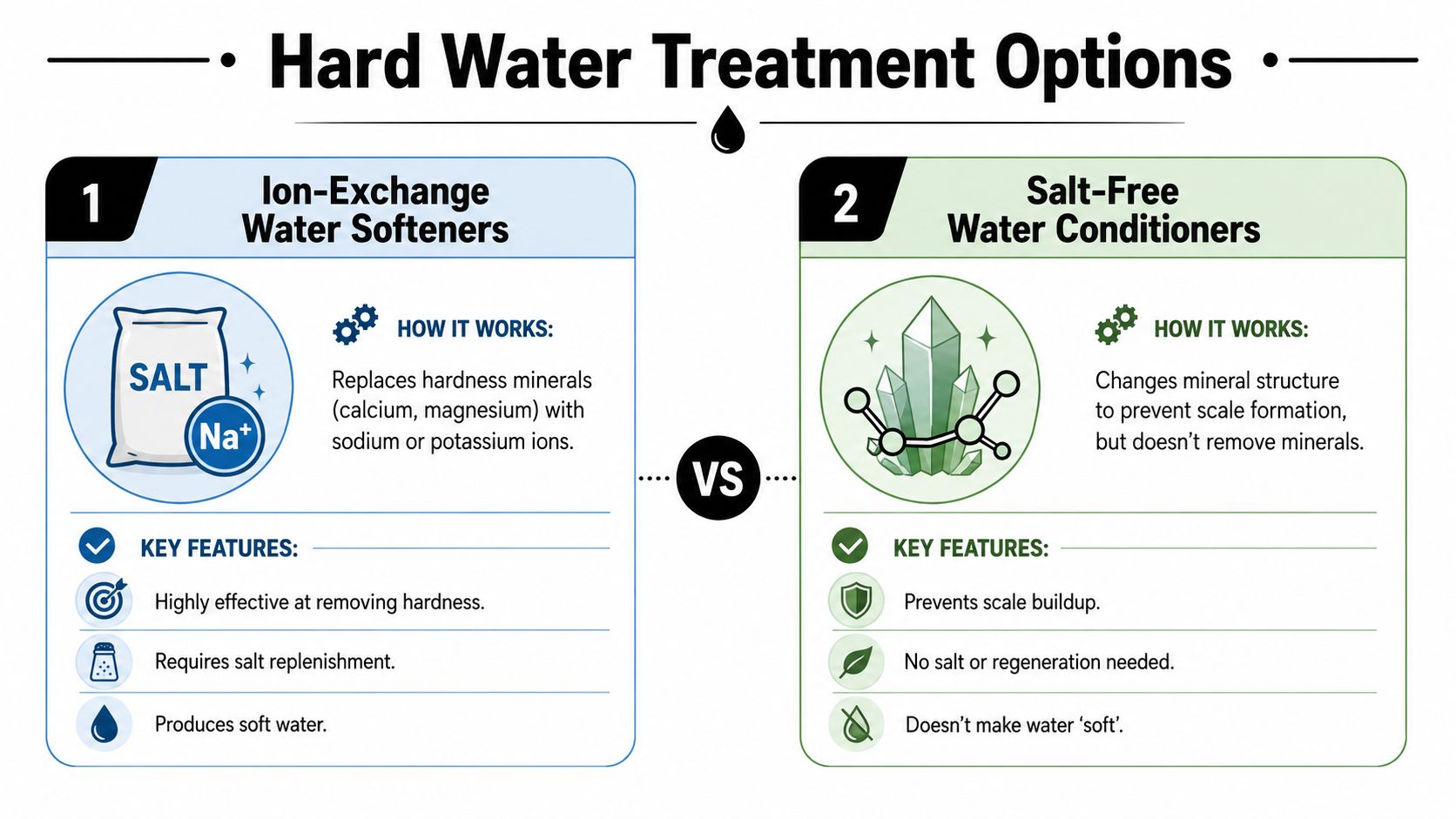
If calcium and magnesium are the main problem, an ion-exchange water softener is the whole-home system that removes those hardness minerals. That is the option homeowners usually want when they are tired of soap that will not lather well, rough-feeling laundry, scale on fixtures, and mineral buildup inside appliances.
A salt-free water conditioner does a different job. It is built to reduce how strongly scale sticks to surfaces, but it does not remove hardness minerals from the water. That difference matters in real life. If your goal is to protect plumbing while still keeping the minerals in place, conditioning may help. If your goal is the feel and performance of softened water, a conditioner will not deliver the same result.
Other filters also have a role, but they should not be mistaken for hardness treatment. Sediment filters catch grit and debris. Carbon filters help with chlorine, taste, and some odors. Neither one solves a true hardness problem by itself.
Where reverse osmosis fits
Reverse osmosis belongs at the tap, not as the main answer for the whole house. It is usually installed at the kitchen sink to improve drinking and cooking water by reducing a broad range of dissolved contaminants.
If you want better water for coffee, ice, and cooking, a reverse osmosis drinking water system can be an excellent add-on. It does not replace a whole-home softener because it will not protect water heaters, shower doors, washing machines, or plumbing lines throughout the house.
The Central Florida decision point
This is where local water knowledge really matters.
On municipal water, the answer is often fairly direct. If hardness is the main complaint, a properly sized softener is usually the right fit.
On a private well, the “Private Well Hardness Paradox” changes the decision. Iron can ride along with hardness, and the symptoms overlap. You may see white scale, orange staining, or both. A homeowner can easily buy a softener because the water looks hard, then find out later that iron is still causing stains, fouling fixtures, or shortening the life of the equipment.
That is why treatment in Central Florida often needs to be built in stages instead of choosing a single box off the shelf.
- Municipal hard water: A whole-home softener is often the main solution.
- Private well with hardness and iron: Softening may need to be paired with iron treatment.
- Sediment, sulfur, or odor issues: Pre-filtration may need to come first so the rest of the system can work properly.
- Drinking water concerns at one faucet: Reverse osmosis is usually the right supplement, not the whole-home answer.
A good treatment plan should fit your actual water chemistry, your plumbing, and how your household uses water each day. In Central Florida, that often means solving more than one problem at once, especially on private wells.
Frequently Asked Questions About Water Hardness
Is hard water safe to drink
In general, hard water is considered safe to drink. The bigger issue for most homeowners is performance, not basic safety. Hardness causes scaling, soap interference, and cleaning frustrations around the home.
Will a softener make my water salty
Most homeowners don't describe properly softened water as tasting salty. If you notice an unusual taste, it may point to settings, maintenance needs, or a separate drinking-water preference. That's one reason many people pair whole-home treatment with a dedicated kitchen drinking-water system.
Can a pitcher filter soften water
A typical pitcher filter isn't designed to remove household hardness at the level needed to protect plumbing, showers, laundry, and appliances. It may improve taste in some cases, but it won't function like a whole-home softener.
How can I tell if my current softener is working
Look at the everyday signs. If soap starts lathering poorly again, white scale returns to faucets, laundry feels rough, or dishes spot more than usual, your system may need service. Salt level, regeneration settings, resin condition, and pre-filter performance can all affect results.
A few practical checks help:
- Check for returning scale: That's often the first visible clue.
- Notice bathing changes: Skin and hair usually feel different when softening stops working.
- Review maintenance history: Missed service can reduce performance.
- Test the water again: That's the fastest way to confirm what's happening.
If your home's symptoms have changed, your water may have changed too. Testing gives you a current answer instead of relying on an old installation date.
If you're dealing with spotting, scale, dry skin, stiff laundry, or confusing well-water test results, the best next step is a free water test from Florida Water Management. Their team works with Central Florida homeowners every day and understands the local mix of hardness, iron, sulfur, and sediment that can make one-size-fits-all advice fall short. If you want clear answers about your water hardness level and the right fix for your home, visit the Florida Water Management contact page and schedule your free water test.