

You turn on the kitchen tap in Sun City Center, fill a glass, and notice that faint swimming pool smell again. The dishwasher leaves a haze on your glassware. Fresh laundry feels a little stiff. The shower helps you wake up, but your skin doesn't feel great afterward. Then someone tells you, “You're on city water now, so you shouldn't need treatment.”
That's where a lot of homeowners get stuck.
Municipal water and ideal household water are not the same thing. Water can be treated well enough to meet public utility standards and still leave behind the daily annoyances that show up on fixtures, inside appliances, and in the taste of what you drink. In Sun City Center, that gap matters more than generally realized. Local infrastructure, mineral content, disinfectant residuals, and what happens after water leaves the treatment side all affect what comes out of your tap at home.
If you've been wondering why “city water” still leaves spots, odor, or buildup, you're asking the right question.
Table of Contents
- Welcome to Sun City Center So You Still Have Water Spots
- What City Water in Sun City Center Really Means
- Common Water Problems Hiding in Your Pipes
- How to Know Exactly Whats in Your Water
- Your Guide to Whole Home Water Treatment Solutions
- Targeted Treatments for Drinking Water and Beyond
- Your Action Plan for Perfect Water in Sun City Center
Welcome to Sun City Center So You Still Have Water Spots
A lot of people in Sun City Center have the same reaction after moving into a home on municipal water. They expect the water issues to disappear. Then the coffee tastes flat, the faucet starts collecting white crust, and the shower door never looks clean for long.
That confusion makes sense. “City water” sounds like the problem has already been solved. In reality, municipal treatment is designed first to make water deliverable and regulated across a large service area. It is not designed around your shower glass, your water heater, your tea kettle, or the feel of your skin after a bath.
One local story shows how quickly water issues can turn into expensive surprises. In Sun City Center, a resident who reported annual water consumption of about 4,000 gallons per cycle ended up with a $1,200 water bill after a spike blamed on a sprinkler system. Hillsborough County Public Works confirmed the sprinkler system was the primary cause, which shows how unnoticed water problems can create real waste and real cost in a home setting, as reported by FOX 13's coverage of the Sun City Center sprinkler-related water bill.
That case was about irrigation, not drinking water quality. But the lesson is the same. If you don't monitor what your water is doing, small issues can become expensive ones.
Practical rule: If your water leaves visible evidence on fixtures, appliances, dishes, or your skin, it's telling you something. Don't ignore the pattern just because the home is on city water.
The good news is that these problems are usually very fixable. Once you know whether you're dealing with hardness, chlorine residual, sediment, or a mix of issues, the path gets much simpler.
What City Water in Sun City Center Really Means
From county treatment to your faucet
When people talk about city water treatment in Sun City Center FL, they're talking about water that moves through Hillsborough County's utility infrastructure before it reaches the home. Utilities treat water on a large scale, monitor it, and distribute it through an underground pipe network.
Nearby Tampa describes its municipal treatment plant as a 24/7 continuous process, with crews working around the clock to deliver safe, clean drinking water, according to the City of Tampa water treatment process overview. That gives you a useful picture of how seriously public systems handle treatment and delivery in this region.
Here's the basic journey homeowners should understand:
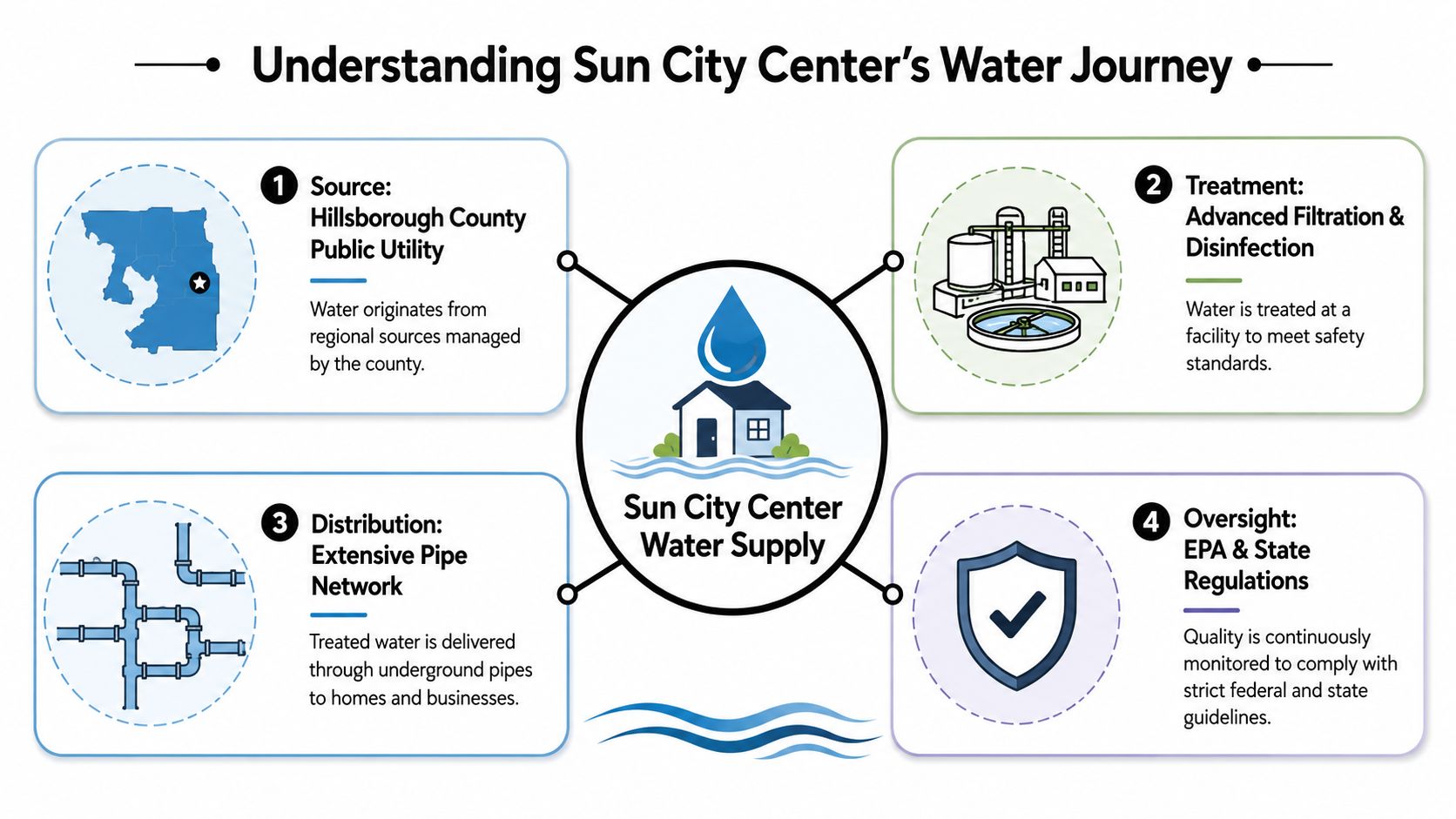
Hillsborough County is also investing heavily in infrastructure. The county says it's implementing one of the largest wastewater infrastructure projects in its history, with advanced wastewater treatment services expected to be fully operational by fall 2026, according to Hillsborough County's project announcement.
That matters because it shows local systems aren't standing still. Utilities know water infrastructure needs constant upgrading.
Safe water and comfortable water aren't the same thing
What many homeowners miss is what happens after treatment. Water leaves the utility side, moves through distribution lines, and finally enters your house. During that trip, the practical experience of the water can change. A disinfectant residual may still be noticeable. Minerals may still create scale. Sediment can still show up. Older plumbing in the broader network can affect what a homeowner sees at the faucet.
That's why “meets standards” and “works beautifully in my home” are different standards.
A useful way to think about it is this:
| Stage | What it does | What it doesn't promise |
|---|---|---|
| Municipal treatment | Makes water suitable for public distribution | Spot-free dishes, soft-feeling showers, great-tasting ice |
| Home treatment | Tailors water to the house and the people using it | It doesn't replace municipal infrastructure |
Municipal treatment protects the system. Home treatment protects your experience inside the home.
That distinction is the whole reason city water treatment in Sun City Center FL is still relevant, even for homeowners who have never been on a private well.
Common Water Problems Hiding in Your Pipes
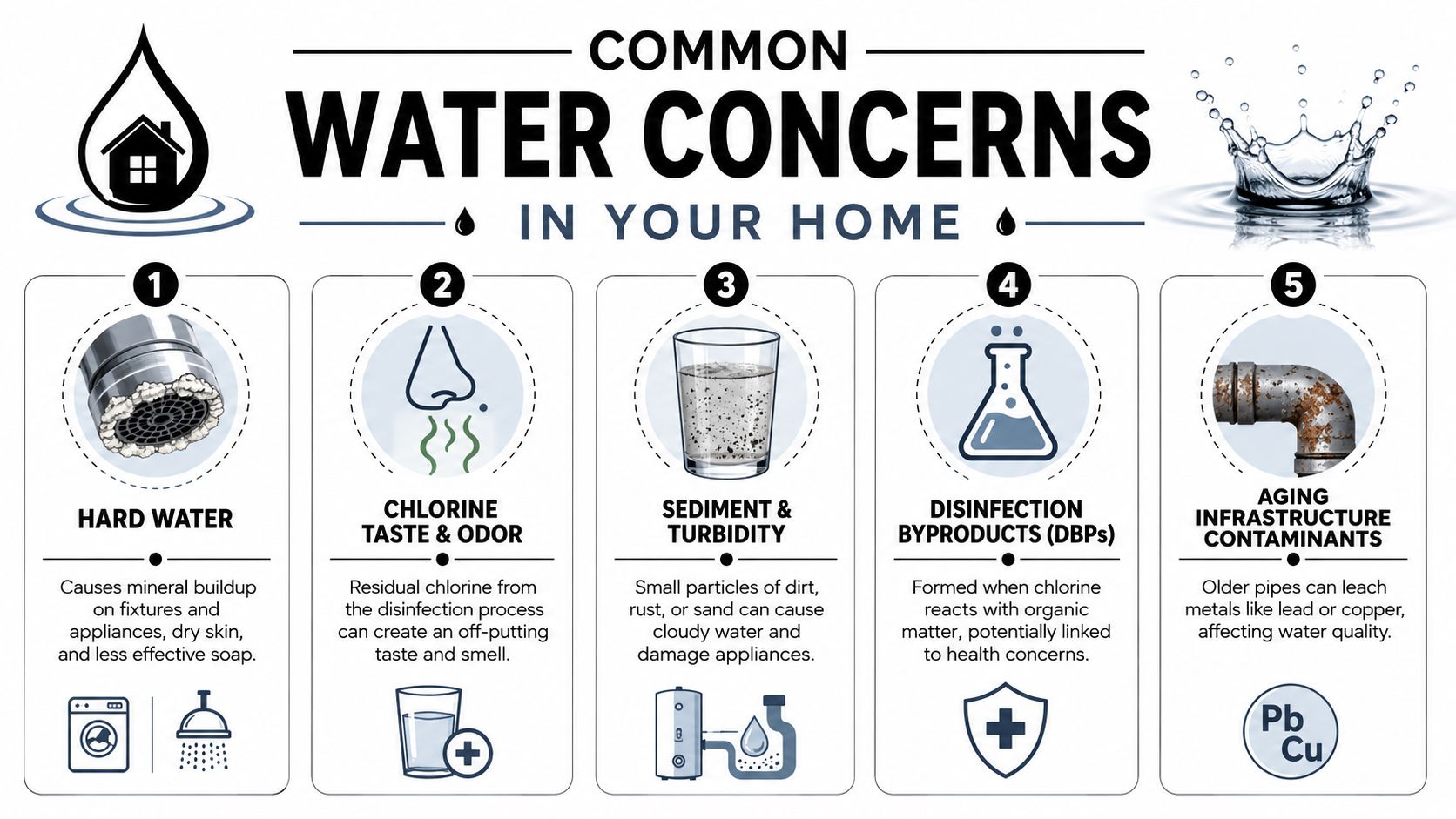
The issues homeowners notice first
Most municipal-water complaints in this area fall into a handful of categories. The symptoms look different, but they often show up together.
Hard water is usually the first one people notice. It leaves white scale on faucets, a filmy look on glassware, and mineral buildup in places you can't see, like water heaters and supply lines. Soap doesn't rinse as easily, and shampoos often feel like they don't fully lather or rinse clean. If you want a quick sense of how hardness is discussed in household treatment, this guide on water hardness levels and what they mean is a useful reference.
Chlorine taste and odor is another common complaint. You fill a glass and catch that pool-like smell right away. Some homeowners are less bothered by the taste than by how it affects bathing. Skin and hair often feel drier when chlorine residual is noticeable.
Sediment can be more subtle. Sometimes it shows up as cloudy water. Sometimes it collects in aerators, settles in toilet tanks, or contributes to appliance wear. It's the kind of issue people notice after they've already replaced parts more than once.
Metal staining or pipe-related contamination concerns can also enter the conversation when a home shows reddish, brownish, or bluish marks around fixtures. In other cases, homeowners never see a color issue but still want to account for what older distribution systems can contribute.
What those symptoms cost around the house
The effect isn't just cosmetic. It changes how the house runs day to day.
The average household in Sun City Center uses about 75 gallons of water per day per person, and that figure is a practical starting point for sizing softeners. In the same local market, water softener systems typically cost between $200 and $6,000, with an average installation cost of $1,500, according to Angi's Sun City Center water softener cost overview.
That usage number matters because every gallon moving through hard water conditions interacts with fixtures, appliances, water heaters, laundry, and bathing.
A quick way to look at it:
- Fixtures and glass: Hard water leaves visible residue that keeps coming back after cleaning.
- Water heater and appliances: Scale coats internal surfaces and makes equipment work harder.
- Laundry and bathing: Minerals and chlorine can make fabrics feel rougher and leave skin feeling less comfortable.
- Cooking and drinking: Taste and odor issues don't ruin every glass, but they make people buy bottled water when they'd rather trust the tap.
If the whole house uses the water, the whole house feels the problem.
What doesn't work well is guessing based on one symptom and buying the first filter you see online. A refrigerator filter won't solve scaling on fixtures. A basic sediment cartridge won't fix chlorine taste through the whole house. A softener won't replace a dedicated drinking water purifier at the sink.
How to Know Exactly Whats in Your Water
Why symptoms only tell part of the story
Water leaves clues, but clues aren't a diagnosis.
A chlorine smell might be chlorine alone, or it might be chlorine plus sediment plus old buildup inside household plumbing. Spotting on dishes usually points toward hardness, but the severity matters. Cloudiness can come from sediment, trapped air, or a mix of conditions. Two homes on the same street can need different treatment because the plumbing, occupancy, and water use patterns are different.
That's why a professional water test matters. It separates guesses from actual design decisions.
DIY kits have their place. They can tell a homeowner that something is worth paying attention to. What they usually don't do well is give a complete enough picture to size and select the right system for the whole house. That's how people end up stacking mismatched equipment under the sink, in the garage, and at the shower head without solving the root issue.
What a professional test helps you avoid
A good test does more than identify a problem. It helps you avoid buying the wrong answer.
It can show whether you need a softener, a carbon system, a sediment stage, a drinking water purifier, or a combination. It can also prevent overtreatment. Some people spend money on equipment they don't need because they're trying to solve one symptom with three products.
Here's the practical sequence that works best:
- Notice the symptoms you see every day, like scale, odor, film, or cloudiness.
- Get the water tested professionally so the treatment plan matches the actual water profile.
- Choose equipment based on the test, not on fear or online guesswork.
If you want a clear starting point, schedule a free water test through the Florida Water Management contact page. It's the simplest way to stop guessing and find out what your Sun City Center home needs.
Your Guide to Whole Home Water Treatment Solutions
Which system fixes which problem
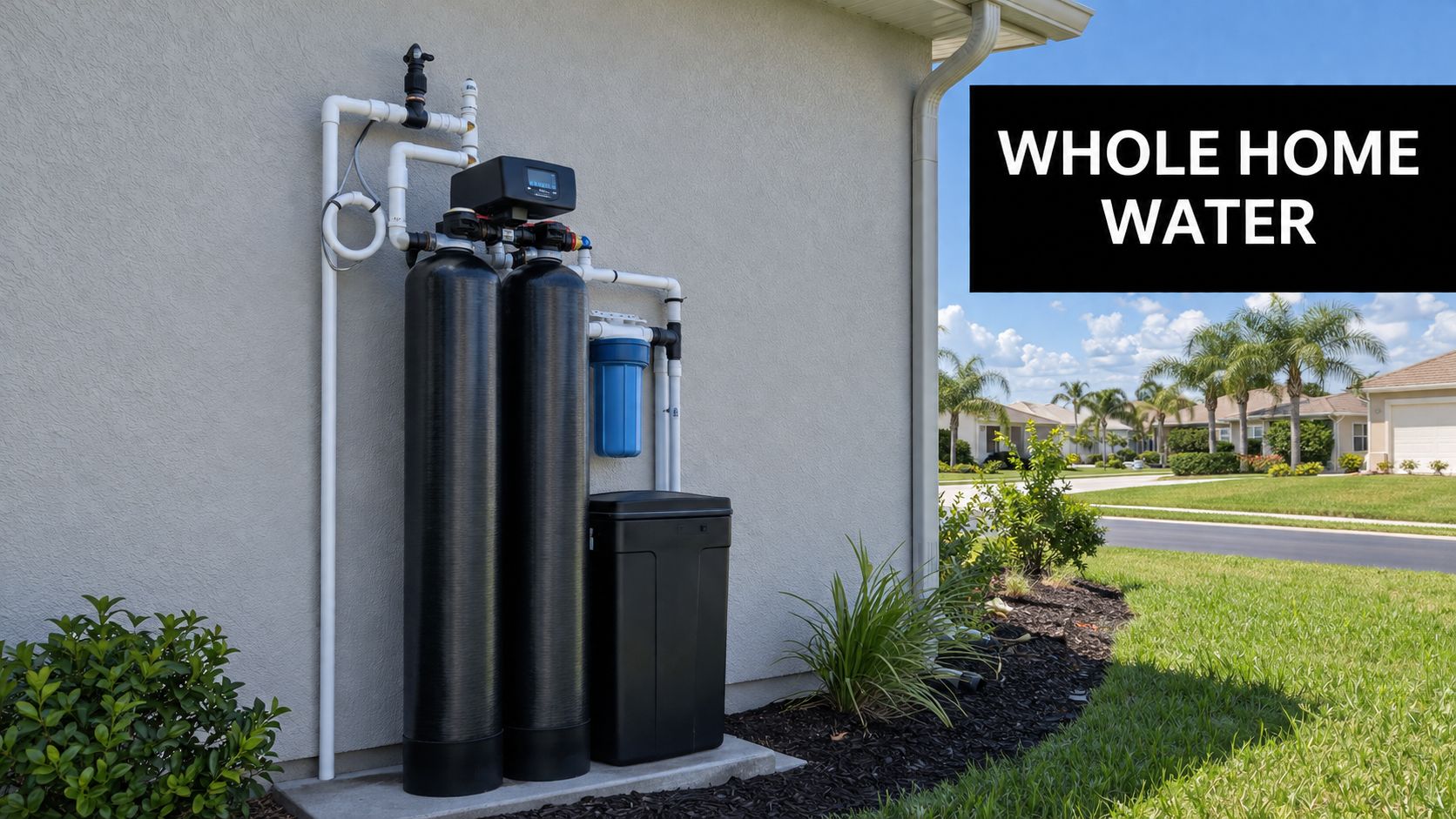
Whole-home treatment works at the entry point, before water reaches the kitchen, bathrooms, laundry, and water heater. That's why it's usually the best first move when the problem affects more than one faucet.
If your main complaint is scale, soap inefficiency, stiff laundry, or constant spotting, a water softener is the usual answer. It's designed to address hardness before minerals settle throughout the plumbing system.
If your biggest issue is taste, odor, or chlorine exposure during showers and general household use, a whole-home carbon filter usually makes more sense. For homeowners comparing options, this page on a whole-house water filter for chlorine gives a good overview of where carbon systems fit.
If sediment is part of the problem, a sediment prefilter often protects the rest of the equipment and keeps debris from reaching fixtures and appliances. If staining points to iron or similar nuisance contaminants, a specialized media filter may be the right match.
A simple comparison helps:
| Problem in the home | Best-fit whole-home approach |
|---|---|
| Scale, spots, soap issues | Water softener |
| Chlorine smell, taste, shower discomfort | Carbon filtration |
| Cloudiness, grit, debris | Sediment filtration |
| Staining tied to nuisance minerals | Specialized media filtration |
What better equipment changes
Not all systems behave the same after installation. The quality of the control head, media, and programming changes how reliably the equipment performs over time.
In South Florida, systems commonly use digital control valves and bacteriostatic filtration media such as Puronics® Hydronex® iGen® B to monitor flow, help prevent microbial regrowth, and optimize filter performance in real time, according to Hydrology's Sun City Center whole-house filtration overview.
That matters in real homes because better controls help the system respond to how the household uses water. A retired couple with light demand doesn't use water the same way a busy multigenerational household does. Good equipment can be adjusted intelligently. Cheap equipment often can't.
Field note: The best whole-home setup isn't the one with the most parts. It's the one that matches the water, the plumbing, and the family's routines.
What doesn't work well is treating every city-water home as if it has the same problem. Some need hardness control first. Others need chlorine reduction first. Some need both. The right order matters.
Targeted Treatments for Drinking Water and Beyond
Why some homes add a second layer at the tap
A whole-home system protects plumbing, improves bathing, and makes daily water use more pleasant. But many homeowners still want an extra level of refinement where water goes directly into a glass, a coffee maker, or a cooking pot.
That's where point-of-use treatment comes in.
The easiest analogy is this: whole-home equipment is the shield, and a dedicated drinking water system is the scalpel. The first protects the house broadly. The second targets the water you consume most directly.
For a lot of homes, that point-of-use system is reverse osmosis. If you're comparing approaches, this breakdown of reverse osmosis vs filtered water helps explain why an RO faucet often produces a different result than a standard carbon filter alone.
Where RO and UV make sense
Reverse osmosis is strong at reducing a range of unwanted substances in drinking water. According to Riverview Water Treatment's RO system installation information for Sun City Center, reverse osmosis systems can reduce chlorine by up to 95%, lead by 97%, and pesticides by 90 to 99%.
Those are meaningful reductions for homeowners who are sensitive to taste, odor, or contaminant concerns at the tap.
RO makes particular sense when you want:
- Better drinking water taste: Especially if the kitchen tap still has a chemical note.
- More confidence for cooking: Clean water matters in soups, coffee, tea, and ice.
- A final polishing step: Even after whole-home treatment, some households want more refinement for direct consumption.
UV treatment is different. It doesn't soften water or remove chlorine. It's used when the goal is an added microbiological safeguard. That can matter for specific households, especially when someone wants another layer of reassurance around water used for drinking.
Good water treatment is layered on purpose. One system protects the house. Another can perfect the water you drink most often.
Your Action Plan for Perfect Water in Sun City Center
A simple four step plan
If you've been dealing with spots, odor, dryness, or uncertainty about your tap water, keep the next steps simple.
1. Observe what the house is telling you.
Look at the shower glass, the faucet aerators, the dishwasher results, the laundry feel, and the taste of the drinking water. Those everyday patterns are your first clues.
2. Get a professional water test.
A professional water test eliminates guesswork. A real test tells you whether you're dealing with hardness, chlorine, sediment, point-of-use concerns, or a combination.
3. Review a treatment plan built for your home.
The right recommendation should match your water profile and how you use water in the house. A home with heavy bathing complaints may need a different priority than one where the biggest issue is scale inside appliances.
4. Install the right combination, not the biggest one.
Some homes need one well-chosen whole-home system. Others do better with a whole-home setup plus RO at the kitchen sink.
Why acting now beats waiting
One reason this matters in Sun City Center is that many homeowners still assume municipal water automatically means no further treatment is necessary. That assumption leaves a lot of people living with avoidable problems.
The gap is simple. Existing discussion around city water treatment in Sun City Center FL often skips the difference between municipal compliance and home-level water quality concerns, including issues such as PFAS, chlorine-byproducts, and hardened sediments, as noted on the Temple Terrace water questions page discussing regional water concerns. You don't need to panic over that. But you also shouldn't assume that regulated city water is automatically optimized for your fixtures, appliances, comfort, and drinking preferences.
There's also a broader reason some homeowners want a treatment plan they control at the house. In Oldsmar, Florida, a hacker attempted to alter the water supply by raising sodium hydroxide to 11,100 ppm, described as a 111x increase from normal levels, according to E&E News reporting on the Florida water supply hacking incident. That event didn't happen in Sun City Center, but it did remind Florida homeowners of something important. Public systems matter, and so does having your own final layer of protection where water enters and where you drink it.
A smart homeowner response is not fear. It's verification, then the right equipment.
If you want better water in Sun City Center, start with testing. It's the shortest path to a solution that fits your home.
Florida Water Management helps homeowners across Central Florida solve hard water, chlorine, sediment, sulfur odors, and drinking water concerns with customized treatment systems and ongoing service. If you want answers instead of guesses, schedule a free water test through Florida Water Management and use the contact us page to get started.