

You're usually not thinking about water hardness while unloading the dishwasher or stepping out of the shower. You're thinking about the cloudy spots on your glasses, the white crust around the faucet, the way towels feel stiff, or why your skin feels tight even though you just rinsed off. In Central Florida, those annoyances often trace back to one thing. Hard water.
A water hardness test kit gives you the first clear answer. It tells you whether the problem is mild, severe, or severe enough that your plumbing and appliances are paying for it behind the scenes. For homeowners in Sebring, Avon Park, Lake Wales, Winter Haven, and nearby areas, that's not a small detail. It's the difference between guessing and making the right treatment decision.
Table of Contents
- Why Your Dishes Have Spots and Your Skin Feels Dry
- Comparing Water Hardness Test Kit Types
- How to Use Your Water Hardness Test Kit Correctly
- Interpreting Your Results in Central Florida
- Choosing the Right Kit for Your Home or Well
- Your Test Is Done What Are the Next Steps
Why Your Dishes Have Spots and Your Skin Feels Dry
Most homeowners first notice hard water in small ways. Glassware comes out looking dusty even when it's clean. The shower door won't stay clear. Soap doesn't rinse the way it should, and freshly washed clothes can feel rough instead of soft.
Then the pattern gets harder to ignore. Faucets develop a chalky ring. Coffee makers and kettles collect mineral buildup. Water heaters start working harder because scale coats the heating surfaces. If you've ever scrubbed the same white residue over and over, you've already seen what hardness leaves behind.
Everyday signs that point to hard water
Hardness is caused mainly by dissolved calcium and magnesium in the water. You can't see those minerals in a glass of water by themselves, but you can see what they do after the water dries or gets heated.
Common clues include:
- Spotted dishes: Minerals stay behind after the water evaporates.
- Dry skin and dull hair: Soap doesn't rinse cleanly in hard water, so bathing can leave a residue.
- Stiff laundry: Fabrics often feel less soft after washing.
- Scale around fixtures: White or crusty deposits show up on faucets, showerheads, and tile.
- Appliance trouble: Water-using equipment tends to accumulate mineral deposits over time.
Practical rule: If you're seeing residue in more than one room of the house, don't assume it's a cleaning issue. Test the water first.
The bigger problem is what happens where you can't see it. Unaddressed hard water can reduce the lifespan of appliances like water heaters and dishwashers by 30 to 50% and increase energy costs by up to 20% annually due to scale buildup, which makes a simple test an important first step in protecting your home investment, according to market data on water hardness test strips.
Why testing comes before treatment
A lot of homeowners jump straight to searching for a filter or softener. That's backwards. Hardness has levels, and the right response depends on how severe the reading is. A quick strip can tell you whether you likely have a problem. A more precise kit can tell you how serious it is.
That matters because the solution for mild hardness isn't always the same as the solution for very hard water. It also helps explain why some homes constantly battle calcium buildup problems while others only notice occasional spotting.
A water hardness test kit doesn't solve the issue. It tells you what you're dealing with, which is what makes the next decision smart instead of expensive guesswork.
Comparing Water Hardness Test Kit Types
Not all kits answer the same question. Some tell you, “Yes, your water is hard.” Others tell you how hard it is, which is the number you need if you're trying to size or program treatment equipment correctly.
Quick comparison table
| Kit Type | Accuracy | Ease of Use | Best For |
|---|---|---|---|
| Test strips | Broad estimate | Very easy | Fast screening |
| Drop-count titration kit | High for home testing | Moderate | Actionable hardness measurement |
| Digital meter | Varies by device and setup | Moderate to advanced | Users who want instrument-based testing and are comfortable maintaining it |
What works well and what falls short
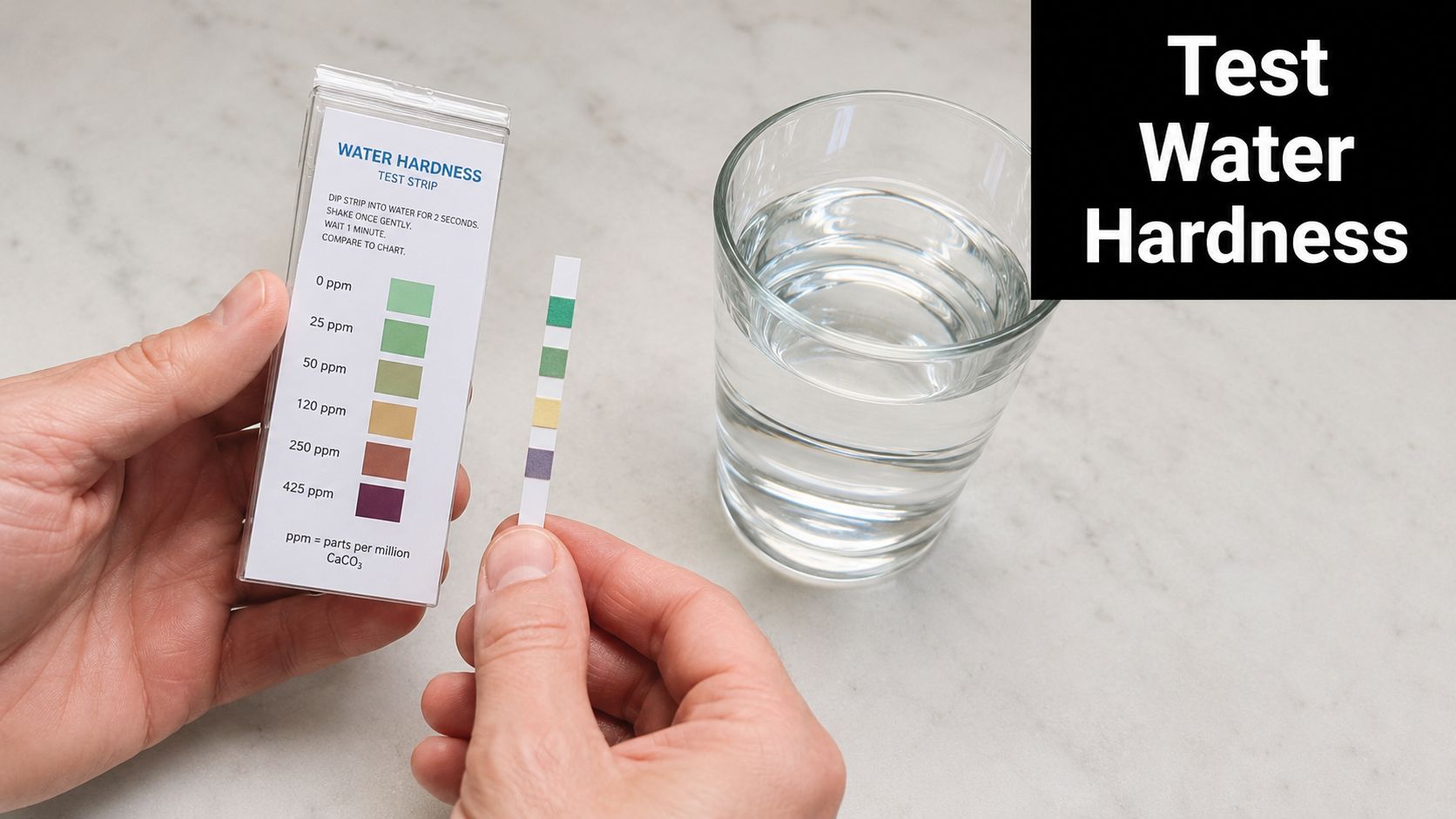
Test strips are the fastest option. Dip the strip, wait for the specified time, and compare the color to a chart. For a homeowner who just wants to confirm whether spots and scale are likely being caused by hard water, that can be enough.
Their weakness is resolution. A strip usually gives you a range, not a precise number. That's fine for screening. It's less useful when you need to know whether your water is sitting near one treatment threshold or another.
Drop-count titration kits are where things get more practical. The most precise and actionable method for home testing is EDTA-based drop-count titration, which yields a quantitative value with higher resolution and helps homeowners distinguish between readings like 150 mg/L and 200 mg/L, a critical distinction when programming a water softener, as explained by Hach's hardness testing guidance.
In plain terms, you add reagent drops to a measured water sample until the color changes. The drop count corresponds to hardness. It takes a little more attention than a strip, but the result is much more useful.
If you're deciding whether you merely have hard water or you need to set up treatment accurately, a strip confirms the suspicion. A titration kit gives you a number you can work with.
Digital meters sound appealing because they feel more advanced, but most homeowners don't need them for a one-time or occasional hardness check. They can be useful in the right hands, but they also add cost, setup, and maintenance. If someone isn't already comfortable with water testing instruments, a good titration kit is often the better fit.
Which kit makes sense for most homeowners
For most homes in Central Florida, this is the practical breakdown:
- Choose strips if you want a fast yes-or-no screening result.
- Choose a titration kit if you want to make treatment decisions based on a real number.
- Skip the digital meter unless you already know why you need one and are prepared to use it correctly.
There's also an accuracy ceiling for any DIY option. When a result is close to a threshold that affects treatment choices, lab analysis still carries more weight than any home kit. But for everyday diagnosis, the right water hardness test kit can get you much closer to the truth than guessing based on spots alone.
How to Use Your Water Hardness Test Kit Correctly
A good kit can still give you a bad result if the sample is sloppy or the timing is off. Most testing mistakes happen before the strip changes color or before the first titration drop goes into the vial.
Start with a clean container, use cold water from the tap you want to evaluate, and follow the kit's instructions exactly. That last part matters more than people think.
Using test strips
Test strips are simple, but the details matter.
- Use a clean glass or cup. If there's soap residue or leftover minerals in the container, your reading can be skewed.
- Collect fresh tap water. Don't use water that has been sitting out.
- Dip the strip as directed. Some strips need a quick dip. Others need a short soak.
- Wait the exact time listed by the manufacturer. Reading too early or too late is one of the most common errors.
- Compare the strip to the color chart in good light. Natural light helps. Dim kitchen lighting often doesn't.
A strip is best treated as a screening tool. If the color lands between two blocks, don't pretend it's more precise than it is. That's a sign to move up to a better test method if you need a firmer answer.
Using a drop-count titration kit
A titration kit takes longer, but it's still manageable for a homeowner.
- Fill the test vial to the marked line. The sample volume has to be right.
- Add the indicator if the kit requires it. Swirl gently.
- Add titrant one drop at a time. Count every drop carefully.
- Swirl after each drop. Don't rush the endpoint.
- Stop at the first permanent color change. That's your endpoint, not the color after several extra drops.
- Convert the drop count using the kit instructions. That gives you the hardness result.
EDTA-based kits are useful because they provide a real measurement of total hardness as calcium carbonate. That makes the result much easier to apply in treatment planning than a broad strip range.
A titration test rewards patience. If you rush the endpoint, you'll usually overcount and think the water is harder than it really is.
Common mistakes to avoid
A few habits cause more bad readings than anything else:
- Using a dirty container: Residue from soap, coffee, or old mineral deposits contaminates the sample.
- Testing hot water: Use cold water unless the kit specifically says otherwise.
- Ignoring wait times: Strips need the correct development time. Guessing ruins the reading.
- Reading colors under poor lighting: Yellow kitchen bulbs can make matching a chart harder than it should be.
- Adding extra drops “just to be sure”: In titration, the first stable color change is the endpoint.
- Testing after a treatment device without noting it: Make sure you know whether you're testing raw water, softened water, or water after filtration.
If your result looks odd, test again. Two careful readings that line up are far more useful than one rushed result you don't trust.
Interpreting Your Results in Central Florida
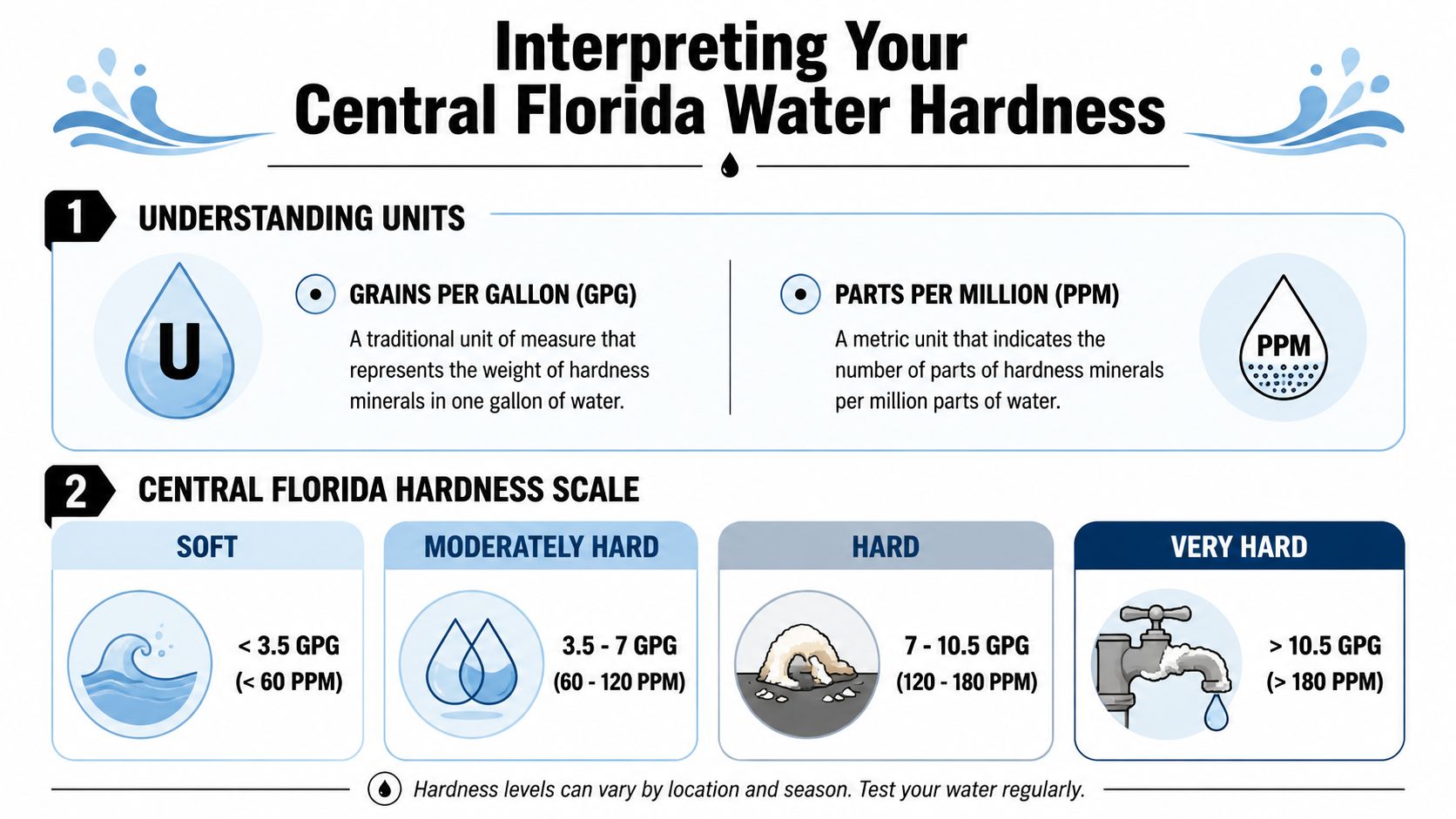
A number by itself doesn't help much. You need context. In water testing, hardness is commonly discussed in mg/L as calcium carbonate and in grains per gallon (GPG). Homeowners often see both units depending on the kit, the service company, or the treatment equipment.
For Central Florida homes, understanding the category matters because local water often lands in the hard or very hard range.
Understanding the numbers
The U.S. Geological Survey classifies water as soft from 0 to 60 mg/L, moderately hard from 61 to 120 mg/L, hard from 121 to 180 mg/L, and very hard above 180 mg/L, as outlined in the USGS hardness classification guide.
That scale is useful because it gives you a plain-language meaning behind the test result. If your kit reports in GPG, many homeowners also compare that reading to treatment equipment settings. Around Central Florida, that's where the local context starts to matter.
What those results mean in local homes
According to the same USGS benchmark, water is considered very hard above 180 mg/L, or 10.5 GPG, and many Central Florida water sources exceed that threshold. In real homes, that often shows up as visible scale, white residue on fixtures, and trouble in water heaters and similar appliances. For a closer look at what those ranges mean locally, this guide to Central Florida water hardness levels gives homeowners helpful regional context.
Here's the practical way to read a result:
- Soft to moderately hard: You may notice fewer cleaning issues and less scale formation.
- Hard: Expect mineral residue, reduced soap performance, and growing scale inside fixtures and appliances.
- Very hard: Scale buildup isn't occasional anymore. It becomes a routine maintenance issue.
A homeowner in Sebring or Lake Wales who tests in the very hard range shouldn't treat that result as academic. It usually lines up with real wear on plumbing, fixtures, and water-using equipment.
For private well users, readings can be even more revealing because the hardness number may only be part of the story. A well may produce hard water and also carry iron, sulfur odor, or sediment. That's one reason a hardness reading is important, but not always the whole diagnosis.
If your result lands just over the line into hard water, your response may be different than if you're far into the very hard range. That's where precision starts to matter. A broad strip estimate can tell you there's a problem. A better number helps determine how aggressively you need to address it.
Choosing the Right Kit for Your Home or Well
The best water hardness test kit depends less on the product packaging and more on the kind of water supply you have. City water and private well water don't create the same testing priorities.
If you have city water
For most municipal-water homes, a hardness test is mainly about confirmation and planning. You're usually trying to answer a practical question: is the water hard enough to justify treatment, and if so, how much?
A strip can work if you only want a quick answer. A drop-count titration kit is better if you're serious about sizing or adjusting treatment equipment. For many homeowners, that extra precision is worth it because the result is more useful than a rough range.
Good fit for city water users:
- Basic strip kit: Best for quick screening when you suspect hard water.
- Titration kit: Better when you want an actionable result you can use for treatment decisions.
If you have a private well
Well owners should think broader. Approximately 43 million Americans rely on untreated private well water, and in Central Florida, well water hardness can average 250 to 300 mg/L while also carrying iron, sulfur, or sediment, which is why a more thorough approach is often needed, according to Persistence Market Research's water test kit market summary.
That doesn't mean a hardness kit isn't useful. It is. It tells you whether scale is one of your main problems. But if you're on a private well, don't assume hardness is the only issue just because it's the most obvious one.
A sensible approach for well owners looks like this:
- Start with hardness screening if scale, spotting, or soap issues are your main complaint.
- Pay attention to other symptoms like staining, odor, or visible particles.
- Move toward broader testing when the water has multiple signs of trouble.
For wells, a hardness kit is often the first page of the report, not the whole report.
Your Test Is Done What Are the Next Steps
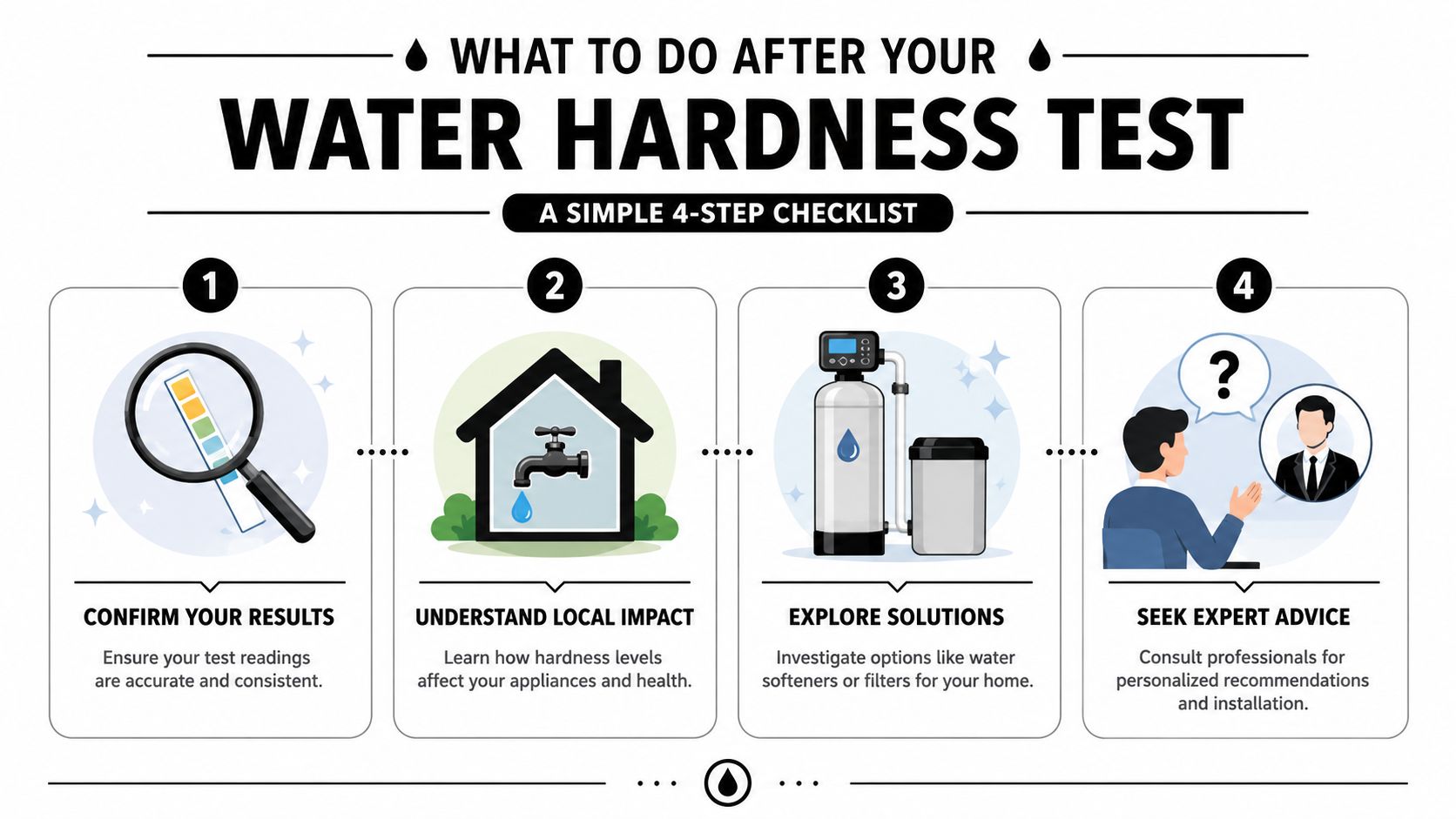
You ran the test because something in the house felt off. Glassware keeps spotting, the shower door hazes over, soap does not rinse clean, or your skin feels tight after a shower. Once you have a hardness result in hand, the next step is to turn that number into a practical decision for your Central Florida home.
Use the result to make a decision
A low to moderate reading usually means hardness is only part of the story. In that case, I would look at the full pattern in the house, including spotting, soap performance, staining, and whether the problem shows up at every tap or only in one area.
A hard or very hard result points more directly to treatment. In Central Florida, that often means scale is already building inside fixtures, on heating elements, and anywhere water evaporates regularly. If you are on city water, a softener may be the right next step. If you already have one, the test result can show that the unit needs adjustment, service, or resin and salt checks rather than replacement. Regular water softener maintenance is important since even a good system will lose performance if salt levels, settings, or cleaning are ignored.
Private well owners should read the number a little differently.
Hardness can explain crusty fixtures and poor soap lather, but it does not explain iron staining, sulfur odor, sediment, or tannin color. A hardness kit gives you one clear answer. It does not give you the whole water profile.
When a professional test makes sense
Home kits are useful for screening. They help confirm whether hard water is likely and whether your household complaints match the result. Before buying equipment, though, accuracy has real value. A tighter analysis helps size treatment correctly, especially if your home has a large family, high water use, a tankless water heater, or a private well with more than one water issue.
A home kit helps you confirm the problem. A professional test helps you choose the right fix.
That difference affects cost. Undersized equipment wears out faster and performs poorly. Oversized equipment adds expense you may not need. In Central Florida, where hardness levels can vary from one neighborhood or well to the next, local testing often clears up what an off-the-shelf kit cannot.
If your result shows hard water and the symptoms match, get a professional opinion before you commit to treatment. Florida Water Management offers free water testing for Central Florida homeowners and small businesses. Use the contact us page to schedule a no-obligation test and get a clearer picture of what is in your water.