

You know your softener is slipping before you ever touch the unit. Laundry starts feeling stiff again. Glassware comes out spotted. Soap stops lathering the way it should. In Central Florida, those little warnings usually mean the system isn't keeping up with the water coming into the house, not that hard water suddenly got worse overnight.
That matters here because generic advice often assumes city water and light mineral load. Around Sebring, Avon Park, Lake Wales, and nearby areas, a lot of homes are on private wells with iron, sulfur, and manganese in the mix. If you want to learn how to maintain a water softener in this part of Florida, the routine has to match local water conditions, not a national checklist written for somewhere else.
Table of Contents
- Why Central Florida Demands a Special Maintenance Plan
- Your Simple Routine Water Softener Checklist
- The Annual Deep Clean Your System Needs
- Choosing the Right Salt and Resin Cleaners
- Troubleshooting Common Florida Softener Problems
- Knowing When to Call a Water Softener Technician
Why Central Florida Demands a Special Maintenance Plan
A softener in Central Florida deals with more than hardness. Many homes, especially on private wells, are also pushing iron, sulfur, and manganese through the system. That changes maintenance from a simple “keep salt in the tank” routine to a more watchful process.
Most maintenance guides fail to address the specific resin-clogging risks of iron-rich well water common in Sebring and Avon Park. Over 60% of Florida's private wells contain high iron levels, which accelerates resin degradation if not treated with specific iron-removing cleaners and increased regeneration frequency, according to this Florida well water maintenance reference.
Why generic advice falls short
If you're on municipal water, the standard routine often gets you by. If you're on a private well, it often doesn't. Iron sticks to resin beads. Sulfur odor makes homeowners think the softener has failed when the issue may be upstream or happening alongside it. Manganese can foul media and leave dark staining even when the system still appears to be running.
That's why homeowners in this area need a maintenance plan built around actual local water conditions, not broad advice written for places with milder water profiles. If your home uses a treatment setup that has to handle more than hardness alone, it helps to understand how a whole-home water filtration system in Sebring fits into the bigger picture.
Practical rule: If your home is on a private well, never assume “the softener is fine because there's salt in the tank.” In this region, iron can foul a system long before the tank looks empty.
What local homeowners usually notice first
The first signs are familiar:
- Laundry changes fast: Towels feel rough and clothes don't rinse clean.
- Fixtures start spotting again: Sinks, shower glass, and faucets show film sooner.
- Soap performance drops: Shampoo, body wash, and dish soap stop behaving normally.
- Orange or brown staining appears: That often points to iron getting past the system.
A lot of people respond by adding more salt and hoping for the best. Sometimes that helps. Often it doesn't, because the issue is fouled resin, a salt bridge, or a system that needs more frequent attention than a generic schedule suggests.
Your Simple Routine Water Softener Checklist
Good maintenance is mostly habit. You don't need to hover over the unit, but you do need to look at it before the house starts telling you something is wrong.
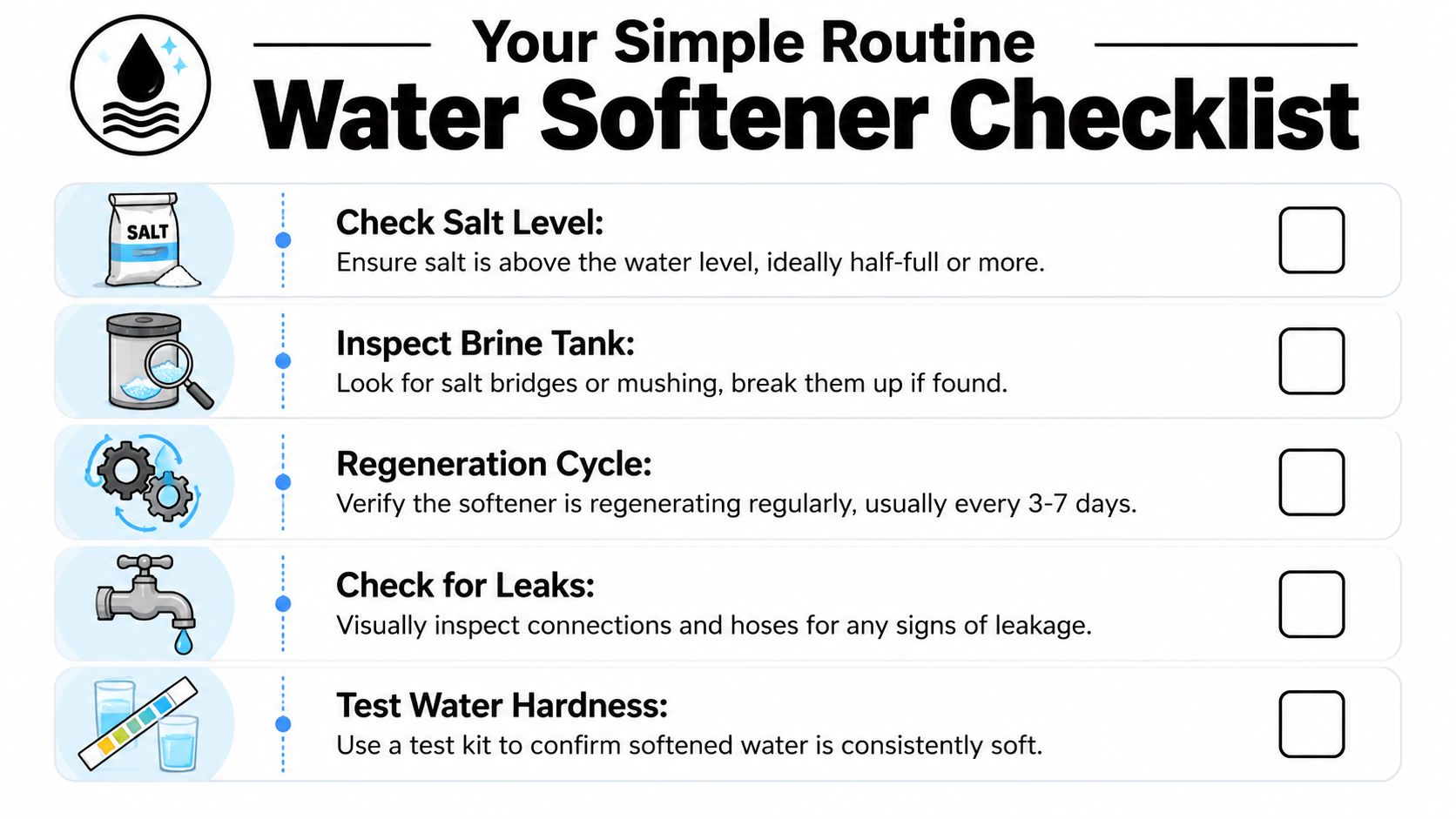
Water softener systems require checking the salt level every 4 to 6 weeks, and you shouldn't wait for scaling or cloudy laundry to tell you there's a problem. If the salt level drops below half the tank or visible water is uncovered, refill it right away to keep the resin beads regenerating properly, as explained in this water softener maintenance guidance.
What to check every few weeks
The easiest routine is a quick walk-through:
- Look at the salt level first: Keep salt above the water line. A half-full tank is a safe target for most homes.
- Check the surface of the salt: If the top looks hard, crusted, or hollow underneath, don't ignore it. That's often the start of a bridge.
- Listen to the unit occasionally: You don't need to stand there for a full cycle, but you should know whether regeneration sounds normal for your system.
- Inspect around the base and plumbing connections: A slow leak can waste water and cause control issues over time.
- Pay attention to water feel inside the house: If soap stops rinsing right or dishes start spotting, test the water instead of guessing.
If your water still feels hard after these checks, the smartest next move is to stop guessing and get a professional analysis. A lot of homeowners are surprised by how much better maintenance decisions get once they understand their actual water profile and the benefits of a home water softening system in relation to their plumbing, fixtures, and appliances.
Hard water symptoms are lagging indicators. By the time you feel them in the shower or see them on faucets, the softener has usually been underperforming for a while.
Water softener maintenance schedule
| Frequency | Task | Why It Matters |
|---|---|---|
| Every 4 to 6 weeks | Check salt level | Keeps the brine tank ready to regenerate resin properly |
| Every 4 to 6 weeks | Inspect for crusting or mush | Catches salt bridging and mushing before performance drops |
| Every 4 to 6 weeks | Look for leaks | Prevents wasted water and damage around the unit |
| Periodically | Confirm the unit is regenerating normally | Helps you catch timer, valve, or setup problems early |
| As needed | Test water hardness if performance seems off | Verifies whether the system is actually softening |
What works and what doesn't
What works is a short, repeatable routine. Open the lid. Look inside. Check the salt condition. Notice whether the water in the home feels different.
What doesn't work is waiting until the unit is nearly empty, dumping in several bags, and assuming that solved it. That approach often creates mushing, hides bridges, and delays the proper fix.
The Annual Deep Clean Your System Needs
Routine checks keep a softener running. The annual deep clean is what keeps the brine tank from turning into a sludge container.
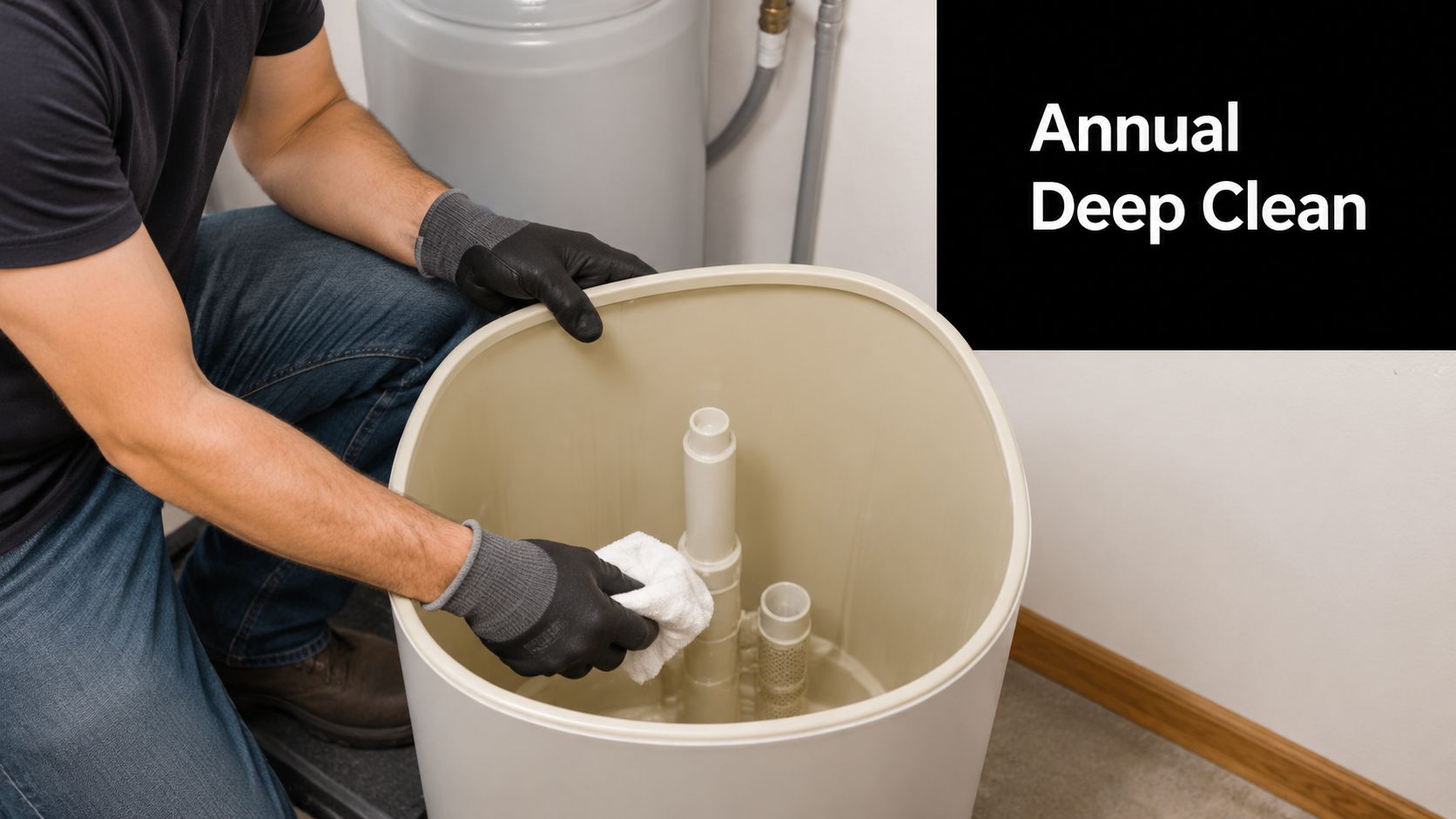
The most effective annual brine tank cleaning is straightforward when you do it in order. A systematic annual brine tank deep-clean protocol has a 95% success rate in preventing resin bead fouling. The process uses a 1:30 bleach-to-water solution, followed by a full rinse, drying, and refilling with high-purity salt to halfway up the tank and 2 to 3 inches above the water line.
How to clean the brine tank without making a mess of the system
Start by putting the unit in bypass so the tank is isolated. Then disconnect power if your system setup calls for it. Remove the old salt, scoop out the remaining water, and clear the bottom so you can scrub the tank walls and floor.
Use a stiff-bristle brush and a bleach solution mixed at 1:30. Scrub the interior thoroughly, especially corners and any sludge line near the bottom. After that, rinse until there's no bleach residue left, and let the tank and brine components dry before reassembling.
Then refill the tank with clean water and high-purity pellet salt. Keep the fill level sensible. A tank packed too high is harder to inspect and more likely to develop mushing in Florida humidity.
Don't rush the rinse. Leftover cleaner inside the tank causes its own problems.
What people get wrong
A lot of homeowners skip the deep clean because the tank “still has salt in it.” That's exactly how sludge builds up. The tank can look full and still be dirty enough to interfere with proper brine production.
The other mistake is using whatever salt is available and overfilling the tank. In our climate, too much salt sitting too long encourages wet clumping at the bottom. Once that happens, the system may appear loaded with salt while producing weak brine.
If the idea of bleach in the tank makes you nervous, keep the process simple. Scrub, rinse thoroughly, and let the tank dry. Clean work matters more than aggressive chemistry.
Choosing the Right Salt and Resin Cleaners
Not all maintenance products help equally. In Central Florida, the wrong salt and no resin cleaner is one of the fastest ways to shorten the useful life of a softener.
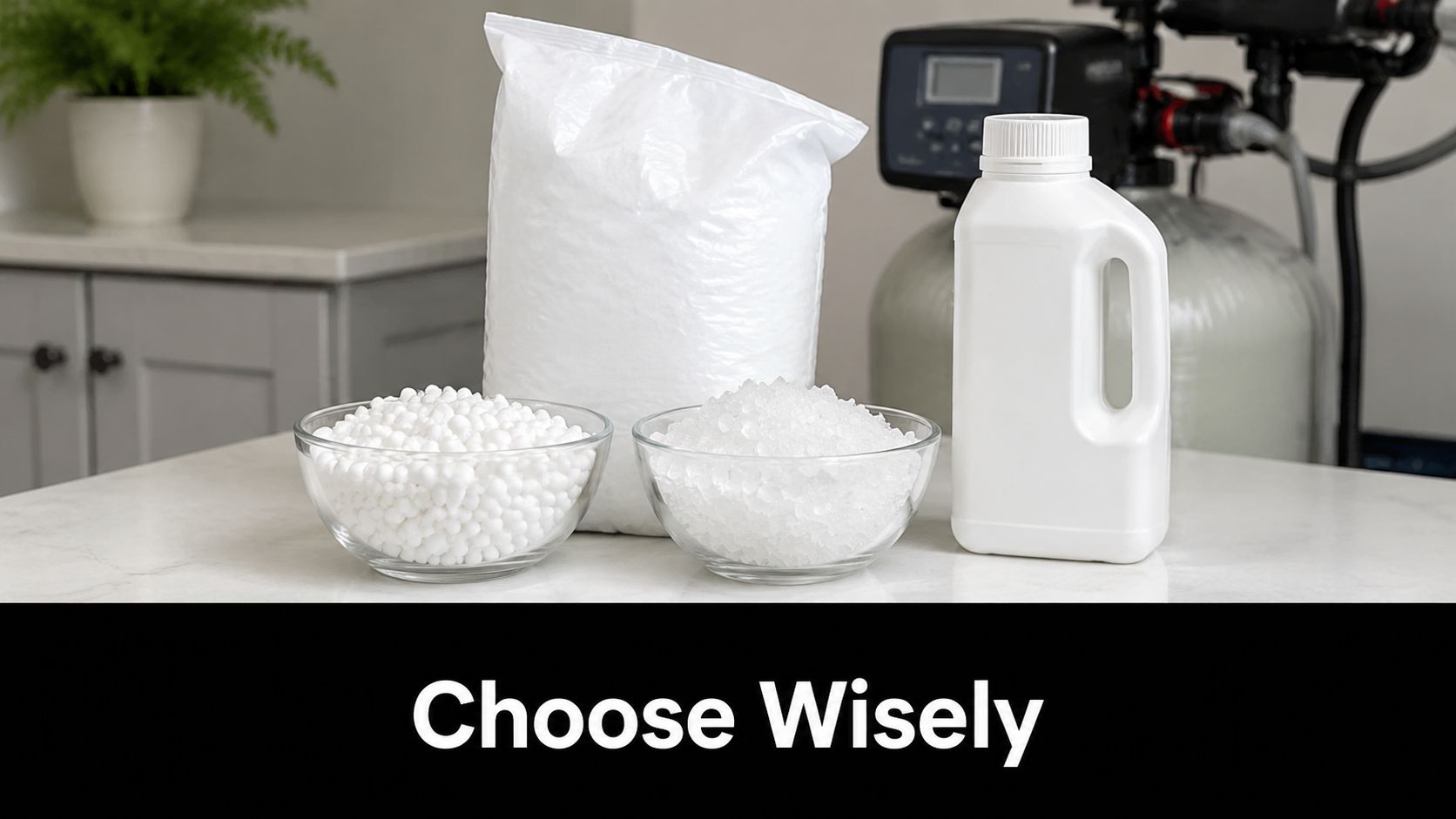
Salt choice affects more than convenience
High-purity pellet salt is usually the safer choice here because it leaves less residue and is less likely to create mush in a humid garage or utility room. The verified guidance for deep cleaning also calls for high-purity salt pellets at 99.9% purity, with the tank refilled to a moderate level rather than packed full.
That matches what works in the field. Cleaner pellets usually mean less sludge at the bottom of the brine tank, fewer crusting problems, and easier visual checks. Lower-quality salt can still dissolve, but it tends to leave more residue behind and makes maintenance less predictable.
There's also an efficiency angle. Single-tank systems can use up to 30% more salt than twin-tank models, while twin-tank systems can reduce salt usage by about 30% treating the same volume of water. That can save an average household $100 to $150 annually in salt costs alone, based on the verified industry testing data provided. If your system is older or undersized, salt choice helps, but design still matters.
Resin cleaner matters on well water
For households with water containing iron or manganese, a specialized resin cleaner must be added to the brine tank every few months, followed by a manual regeneration cycle to flush out mineral deposits from the resin beads and restore ion exchange performance, according to this resin cleaner maintenance guidance.
This is the step many national guides skip, and it's the one Central Florida well owners can't afford to miss. Salt handles regeneration chemistry. It does not remove stubborn iron fouling by itself. If iron coats the resin, the system can keep cycling and still deliver poor results.
A practical way to view it:
- Salt keeps the softener operating
- Resin cleaner helps restore performance on iron-heavy water
- Using only salt on well water often isn't enough
If you're seeing orange staining and adding more salt doesn't change anything, stop blaming the salt level. The resin may be fouled.
Troubleshooting Common Florida Softener Problems
Most softener problems in this part of Florida show up the same few ways. The trick is reading the symptom correctly before you start replacing parts or dumping in more salt.
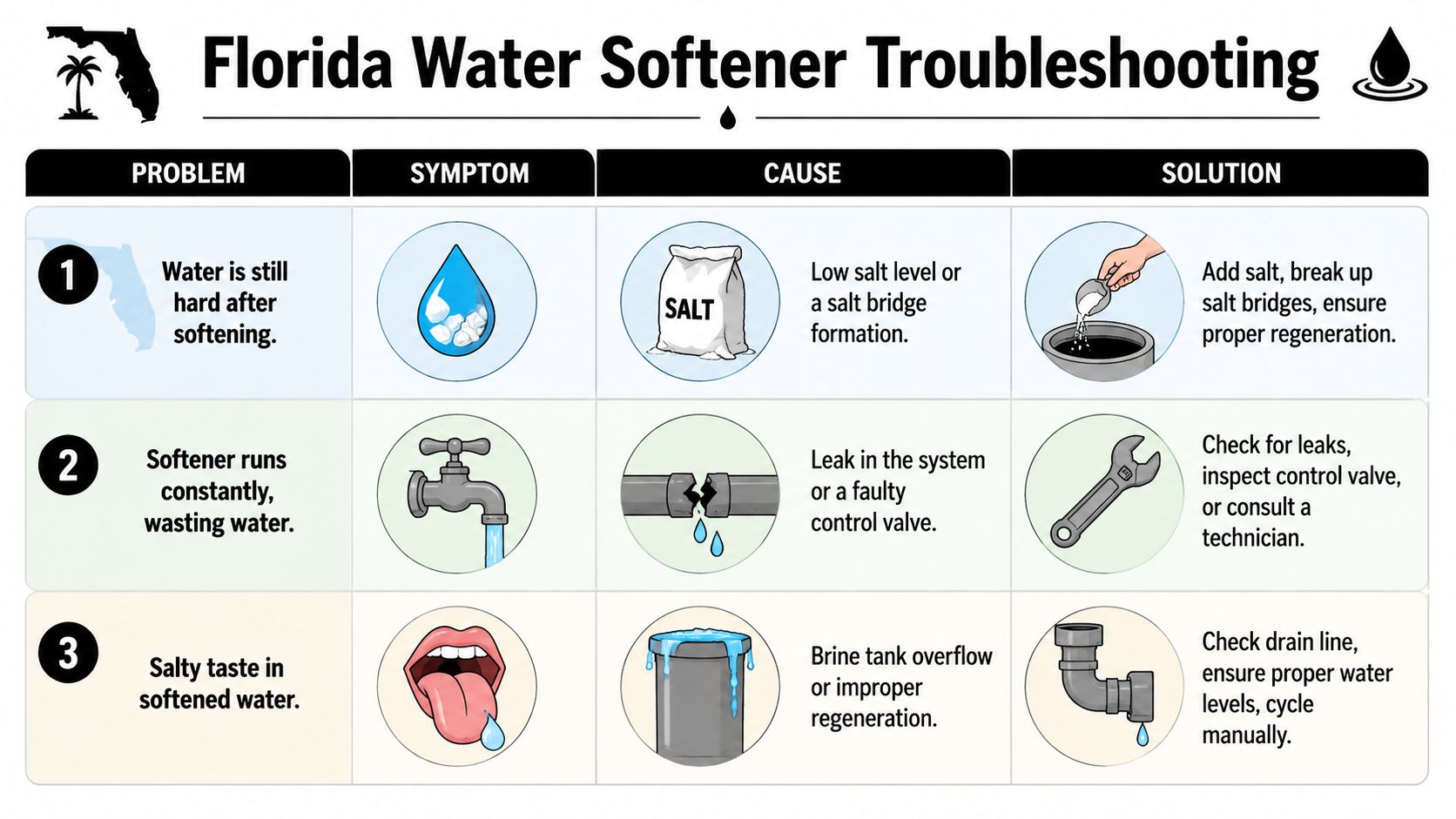
When the water feels hard again
If showers feel different, dishes spot quickly, and laundry gets rough, check the easy causes first. Low salt is still common. So is a regeneration issue. A leak or control problem can also keep the unit from cycling the way it should.
Start with a simple homeowner inspection:
- Open the brine tank: Confirm there's enough salt and that the top surface isn't crusted over.
- Look for standing issues around the unit: Wet fittings, drips, or drain line problems can point to a mechanical fault.
- Notice the timing of the problem: If hardness returns suddenly after normal performance, a bridge or regeneration interruption is more likely than gradual resin wear.
When Florida humidity causes trouble in the tank
Salt bridges are a Florida classic. The surface hardens into a crust while the space underneath empties out. The tank looks full from above, but the softener can't make proper brine.
To check for one, use the broom handle test. Insert the handle gently into the salt. If it hits a hard layer or feels hollow beneath the crust, you've got a bridge. To remediate salt bridges, gently tap the hardened crust with a broom handle and scoop out any mush from the bottom, because that mush can reduce brine concentration by up to 40% and cause false regeneration cycles.
The broader verified data is even more revealing. In humid regions like Florida, 60% to 70% of households experience salt bridges annually. Overfilling increases bridge formation risk by 50%. Untreated bridge problems can lead to hard water returning within weeks, and neglected systems show a 45% failure rate in that context. That's why a quick monthly tank check pays off.
A full-looking tank can still be functionally empty if the salt has bridged over.
When staining or odor points to raw water issues
Orange or brown staining usually points to iron getting through. On private well water, that may mean the resin needs cleaning or the system is dealing with more iron than a basic maintenance routine can handle.
A sulfur smell is different. The softener may not be the root cause at all. If the incoming water has a rotten-egg odor, the answer often involves the overall treatment setup, not just the softener tank. Homeowners get into trouble when they treat every smell, stain, and texture change as a salt problem.
Here's a simple field guide:
| Symptom | Likely cause | First response |
|---|---|---|
| Hard water feel | Low salt, bridge, failed regeneration | Check tank condition and regeneration behavior |
| Orange or brown stains | Iron fouling or iron bypass | Use the proper resin cleaner routine and evaluate raw water load |
| Mush in tank bottom | Humidity, poor salt choice, overfilling | Remove mush and refill with high-purity pellets |
| Sulfur odor | Source water issue or treatment gap | Check the broader water treatment setup |
If the same symptom returns quickly after you fix the obvious issue, stop repeating the same DIY step. Recurring problems usually mean the softener is reacting to the water quality profile, not just a missed refill.
Knowing When to Call a Water Softener Technician
DIY maintenance has limits. Salt checks, bridge removal, and brine tank cleaning are reasonable homeowner jobs. Internal valve issues, control head failures, and persistent performance problems usually aren't.
With proper maintenance, including annual professional check-ups to service internal components, most water softeners are designed to operate effectively for 10 to 15 years. In very hard water regions like Central Florida, professional service can extend that life by up to 20%.
Problems that usually need a pro
Call a technician when you notice any of these:
- The water stays hard after you've handled the basics: If the tank has salt, there's no bridge, and the problem continues, the issue may be internal.
- The control head shows errors or behaves unpredictably: Electronic faults and programming issues aren't guesswork jobs.
- The unit runs constantly or drains improperly: That often points to valve, seal, or control trouble.
- You see repeated staining despite maintenance: That can mean resin fouling, raw water changes, or system mismatch.
- Your setup is on a private well with multiple contaminants: At that point, maintenance and system design overlap.
Why service is cheaper than waiting
Softener problems usually start small. Weak regeneration, partial fouling, and minor leaks are easier to correct before they turn into failed resin, damaged valves, or a system replacement conversation.
If you're already weighing repair versus replacement, it helps to understand what a properly sized and configured water softener installation in Lake Wales should do in local water conditions. That gives you a better baseline for deciding whether your current system needs service or has reached the end of its useful life.
If your water softener isn't keeping up, or you want to know exactly what's in your water before you spend money on salt, cleaners, or repairs, schedule a free water test with Florida Water Management through the contact us page. It's the fastest way to find out whether you're dealing with hardness alone or the added iron, sulfur, and manganese issues that are common in Central Florida homes and private wells.