

If your shower's pressure has been sagging, the dishwasher leaves cloudy spots again, and the water heater seems to groan a little louder every month, you're probably not dealing with random bad luck. In Central Florida, those annoyances often point to scale buildup in pipes, the same mineral deposit that slowly narrows plumbing, coats heating surfaces, and makes appliances work harder than they should.
The frustrating part is that scale usually hides where you can't see it. A faucet scrub or a vinegar soak may make the sink look better for a day, but the damage keeps happening inside the lines, inside the water heater, and inside every hot-water branch that runs through the house.
Table of Contents
- Is Your Plumbing Secretly Clogging Up
- What Causes Scale Buildup in Your Pipes
- Recognizing the Telltale Signs of Scale Buildup
- Why DIY Scale Removal Methods Fall Short
- Choosing Your Solution Professional Descaling vs Water Treatment
- The Ultimate Solution Preventing Scale Before It Starts
- Take Control of Your Central Florida Water Quality
Is Your Plumbing Secretly Clogging Up
The first clue is usually subtle. Water still comes out of the tap, but it doesn't feel the same, the shower takes longer to rinse soap away, and a glass of water leaves a chalky ring behind after it dries. In a Central Florida home, that slow change often comes from lime scale, the calcium carbonate deposit the USGS identifies as forming when hard water is heated, especially in water heaters and hot-water lines (USGS).
A homeowner usually notices the symptoms before they connect the cause. The pressure drops a little at first, then appliances start behaving inconsistently, and the water heater begins to lose efficiency long before it stops working altogether. That's why scale buildup in pipes feels sneaky, it doesn't fail all at once, it just keeps stealing performance in small increments.
Practical rule: if hot water seems weaker than cold water, scale is often part of the story.
Central Florida makes this issue especially common because hard water is normal across much of the region's limestone-rich groundwater profile. The Water Quality Association defines soft water as less than 1 grain per gallon, or less than 17.1 mg/L, of hardness, and it notes that hardness-related scale affects fixtures and appliances throughout the whole home or business (Water Quality Association reference in verified data). That's why one sink or one shower rarely tells the whole story.
A quick clue is location. If the hottest fixtures, the water heater, and the longest plumbing runs show trouble first, you're looking at a systemic issue, not a single dirty aerator. That distinction matters, because the fix for a visible stain is not the same as the fix for mineral buildup inside the plumbing system.
What Causes Scale Buildup in Your Pipes
Scale starts when dissolved minerals, mainly calcium and magnesium, stop staying in solution and begin attaching to pipe walls, heaters, and fixtures. In Central Florida, that process gets a steady push from the limestone-rich aquifer, so hard water is not a random annoyance. It is a predictable part of the plumbing conditions many homes live with every day.
Hard water behaves like cholesterol for your pipes
Hard water acts like cholesterol for your pipes. It does not block flow overnight, but it leaves behind a narrowing layer that keeps growing as more mineral deposits stick to the inside of the system. Water quality professionals use the Langelier Saturation Index, or LSI, to estimate whether water is likely to deposit calcium carbonate scale. The calculation looks at pH, alkalinity, calcium concentration, temperature, and total dissolved solids (USGS guidance on lime scale formation in water pipes).
That matters because scale risk is tied to chemistry, not luck. A pH below 6.5 is associated with corrosive conditions, while values above the normal operating range can point to higher scaling risk. Technicians do not guess at the cause. We test the water, read the numbers, and decide whether the problem is scale, corrosion, or a mix of both.
Why heat makes the problem worse
Heat speeds up precipitation, which is why the hot-water side usually shows trouble first. A water heater, tankless unit, or recirculation loop often shows scale before the rest of the house does, even when cold water still seems normal. For a Central Florida homeowner, that pattern is a warning sign, because the minerals are settling where the water gets hottest and stays there longest.
The chemistry behind that buildup is easier to understand once you know your home's hardness level. A local test gives a much clearer picture than judging only by soap scum or spots on dishes, and a hardness-level explanation can help you interpret what the numbers mean in everyday plumbing terms.
Scale is easiest to control before it coats the system. Once mineral layers begin lining the pipes, the damage shows up in flow, efficiency, and appliance wear, and the fix has to address the whole water supply, not just the visible residue.
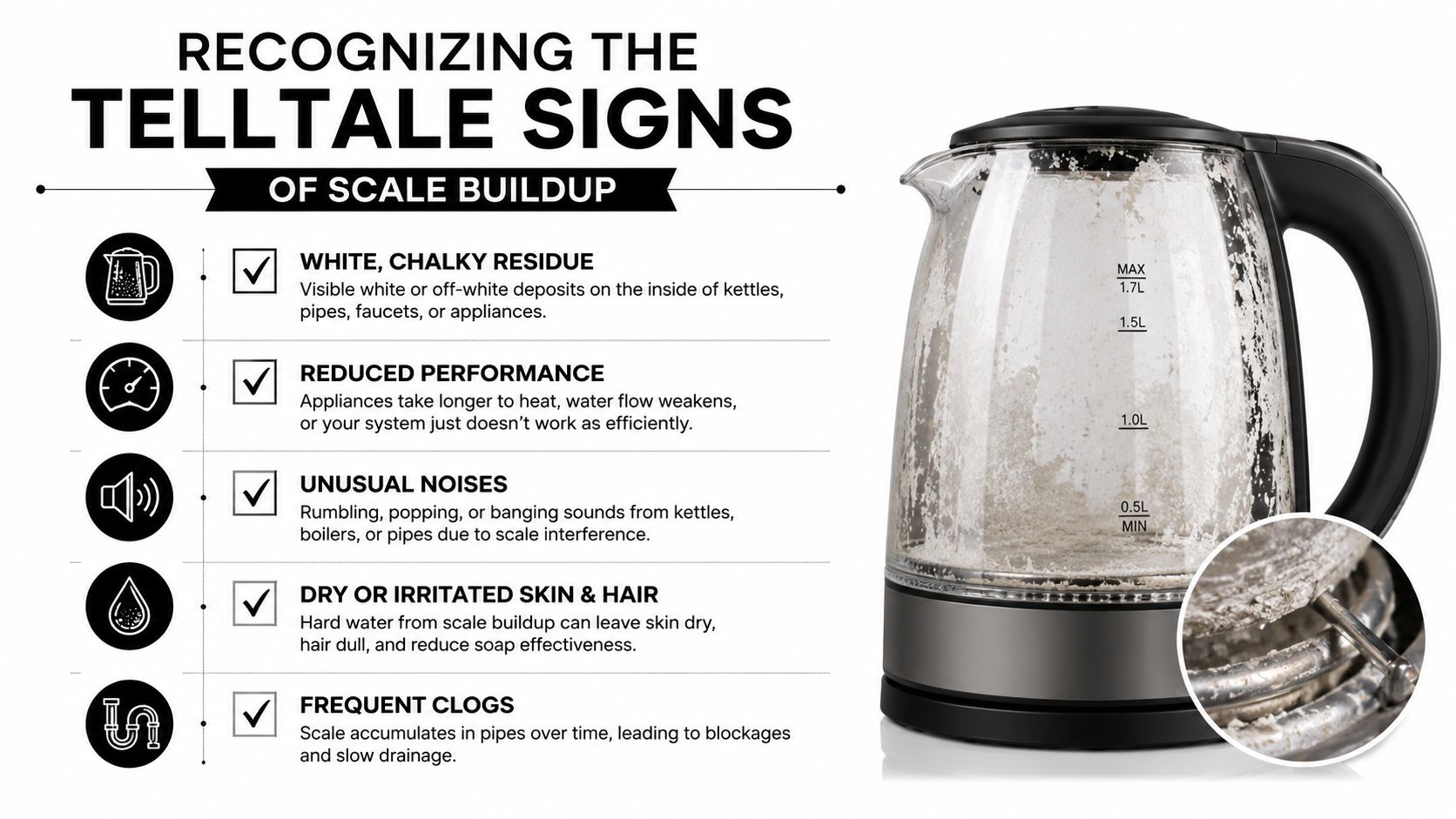
Recognizing the Telltale Signs of Scale Buildup
The obvious signs show up on faucets and shower glass, but those are the least expensive symptoms. The costly ones are deeper in the system, where mineral deposits restrict flow, trap heat, and shorten equipment life.
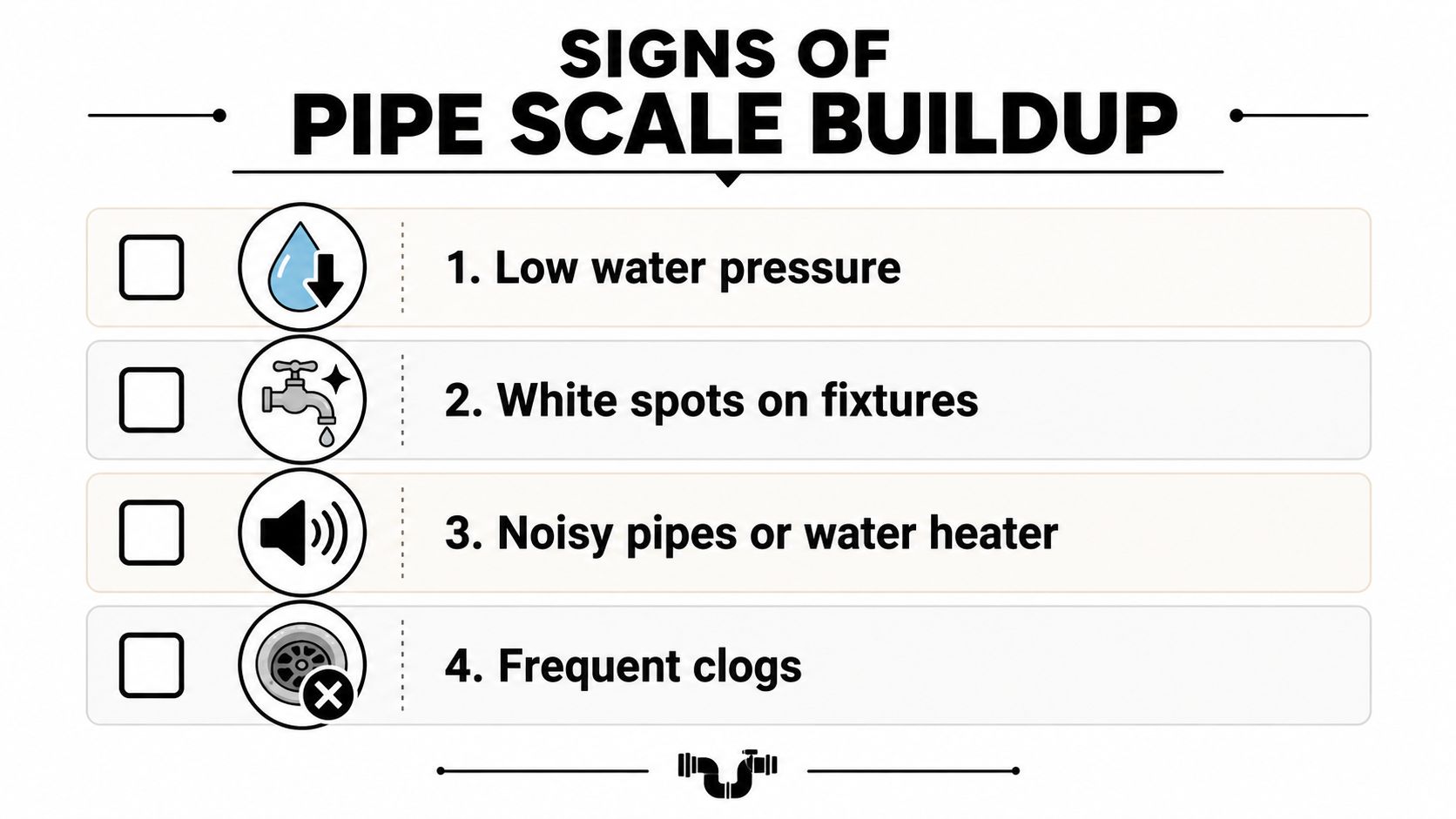
A useful diagnostic list starts with everyday complaints:
- Lower pressure at multiple fixtures. If several taps feel weak, the pipe network may be narrowing from the inside.
- White spotting on fixtures. Those deposits are often the visible residue of the same water chemistry that's coating the plumbing.
- Noisy water heater behavior. Rumbling or kettling sounds often mean the heater is working through mineral accumulation.
- Repeated clogs or sluggish drains. Scale can contribute to restricted flow and persistent maintenance calls.
The pressure problem can become severe. According to studies referenced by the American Water Works Association, significant mineral deposits can reduce a pipe's flow by 40% or more, and in very hard water areas that level of pressure loss can show up in as little as 5 to 7 years, mainly in hot-water lines first (Crystal Quest summary of AWWA-referenced studies). Another independent report says scale buildup in pipes can reduce water flow by up to 75% in half-inch pipes within five years in very hard water conditions.
That's why a fixture that “just feels a little weak” deserves attention. Scale doesn't need to cause a total shutdown to be expensive, it only has to make pumps, heaters, and fixtures work harder every day.
Why DIY Scale Removal Methods Fall Short
A vinegar soak can clean a showerhead. It can even make a faucet aerator look new again. What it can't do is reach the hidden surfaces inside a wall, inside a water heater tank, or through the full length of a branch line where scale is doing the damage.
Surface cleaning fixes the symptom, not the plumbing
That's the big gap most homeowners run into. A scrubbed fixture looks better, but the system can still be full of mineral deposits. One practical guide to hard-water buildup makes the same distinction clearly, visible cleaning is easy, while internal buildup is the part that needs a whole-home solution (American Discount Plumbing).
The difference matters because the most expensive parts of the plumbing are the ones you don't see every day. A water heater, for example, can keep running while scale cuts into efficiency and raises stress on internal surfaces. That's also why surface-only treatment feels satisfying but doesn't solve the underlying water chemistry.
Why the quick fix cycle gets old fast
DIY methods are best understood as maintenance for visible residue, not prevention for the whole house. They can help with:
- Faucet buildup. Good for the part you can reach.
- Showerhead spotting. Useful when the issue is cosmetic.
- Occasional fixture cleaning. Fine for appearance, not for pipe protection.
But they don't change the water flowing through the system. For that reason, they're temporary tools, not a complete strategy. If you want a closer look at what removable deposits are and how technicians think about them, this calcium buildup removal overview gives a practical starting point.
Bottom line: if the mineral source stays in the water, the problem keeps coming back.
Choosing Your Solution Professional Descaling vs Water Treatment
Professional descaling and whole-home treatment solve different problems. Descaling removes what's already attached, while water treatment changes the water so new scale doesn't keep forming in the first place.
Reactive cleaning has a place, but it's not a finish line
Mechanical or chemical descaling can be useful when a system already has stubborn buildup. It can restore some performance, especially in accessible equipment, and in the right hands it's a legitimate repair approach. But it's still a reactive service, which means you're cleaning after the damage has started.
That's why water chemistry has to drive the decision. Authoritative guidance recommends laboratory testing to assess risk and emphasizes that point-of-entry treatment is the only way to protect the entire plumbing system, especially in hard-water regions or homes on well water (MyTapScore). If only one tap is treated, the rest of the house keeps taking the hit.
Whole-home treatment protects every branch line
A whole-home system is different because it treats the water before it enters the plumbing network. That means every shower, toilet, washer, dishwasher, and water heater benefits from the same corrected water chemistry. For Central Florida homeowners, that's the practical advantage, the fix follows the water everywhere.
A salt-free conditioner overview can help homeowners compare options, but the key question is always the same, does the solution prevent new scale in the pipes, or does it only make the water feel different at one fixture? That's the line between a partial improvement and real protection.
Professional descaling still has a role when scale already exists. The smarter long-term plan is to pair cleanup with prevention so the system isn't forced into repeated restoration cycles. That approach protects plumbing, reduces repeat service calls, and gives appliances a better operating environment.
The Ultimate Solution Preventing Scale Before It Starts
The strongest prevention strategy is changing the water before minerals have a chance to precipitate. That's why a properly sized water softener sits at the center of most whole-home scale control plans in hard-water areas.
Why softening works at the source
The core idea is simple. Water softening removes calcium and magnesium upstream, so those minerals don't enter the plumbing in the same form that creates scale. Industry guidance describes this as the highest-impact preventive move, because once scale is attached, removal is always harder and costlier than stopping it from forming in the first place (Fossil Consulting).
That preventive logic has everyday consequences. A water heater coated in scale has to fight through an insulating layer before it can transfer heat efficiently. Appliances that run on hard water tend to wear faster, and detergent doesn't work as cleanly when mineral content stays high. Soft water doesn't just protect pipes, it improves how the whole house operates.
The benefits homeowners actually notice
The payoff shows up in small, repeatable ways:
- Cleaner-running appliances. Dishwashers and washers work in better water and stay in service longer.
- More efficient water heating. Less internal insulation means less wasted effort from the heater.
- Less soap and detergent struggle. Soft water rinses cleaner and leaves less residue behind.
- Better comfort in bathing and cleaning. People often notice the feel of the water before they understand the chemistry.
If you're trying to think about value, that's the calculation. You're not just buying softer water, you're protecting the hidden infrastructure that costs far more to replace than it does to treat correctly from the start.
Preventing scale is almost always cheaper than chasing it after it has already attached to the plumbing.
Take Control of Your Central Florida Water Quality
Scale buildup in pipes is a plumbing problem, but it starts as a water chemistry problem. That's why the right response isn't more scrubbing on the outside of the faucet, it's a plan that protects the plumbing on the inside.
Central Florida homes are especially vulnerable because hard water keeps feeding the same cycle, mineral deposits form, hot-water lines take the first hit, and appliances slowly lose efficiency. Visible cleaning has a place, but it doesn't stop the internal buildup that does the expensive damage. A whole-home solution does.
If your pressure has changed, your fixtures won't stay clean, or your water heater is making you suspicious, don't guess at the cause. A proper water test gives you the hardness profile and the scale risk you need to choose the right fix instead of another short-lived workaround.
Florida Water Management can test your water, explain what the numbers mean, and recommend a whole-home solution that fits the way your house uses water. If you're in Central Florida and want straight answers about hard water, scale, and protection for your plumbing and appliances, visit Florida Water Management to schedule your free water test and get a custom recommendation.