

Your water may look clear in the glass and still be giving you warnings everywhere else in the house. In Central Florida, that usually starts with the little things. A faint rotten-egg smell when the shower turns on. Rust-colored staining in the toilet bowl. White scale on fixtures. Laundry that comes out stiff. Coffee that tastes off even when you buy good beans.
Homeowners in Sebring, Lake Wales, Winter Haven, Lakeland, and nearby communities often assume one problem means one fix. It usually doesn't. Sulfur odor points in one direction. Hard water points in another. Iron, sediment, plumbing corrosion, and well-related contamination each need a different response. The mistake I see most often is treating symptoms before identifying the actual water profile.
That matters because contamination isn't only a big-city or industrial problem. Globally, 44% of all wastewater returns to the environment untreated, which means pollutants can make their way back into rivers and groundwater unless treatment and reuse improve at scale, according to this UN-Water summary reported by DevelopmentAid. For Central Florida homeowners, the practical takeaway is simple. Source water can pick up contaminants long before it reaches your faucet, especially if you're on a private well.
The good news is that clean, dependable water is a fixable problem when you stop guessing and start with the right test.
Table of Contents
- Is Your Water As Clean As It Looks
- Identifying Your Specific Water Contaminants
- Choosing the Right Water Treatment System
- How to Protect Your Private Well Source
- Maintaining Your System for Long-Term Safety
- Take Control of Your Home's Water Quality Today
Is Your Water As Clean As It Looks
A homeowner calls because the kitchen sink has orange staining and the guest bathroom smells odd in the morning. They think the problem is the faucet. Then they mention the dishwasher leaves spots, the water heater seems to struggle, and the family drinks bottled water because nobody trusts the tap. That's a familiar Central Florida pattern.
In this part of the state, water issues often show up as a mix of nuisance problems and real contamination concerns. Hard water leaves scale on shower doors and shortens the life of appliances. Sulfur can make water smell like rotten eggs. Iron can stain fixtures and laundry. Sediment can clog fixtures and wear down valves. If the home uses a private well, there can also be questions about bacteria, runoff, septic influence, or changes in groundwater conditions after heavy rain.
Clear water can still have a problem
The hardest part for most homeowners is that appearance alone doesn't settle anything. Water can be cloudy and harmless in one case, then look perfectly clean and still need treatment in another. Taste and odor help, but they don't tell the full story either.
Clear water isn't the same as clean water. A lot of the most important water decisions get made before a contaminant is visible.
That's why generic advice falls short in Central Florida. A charcoal pitcher won't solve hard water. A softener won't disinfect unsafe well water. A single cartridge filter won't fix every issue coming into the house. If you don't identify the source and type of problem first, you can spend money and still dislike your water.
Start with the water, not the product
A practical homeowner approach is to treat water quality like any other house system. Diagnose first. Then choose the right equipment. Then keep it maintained. That's how you reduce water contamination without overbuying, under-treating, or chasing symptoms one room at a time.
If your water smells off, tastes off, stains surfaces, or leaves buildup, that's enough reason to act. The first step isn't guessing between products at the hardware store. It's getting a professional water test so the treatment matches what your home is dealing with.
Identifying Your Specific Water Contaminants
The fastest way to make a bad water decision is to treat every water problem like it's the same problem. In Central Florida, the clues are usually right in front of you, but they have to be read correctly.
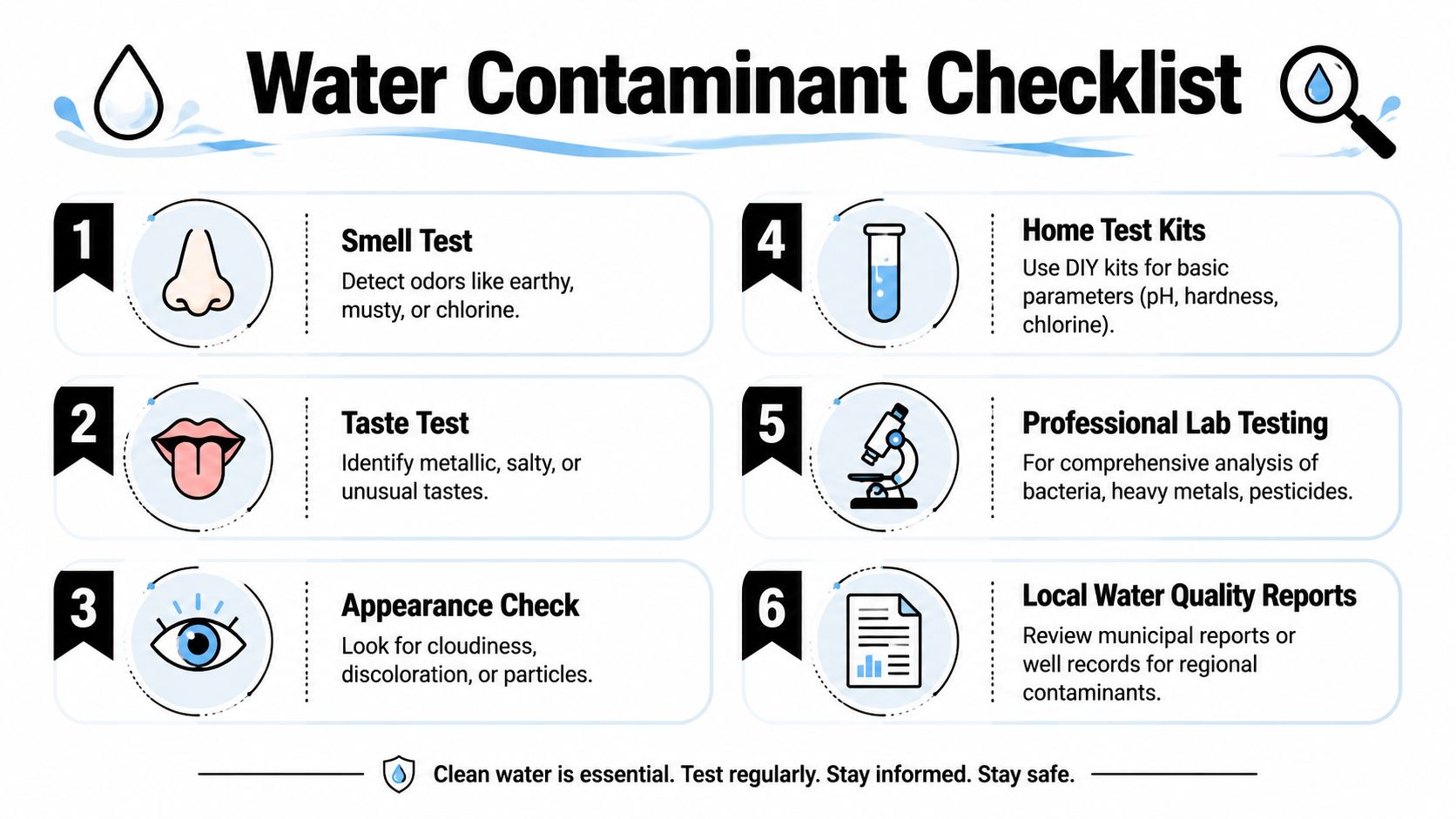
What your water is already telling you
Start with what you can observe around the home:
- Rotten egg odor: This often points homeowners toward sulfur-related issues, especially on well water.
- Reddish-brown stains: Iron is a common suspect when sinks, tubs, or toilets discolor this way.
- White crust on fixtures: Hardness minerals are usually behind this.
- Blue-green staining: That can suggest acidic water contributing to copper corrosion in plumbing.
- Grit, cloudiness, or particles: Sediment may be entering the system and needs to be handled before finer treatment stages.
- Bad taste with no obvious staining: That can involve chlorine, dissolved contaminants, or other water chemistry issues that aren't easy to identify by smell alone.
Those signs are useful, but they're not a full diagnosis. One symptom can come from more than one cause, and multiple issues often show up together. That's common on private wells and in older plumbing systems.
What DIY kits can and cannot tell you
Home test strips have a place. They can give you a rough read on pH, hardness, or chlorine. They can help confirm that something changed. They can also help a homeowner notice patterns over time.
What they don't do well is give you a full treatment plan. They won't reliably tell you how to build a complete system, whether your staining is coming from iron alone, whether sediment is interfering with downstream equipment, or whether a point-of-use filter is enough when the actual problem is house-wide.
The CDC says at least 1.1 million people in the United States get sick every year from germs in drinking water, and it points to understanding water quality through testing as a key part of reducing exposure, as explained in the CDC drinking water facts and statistics page.
A strip test is a clue. It isn't a design spec.
For most Central Florida homes, especially those on wells, the better approach is to combine observation with a professional analysis. That lets you separate nuisance problems from health-related concerns and avoid installing equipment that only solves part of the issue.
A homeowner looking into a water filtration system in Sebring, FL usually needs that analysis before choosing media, system size, or treatment sequence. Otherwise, you're buying hardware first and answers second.
Here is a practical way to understand this:
| What you notice | What it may suggest | Why professional testing matters |
|---|---|---|
| Odor | Sulfur or other water chemistry issues | Confirms whether odor control alone is enough |
| Staining | Iron, corrosion, or mineral issues | Helps distinguish source water from plumbing-related problems |
| Scale | Hardness minerals | Shows whether a softener should be part of the solution |
| Cloudiness | Sediment or suspended particles | Determines whether pretreatment is needed |
| Bad taste | Chlorine, dissolved solids, or mixed issues | Helps match the right point-of-use or whole-home system |
If you want to know how to reduce water contamination, begin with a critical first step. Test first. Everything else gets easier after that.
Choosing the Right Water Treatment System
Once you know what's in the water, the treatment decision gets much simpler. Most bad outcomes come from mismatch. The wrong system gets installed, or the right system gets installed in the wrong order.
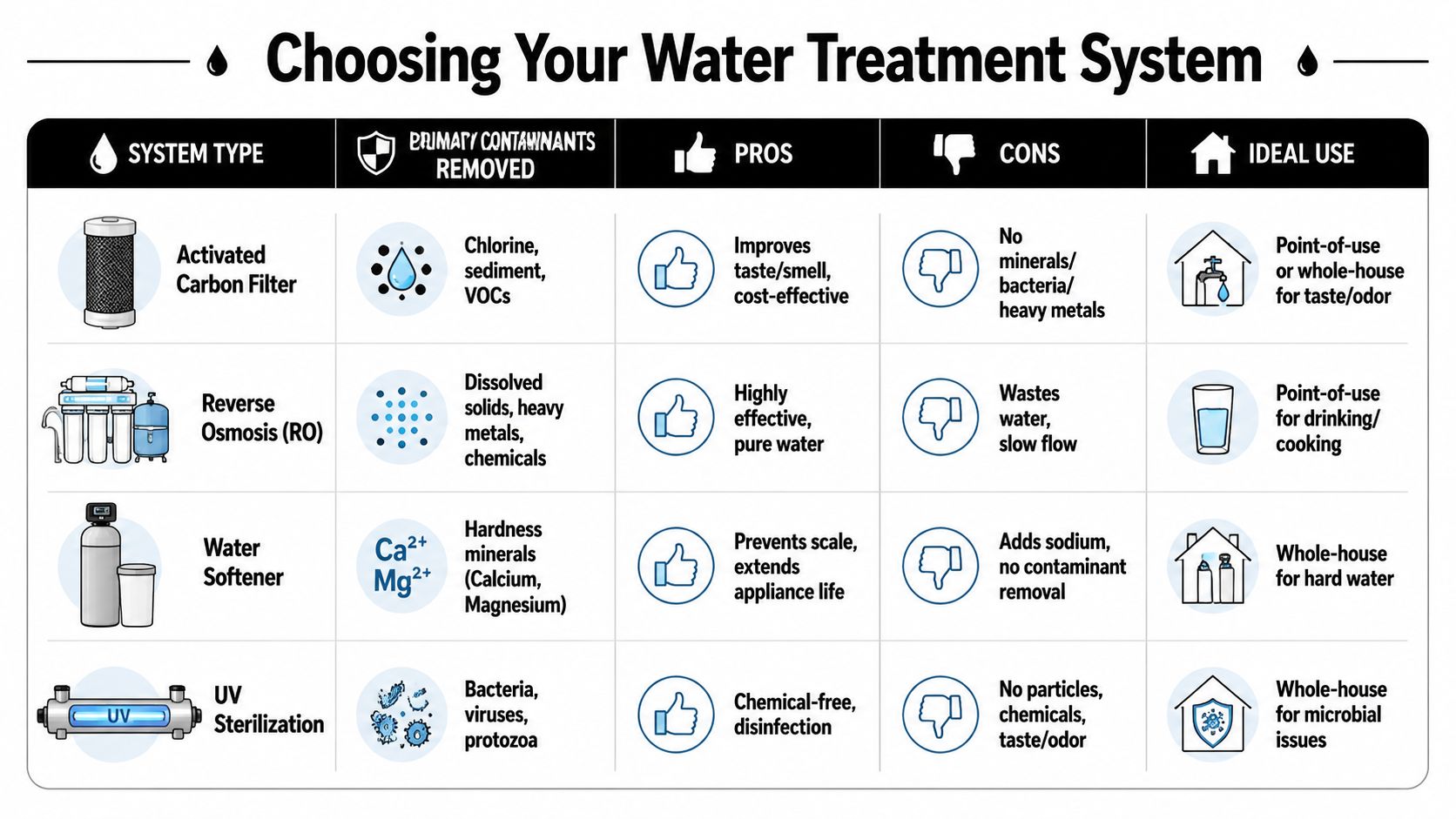
Match the system to the problem
In Central Florida homes, these are the most common treatment categories and what they do:
| System | Usually helps with | Usually does not solve by itself | Best fit |
|---|---|---|---|
| Sediment filtration | Sand, grit, visible particles | Dissolved contaminants, hardness, microbial disinfection | First-stage protection for well water and particle-heavy supply |
| Activated carbon | Taste, odor, chlorine, some chemical-related complaints | Hardness, full dissolved solids reduction, reliable disinfection | Whole-home taste and odor improvement or point-of-use polishing |
| Water softener | Hardness minerals that cause scale and soap problems | Bacteria, sulfur by itself, many chemical contaminants | Whole-home protection where scale is the main complaint |
| Reverse osmosis | Drinking water refinement, dissolved solids, many dissolved contaminants | Whole-home scale prevention, high-flow whole-house use | Kitchen drinking and cooking water |
| UV sterilization | Microbial disinfection | Sediment, taste, odor, chemical removal | Well systems where microbial risk is a concern |
A few examples make this clearer.
If your shower glass keeps spotting and your water heater struggles, a softener is often the main workhorse. If the complaint is chlorine taste at the tap or chemical-like odor, carbon filtration usually enters the conversation. If you want cleaner drinking and cooking water at one faucet, reverse osmosis is often the practical choice. If a well owner needs an added barrier against bacteria or similar microbial concerns, UV can be an effective safety step when the water has been properly pretreated.
For homes with multiple issues, one device usually isn't enough. That's normal, not excessive. A well with sediment, sulfur odor, hardness, and drinking-water taste concerns may need a staged setup instead of a single tank or under-sink unit.
Why treatment order matters
The CDC describes effective treatment as a sequence of coagulation, flocculation, sedimentation, filtration, and disinfection, and the practical lesson for homes is that larger particles need to be addressed before later treatment stages can work as intended, as outlined in the CDC explanation of how water treatment works.
That principle matters in residential systems too. If sediment hits carbon media first, the media can foul faster. If cloudy water reaches a UV chamber, disinfection becomes less reliable. If hard water reaches the wrong equipment untreated, scale reduces performance and service life.
Practical rule: Pretreatment isn't optional when the incoming water is carrying particles, staining minerals, or heavy fouling load.
This is why a customized configuration usually beats a one-size-fits-all package. A solid system starts by removing what interferes with the next stage.
A common treatment path looks like this:
- Sediment first when the water carries grit, sand, or suspended matter.
- Specialty media or oxidation approach if sulfur or iron is part of the profile.
- Softening when hardness is creating scale and soap inefficiency.
- Carbon polishing for taste and odor improvement where appropriate.
- Reverse osmosis at the kitchen sink for high-quality drinking water.
- UV disinfection when a tested well profile calls for microbial protection.
That doesn't mean every home needs every stage. It means the sequence has to fit the water.
For homeowners comparing options, a reverse osmosis system often makes sense as the final drinking-water step, not the first answer to a whole-house problem. And if a local provider such as Florida Water Management designs a system, the useful part isn't the brand name. It's the fact that the configuration can be matched to sulfur, iron, hardness, sediment, and well-specific concerns instead of forcing one product to do everything.
What doesn't work well is buying a single filter because the box promises cleaner water in general. Water treatment isn't general. It's specific.
How to Protect Your Private Well Source
If your home runs on a private well, treatment inside the house is only half the job. You also have to protect the source. A lot of well problems start above ground, then show up later at the tap.
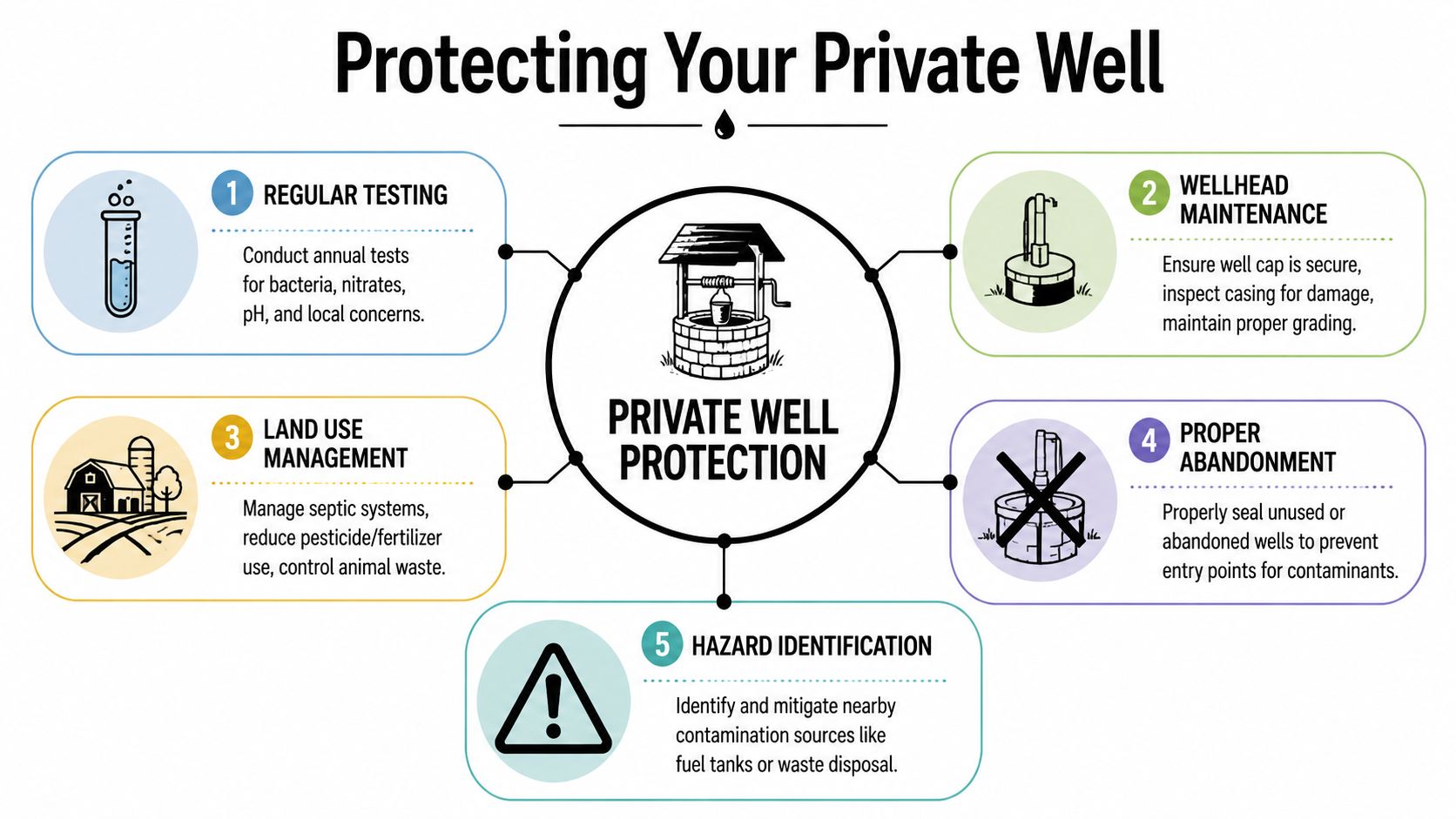
The wellhead and the ground around it matter
A secure, properly maintained wellhead helps keep surface contamination from entering the system. If the cap is damaged, the casing is compromised, or the ground slopes water toward the well instead of away from it, you're giving runoff an easier path.
Walk the area around the well and look for trouble that homeowners often ignore:
- Standing water near the well: Poor drainage raises risk after heavy rain.
- Damaged or loose well cap: Openings invite debris, insects, and surface contamination.
- Exposed casing issues: Cracks or deterioration need attention.
- Nearby storage hazards: Fuel, chemicals, and waste materials should never be handled casually around the well area.
- Unused wells on the property: These should be properly addressed, not left as unknown entry points.
The yard matters too. If someone sprays carelessly, mixes chemicals near the well, or treats the area like a convenient washdown spot, the ground can become part of the contamination pathway.
Septic and yard practices cause more trouble than most owners realize
The EPA warns that malfunctioning septic systems can release bacteria, viruses, and chemicals into aquifers, and it recommends inspections at least every three years and pumping every three to five years for typical systems on its source water protection guidance for homeowners.
That recommendation matters across Central Florida, where many rural and semi-rural properties rely on both wells and onsite wastewater systems. If your septic system is neglected, your drinking water source can be part of the damage.
Use this checklist around the property:
- Keep septic on schedule: If you can't remember the last inspection or pump-out, that's your first clue to act.
- Be careful with fertilizers and pesticides: Use them sparingly and according to label directions. Don't apply before rain, and don't let chemicals wash over paved areas into runoff paths.
- Know where mixing happens: If lawn or agricultural chemicals are mixed or loaded, an impervious surface or a closed transfer approach reduces the chance of spills soaking into the ground.
- Respect separation areas: Keep applications away from the wellhead and nearby surface water features.
- Don't dump hazardous waste: Never pour chemicals into drains, storm systems, or onto soil where they can migrate.
A lot of well owners focus only on the pump, pressure tank, or filter housing. The safer habit is to think wider. Look at the septic field, the slope of the yard, the spray routine, the storage shed, and the runoff pattern after storms.
If contamination starts outside, no indoor filter can be your only line of defense.
Homeowners dealing with private wells often need both source protection and indoor treatment. If the water profile includes odor, staining, sediment, or microbial concerns, a well water treatment system can be part of the solution. It just shouldn't replace smart source control.
Maintaining Your System for Long-Term Safety
A water system that was set up correctly can still stop doing its job if nobody maintains it. That's where a lot of homeowners get surprised. They assume the installation solved the problem permanently, then months later the symptoms creep back in.
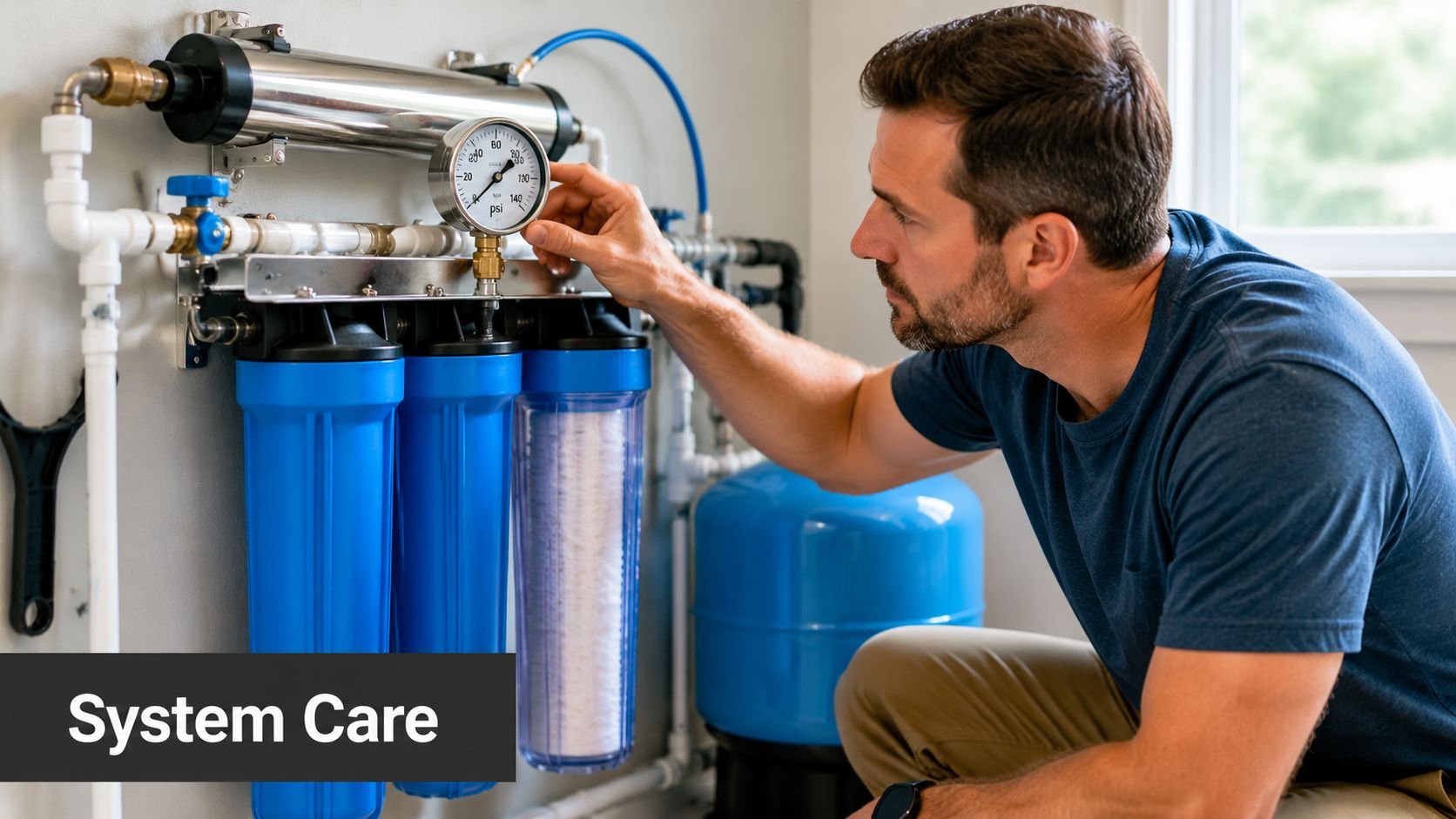
What neglect looks like in real life
Maintenance problems usually show up as performance problems before they show up as obvious failure.
A clogged sediment filter can reduce pressure at showers and fixtures. Exhausted carbon media can stop improving odor and taste. A softener with salt neglected for too long lets hardness return, and the homeowner thinks the system "stopped working" when it really stopped being maintained. If an RO system isn't serviced on schedule, water quality at the drinking tap can drift. If a UV system isn't kept in service condition, the homeowner may assume disinfection is happening when the protective barrier has weakened.
That's why "set it and forget it" is the wrong mindset for water equipment.
A simple maintenance mindset
Think of maintenance as proof that the system is still doing the job you bought it to do. For most homeowners, that means keeping a short record and paying attention to changes.
Good habits include:
- Watch for symptom return: Scale, odor, stains, or taste changes often show up before a full failure.
- Replace parts on schedule: Cartridges, membranes, media, bulbs, and service components all age out.
- Check pressure and flow: Reduced flow can signal fouling, clogging, or bypass issues.
- Keep the softener supplied: If your system depends on salt, don't wait until hard water returns.
- Retest when conditions change: Storms, plumbing work, a home purchase, or a long period of vacancy can justify another look.
The system doesn't need constant attention. It does need regular attention.
Professional service helps because it catches the things most homeowners won't spot during day-to-day use. A technician can verify operation, replace the right components, and make sure one stage of treatment isn't inadvertently compromising the next. That's especially important in Central Florida homes where iron, sulfur, hardness, and sediment can foul equipment faster than people expect.
If you want to know how to reduce water contamination over the long haul, maintenance is part of the answer. Not because it sounds responsible, but because neglected treatment stops being treatment.
Take Control of Your Home's Water Quality Today
You turn on the kitchen tap, fill a glass, and the water looks clear. Then the sulfur smell shows up again in the shower, orange stains keep building around fixtures, or scale starts coating faucets and appliances. In Central Florida, those mixed signals are common, especially in homes with well water or water that changes with the season.
A good plan is simple. Start with a professional test, match the treatment to the actual contaminants, protect the water source, and keep the equipment serviced. That sequence saves money because it prevents the two mistakes I see most often: treating the wrong problem, or buying decent equipment arranged in the wrong order.
Test treat protect maintain
Test the water first. Clear water can still carry hardness, iron, sulfur, sediment, nuisance bacteria, or other well-related issues. A basic DIY kit can be useful for a quick check, but it rarely gives enough detail to size equipment correctly or explain why one problem appears only at certain fixtures.
Treat based on the test results and the way the home uses water. Some Central Florida homes need a softener and reverse osmosis for drinking water. Others need sediment filtration, iron or sulfur treatment, and disinfection. The right setup depends on the source water, plumbing layout, flow rate, and contaminant load.
Protect the source if the home uses a private well. Wellhead condition, drainage, nearby chemical use, and septic performance all affect water quality over time.
Maintain the treatment system on schedule. Clean water today does not guarantee clean water next year, especially in areas where iron, sulfur, and hardness can foul media, injectors, and control valves faster than homeowners expect.
Trust matters too. Research discussed in this peer-reviewed article on water access and trust shows that confidence in water quality affects whether people use their tap water, even when it meets safety standards. Verified testing and visible upkeep help close that gap.
For a homeowner, that confidence is practical. It means knowing the water is fit for drinking, cooking, bathing, laundry, and protecting fixtures and appliances. It also means fewer guesses every time the taste changes or a new stain appears.
If your water has been raising questions, stop troubleshooting one symptom at a time. Get a professional test and make decisions from the actual results in your home.
If you're ready to stop guessing, schedule a free water test with Florida Water Management. Their team works with homeowners and small businesses across Central Florida to identify water problems, recommend an appropriate treatment setup, and keep systems performing over time. As noted earlier, their contact page is the place to get started.