

You dip a cheap TDS meter into the kitchen tap, wait for the numbers to settle, and suddenly that little screen feels louder than the water in your glass. In a Central Florida home, that reaction makes sense. Hard water, limestone aquifers, iron stains, sulfur smells, and well water changes can all make people wonder if a single reading is telling them something dangerous.
The problem is that total dissolved solids in drinking water is a broad measurement, not a safety verdict. It tells you how much dissolved material is present, not which minerals, salts, or contaminants are in the water. That distinction matters a lot when you're standing at the sink trying to decide whether your water needs treatment or just a better explanation.
Table of Contents
- Why Your TDS Reading Might Be Causing Unnecessary Worry
- What Total Dissolved Solids Are
- Regulatory Standards and Recommended TDS Levels
- The Hidden Limitations of Handheld TDS Meters
- Treatment Options That Actually Address TDS and Water Quality
- Local Water Challenges for Central Florida Homeowners and Well Users
- Your Next Step Toward Better Water Quality
Why Your TDS Reading Might Be Causing Unnecessary Worry
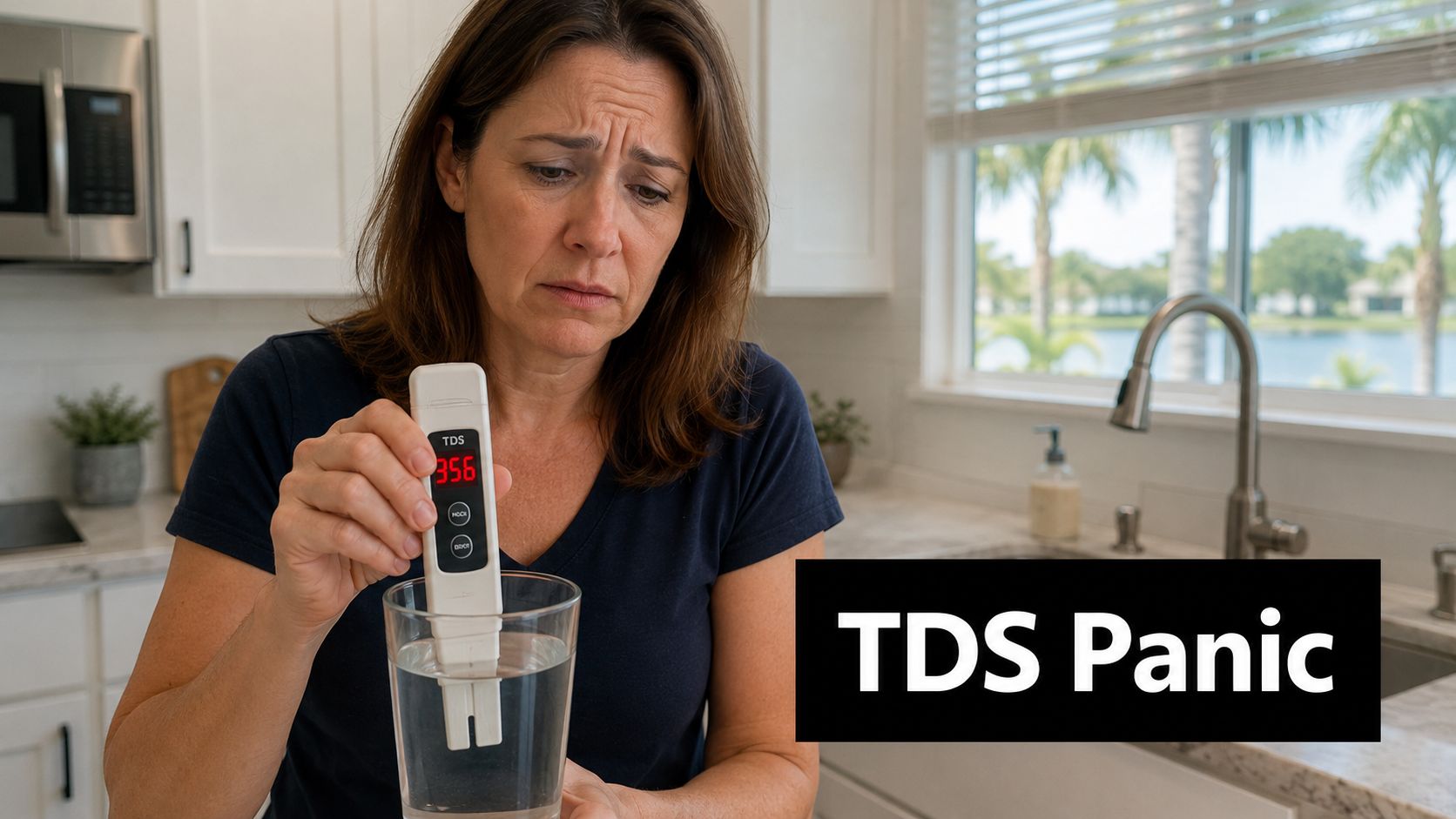
A homeowner in Sebring pours a glass of tap water, drops in a handheld meter, and sees a number that looks high enough to feel alarming. The next move is usually a search spiral, because a meter is fast, cheap, and very convincing. The trouble is that the reading only shows an aggregate amount of dissolved material, not whether that material is a harmless mineral mix or something that needs attention.
Why the number feels bigger than it is
A TDS meter rewards simplicity, which is exactly why it can cause confusion. It gives you one number, but water quality rarely works that way. WHO says TDS in drinking water is not a health-based guideline value because reliable direct health data are lacking, and water below 1,000 mg/L is usually acceptable to consumers (WHO background document).
That framing matters at the kitchen counter. A meter reading can look “bad” even when the water is mainly carrying dissolved calcium, magnesium, or other naturally occurring minerals. It can also look “fine” while missing problems that don't show up in conductivity, which is why the reading should start a conversation, not end one.
Practical rule: If the water tastes odd, leaves scale, stains fixtures, or comes from a private well, treat the TDS reading as a clue, not a conclusion.
A lot of Central Florida homeowners are really asking a different question. They want to know whether their water is safe, whether it will damage appliances, and whether treatment will improve daily life. A single TDS number can't answer all three, so the better move is to connect the reading to the water source, the plumbing, and the local geology.
What Total Dissolved Solids Are
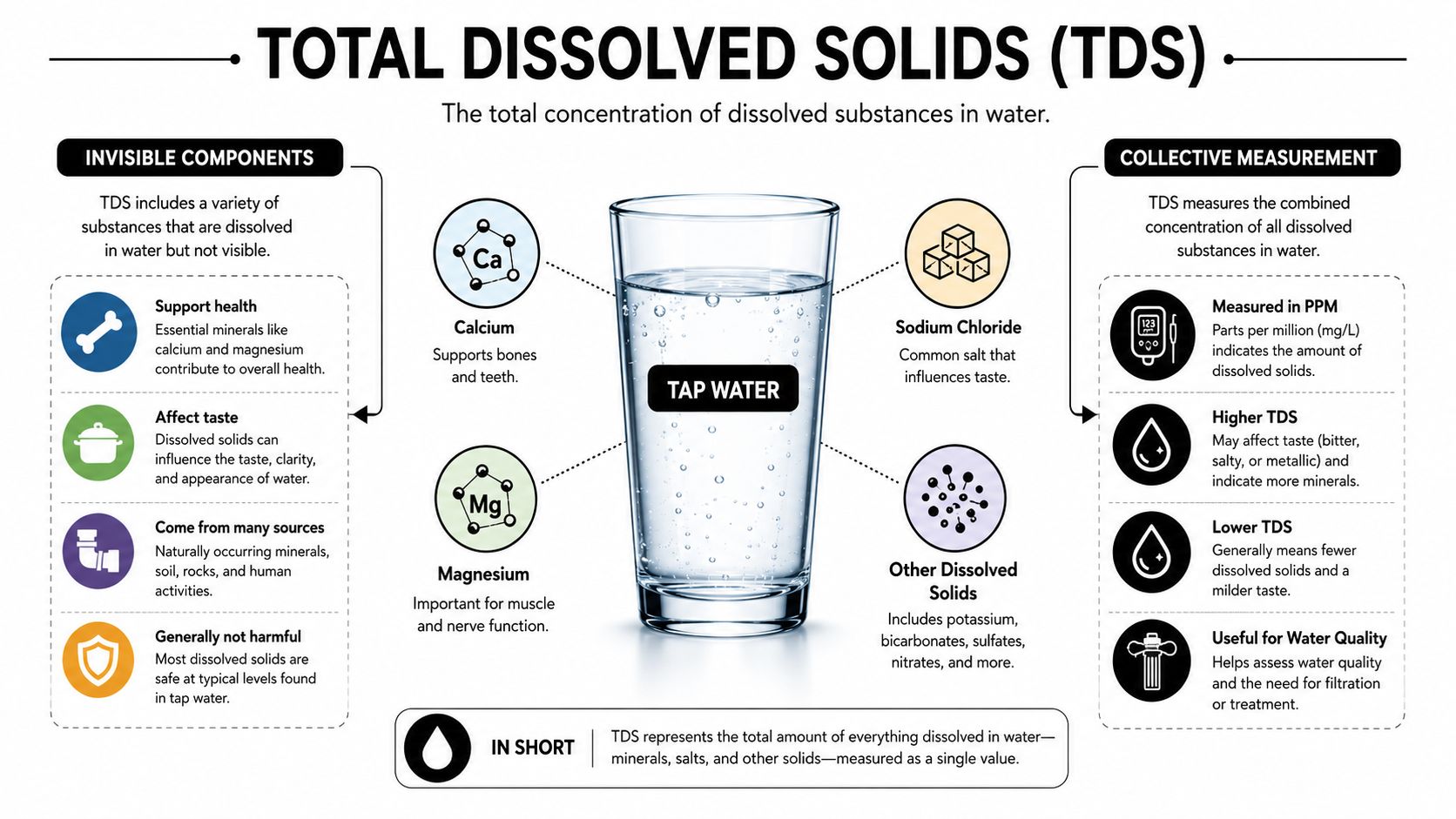
A glass of water can hold salt, sugar, or baking soda without any visible particles left behind. The ingredients are still there, just dissolved into the water. TDS describes that dissolved load, usually reported in milligrams per liter or parts per million (WHO fact sheet).
What the meter is sensing
Most handheld meters do not weigh dissolved solids directly. They estimate the amount by measuring how well the water conducts electricity, since dissolved ions carry charge. That makes the meter useful for a quick screen, but it still cannot identify which substances are present.
In practical terms, TDS includes inorganic salts, minerals, metals, and some organic matter dissolved in the water. In Central Florida, that broad category often includes calcium and magnesium from hard water, iron from local geology, sodium from softening or natural deposits, chlorides, and sulfates. The reading may rise because the water is carrying ordinary minerals, or because something more specific is worth checking.
Dissolved solids versus suspended solids
Dissolved solids are mixed into the water at a molecular or ionic level, so they pass right through ordinary sediment filtration. Suspended solids are particles you might be able to filter out because they are physically floating in the water.
Water can look clear and still carry a high dissolved load. It can also look cloudy for reasons that have nothing to do with TDS.
That is why a TDS number is an aggregate measurement, not a diagnosis. It tells you how much is in the water, but not what is in it. For a homeowner, the question is never just “What is the number?” It is “What is causing it, and does that cause matter for taste, scale, corrosion, or health?” The answer depends on the source water and the ions behind the reading.
Regulatory Standards and Recommended TDS Levels
The official benchmarks for TDS are a lot more modest than the worry that a handheld meter can create. In the U.S., the Environmental Protection Agency lists TDS as a secondary drinking water standard at 500 mg/L, which means it is treated as an aesthetic or nuisance issue rather than a primary health-based contaminant (EPA drinking water regulations). Health Canada uses an aesthetic objective of ≤500 mg/L and notes that higher levels can cause excessive hardness, unpalatability, mineral deposition, and corrosion, while lower levels improve palatability (Health Canada guidance).
Why the history matters
WHO's historical record shows how the standard changed over time. The 1958 international standard said total solids above 1,500 mg/L would markedly impair potability, the 1984 WHO guideline set 1,000 mg/L mainly on taste grounds, and the 1993 guidelines removed a health-based limit while noting that water above 1,200 mg/L may be objectionable (WHO history document). WHO also states that no health-based guideline value is proposed because reliable data on direct health effects are lacking.
That shift matters because it shows how experts classify TDS. It is mainly an aesthetic and operational indicator, not a toxicity threshold. Taste, scale, corrosion tendency, and source-water behavior carry more weight here than a false sense of safety or danger based on one reading. The WHO background document makes the same point, explaining that the evidence does not support a direct health-based limit for TDS.
What the benchmarks are really saying
A homeowner in Winter Haven with water that tastes mineral-heavy is dealing with a different issue than a household with a low reading and a bacteria concern. TDS can help flag the first problem, but it does not replace the testing needed for the second. That is why municipal reports and well tests often include TDS alongside other measures instead of treating it like lead or bacteria.
A TDS meter is a rough screen, like checking the weight of a suitcase before a trip. It tells you the bag is heavy, but not whether the weight comes from clothes, tools, or something that should not be packed at all. In Central Florida, that distinction matters because local groundwater often carries dissolved minerals from limestone, and well owners may also see hardness, iron, or salinity-related changes that need specific tests.
Bottom line: The common 500 mg/L benchmark is about acceptability, not a direct health warning.
The Hidden Limitations of Handheld TDS Meters
A handheld TDS meter can be helpful, but it can also be misleading if you treat it like a full water analysis. The Kansas Department of Health and Environment notes that a TDS reading measures dissolved material, not the identity of those substances, so it doesn't tell you whether the water contains bacteria or specific health risks (Kansas TDS guidance). That's the core limitation, and it's the reason a cheap meter should never be used as a safety shortcut.
What the meter cannot tell you
Two samples can show the same TDS reading and still have completely different water quality profiles. One may be mostly calcium and bicarbonate, which can create hardness and scale. Another may include dissolved contaminants that need separate testing, and the meter won't distinguish between them.
It also won't help with non-ionic pollutants. Many organic chemicals and pathogens won't register in a conductivity-based reading, which is why a low number can still leave major questions unanswered. That's the gap private well owners notice most often, especially when the water has changed in taste, smell, or color.
Why a reading can change for harmless reasons
TDS can rise or fall because of seasonal changes in well water, changes in source-water chemistry, or the way the water is being treated. In some cases, a higher reading is tied to minerals that improve taste. In other cases, a lower reading after treatment doesn't prove the system solved the underlying issue, it just means less dissolved material is passing the probe.
A proper lab panel earns its keep. If a well owner in Central Florida sees a weird reading and already has iron staining, sulfur odor, or scaling, the right move is to identify the ions behind the number rather than chasing the number itself.
Practical advice: Use the meter for screening and trend-spotting. Use a lab test when you need to know what's actually in the water.
A full test is also the better choice when a home is on a private well, when the water suddenly changes, or when treatment decisions affect a rental property or small business. A meter can point you toward action. It can't tell you which action is correct.
Treatment Options That Actually Address TDS and Water Quality
Different systems solve different problems, and that's why the right treatment depends on what your water test shows. Reverse osmosis physically removes dissolved solids at the point of use, so it's the main residential option that lowers TDS. Water softeners exchange calcium and magnesium for sodium, which helps with hardness but doesn't meaningfully solve every dissolved-solids issue. Activated carbon improves taste and reduces chlorine and some organics, while sediment filters handle particles, not dissolved minerals.
How the common options compare
| Treatment Type | Reduces TDS | Best For | Maintenance Needs |
|---|---|---|---|
| Reverse osmosis | Yes | Drinking water, cooking water, lowering dissolved minerals | Filter and membrane changes, periodic system checks |
| Water softener | Minimal change in total number | Hardness, scale, soap scum | Salt refill, resin service, inspections |
| Activated carbon | No significant reduction | Chlorine, taste, odor, some organics | Regular cartridge replacement |
| Sediment filter | No | Sand, rust, visible particles | Cartridge replacement as it loads up |
The practical point is simple. If calcium and magnesium are driving the problem, a softener may solve the shower and plumbing issue while leaving the drinking-water profile largely intact. If the goal is lower TDS at the faucet, reverse osmosis is the system that targets dissolved solids.
Matching the system to the water
A lot of homeowners assume the same filter should solve every complaint. That rarely works. Iron, hardness, sulfur, sediment, and dissolved salts need different treatment strategies, and the wrong system can leave the core issue untouched.
Good rule of thumb: Treat the specific water problem, not the TDS number in isolation.
For homeowners comparing options, a well-designed reverse osmosis setup for drinking water is usually the clearest route when TDS and taste are the main issues. You can see one example of that approach in reverse osmosis for well water. The tradeoff is maintenance, because membranes and prefilters need inspection and replacement to keep performance steady.
Whole-home systems matter too, but they're usually selected for scale, odor, sediment, or corrosion control, not because someone wants to make the TDS meter look better. That's the distinction that saves money and frustration. A system should answer the water problem in front of you, not a number pulled from a pocket tester.
Local Water Challenges for Central Florida Homeowners and Well Users
Central Florida water often carries a mineral story before it ever reaches your tap. Limestone aquifer geology naturally contributes calcium, magnesium, and other dissolved minerals, which is one reason local homeowners see hard water behavior in plumbing, fixtures, and appliances. That same geology is why TDS readings can be higher than people expect even when the water is perfectly normal for the area.
What homeowners notice first
The signs usually show up in everyday life. Soap scum sticks to shower tile. Glassware comes out spotted. Water heaters and plumbing develop scale that reduces efficiency and adds maintenance headaches. In places like Sebring, Avon Park, Lake Wales, Winter Haven, and Frostproof, those complaints are common enough that homeowners often assume the water is “bad” when it's really mineral-rich and untreated for hardness.
Agricultural activity can add dissolved compounds to the picture, and private wells can reflect whatever is moving through the local groundwater system. Iron and sulfur complaints are common in well water, and those issues belong to the broader dissolved-solids conversation even though they need their own testing logic. TDS can signal that the water chemistry is worth looking at more closely, but it can't identify whether the culprit is geology, runoff, or something else.
Why local testing matters more than a meter reading
A property manager or builder in this region needs different information than a homeowner with a kitchen faucet complaint. Rental units, small businesses, and remodels all carry different tolerance for staining, odor, scale, and service calls. A general reading from a handheld meter won't tell you how that water will behave in a water heater, a coffee machine, or a guest bath.
For that reason, a local well test is far more useful than guessing from a single number. A professional assessment through well water testing in Fish Hawk, FL gives a better picture of the dissolved ions and treatment needs that matter in Central Florida.
The point isn't to chase low numbers for their own sake. It's to match treatment to the water chemistry that is present. In this region, that usually means looking beyond TDS and into hardness, iron, sulfur, staining, and the way the water affects the home day after day.
Your Next Step Toward Better Water Quality
A TDS meter can help you notice a problem, but it can't solve the problem on its own. The number is best treated as a starting point, especially in Central Florida where geology, well water, and hard water realities shape what ends up in the glass. If your water tastes off, smells unusual, leaves scale, stains fixtures, or has changed appearance, those are the clues that matter.
A professional test gives you the missing pieces. It shows what's dissolved in the water, which issues are cosmetic or operational, and which ones need real treatment. If you want a clear answer instead of a guess, how to reduce water contamination is the right conversation to start with.
Florida Water Management offers professional water testing and treatment planning for homes and small businesses across Central Florida. If you're trying to make sense of a TDS reading, their team can help you figure out what the number means, what it misses, and what your water needs. Visit Florida Water Management to schedule a free water test and get a recommendation built around your water, not just a meter reading.