

You turn on the kitchen tap, smell sulfur for a second, then wonder if the water is really the problem or just the plumbing. In Central Florida, that concern is common, whether you're on a private well outside Sebring or Avon Park, or on city water in Lake Wales or Winter Haven and still noticing chlorine taste, scale on fixtures, or water that just doesn't drink cleanly. A reverse osmosis system with UV light is built for exactly that kind of mixed water reality, where one treatment stage alone doesn't solve the whole picture.
Table of Contents
- Why Central Florida Water Needs a Second Look
- The Double Barrier of RO and UV Filtration
- Is an RO System with UV Light Right for Your Florida Home
- Benefits and Limitations of RO with UV Purification
- Installation Sizing and Maintenance Essentials
- How RO+UV Compares to Other Water Treatment Systems
- Frequently Asked Questions About RO and UV Systems
- Your Next Step to Pure Safe Water in Central Florida
Why Central Florida Water Needs a Second Look
A lot of homeowners notice the same pattern. The water might look clear, but it still smells off, leaves spots on glass, or tastes flat after sitting in the refrigerator dispenser. In Central Florida, that's enough to make people start asking a real question, not just “Is my water safe?” but “What kind of treatment matches my water source?”
Private wells bring a different set of worries than city water. Wells can carry microbial risk, and they also tend to show the kind of dissolved-solids and mineral issues that make water feel harsh at the tap. City water may arrive with a disinfectant residual, but that doesn't erase every concern about taste, plumbing contact, or contaminants that aren't fully addressed before the water reaches the house.
Practical rule: if the water problem changes by source, storage, or plumbing, the fix usually needs more than one stage.
That's where an RO plus UV setup earns its place. The RO membrane handles the dissolved contaminants, and the UV stage adds a microbial safeguard after filtration. EPA's point-of-use guidance explains that RO uses pressure to force water through a semi-permeable membrane, producing treated water and a reject stream, and that these systems can remove contaminants including lead, VOCs, PFAS, arsenic, bacteria, and viruses. A home review of an RO and UV unit also reported 87% nitrate reduction and 94% TDS reduction, which is the kind of dissolved-solids performance that matters when local water feels mineral-heavy or comes from a private well.
The local advantage is simple. You're not guessing whether the problem is chemical, mineral, or biological, you're testing and matching the treatment to the water.
The Double Barrier of RO and UV Filtration
A reverse osmosis system with UV light works like a two-part security system. The first barrier blocks the dissolved material you don't want in the glass. The second barrier handles microorganisms that filtration alone can't fully address or that might show up after water sits in a tank or line.
How the treatment train works
The EPA describes point-of-use RO as a system that pushes water through a semi-permeable membrane and produces both treated water and a reject stream. In a typical 5-stage design, the water moves through sediment, carbon, the RO membrane, polishing, and then UV exposure before dispensing, so each stage has a job that the others don't. That sequence matters because RO and UV are complementary, not redundant.
The RO membrane is the physical separator. It reduces dissolved contaminants and is the reason these systems are used for problems like lead, arsenic, PFAS, and other dissolved constituents. UV doesn't replace that work. It comes after it.
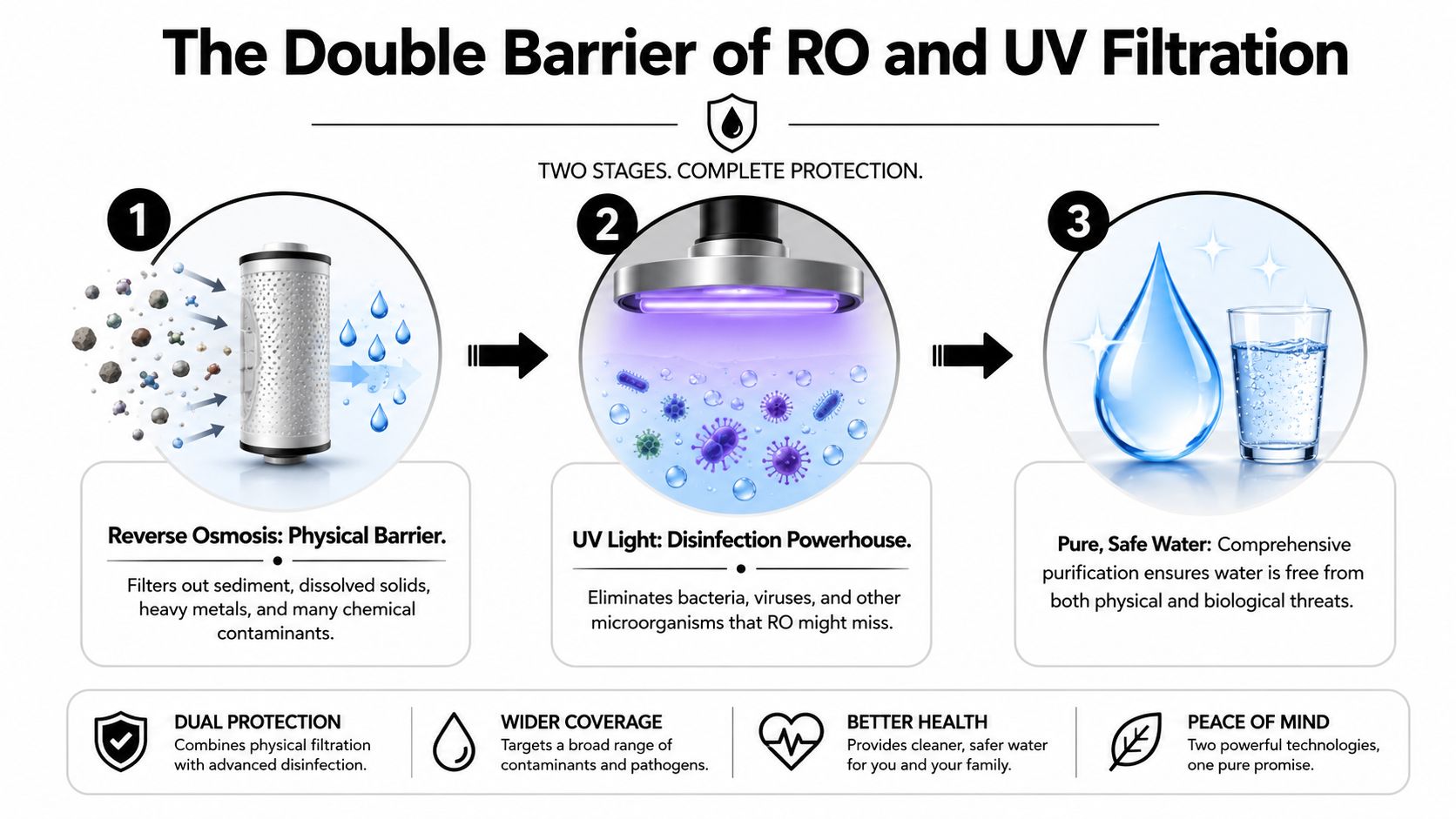
The UV stage is a final disinfection step. Product guidance and technical explainers place UV at about 254 nanometres, which is the wavelength commonly used for germicidal treatment. In practical terms, that means the water is already cleaned up by RO, then the UV chamber gives it a last pass for microbial control before it reaches the faucet. A PubMed-indexed study on high reverse osmosis water quality found that ultraviolet irradiation preserves low RO water bacterial/endotoxin content in the distribution line and was not associated with a measurable endotoxin increase, which is exactly why the UV stage belongs at the end of the train.
Why the UV stage belongs at the end
The UV lamp is a safeguard for the water after filtration, not a substitute for source control. That distinction matters in homes where water is stored, travels through short tubing runs, or sits long enough for recontamination to become a concern. In plain terms, RO cleans the water, UV protects the finished water.
Water can be excellent at the membrane and still deserve a microbial final barrier before the tap.
For homeowners, that's the key advantage. You get one system that handles dissolved solids and another that watches for microorganisms, all in a compact point-of-use format. Local UV sterilization service details for Lakeland homes fit into that same treatment logic, especially for households comparing drinking-water protection options.
Is an RO System with UV Light Right for Your Florida Home
The right answer depends on where your water comes from and what happens to it before you drink it. A private well in Frostproof calls for a different conversation than city water in Winter Haven, and the reason isn't marketing, it's water chemistry and microbiology.
Private wells in Central Florida
For well owners, the appeal of RO plus UV is straightforward. Wells can bring in dissolved solids, taste issues, and microbial concerns all at once. If the water is cloudy, carries turbidity, or changes after rain and seasonal groundwater shifts, UV alone isn't enough, because turbidity can shield microorganisms from exposure. Agriculture and Agri-Food Canada notes that turbidity should be below 1.0 NTU and total suspended solids below 10 mg/L so microbes aren't shielded from UV exposure, which is why pretreatment matters so much before the disinfection stage.
That's also why an RO membrane matters first. It cleans up the feed water before UV does its job, and guidance for private-well systems emphasizes that clarity is a major part of whether UV disinfection works. If a well owner skips the membrane or undersizes the pretreatment, the UV unit is forced to handle water it wasn't meant to correct.
Field note: if the water looks, smells, or tests unstable, UV should never be the first and only answer.
For households dealing with well water, reverse osmosis solutions for well water are often the better fit because the membrane and UV stage solve different problems in the same tap-level system.
Municipal water in town
City water changes the conversation. The water is already treated, so the question becomes whether you want better taste, lower dissolved solids, and a stronger barrier at the point where water meets your plumbing. EPA guidance confirms RO systems can remove contaminants such as lead, VOCs, PFAS, arsenic, bacteria, and viruses, so point-of-use treatment can still make sense even on municipal service.
For Central Florida homeowners, that can matter when chlorine taste lingers, when fixtures show scale, or when you just want a cleaner drinking-water point without reworking the whole house. The UV stage doesn't target chlorine, and that's fine, because its job is microbial protection after the membrane does the chemical and dissolved-solids work.
The practical split is simple. Private wells lean harder toward needing both barriers. Municipal water users often want the RO membrane for dissolved contaminants and the UV stage for extra peace of mind, especially if water sits in a storage tank or travels through older plumbing before it gets to the sink.
Benefits and Limitations of RO with UV Purification
The strongest reason to install an RO system with UV light is that it solves two different problems at once. RO improves the water you see, taste, and cook with, while UV protects the water from biological contamination at the end of the line. That combination is more complete than either treatment by itself, especially when the source water changes over time.
The UV stage is not decoration. A PubMed-indexed review found that ultraviolet irradiation preserves low RO water bacterial/endotoxin content in the distribution line and was not associated with a measurable endotoxin increase, which means the final disinfection step helps keep water safe after it leaves the membrane. Product guidance also notes that UV units are commonly used in household, industrial, and commercial settings, and that lamps generally need annual replacement because effectiveness drops over time even if the lamp still glows.
The trade-offs are real, though. RO systems create a reject stream, so they use some water as part of the separation process. They also need routine filter changes, membrane replacement on a normal service cycle, and a UV lamp replacement schedule that you can't ignore. Point-of-use systems also treat the water at one tap, not the whole home, so they're ideal for drinking and cooking but not a substitute for broader treatment if shower or laundry water is the problem.
A balanced way to look at it is this:
- Best strength: full protection at the tap, especially for drinking water.
- Main compromise: maintenance is predictable, not optional.
- Main limitation: it's a point-of-use solution, not whole-house coverage.
If you want a system that stays chemically neutral, improves taste, and gives you a microbiological safeguard after the membrane, RO plus UV is a strong fit. If you want a hands-off, whole-home fix for every fixture, that's a different design conversation entirely.
Installation Sizing and Maintenance Essentials
A good system starts with space, plumbing, and power, not just a product box. Under-sink RO and UV units need room for the tank, the membrane housing, tubing, and the UV chamber, and the UV section needs a reliable electrical connection because the lamp has to stay powered for disinfection to happen. The unit also has to be installed downstream from the RO system and close to the tap, which keeps the final barrier where it belongs.
Sizing should match the amount of drinking and cooking water the household uses. A larger family, a home office, or a small commercial kitchen all change the demand profile, and the system has to be selected accordingly. In Florida, I'd rather see a homeowner choose a well-matched unit than chase a bigger-looking model that doesn't fit the cabinet or the plumbing layout.
Maintenance is where a lot of homeowners get surprised, not because it's difficult, but because it's easy to forget. The UV lamp or LED side of the unit needs attention on a schedule, and the filters that protect the membrane and the light chamber need routine replacement to keep the whole train working properly.
A practical maintenance checklist looks like this:
- Sediment pre-filter: replace on schedule so fine particles don't load the system.
- Carbon stage: replace to keep taste, odor, and upstream protection on track.
- RO membrane: replace when performance drops or at the manufacturer's service interval.
- UV lamp or LED module: maintain on a regular schedule because output, not just visible glow, is what matters.
The installation also needs realistic layout planning. If the cabinet is cramped, if the drain tie-in is awkward, or if the outlet is missing, the project becomes more complicated than it looks on a sales sheet. Reverse osmosis system cost guidance is useful here because it helps homeowners think about the full setup, not just the sticker on the equipment.
Don't buy the system first and hope the plumbing works out later. Measure the cabinet, confirm the power, and confirm the drain path before installation day.
How RO+UV Compares to Other Water Treatment Systems
Some systems do one job well. The RO plus UV combination does two jobs in sequence, which is why it usually beats the simpler options when the goal is clean drinking water with a microbial backstop.
| Feature | RO System with UV Light | RO System Only | UV System Only | Carbon Filter (Pitcher/Faucet) |
|---|---|---|---|---|
| Dissolved solids reduction | Strong, because the membrane is the main barrier | Strong | No meaningful dissolved-solids removal | Limited |
| Microbial protection | Strong final disinfection step | No UV safeguard | Strong for microbes, but only after proper pre-filtration | No meaningful disinfection |
| Taste improvement | Strong | Strong | Limited | Often helpful for chlorine taste |
| Chemical reduction | Broad point-of-use reduction, depending on contaminant | Broad point-of-use reduction | No chemical removal | Narrower, mostly taste-related |
| Best use case | Drinking water with mixed chemical and microbial concerns | Drinking water focused on dissolved contaminants | Microbial disinfection when water is already clear | Simple taste improvement |
| Maintenance | Filter changes plus UV upkeep | Filter changes plus membrane upkeep | Lamp replacement and pre-filtration upkeep | Cartridge changes |
| Overall scope | Two-barrier treatment train | Single barrier for dissolved contaminants | Single barrier for microbes | Basic taste and odor improvement |
RO alone is strong if the concern is dissolved contaminants and taste. UV alone is strong if the concern is microbial disinfection and the water is already clear. Carbon filtration is useful for polishing taste, but it doesn't match the breadth of an RO plus UV setup for a Central Florida household that wants both cleaner water and a biological safety layer.
The biggest difference is reliability across variable water conditions. When the source changes, the plumbing is old, or the home stores water before use, the two-barrier approach gives you more margin than a single technology can. That's why the combination tends to make the most sense where water quality isn't predictable day to day.
Frequently Asked Questions About RO and UV Systems
Does reverse osmosis remove beneficial minerals?
Yes, RO reduces dissolved minerals along with unwanted contaminants. For most households, that trade-off is acceptable because people get the bulk of their minerals from food, not tap water. If taste is a concern, remineralization is an option after filtration.
Will an RO plus UV system lower my water pressure?
At the tap, no, because this is a point-of-use system with its own faucet. It doesn't reduce whole-home water pressure the way a whole-house restriction might. What matters is having the right feed pressure for the RO unit itself so the membrane works properly.
Is the reject water just wasted?
Not always. It is part of how RO separates clean water from dissolved contaminants, so it shouldn't be treated like a flaw. Some homeowners also reuse it for non-drinking tasks when their setup allows it.
Do I really need UV after RO?
That depends on the source water, storage conditions, and whether a reliable disinfectant residual is present. For private wells without a chlorine residual, UV is a critical final safety barrier, while city water users may need it more for added assurance than for the baseline municipal supply itself.
Does UV fix taste or minerals?
No. UV is a disinfection step, not a mineral or taste treatment. That's why it works best after RO, not instead of it.
Your Next Step to Pure Safe Water in Central Florida
The best water system is the one matched to your actual water, not the one that sounds good in an ad. For Central Florida homes, a reverse osmosis system with UV light is often the smartest drinking-water setup because it handles dissolved contaminants and adds a microbial safeguard at the end of the line.
You can't solve a water problem you haven't identified yet. A free water test shows whether you're dealing with minerals, chlorine, turbidity, bacteria risk, or a combination of issues, and that's the only way to know whether RO, UV, or both belong at your tap. If you want a clear recommendation for your Sebring, Avon Park, Lake Wales, Winter Haven, or Frostproof home, schedule a free, no-obligation test with Florida Water Management.
A CTA for Florida Water Management.