

You turn on the kitchen faucet and notice the same things you've been noticing for months. Rust-colored stains around the sink. A faint rotten egg smell in the morning. White buildup on fixtures that keeps coming back. Maybe the drinking water tastes flat, metallic, or just off enough that everyone in the house reaches for bottled water.
That's a familiar Central Florida well water story.
A lot of homeowners hear about reverse osmosis for well water and assume it's a simple fix. In the right setup, it's one of the best purification methods available for drinking water. But on a private well, especially in Sebring, Avon Park, Lake Wales, Winter Haven, Frostproof, and nearby areas, a standard RO unit by itself often isn't the answer. Local well water commonly carries iron, sulfur, sediment, and hardness that can ruin an RO membrane long before the system ever delivers the performance you expected.
The difference between an RO system that works and one that becomes a service headache usually comes down to what happens before the membrane. That's where most homeowners get bad advice. They buy the RO unit first, then find out later that untreated feed water was the problem.
Table of Contents
- Is Your Well Water as Clean as You Think
- How Reverse Osmosis Purifies Your Water
- What RO Removes from Well Water and What It Misses
- Why Pre-Treatment is Non-Negotiable for Florida Wells
- Choosing Your System Point-of-Use vs Whole-Home
- Installation Maintenance and Long-Term Costs
- Your Well Water Decision Checklist and Next Steps
Is Your Well Water as Clean as You Think
A lot of well owners assume clear water means clean water. That's where trouble starts.
Water can look fine in a glass and still cause problems throughout the house. In Central Florida, I've seen homeowners chase one symptom at a time. They replace a faucet because of staining, switch detergents because laundry feels dingy, or use scented cleaners to cover sulfur odor. The water keeps causing the same problems because the source issue never changed.
The signs usually show up around the house first
You might already be dealing with some of these:
- Rust stains on sinks and toilets: Iron is one of the most common reasons.
- Rotten egg smell at the tap: Sulfur compounds are a frequent cause in well systems.
- Scale on fixtures and shower glass: Hardness builds up fast in many Florida homes.
- Bad-tasting drinking water: Dissolved minerals and other contaminants can change taste even when the water looks normal.
Those symptoms don't automatically mean you need reverse osmosis. They do mean you need to stop guessing.
Clear water isn't the same as treated water. Private wells can carry dissolved contaminants that you can't see and equipment problems that you won't notice until filters, fixtures, and appliances start failing.
RO is powerful, but it isn't plug-and-play on a well
Reverse osmosis is excellent for producing high-quality drinking water. It's often the right answer for the water you cook with and the water you drink every day. But if your well water has untreated iron, sulfur, hardness, or sediment, a basic RO unit won't hold up.
That's the part many homeowners never hear until after installation.
An RO membrane is delicate compared to the rest of your water treatment equipment. Feed it rough well water, and the system starts losing output, fouling up, and producing poor-quality water. In other words, reverse osmosis for well water works best when it's treated as part of a complete system, not as a standalone gadget under the sink.
How Reverse Osmosis Purifies Your Water
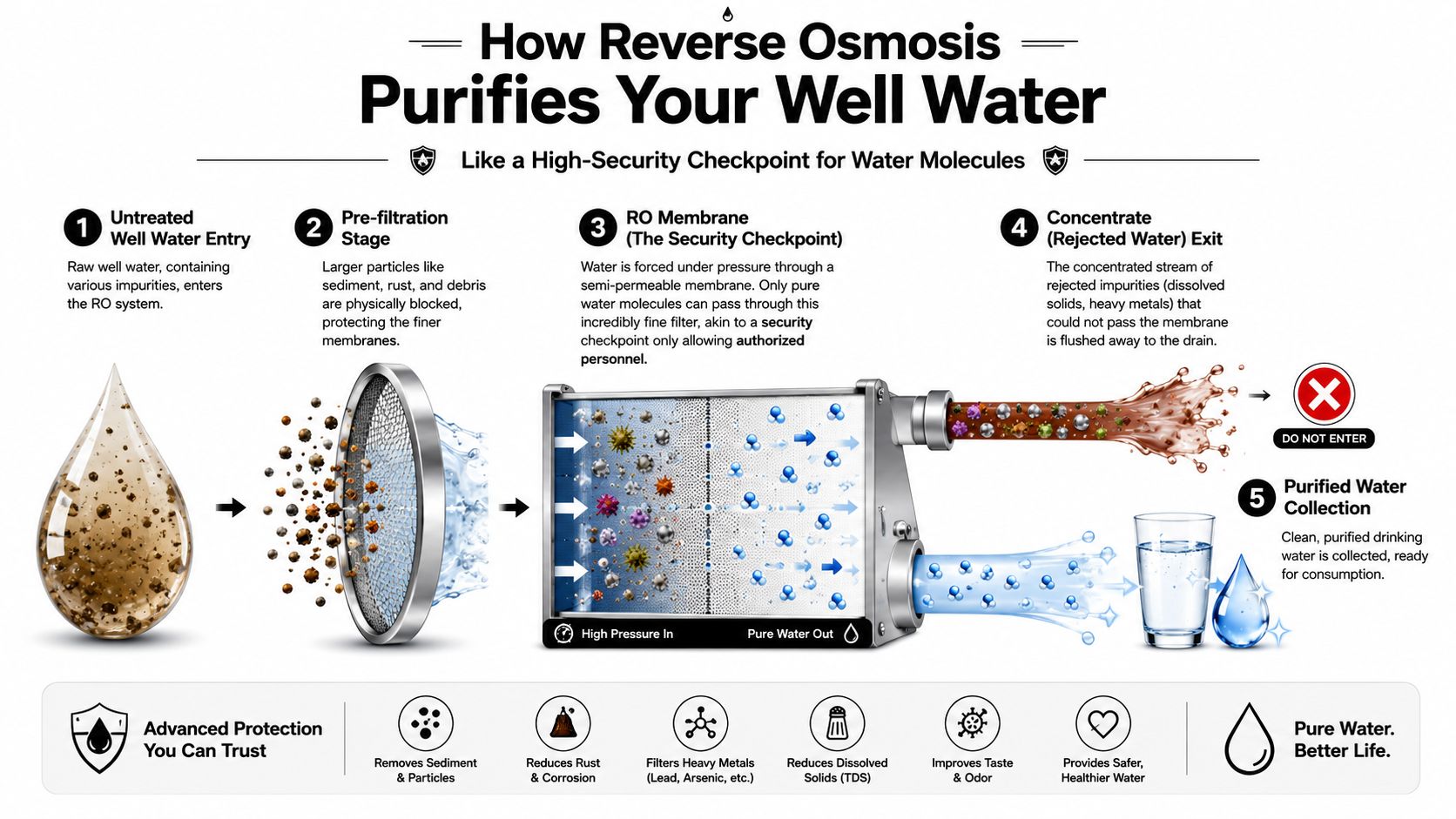
Reverse osmosis works like a high-security checkpoint for water.
Water pressure pushes raw water against a semi-permeable membrane. Water molecules pass through. Many dissolved contaminants don't. The clean stream is called permeate. The rejected stream, which carries away concentrated contaminants, is called concentrate.
Think of the membrane like a final barrier
A standard household setup usually follows a simple path:
- Well water enters the system
- Pre-filters catch larger troublemakers first
- Pressure pushes water across the RO membrane
- Purified water moves to storage or a delivery point
- Rejected contaminants flush away in the waste stream
That middle step matters most. The membrane does the precision work, but only if the water reaching it has already been cleaned up enough to protect it.
According to DuPont's reverse osmosis technology guidance, RO systems for well water can achieve 95–99% rejection of Total Dissolved Solids and inorganic contaminants when feedwater is properly pre-treated to remove chlorine below 0 ppm, iron below 2 ppm, and turbidity below 5 SDI. If those pretreatment conditions aren't met, rejection can fall below 90%.
Why pressure and flow matter
RO doesn't work like a simple carbon filter where water passes through media and comes out improved. It depends on pressure. That pressure has to overcome the natural tendency of dissolved minerals to stay in the feed water.
If the incoming water is dirty, too mineral-heavy, or not conditioned properly, the membrane has to work against contamination and poor operating conditions at the same time. That's why people sometimes say their RO “stopped making water” or “isn't keeping up.” In many cases, the membrane didn't fail randomly. The feed water set it up to fail.
Practical rule: Treat the membrane like the last step, not the first one. If sediment, iron, sulfur, and hardness aren't handled upstream, the RO unit becomes the part of the system that takes all the abuse.
For a homeowner, the takeaway is simple. Reverse osmosis for well water is not just one filter. It's a pressure-driven purification process that depends on everything ahead of it being designed correctly.
What RO Removes from Well Water and What It Misses
Reverse osmosis is strong at removing dissolved contaminants. That's why it's so useful for drinking water treatment on a private well. But it's not a cure-all, and homeowners get into trouble when they expect it to solve every water problem by itself.
What RO handles well
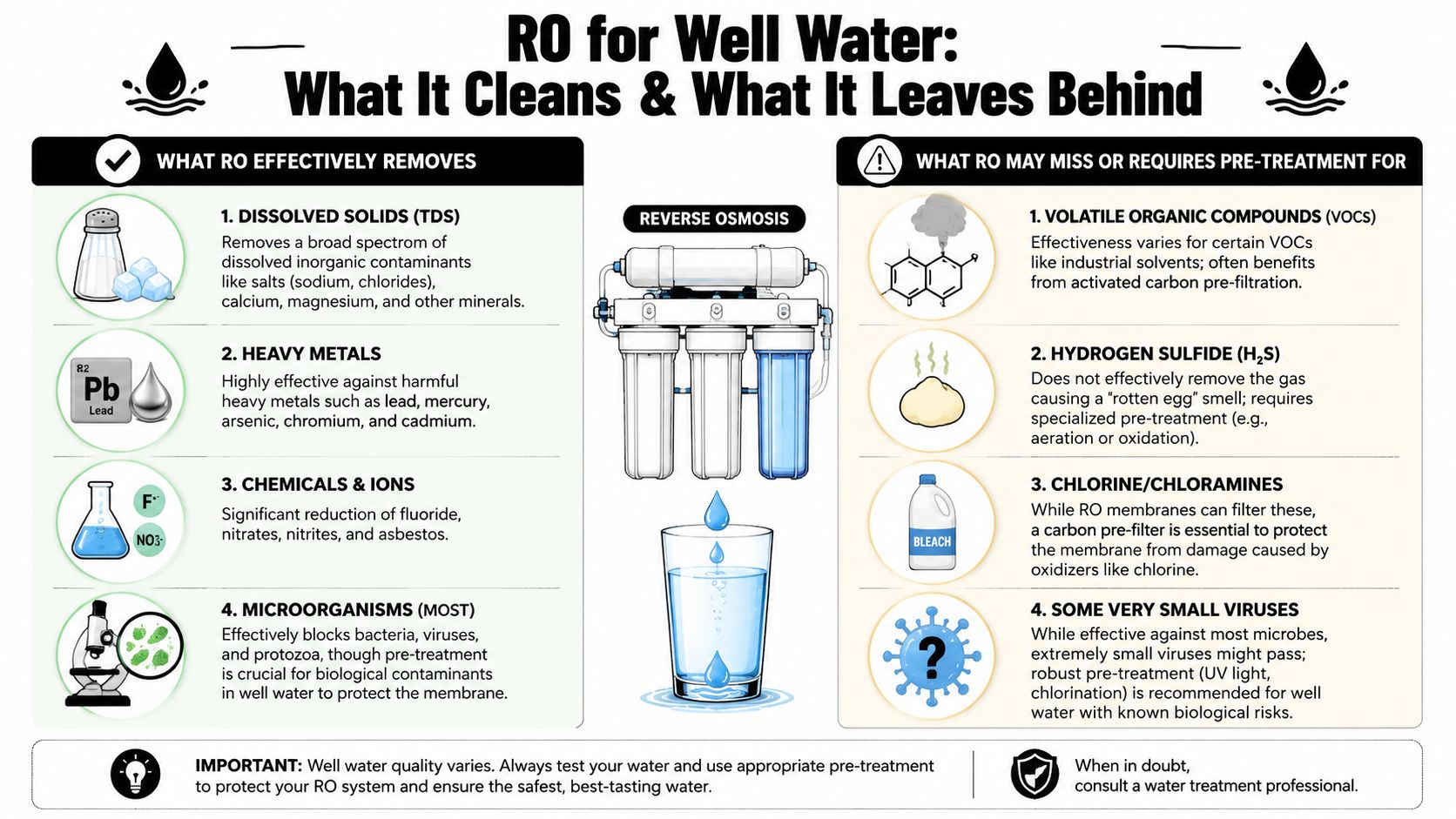
A properly designed RO system is used to reduce a broad range of dissolved contaminants in well water, including:
- Dissolved solids: Salts and mineral content that affect taste and water quality
- Heavy metals: Concerns such as lead and arsenic
- Problem ions: Fluoride and nitrates
- Many inorganic contaminants: The category RO is best known for
Reverse osmosis for well water distinguishes itself as a highly effective solution. If your main concern is what's dissolved in the water you drink, RO is often the right technology.
A good example is arsenic reduction. In a study of private well owners using RO for arsenic reduction, the average percent reduction was 79%. That's meaningful. But the same study also found that only 47% of homes got below the USEPA standard of 10 μg/L after treatment.
Where RO needs help
Here's what homeowners in Central Florida need to know. Some of the most annoying well water issues are not the things RO handles best on its own.
Hydrogen sulfide is a classic example. If you have rotten egg odor, the membrane isn't the first tool I'd reach for. That gas needs treatment before the RO stage. The same goes for heavy sediment loads, iron fouling, and hardness scale.
RO also depends on system integrity. If storage, plumbing, or upstream treatment is poor, the fact that the membrane is capable of fine filtration doesn't fix the whole installation.
RO is excellent at polishing water. It is not a substitute for correcting the well water conditions that attack the system before polishing can happen.
The practical divide
Homeowners usually get better results when they split the problem in two:
| Water issue | Best role for RO |
|---|---|
| Bad drinking water taste | Strong option |
| High dissolved minerals | Strong option |
| Arsenic or nitrate concern | Often appropriate with proper design |
| Rotten egg smell | Needs pre-treatment first |
| Iron staining | Needs pre-treatment first |
| Hard water scale | Needs pre-treatment first |
That's why testing matters. The same under-sink RO unit that works well on one home can struggle badly on another a few miles away. On a private well, the details matter more than the label on the box.
Why Pre-Treatment is Non-Negotiable for Florida Wells
For Central Florida homes, most RO discussions should begin with this.
If your well water has iron, sulfur, hardness, or sediment, pre-treatment is not an add-on. It's the difference between a system that performs and a system that clogs, scales, and burns through service parts. A lot of homeowners think they're shopping for an RO unit. In reality, they're shopping for a treatment train.
What local well water does to an RO system
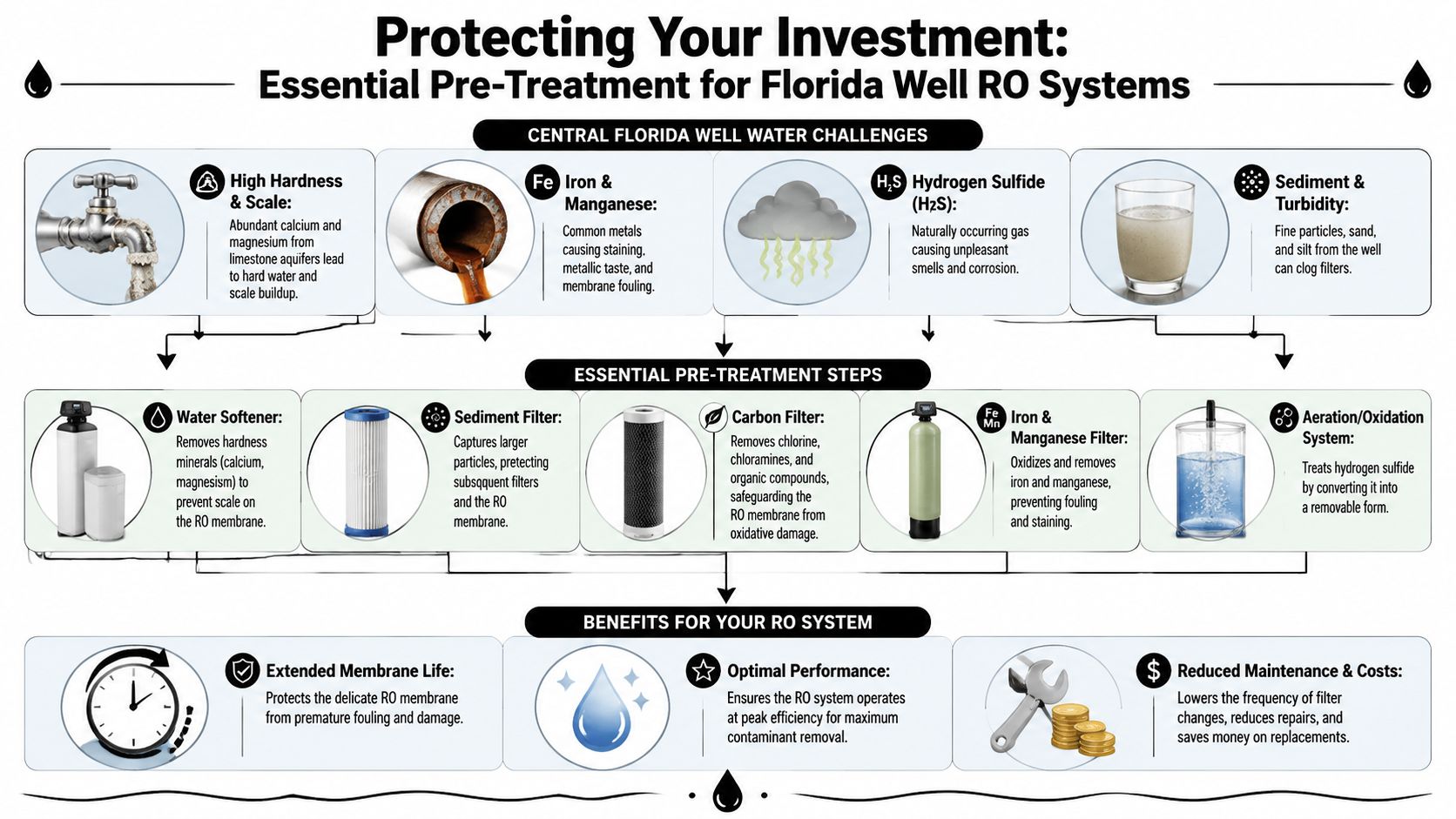
Iron doesn't just discolor fixtures. It can coat the membrane surface and foul the system. Sediment does its own damage by clogging pre-filters and restricting flow. Hardness causes scale, and scale is one of the fastest ways to choke off RO production.
For Florida wells, this shows up in a predictable pattern. The unit starts slower than expected, taste slips, the storage tank never seems full enough, and replacement intervals get shorter. Homeowners often blame the RO membrane first when the actual problem was untreated feed water.
According to Crystal Quest's RO filtration guidance, well water RO systems require a sediment filter in the 5–10 µm range and an activated carbon filter to protect the membrane. The same guidance states that when hardness is above 15 gpg, a water softener should be installed before the RO system to prevent scaling, which can reduce recovery rates by up to 30%.
The minimum equipment most Florida wells need
A proper setup often includes several pieces working together:
- Sediment filtration: This catches sand, silt, rust, and particulate matter before they hit finer stages.
- Iron treatment: If iron is present, it needs to be reduced before it reaches the membrane.
- Sulfur treatment: Rotten egg odor usually points to hydrogen sulfide, which calls for aeration, oxidation, or another dedicated treatment method.
- Water softening: Hardness needs to be removed upstream if you want reliable RO production.
- Carbon filtration: This stage helps protect the membrane and improve water quality before final purification.
If you're dealing with multiple issues, it helps to look at complete well water treatment solutions instead of trying to patch the problem one cartridge at a time.
Why standard under-sink RO systems fail on untreated wells
The mistake is easy to understand. A homeowner wants better drinking water, so they install a standard point-of-use RO system under the sink. It may run fine at first. Then the incoming well water starts doing what local well water does.
Iron builds film on the membrane. Hardness leaves scale behind. Sediment keeps loading the front end. Sulfur odor may still be present because the gas was never addressed upstream. The homeowner changes filters, but performance doesn't come back the way it should.
If your well water leaves stains, smells like sulfur, or builds scale on fixtures, a standalone RO unit is usually being asked to do work it was never meant to do by itself.
What actually works
The reliable approach is boring, and that's a good thing.
Test the water. Identify the load on the system. Match the pre-treatment to those conditions. Then let the RO membrane do the precision work it's good at. That's how reverse osmosis for well water holds up in Central Florida. Not by skipping the prep work, but by respecting it.
Choosing Your System Point-of-Use vs Whole-Home
Once the water chemistry is understood, the next decision is about scope. Do you want purified water at one faucet, or do you want treated water protecting the whole house?
Those are two different jobs.
Point-of-use solves the drinking water problem
A point-of-use (POU) RO system usually sits under the kitchen sink. It's built for drinking and cooking water. For many households, that's enough. If your main concern is the water you consume, a POU system can make sense.
The trade-off is efficiency and coverage. A typical point-of-use RO system can generate 5 or more gallons of reject water for every 1 gallon of treated water, according to the University of Nebraska-Lincoln Extension overview of RO systems. That doesn't make POU wrong. It means you should go into the decision with realistic expectations.
Whole-home treats the house, not just the glass
A whole-home (POE) approach treats water as it enters the property. That matters if your problems go beyond drinking water.
If scale is wrecking water heaters, if iron is staining tubs and toilets, or if sulfur odor shows up in showers and laundry, a whole-home strategy usually makes more sense. In many Florida homes, that means pairing softening and specialty filtration at the main line, then adding RO at the kitchen sink only if you want higher-purity drinking water on top of housewide treatment.
If hardness is part of the problem, it's smart to understand your options for water softening systems before deciding that an RO unit alone will solve the entire issue.
Point-of-Use vs. Whole-Home Reverse Osmosis
| Feature | Point-of-Use (POU) System | Whole-Home (POE) System |
|---|---|---|
| Primary purpose | Drinking and cooking water at one location | Treatment for water used throughout the home |
| Best fit | Homeowners focused on taste and consumption | Homes with staining, scale, odor, and plumbing protection needs |
| Installation footprint | Small, usually under a sink | Larger equipment area required |
| Water coverage | One faucet or a limited number of outlets | Entire home |
| Maintenance style | Simpler, but still requires routine service | More involved because multiple treatment stages may be present |
| Water waste concern | Higher concern with standard residential RO reject flow | Depends on system design and whether RO is used at the main line or as a final drinking-water stage |
| Typical homeowner goal | Purified kitchen water | Protected plumbing everywhere |
The right choice depends on what you're trying to fix. Bad drinking water points toward POU. Housewide staining, odor, and scale point toward upstream treatment, often with RO reserved for a dedicated drinking line.
Installation Maintenance and Long-Term Costs
A reverse osmosis system isn't a set-it-and-forget-it appliance. It's water treatment equipment, and the installation matters as much as the hardware.
Installation gets more technical on well water
A basic under-sink system is one thing. A well water setup with pre-treatment, storage, pressure requirements, and drain connections is another. If the house has iron, sulfur, or heavy hardness, the equipment has to be installed in the right order and sized to the actual water conditions.
Pressure is a common problem on well systems. If the dissolved solids are high enough, the RO unit can struggle badly even when everything else looks normal. According to WCP Online's guidance on RO performance, a booster pump becomes essential when well water TDS exceeds 500 ppm. In Florida, brackish wells often cross that threshold.
That means a homeowner may think they're buying “an RO system,” but the actual installation may also need a booster pump, pretreatment tanks, bypass valves, shutoffs, drain routing, and space for service access.
Maintenance is routine, not optional
Owning an RO system means planning for service. Filters load up. Membranes foul over time. Tanks, valves, and fittings need inspection. If your well water changes seasonally or after heavy rain, the maintenance picture can change with it.
A practical maintenance mindset looks like this:
- Watch performance: Slower production, taste changes, and weak flow usually show up before complete failure.
- Service pre-treatment first: Many RO complaints start upstream.
- Inspect for scale or fouling: If hardness and iron control slip, the membrane pays for it.
- Retest water when conditions change: Well water isn't always stable.
The cost question homeowners should ask
The right question isn't just “What does the unit cost?” It's “What will this system need to keep working?”
That includes:
- Initial equipment
- Professional installation
- Pre-treatment components
- Replacement filters and service parts
- Possible booster pump requirements
- Ongoing maintenance visits
Cheap RO equipment on bad well water often turns into expensive maintenance. Well-designed systems usually cost more upfront because they include the protection stages that keep the membrane alive.
For a homeowner, the practical rule is simple. Budget for ownership, not just purchase. Reverse osmosis for well water can be an excellent investment, but only when the full system is installed to match the water, not the other way around.
Your Well Water Decision Checklist and Next Steps
If you're trying to decide whether reverse osmosis makes sense for your well, use a simple checklist.
Ask these questions before you buy anything
- What problem am I solving? Drinking water taste, staining, sulfur odor, scale, or all of the above?
- Do I need purified water at one tap or treatment across the house?
- Has the well water been tested recently?
- Do I have signs of iron, sulfur, sediment, or hardness that could damage an RO system?
- Am I prepared for ongoing maintenance, not just installation?
- If pressure or dissolved solids are high, is the system being designed to handle that?
If you can't answer those questions clearly, you're not ready to choose equipment yet.
Don't guess with well water
Well water treatment goes wrong when homeowners buy hardware before they know their water profile. That's how people end up with sulfur smell still present, iron staining unchanged, or an RO membrane that fouls too quickly.
The safer move is to start with testing, then match the treatment stages to the actual water conditions. If you want to explore options for a local water filtration system in Sebring, FL, start with the water itself before making any system decision.
A well-designed RO setup can produce excellent drinking water. A poorly matched one becomes a maintenance project.
Florida Water Management helps Central Florida homeowners get clear answers before they buy equipment. If you're dealing with staining, sulfur odor, hard water, or concerns about what's in your drinking water, schedule a free water test through Florida Water Management. It's the best first step if you want a system that properly fits your well water.