

You're probably dealing with one of these Central Florida water headaches right now.
Your city water smells a little like chlorine when you fill a glass at the kitchen sink. Your well water has that rotten egg smell that hits the moment the shower starts. Your dishwasher leaves spots on glasses no matter what rinse aid you buy. Or your coffee tastes flat even though you're using the same beans.
That's usually the point where homeowners start comparing reverse osmosis vs filtered water and get buried in vague advice. One website says a basic filter is enough. Another acts like every house needs reverse osmosis. Neither answer helps if your real issue is sulfur, hardness, sediment, iron, or something dissolved in the water that you can't see.
Here's the blunt answer. Neither system is automatically “better.” The right choice depends on what's in your water and where the problem shows up. A standard filtration system can be the smart move for taste, odor, and whole-home comfort. A reverse osmosis system can be the right tool when you want much deeper contaminant reduction at the drinking tap.
If you're in Sebring, Avon Park, Lake Wales, Winter Haven, Frostproof, or nearby, that distinction matters more than most national guides admit. Central Florida homes often deal with a mix of municipal treatment issues and private well problems, and those require different solutions. If you're already looking at a water filtration system in Sebring, FL, don't guess based on marketing. Start with a proper water analysis so the system matches the water.
Table of Contents
- Is Your Tap Water Really as Clean as It Looks
- Understanding the Core Filtration Technologies
- A Side by Side Comparison of Water Treatment Systems
- Solving Central Floridas Specific Water Challenges
- Health Considerations Demineralization and Remineralization
- Which System Is Right for You Recommended Use Cases
- Take the First Step to Perfect Water in Your Home
Is Your Tap Water Really as Clean as It Looks
A lot of homeowners assume clear water means clean water. That's the mistake.
A glass can look fine and still taste off, smell odd, leave residue on fixtures, or create long-term frustration with appliances and plumbing. In Central Florida, that happens all the time. Municipal water may arrive disinfected but still leave a noticeable taste or odor. Private well water may come out clear one day and carry sulfur, sediment, or staining minerals the next.
What homeowners usually notice first
The first signs are rarely dramatic. They're annoying.
- Taste problems often show up in coffee, tea, ice, and drinking water straight from the tap.
- Odor issues are common in showers, kitchen sinks, or hot water lines.
- Residue and spotting show up on faucets, shower glass, and dishes.
- Laundry and bathing complaints creep in when water feels harsh or leaves fabrics stiff.
Those symptoms point to different causes. That's why buying a random pitcher filter or an under-sink unit without testing the water first usually leads to disappointment.
The system that fixes chlorine taste won't necessarily fix sulfur odor, hardness, iron staining, or dissolved contaminants in drinking water.
The clean-looking water trap
Homeowners with city water often focus on taste and smell. Homeowners on wells often deal with a more complex mix of sediment, minerals, odor, and possible microbial concerns. Both groups make the same mistake when they shop by product category instead of water profile.
If your concern is every faucet, shower, and appliance in the house, a broad filtration strategy may make more sense. If your concern is the water you drink and cook with, reverse osmosis may be the smarter option. If you're dealing with multiple issues, the right answer may be a combination.
That's why the first real step isn't picking equipment. It's identifying the actual problem in the water.
Understanding the Core Filtration Technologies
Most confusion around reverse osmosis vs filtered water comes from one problem. People use the word “filter” to describe systems that work in completely different ways.
What standard filtered water systems do well
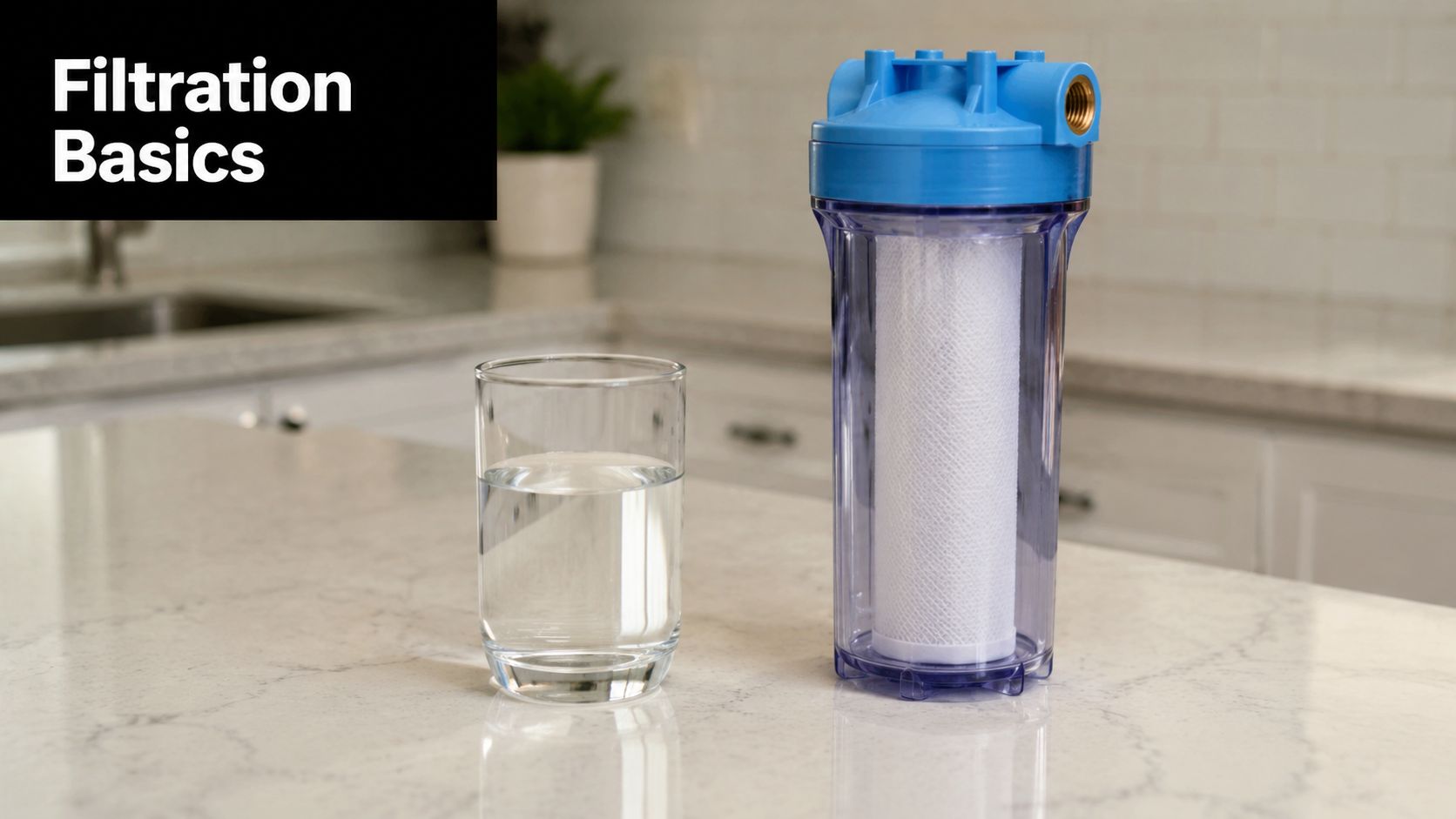
A conventional filtered water system usually relies on media such as carbon or sediment filtration. Think of it as trapping, screening, or adsorbing unwanted material as water passes through.
Sediment filters catch visible particles like dirt, rust, and debris. Carbon filters are commonly used to improve taste and odor and reduce certain chemicals. They're practical, straightforward, and often ideal when the goal is better everyday water throughout the home.
That's why filtered water systems are so often used for showers, laundry, dishwashing, and whole-home treatment. They can improve water quality without slowing everything down to a trickle.
What reverse osmosis actually does
Reverse osmosis is different. It's a membrane separation process, not just a basic trap. The U.S. EPA describes point-of-use RO as a system that forces water through a semi-permeable membrane, producing treated water and reject water, and notes that typical residential units can generate five gallons or more of reject water for every gallon of treated water on its point-of-use reverse osmosis systems page.
A technical summary from Brother Filtration's explanation of filtration versus reverse osmosis puts the core distinction clearly. Reverse osmosis is a pressure-driven membrane process that removes dissolved contaminants as well as suspended particles, while conventional filtered water systems mainly trap particles and some chemicals but do not remove dissolved salts, minerals, or many metals.
Practical rule: If your main concern is something dissolved in the water, not just something floating in it, reverse osmosis belongs in the conversation.
For many homes, that makes RO the better choice at the kitchen sink. If you want a closer look at how these systems are used in residential settings, see this guide to reverse osmosis systems.
A Side by Side Comparison of Water Treatment Systems
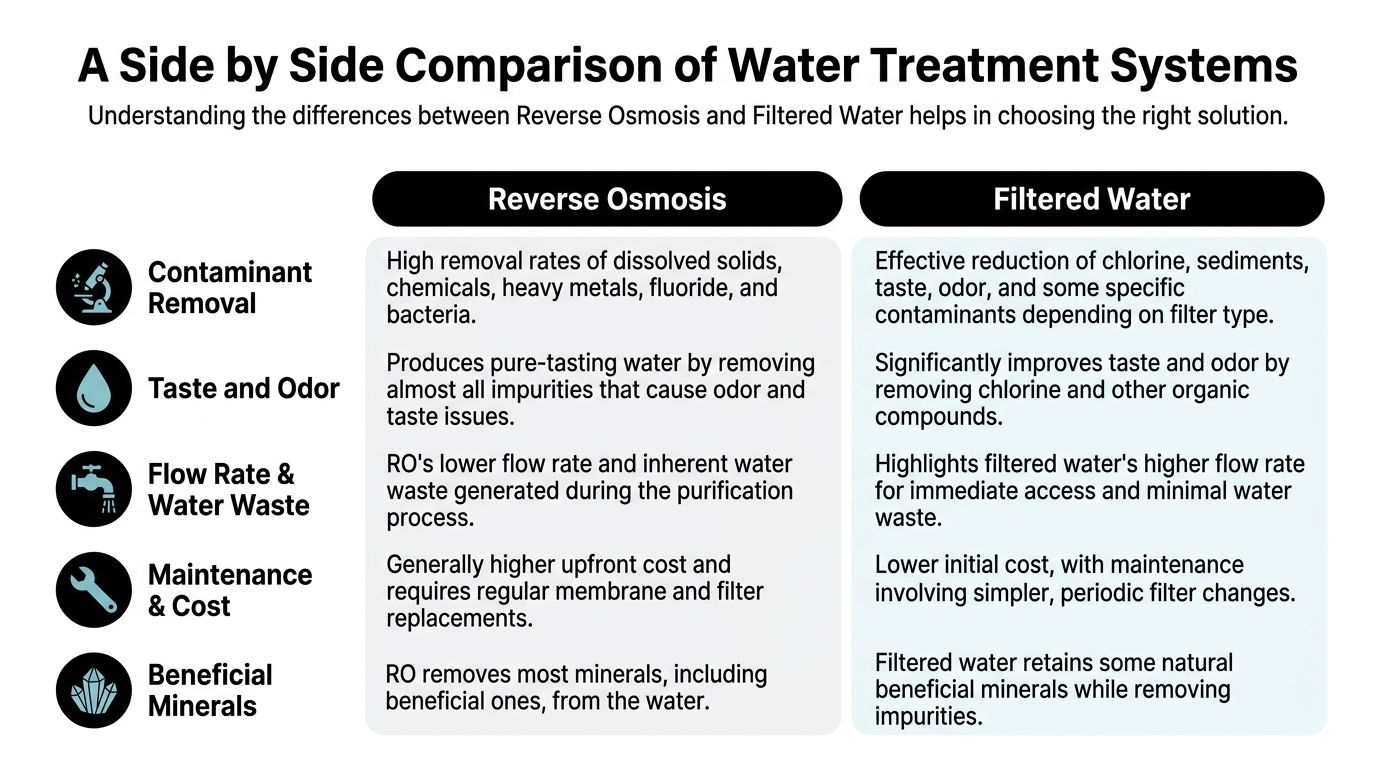
Start with the problem in your house. If your water smells like chlorine, leaves grit in fixtures, or tastes off across the whole home, standard filtration usually makes more sense. If your concern is what is dissolved in the water you drink at the kitchen sink, reverse osmosis is the better tool.
Quick comparison table
| Criteria | Filtered Water | Reverse Osmosis |
|---|---|---|
| Primary method | Carbon or sediment media that traps or adsorbs contaminants | Pressure-driven membrane separation |
| Best use | Whole-home improvement, taste, odor, sediment reduction | Drinking and cooking water with broader contaminant reduction |
| Dissolved contaminants | Limited | Stronger option |
| Flow | Better for general household use | Slower, usually point-of-use |
| Waste water | Minimal in typical setups | Produces reject water |
| Mineral retention | Retains more of the original mineral content | Removes much more mineral content |
| Typical placement | Whole-house or point-of-use | Most often under the sink |
Contaminant removal
This is the clearest dividing line.
If your water issue is chlorine, musty taste, sulfur odor, or visible sediment, filtration is often the right first move. If the concern is dissolved solids, salts, or other dissolved contaminants, reverse osmosis gives you a much deeper level of treatment at one tap.
Nebraska Extension states that home RO membranes are typically used to reduce total dissolved solids and suspended particles, and that a home RO system commonly produces only 10 to 35 gallons per day on its home reverse osmosis treatment publication. That is why RO belongs at the kitchen sink, not as the main answer for every fixture in the house.
For most Central Florida homes, filtration handles broad water quality problems. RO handles high-priority drinking water problems.
Taste and odor
Many city-water customers in Central Florida are chasing better taste, not laboratory-grade water. A carbon-based filter usually fixes that faster and with less hassle.
RO improves taste too, but that is not its main advantage. Its value is stronger reduction of dissolved material that standard filters leave behind. On municipal water, that can be a smart upgrade for drinking and cooking. On private wells, it often needs pre-treatment first because iron, sediment, and sulfur can foul the system.
Flow rate and water waste
This trade-off matters in real life.
Filtered water systems are better for normal household demand. They keep up with showers, laundry, dishwashing, and outdoor use without depending on a small storage tank.
RO is slower by design. Nebraska Extension notes that many residential systems make 10 to 35 gallons per day. As noted earlier from the EPA source already cited in this article, point-of-use RO also creates reject water, though higher-efficiency models reduce that waste compared with older designs.
Installation and maintenance
Whole-home filtration is usually simpler to size and maintain, especially on Central Florida water where the issue affects the entire house. That includes municipal chlorine, sand or sediment, and nuisance odors.
RO needs cleaner feed water to perform well. On a private well, that often means handling sediment, iron, hardness, or sulfur before the water reaches the membrane. Skip that step and you shorten membrane life, increase service needs, and get disappointing performance.
RO is not a rescue system for neglected well water. It is the finishing step after the upstream water problems are under control.
Lifetime cost and value
Buy the system that matches the problem.
A whole-home filtered water system usually gives better value when the complaints involve showers, laundry, fixtures, appliances, and everyday water use throughout the house. RO earns its keep when your top priority is cleaner water for drinking, ice, coffee, baby formula, and cooking.
For many Central Florida homeowners, the best answer is not filtration versus RO. It is filtration for the house, plus RO at the sink when dissolved contaminants are the concern. That is the setup that solves the problem instead of forcing one device to do a job it was never meant to do.
Solving Central Floridas Specific Water Challenges
You move into a Central Florida home, the water looks clear, and within a few weeks the clues show up. White scale on the shower glass. Orange stains in the toilets. A rotten egg smell at one sink that turns into a whole-house problem by the weekend. That is why generic advice fails here. Central Florida water needs to be treated based on the source and the symptom.
Hard water and scale
Hard water is one of the biggest complaints on both city water and wells in this area. Homeowners usually notice the aftermath first. Spotty dishes, crusted fixtures, reduced appliance life, and soap that never seems to rinse clean.
Reverse osmosis helps at a single drinking tap. It does not protect the rest of the house. If scale is building up on faucets, shower doors, water heaters, and washing machines, the fix is whole-home treatment. In many homes, that means pairing filtration with a water softener installation in Lake Wales, FL.
Iron and staining
Iron is a common well-water issue across Central Florida, and it shows up fast. Rust-colored staining in sinks and tubs is the usual giveaway. Laundry damage and metallic taste often follow.
Treat iron before it reaches the fixtures and equipment you care about. An under-sink RO system has a role for drinking water, but it should not be the first tool you use for iron-heavy well water. If you start there, you protect one faucet and leave the main problem in place.
Sulfur odor and well water smell
If your water smells like rotten eggs, treat that as a house-wide water quality issue until proven otherwise. The smell may come from sulfur compounds in the well, bacteria in the plumbing, or reactions inside the water heater.
A point-of-use filter will not solve an odor problem in showers, hot water, and multiple fixtures. You need the source identified first, then matched to the right treatment. That may involve oxidation, filtration, disinfection, or water heater correction.
If the smell shows up in more than one place, start with whole-home diagnosis, not a gadget under the kitchen sink.
Microbial concerns in private wells
Private wells need a different standard of care than municipal water. City water arrives disinfected. Well water puts the testing and treatment burden on the homeowner.
As noted earlier, the EPA explains that point-of-use RO can reduce certain contaminants, including some germs and chemicals, when the system is chosen for the specific problem. That matters in Central Florida because well issues are often layered. Sediment, iron, sulfur, hardness, and potential microbial concerns can all exist in the same water supply.
RO can be a smart finishing step for drinking and cooking water. It is rarely the full answer on a private well. If testing shows broader contamination risks, build the treatment train correctly from the front end. Start with the well's real problems, then add RO where it makes sense.
Health Considerations Demineralization and Remineralization
Why people ask about mineral removal
A lot of homeowners hesitate on RO for one reason. They've heard it removes minerals, so they worry the water is somehow unhealthy.
That concern is understandable, but it usually gets oversimplified. In practice, people don't rely on drinking water as their main source of essential nutrition. Food does the heavy lifting there. What minerals in water often affect most noticeably is taste.
Some people love the clean, stripped-down taste of RO water. Others think it tastes flatter than filtered water that still contains more of the original mineral profile. That isn't a right-or-wrong issue. It's preference.
When remineralization makes sense
If you want the broader contaminant reduction of reverse osmosis but don't like the taste of highly demineralized water, remineralization is a practical add-on. It's installed after purification and adjusts the character of the finished water.
That can make the water taste more balanced to some homeowners. It can also help if you want a less “empty” taste from your drinking water.
Here's the practical advice. Don't reject RO because you're worried about minerals, and don't assume you need remineralization because someone on the internet said so. Choose based on your water, your taste preferences, and your treatment goals.
- If purity is your top priority, RO makes sense even without a remineralization stage.
- If taste is your sticking point, remineralization may improve your experience.
- If you mostly want better flavor and odor, a standard filtration system may already do the job without removing as much mineral content.
Which System Is Right for You Recommended Use Cases
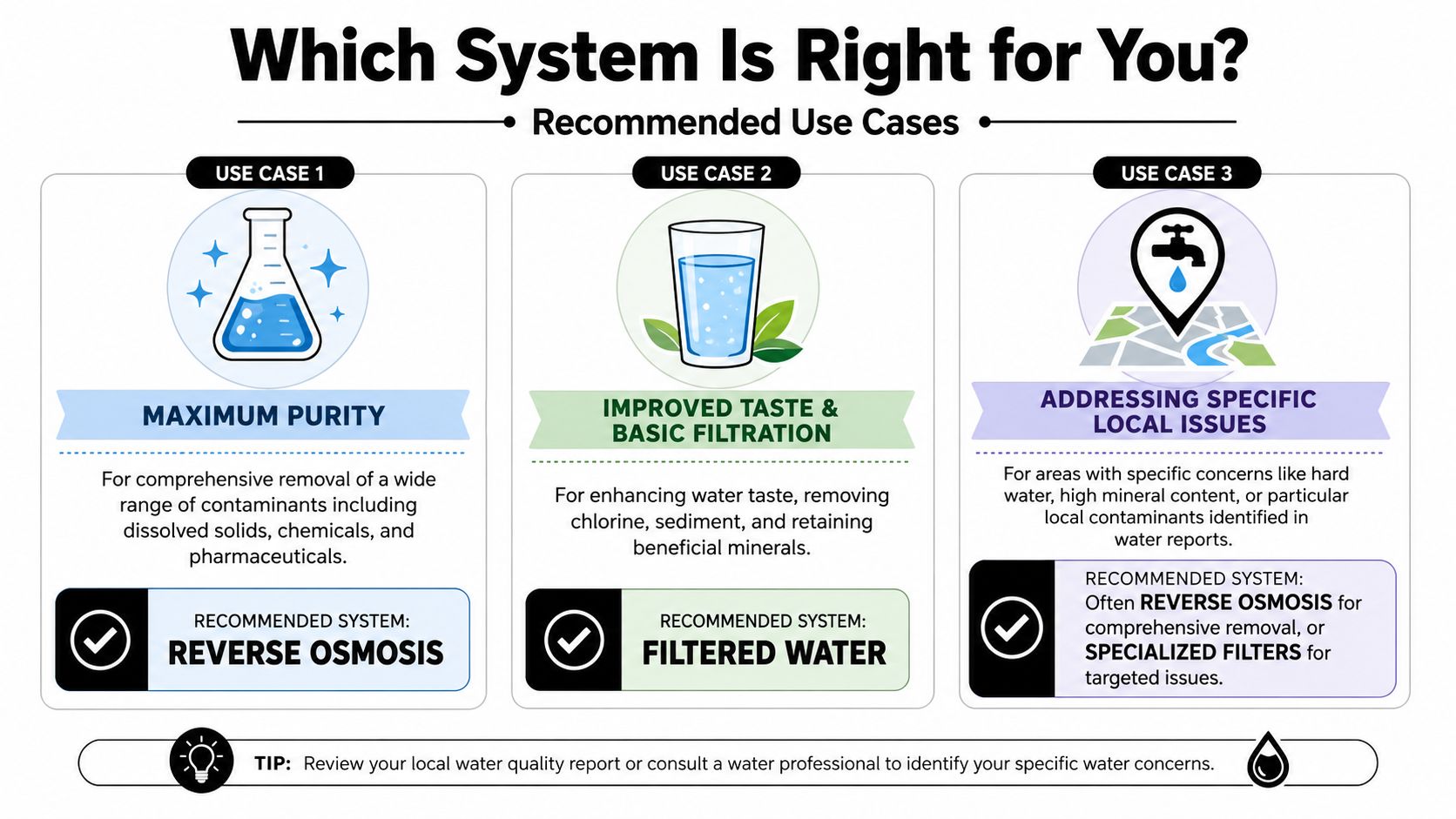
Most homes don't need a lecture. They need a clear recommendation.
Choose filtered water when
A standard filtered water system is usually the right pick when your complaints are broad, visible, and daily.
Use it when:
- You want better taste and odor throughout the home. This is common with municipal water that smells or tastes treated.
- You need sediment reduction. That matters for fixture performance and overall water clarity.
- You care about showers, laundry, and appliances. Whole-home treatment helps where point-of-use systems can't.
If your main complaint is “I don't like my tap water,” filtered water is often the first place to look.
Choose reverse osmosis when
Reverse osmosis is the better choice when your concern is deeper drinking-water purification, not just general improvement.
Choose RO when:
- You want stronger reduction of dissolved contaminants at the kitchen tap.
- You're on a private well and want a more protective drinking-water solution.
- You cook a lot and want higher-purity water for beverages, soups, sauces, and ice.
If your question is “What's the cleanest water I can drink from my tap?” RO is usually the answer.
Choose both when you want the best setup
For many Central Florida homes, the strongest setup isn't reverse osmosis vs filtered water. It's reverse osmosis and filtered water doing different jobs in the same house.
Use whole-home treatment to improve water for bathing, cleaning, plumbing, and appliances. Add under-sink RO for the drinking and cooking water that needs deeper treatment. That combination solves more problems without forcing one system to do a job it wasn't built for.
Most water issues become easier to solve when you stop looking for one magic product and start matching each tool to the part of the house it should serve.
If you're still unsure, that's normal. Most homeowners can't identify the correct system by taste alone. A proper water test is what turns this from guesswork into a clear decision.
Take the First Step to Perfect Water in Your Home
The decision is simple once you strip away the noise.
Filtered water is usually the better fit when you want to improve taste, odor, sediment, and overall water quality across the home. Reverse osmosis is the stronger option when you want much broader contaminant reduction for drinking and cooking water at a specific tap.
What you shouldn't do is guess.
If your Central Florida home has chlorine taste, sulfur odor, spotting on dishes, staining, scale, or concerns about well water quality, the right system depends on the water itself. Not on a box at a hardware store. Not on a generic online quiz. And not on what worked for your neighbor across town.
A professional water analysis gives you the answer quickly. It tells you whether you need a whole-home filtration system, reverse osmosis at the sink, a softener, pre-treatment for well issues, or a combination that matches your house.
That's the step that saves time, avoids buying the wrong equipment, and gets you to water that tastes better, works better, and causes fewer problems every day.
If you want a clear answer instead of a sales pitch, schedule a free water test with Florida Water Management. Their team can evaluate your home's water, explain what's causing the taste, odor, staining, or buildup, and recommend a system that fits your water and your budget.