

Most advice about a salt-free water softener in Riverview, FL skips the one detail that matters most. A salt-free unit usually isn't a true softener at all.
That sounds picky, but it changes what you should expect in your home. If you're hoping for less scale on fixtures, cleaner plumbing, and lower maintenance, a salt-free system may be a smart fit. If you're expecting slippery bath water, complete hardness removal, or a fix for iron and sulfur in well water, that's a different conversation.
Riverview homeowners deal with familiar hard water headaches. Cloudy spots on glass. White crust around faucets. Mineral buildup that makes appliances work harder. The right solution depends on your water source and your actual water chemistry, not the label printed on the tank.
Table of Contents
- The Truth About Salt-Free Water Softeners
- How Salt-Free Water Conditioners Actually Work
- Salt-Free Conditioner vs Traditional Salt-Based Softener
- Cost and Maintenance What to Expect in 2026
- Is a Salt-Free System Right for Your Riverview Home
- Your Suitability Checklist and Recommended Next Step
- Your Questions About Salt-Free Systems Answered
The Truth About Salt-Free Water Softeners
The phrase salt-free water softener is popular because it sounds simple. It also creates a lot of disappointment.
The more accurate term is salt-free water conditioner. That distinction matters because these systems don't remove hardness minerals from water. They change how those minerals behave so they're less likely to stick to plumbing surfaces and form scale. That's the gap many articles gloss over, and it's why some homeowners in Riverview buy one system while expecting the results of another, as explained in this breakdown of salt-free softeners versus conditioners.
Why the name matters
A traditional softener removes hardness minerals through ion exchange. A salt-free conditioner doesn't do that. It targets scale prevention, not total hardness removal.
That means a homeowner can install a salt-free system and still notice some signs of hard water they thought would disappear. Water may not feel "soft" in the classic sense. Some spotting can remain. Soap may not behave the way it does with a true salt-based softener.
Practical rule: If your goal is "stop scale," a conditioner may fit. If your goal is "make hard water become soft water," the wording on the brochure matters a lot.
This isn't a knock on salt-free technology. It's a reminder to match the tool to the problem. For plenty of homes, especially where low maintenance and no added sodium are priorities, conditioning can be a very sensible approach.
A simple way to avoid the wrong purchase
Before comparing brands or tank sizes, answer these questions:
- What bothers you most: Is it scale on fixtures and appliances, or the feel of the water on skin and laundry?
- What water source do you have: City water and private well water create very different system needs.
- What else is in the water: Iron, sulfur, sediment, and chlorine require different treatment steps.
The right answer starts with your water test, not with a marketing claim.
How Salt-Free Water Conditioners Actually Work
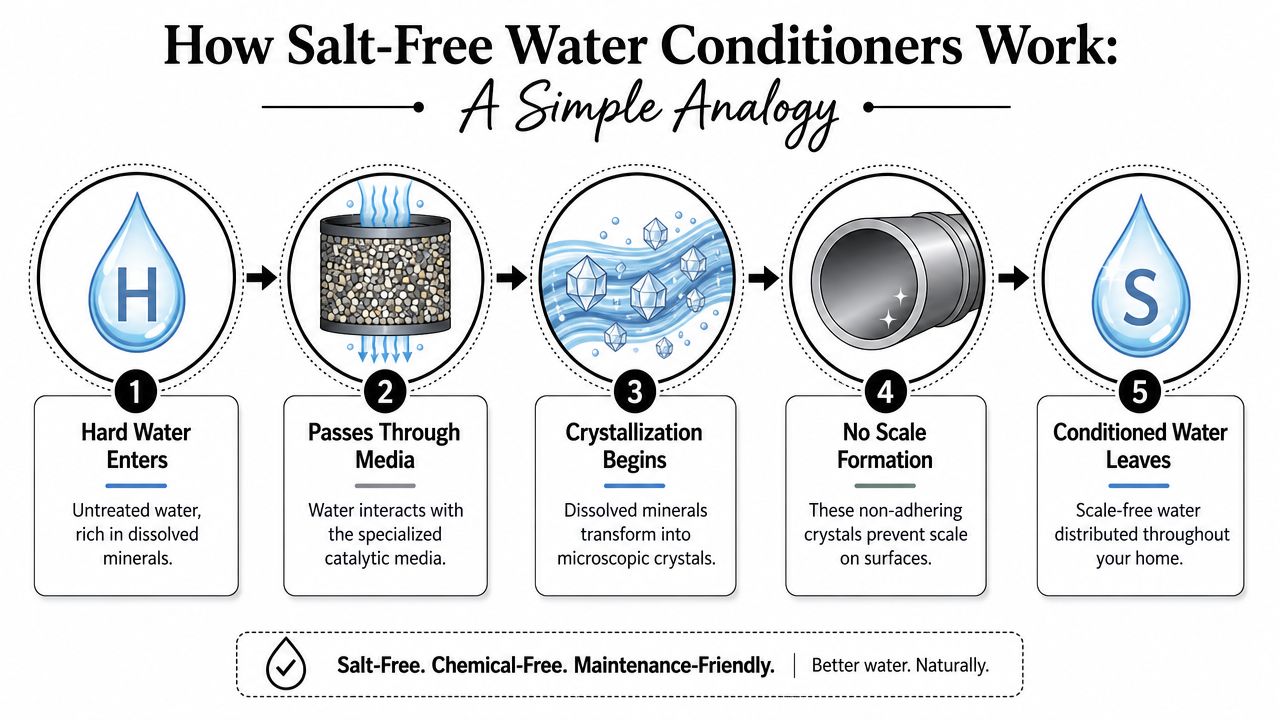
A salt-free conditioner works by changing the form of hardness minerals as water passes through special media inside the tank. The most common technology is Template Assisted Crystallization, often shortened to TAC.
Why the name matters
Here is the key scientific point. A salt-free conditioner does not physically remove calcium and magnesium. Instead, it transforms those hardness minerals into microscopic, stable crystals that can't easily cling to pipes, fixtures, and appliance components. TAC-based systems leave 100% of the calcium and 100% of the magnesium in the water while changing how those minerals interact with surfaces, according to this explanation of TAC water conditioner technology.
That's why post-treatment water still tests as hard. The mineral content remains. What changes is the minerals' tendency to build scale.
A simple way to picture TAC media
Think of dissolved hardness minerals like tiny particles that want to settle onto hot metal and plumbing surfaces. TAC media nudges those minerals into a crystal form that behaves more like non-stick dust than stubborn crust.
A simple mental model looks like this:
- Hard water enters the tank.
- Water passes across specialized media.
- The minerals form microscopic crystals.
- Those crystals stay suspended and pass through the plumbing.
- Scale buildup becomes much less likely on surfaces.
This is why people often report cleaner plumbing components and less mineral crust on appliances, even though the lab reading for hardness doesn't suddenly drop.
Salt-free conditioning is a scale-control technology, not a mineral-removal technology.
That difference also explains what these systems don't do. They don't remove chlorine, sediment, heavy metals, or iron on their own. They also don't create the slippery feel associated with fully softened water. If a home has more than one water issue, a conditioner may need to be paired with other treatment equipment.
Salt-Free Conditioner vs Traditional Salt-Based Softener
These two systems solve hard water in different ways. One changes mineral behavior. The other removes hardness minerals from the water.
That sounds like a technical distinction, but it affects everyday life in the kitchen, laundry room, shower, and mechanical room.
What changes in your water
A salt-free conditioner is usually best understood as a scale-management tool. It helps protect plumbing and appliances from mineral buildup while keeping calcium and magnesium in the water. Many homeowners like that because there are no salt bags to haul and no brine discharge involved.
A salt-based softener uses ion exchange to remove hardness minerals. That's the system people usually mean when they talk about water that feels soft, helps soap lather differently, and leaves less mineral residue overall.
The water experience is different in practical terms:
- Water feel: A salt-based softener changes the feel of water more noticeably. A salt-free conditioner generally doesn't create that silky or slippery effect.
- Scale control: A conditioner is designed specifically to reduce scale formation. A salt-based unit addresses scale by removing the minerals that cause it.
- Maintenance routine: Salt-free systems are simpler for many households. Traditional softeners require ongoing salt refills and periodic upkeep.
- Environmental profile: Some homeowners prefer salt-free systems because they avoid salt discharge.
- Other water problems: Neither approach should be treated as a universal fix for every contaminant. If you also have chlorine, iron, sulfur, or sediment, separate treatment may be needed.
Some Riverview homeowners don't need "soft" water. They need less scale and less maintenance. Those are not the same goal.
Salt-Free Conditioner vs. Salt-Based Softener at a Glance
| Feature | Salt-Free Water Conditioner | Salt-Based Water Softener |
|---|---|---|
| Core process | Conditions minerals to reduce scale adhesion | Removes hardness minerals through ion exchange |
| Calcium and magnesium | Remain in the water | Removed from the water |
| Water feel | More like normal water | More likely to feel traditionally soft |
| Scale protection | Designed to prevent minerals from sticking as scale | Reduces scale by removing the minerals that cause it |
| Salt required | No | Yes |
| Regeneration cycle | No salt regeneration | Requires regeneration |
| Best fit | Homeowners focused on scale reduction and low maintenance | Homeowners who want true soft water results |
| Well water with iron or sulfur | Usually needs pretreatment and may not be suitable alone | May still need separate treatment for non-hardness contaminants |
A good decision comes down to expectations. If you want fewer service chores and your main issue is scale, salt-free conditioning has real appeal. If you want hardness removed and want the classic soft water feel, a traditional softener is usually the better match.
Cost and Maintenance What to Expect in 2026
Sticker price alone doesn't tell you much. The better question is what the system costs to own and live with over time.
Upfront cost vs ownership cost
For 2026 projections, salt-free systems range from $800 to $4,000 upfront, while salt-based systems start around $1,500 for installation. The bigger cost difference often shows up later. Salt-free annual maintenance is typically $60 to $170, while salt-based systems run $150 to $900 annually for maintenance, plus ongoing salt purchases. The same comparison notes that salt-free options often become more economical after 3 to 5 years, based on this 2026 cost comparison for salt-based and salt-free softeners.
That long-term math matters in Riverview because many homeowners focus on monthly hassle just as much as the day-one invoice.
What maintenance really looks like
A salt-free conditioner is often attractive because the main tank doesn't usually demand much attention. In many setups, the recurring task is changing a sediment pre-filter on schedule.
A traditional salt-based softener asks more from the homeowner. Salt has to be purchased, lifted, poured, and monitored. The system also needs periodic checks to keep the regeneration process working the way it should.
If you already own a conventional unit, this guide on how to maintain a water softener gives a helpful overview of the kinds of upkeep those systems need.
Here's the practical difference in day-to-day ownership:
- Salt-free system: Lower-touch upkeep, fewer recurring purchases, simpler routine.
- Salt-based system: More hands-on, more consumables, more ongoing attention.
Budget tip: Compare the maintenance you can tolerate, not just the installation quote you'll pay once.
For some families, that convenience alone makes a salt-free option attractive. For others, true softness is worth the extra chores. Cost isn't just dollars. It's also time, effort, and how much system management you want to do.
Is a Salt-Free System Right for Your Riverview Home
A lot of Riverview homeowners start with the wrong question. The question is usually, "Which salt-free water softener should I buy?" The better question is, "Do I need a softener at all, or am I really looking for a conditioner?"
That distinction matters in Riverview because our water often has enough hardness to cause scale, but the rest of the water chemistry can change the right answer completely.
Why local water conditions matter
A salt-free unit does not remove hardness minerals the way a traditional softener does. It conditions them so they are less likely to stick and form hard scale. For a homeowner, that usually means less buildup on fixtures and appliances, but not the classic slippery feel of softened water.
So the first checkpoint is your actual hardness level. If you have never tested it, start with this guide to understanding your home's water hardness level. It gives you a practical baseline before you compare equipment.
That simple test clears up a lot of marketing confusion.
If your water falls into a reasonable range for salt-free treatment, a conditioner may do exactly what you want. If hardness is severe, or if you expect true soap lather and spot reduction like a salt-based softener provides, a salt-free system can feel disappointing even when it is working as designed.
Well water changes the decision even more
This is the part many general articles skip. In Central Florida, private well water often brings more than hardness. Iron, manganese, sulfur odor, and sediment are common troublemakers, and a salt-free conditioner is not built to solve those by itself.
A good way to picture it is a kitchen setup. If your main problem is mineral scale, a conditioner may be the right tool. If your water also has staining, rotten-egg smell, or grit, you are dealing with several separate problems, and one tank usually cannot handle all of them.
That is why many well-water homes need a treatment train instead of a single device. A Florida-focused overview of choosing the right system for well water homes explains why pretreatment is often needed before any conditioner or softener can perform well.
Here is the practical way I would frame it for a Riverview homeowner:
- City water, mostly hardness, scale on fixtures: A salt-free conditioner may be a sensible fit.
- Well water with iron stains or sulfur smell: You likely need filtration or pretreatment before considering salt-free conditioning.
- Hard water plus multiple symptoms: A traditional softener, a filter system, or a combination setup may make more sense than a single salt-free tank.
For well water, hardness is only part of the story.
A salt-free system can be a smart choice for the right Riverview home, especially if your goal is scale control with less upkeep. But if you are on a well, the softener versus conditioner question becomes much more important, because the wrong match can leave the actual water problems untouched.
Your Suitability Checklist and Recommended Next Step
A lot of Riverview homeowners get sold on the phrase "salt-free softener" before anyone explains the bigger question. Do you need softer water, or do you need help controlling scale? Those are related problems, but they are not the same problem.
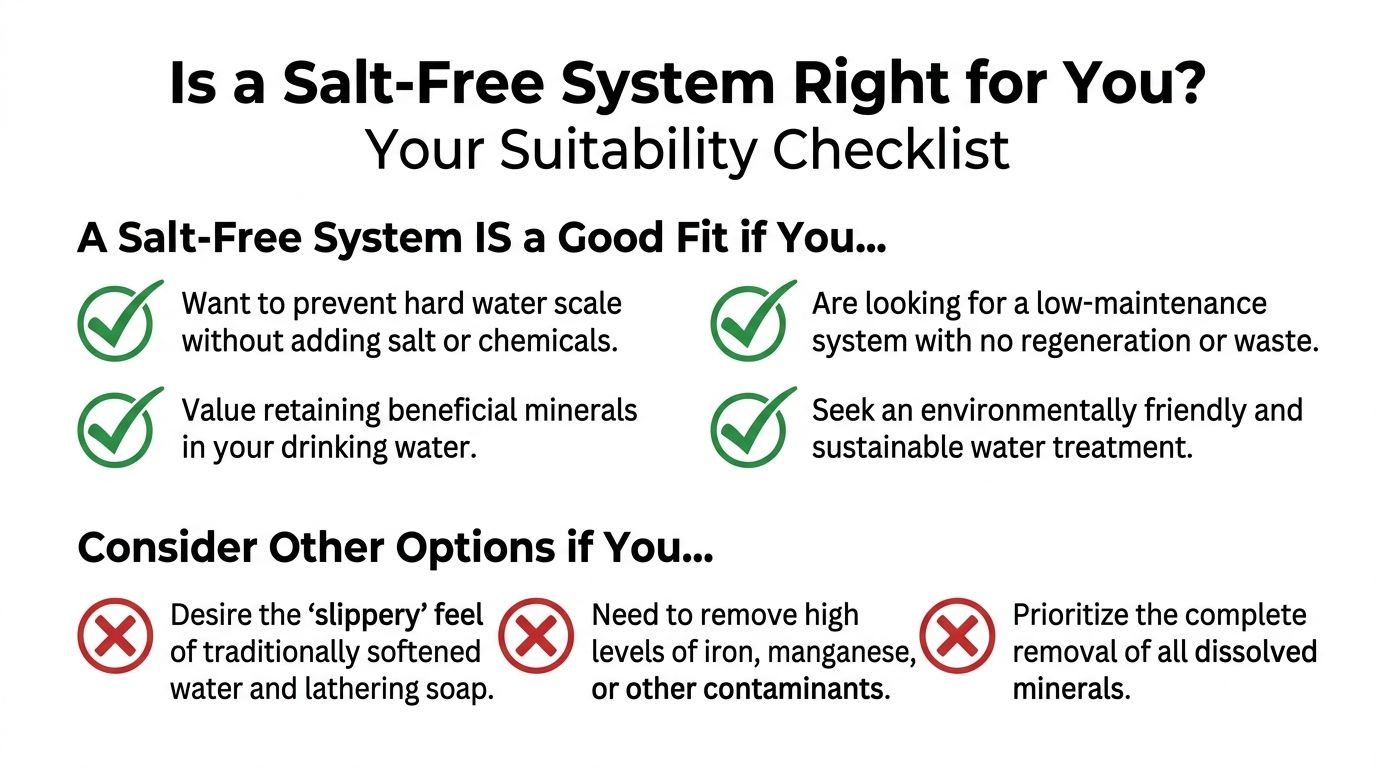
Start with your symptoms at home. The right system usually becomes clearer once you look at what your water is doing on fixtures, in appliances, and around your plumbing.
A salt-free conditioner is likely a good fit if
- Your main complaint is scale: You see white buildup on faucets, shower glass, or heating elements, and scale control is your top goal.
- You do not need the classic soft-water feel: You care more about reducing buildup than changing how the water feels on skin or how soap behaves.
- You want less routine upkeep: You prefer a system without salt bags and regular brine management.
- Your water test shows the kind of hardness a conditioner can reasonably handle: Testing matters here, because salt-free units work best in the right water conditions and can disappoint when hardness is very high.
- You are on city water, or your well water has already been cleaned up first: A conditioner generally performs better when iron, sulfur, and sediment are not part of the picture.
A traditional softener may make more sense if
- You want actual hardness removal: That is what changes the feel of the water and improves soap lather.
- You keep hearing "softener" but your goal is true soft water: This is the point where marketing language causes trouble. A conditioner does not do the same job as an ion-exchange softener.
- Your home uses well water with multiple issues: In Central Florida, well water often brings hardness together with iron, odor, staining, or grit. A single salt-free tank usually does not address that mix.
- Your fixtures show more than white scale: Orange staining, black staining, rotten-egg smell, or cloudy sediment usually mean you need filtration, a softener, or a staged treatment setup.
Here is the simplest checklist I use with local homeowners. If you answer yes to most of the first group, salt-free is worth a closer look. If you answer yes to the second group, pause before buying one.
- Is scale your main problem?
- Are you okay with minerals staying in the water?
- Are you on municipal water, or has your well water already been treated for iron, sulfur, and sediment?
- Do you want lower maintenance more than you want the classic soft-water feel?
- Has a recent water test confirmed what is in your water?
If any answer is no, slow down and test first.
That next step saves money. It also keeps you from installing a conditioner for a problem that really calls for a softener or a filter. If you want to see what a properly matched local setup looks like, our page on water softener installation in Riverview, FL is a practical place to start.
For a Riverview well-water home, I would be especially careful here. Well water can look like a hardness problem when the actual issue is a stack of problems. A good recommendation starts with the water itself, not the label on the tank.
Your Questions About Salt-Free Systems Answered
The basics make more sense once you separate "conditioner" from "softener." Most remaining questions come down to daily use.
Common questions from Riverview homeowners
Will my water feel soft and slippery?
Usually, no. A salt-free conditioner doesn't create the classic feel people associate with a traditional salt-based softener.
Will it remove chlorine or bad tastes?
Not by itself. A salt-free conditioner focuses on hardness minerals and scale behavior. Chlorine, taste, odor, and sediment issues usually call for separate filtration equipment.
Can it fix iron stains or sulfur smell from well water?
No. Those are different water problems and need different treatment methods. If you have orange staining, rotten-egg odor, or visible sediment, don't assume a salt-free unit will solve it.
Can I install one myself?
Some homeowners are comfortable with plumbing work, but sizing and system selection are where many mistakes happen. Installation isn't the only issue. Matching the technology to the water is the bigger challenge.
How do I know it's working if hardness still shows up on a test?
That's one of the most confusing parts. A salt-free conditioner doesn't remove the minerals, so hardness may still appear on testing. The practical sign is reduced scale sticking to plumbing surfaces and appliances over time.
Is it a good option for every Riverview home?
No. It's a strong fit for some homes and the wrong fit for others. Water source, hardness level, and the presence of iron, sulfur, or sediment all affect the answer.
If a product promise sounds universal, slow down. Water treatment is rarely one-size-fits-all.
The most reliable shortcut is still a proper water analysis. That gives you a real answer instead of a guessed one.
If you're trying to decide whether a salt-free system makes sense for your home, the smartest move is to start with a free water test. Florida Water Management helps Central Florida homeowners identify hardness, iron, sulfur, sediment, and other water issues so the solution fits the water you have. Use the contact us page to schedule your free water test and get clear guidance before you buy.