

The average annual water softener maintenance cost typically ranges from $150 to $600, but it can swing quite a bit depending on your water, your system, and how you maintain it. Around Central Florida, that range matters because a city-water home in Lakeland usually faces a different maintenance picture than a private well home in Frostproof or Sebring.
If you're reading this, there's a good chance your softener is already doing its job. Your dishes look better, your shower doors don't spot up as fast, and your water heater isn't fighting hard scale every day. The question now is simpler and more practical: what should you budget each year so the system keeps working instead of turning into an expensive surprise?
In this part of Florida, that answer isn't one-size-fits-all. Private wells often bring iron, manganese, sulfur odors, sediment, and organic contamination into the conversation, and those conditions can push maintenance needs up faster than many homeowners expect. City water is usually more predictable, but that doesn't mean upkeep is free.
A good maintenance budget usually comes down to four things: consumables like salt, routine service, wear parts such as filters or resin media, and the occasional repair. If you're still figuring out whether your current setup is the right fit, it's also worth comparing those ownership costs with broader water softener installation cost considerations.
Table of Contents
- What Is the Real Cost of Owning a Water Softener
- Breaking Down Your Annual Water Softener Expenses
- Why Your Water Softener Bill Might Be Different
- DIY vs Professional Maintenance A Cost Benefit Analysis
- Estimated Water Softener Maintenance Costs in Central Florida
- How to Reduce Costs and Protect Your Investment
What Is the Real Cost of Owning a Water Softener
A Central Florida homeowner usually notices the softener cost in stages. First it is the equipment and installation. Then come the recurring expenses that keep the system working, and those are the costs that tend to surprise people a year or two later.
If you're still comparing systems, it helps to look at both upkeep and the installed price of a water softener in Central Florida at the same time. A lower upfront price can still lead to higher ownership costs if the unit is undersized, poorly matched to well water, or installed without accounting for iron, sulfur, or sediment.
Around here, that distinction matters. City water in places like Lakeland is one thing. Private well water in Polk, Pasco, or nearby rural areas is another. I regularly see homeowners blame the softener when the underlying problem is that the system is treating more than hardness. If iron or fine sediment is getting into the unit, maintenance costs rise faster and parts wear out sooner.
What homeowners usually end up paying for
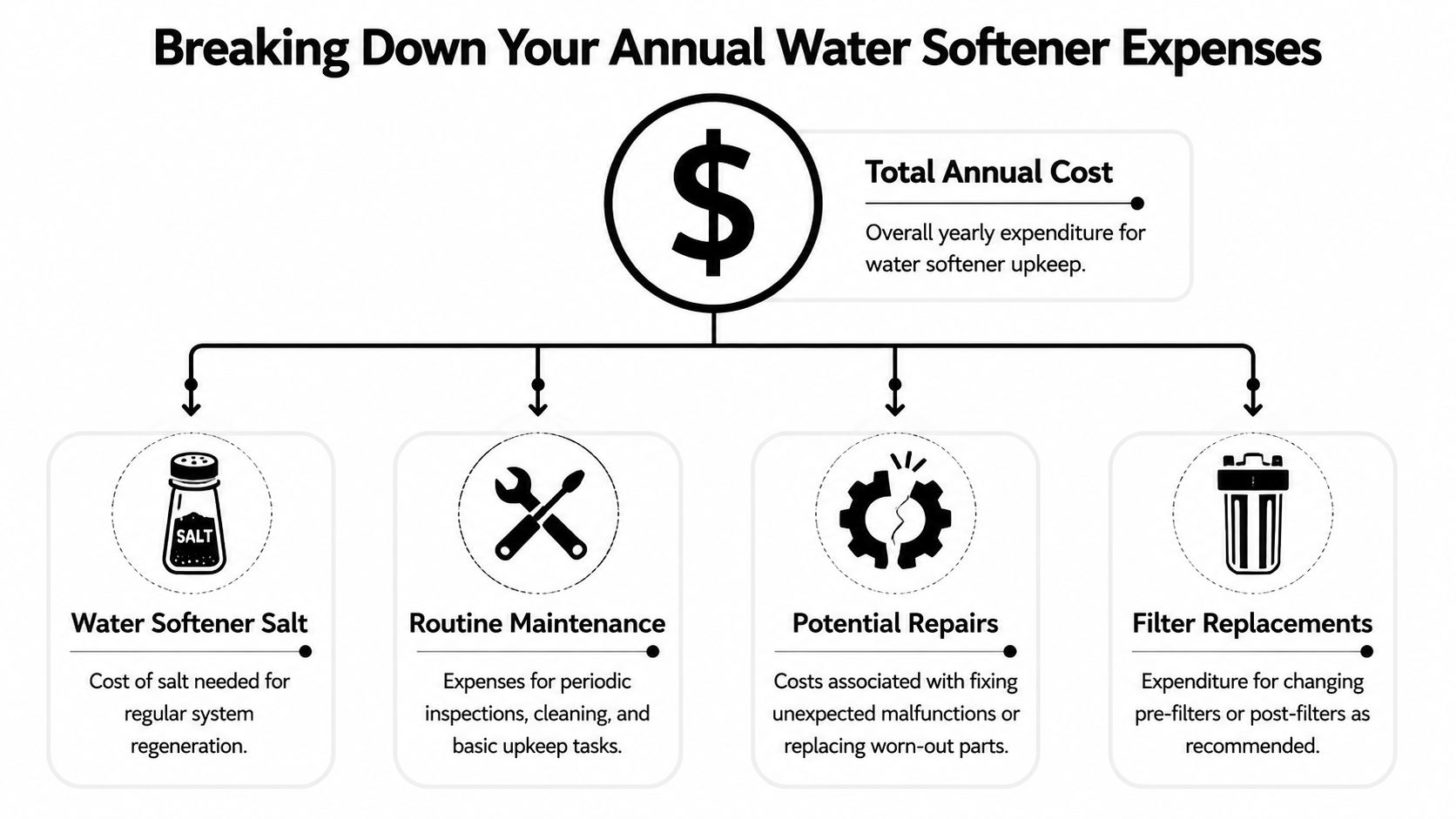
Annual ownership cost usually falls into four categories:
- Consumables: Salt, cleaner, or other treatment materials the system uses regularly.
- Routine upkeep: Cleaning the brine tank, checking settings, inspecting the control head, and making sure regeneration is happening correctly.
- Wear items and media: Filters, injector parts, seals, resin, or pre-treatment components, depending on the setup.
- Repairs: Leaks, stuck valves, clogged injectors, control problems, or performance issues that show up after the system has been struggling for a while.
The pattern is simple. Systems that get basic attention on schedule usually cost less over time than systems that are ignored until the water feels hard again.
There is also a difference between yearly spending and long-term ownership cost. A homeowner may spend very little one year, then face a larger bill when fouled resin, a failed valve, or neglected prefiltration catches up with the system. That is common on well water in Central Florida, where the softener often has to deal with more than plain hardness.
Where homeowners misjudge the cost
Many people budget for salt and stop there. Salt is only the visible part of the bill. The less obvious costs come from water quality changes, missed service, and using a softener to handle contaminants that should be treated before the unit.
What works is steady maintenance and the right equipment setup for the water source. What gets expensive is letting the system run dirty, using the wrong salt, or assuming your neighbor's setup applies to your house. Two homes a few miles apart can have very different water, especially on private wells.
A proper water test usually saves money because it shows what the softener is being asked to treat. In Central Florida, that answer often determines whether your ownership cost stays predictable or starts climbing.
Breaking Down Your Annual Water Softener Expenses
A Central Florida homeowner can look at the brine tank, see salt in it, and assume the yearly cost is under control. Then the water starts spotting glass again, the shower feels different, or orange staining shows up around fixtures. That is usually the point where expenses become clearer.
Salt refills
Salt is the cost homeowners notice first because it is the one they carry home themselves. According to WaterTech's breakdown of ongoing water softener expenses, a typical family of four with moderate hardness may spend $50 to $200 per year on salt, depending on bag price and usage.
In Central Florida, that range can move fast. Homes on municipal water often stay closer to predictable salt use. Private well systems can burn through more if the softener is undersized, programmed poorly, or trying to compensate for iron and manganese.
The starting point is knowing your home's water hardness level, then matching the settings to the actual water instead of guessing.
A few salt habits make a real difference:
- Low-grade salt can leave more sludge in the brine tank. That leads to cleanup and can interfere with proper draw.
- Letting the salt level drop too far can hurt regeneration. The system may still run, but not as effectively.
- Incorrect regeneration settings raise monthly cost. Extra cycles use more salt and more water than the house needs.
Filter and resin replacement
Resin is not a forever component. In clean, steady water, it can last years. In well water with iron fouling, sediment, or sulfur issues, it can lose performance much sooner.
That is why I tell homeowners to separate "routine supply cost" from "media cost." Salt is predictable. Resin and cartridge filters are the parts that turn into bigger bills if upstream water problems are ignored. A softener that has proper pretreatment usually costs less to keep alive than a softener doing all the work itself.
If a homeowner tells me the system "just needs salt" every time performance slips, I start looking for fouled resin, a clogged injector, or a prefilter issue.
Salt-free systems shift this category rather than eliminating it. They avoid salt purchases, but replacement media or cartridges still have a service life, and the savings only hold up if the equipment fits the water quality.
Professional service calls
Scheduled service is usually cheaper than troubleshooting after the system has been underperforming for months. A basic maintenance visit may include cleaning the injector, checking the brine draw, verifying settings, inspecting the valve, and testing the treated water. Those steps catch the small issues that homeowners rarely see until hardness breaks through.
Around Central Florida, professional maintenance often matters more on private wells because the softener is part of a larger treatment setup. If there is a sediment filter, iron filter, chlorinator, or neutralizer ahead of it, one neglected component can affect the softener's performance and cost.
Annual service plans can make sense for busy households, rental properties, and homeowners who do not want to track service intervals themselves. Pay-as-needed service can work too, but it usually costs more once a minor issue turns into a no-soft-water call.
Utilities and hidden operating costs
Power use is usually modest. Water loss during regeneration and preventable wear tend to matter more.
The hidden costs show up in places homeowners do not always connect to the softener right away. Extra soap use, scale on fixtures, shorter appliance life, repeat service calls, and wasted salt from bad settings all add to ownership cost. On well water, one of the biggest mistakes is blaming the softener for every water problem instead of checking whether another treatment stage needs attention.
That is the honest annual breakdown. Salt is only one line item. The full cost comes from supplies, periodic parts replacement, service, and how hard the local water makes the system work.
Why Your Water Softener Bill Might Be Different
A homeowner in Lake Wales can spend far less on softener upkeep than a homeowner on a private well a few miles outside town, even if both houses have similar square footage and the same brand of equipment. In Central Florida, maintenance cost usually follows the water first, then the equipment.
Central Florida well water changes the math
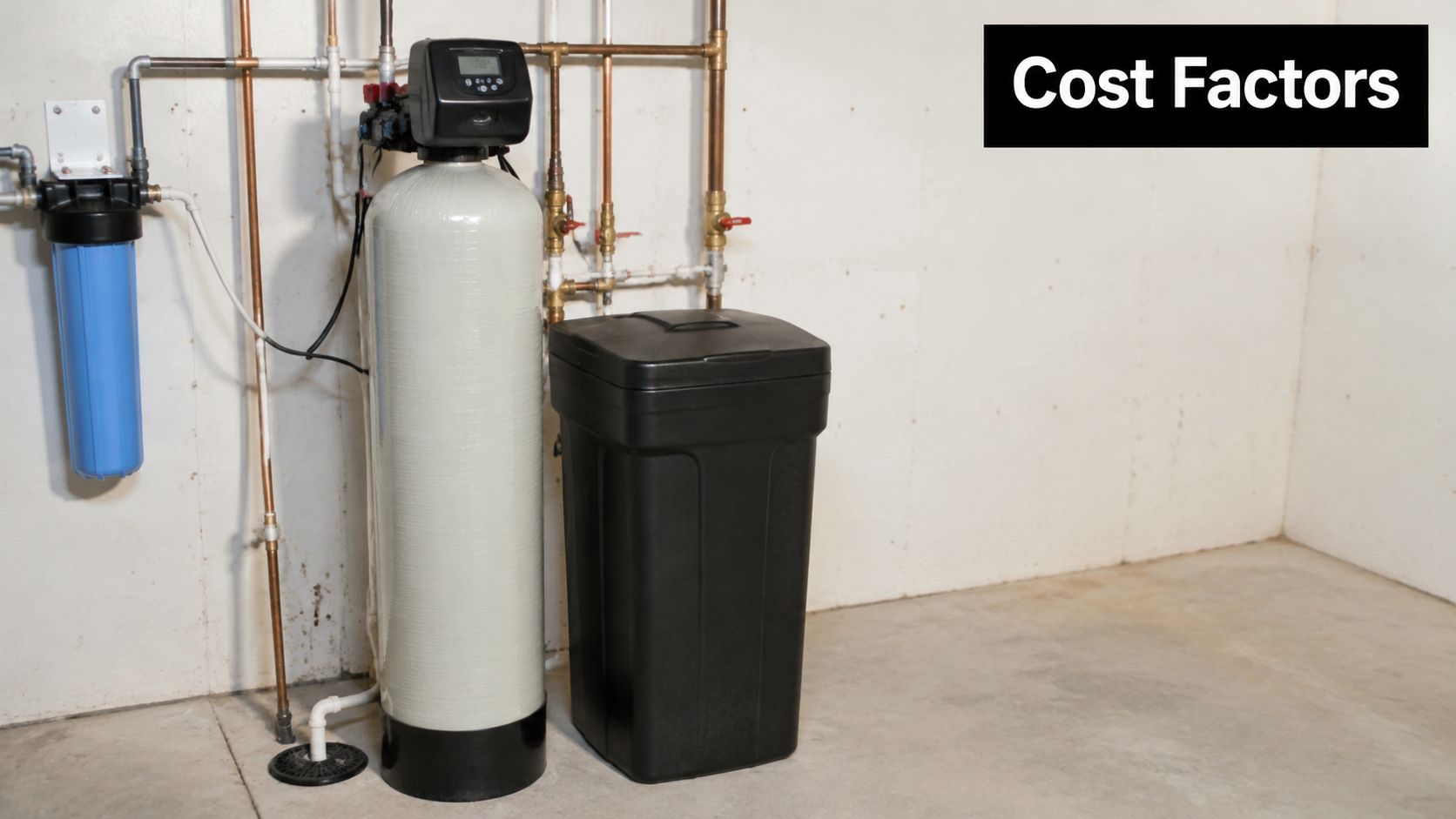
If you're on a private well in Sebring, Avon Park, Frostproof, or outside Lake Wales, the softener often has a harder job than a city-water unit. Hardness is only part of the load. Iron, manganese, sulfur odor, sediment, and organic fouling can all shorten cleaning intervals and wear parts faster.
SoftPro's well water softener maintenance overview notes that well water systems often cost more to maintain because higher mineral and contamination levels put more stress on resin and control components. That matches what we see across Central Florida. A softener on municipal water usually gets a more stable feed. A softener on a well can face changes after heavy rain, pump repairs, drought periods, or long stretches where the house sits empty.
The setup ahead of the softener matters just as much as the softener itself. If iron removal, sediment filtration, or disinfection is missing or overdue for service, the softener starts carrying problems it was never meant to handle.
If you are not sure what your system is treating, start by checking your water hardness level before setting a maintenance schedule.
Well water changes both the cost and the kind of maintenance a softener needs.
Household use, equipment size, and service history
Water source is a major factor, but it is not the only one.
A larger household pushes more gallons through the resin bed, which means more frequent regeneration and faster salt use. A higher-capacity or dual-tank system can also cost more to service because there are more parts to inspect, clean, and adjust. Brand and valve design matter too. Some units are simple to get parts for. Others take more labor, special components, or longer diagnostic time.
Service history affects the bill more than many homeowners expect. Inherited systems are a common example in Central Florida. We walk into homes with no records, unknown settings, and no recent water test, and the softener may still appear to run normally. Then we find the unit is regenerating too often, not drawing brine correctly, or trying to treat iron-heavy water without proper pretreatment. That kind of hidden problem raises operating cost before it causes a total failure.
Water conditions do not stay fixed
This is common on well water. A system that ran fine last year can start leaving orange staining, hardness spots, or odor because the incoming water changed, not because the softener suddenly quit.
That distinction matters. Replacing softener parts will not solve a new iron problem upstream, and blaming the softener alone can waste money. The lower-cost fix is often a water test and a correction to the treatment train, not a full equipment replacement.
DIY vs Professional Maintenance A Cost Benefit Analysis
A homeowner in Polk or Osceola County can usually handle the day-to-day side of softener care. A homeowner on a private well with iron, sulfur, or changing water conditions often saves money by bringing in a technician before small issues turn into valve, injector, or resin problems.
What homeowners can handle
Routine upkeep is realistic for many households. Check the salt level, break up a salt bridge if one forms, keep the brine tank from sitting empty, and pay attention to warning signs like hard water spots, orange staining, or slippery water that suddenly feels different.
That kind of attention cuts down on preventable service calls.
For a city-water home with stable hardness, DIY care often covers the basics well. For a Central Florida well system, DIY still matters, but it usually works best as observation and upkeep, not full diagnosis. Well water can change enough that the softener issue you see is only part of the problem.
What professional service adds
A service visit is not just someone adding salt and leaving. A good technician checks whether the unit is regenerating on the right schedule, whether the brine draw is working, whether the injector or venturi is restricted, and whether iron or sediment is starting to foul the resin. On well water, we also look for clues that the softener is being asked to do work it was never meant to do.
That is where homeowners often waste money. They replace a part because the system seems weak, but the actual problem is upstream sediment, new iron loading, or settings that no longer match the water.
In Central Florida, that difference shows up fast. A softener on municipal water may go a long time with basic homeowner attention. A softener on a well outside Lakeland, Winter Haven, or Frostproof can drift out of adjustment or foul early if nobody checks the full treatment setup.
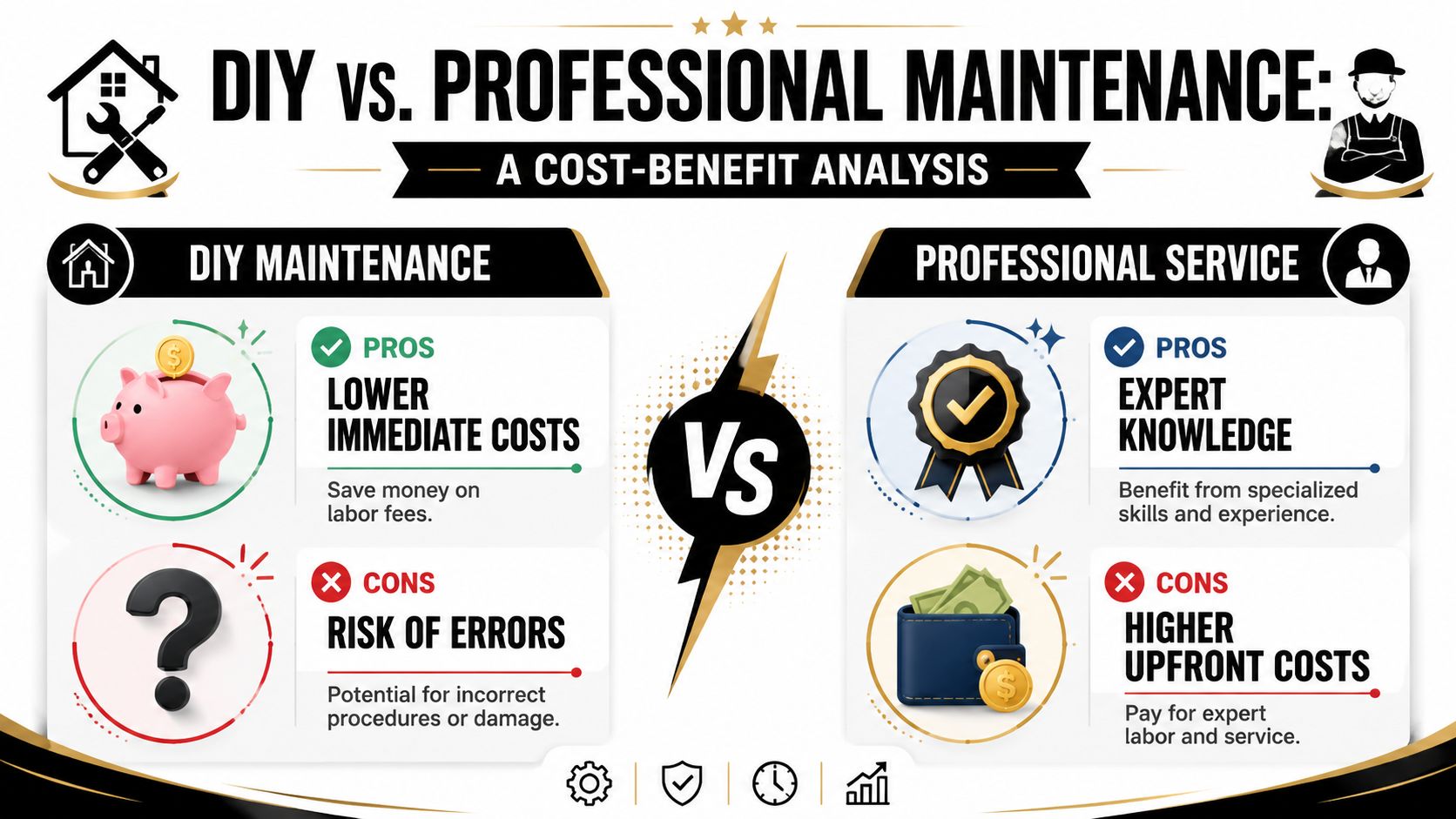
| Factor | DIY Maintenance | Professional Service |
|---|---|---|
| Upfront cost | Lower if you stay on top of routine checks and salt | Higher because labor, inspection, and testing are part of the visit |
| Skill required | Best for basic upkeep and spotting changes | Better for diagnosis, programming, cleaning internal parts, and checking component wear |
| Risk of missed issues | Higher, especially on well water or inherited systems with no records | Lower because the technician inspects performance, settings, and related equipment |
| Time commitment | Ongoing homeowner responsibility | Limited homeowner time after scheduling |
| Best fit | Stable city-water systems and hands-on owners | Well water, iron or sulfur issues, larger households, rentals, and homes with inconsistent service history |
Field advice: If the water source is predictable and the system has a clean service history, DIY maintenance can keep costs down. If the home is on a private well, one professional check each year is often cheaper than chasing the wrong repair.
The most expensive approach is partial DIY with no routine. Homeowners add salt when they remember, ignore staining for months, and call for service only after the softener stops keeping up. A simple maintenance schedule works better. Watch the system, write down changes, and get help early when the water tells you something has shifted.
Estimated Water Softener Maintenance Costs in Central Florida
A Polk County homeowner on city water and a homeowner ten miles out on a private well can own the same softener and end up with very different maintenance bills. I see that all the time in Central Florida. The system matters, but the raw water matters more.
Lakeland city water example
In Lakeland or Winter Haven on municipal water, a standard salt-based softener usually has a steadier maintenance pattern. The hardness is still high enough to justify treatment, but the water quality tends to be more consistent than what we see on private wells. That consistency keeps the softener from getting hit with as many surprises.
For this kind of home, the yearly budget usually centers on salt, occasional cleaning, and a service call when settings drift or a valve component starts wearing out. Resin and major parts still belong in the long-term ownership cost, but they are less likely to become an early expense if the unit is sized correctly and the programming matches the household's water use.
Homeowners who want to keep these systems in the lower-cost range should pay attention to water softener efficiency settings and regeneration performance. A softener that is running too often wastes salt and water. A softener that is set too conservatively can let hardness slip through and make people assume the unit needs repair when it really needs adjustment.
Frostproof well water example
A private well near Frostproof, rural Avon Park, or outside Sebring changes the math. Hardness is only part of the job. Iron, sulfur odor, sediment, and seasonal water shifts can all raise maintenance costs because the softener is being asked to handle conditions it was never meant to solve alone.
In those homes, some years stay reasonable. Then a stretch of heavier iron or bacterial fouling shows up, and the cost jumps because the softener needs cleaning, diagnosis, or earlier media replacement. If there is no prefilter, iron filter, or sulfur treatment ahead of the softener, the resin often takes the hit first.
That is why well-water budgets in Central Florida have more spread. The maintenance cost is tied to the full treatment setup, not just the softener tank in the garage.
The practical takeaway for local homeowners
City-water homes in Lakeland and Winter Haven usually see more predictable upkeep. Private-well homes in Frostproof, Sebring, and surrounding rural areas should plan for more variability and occasional heavier service years.
The fairest local estimate is simple. If the softener treats stable city water, maintenance is usually easier to forecast. If it treats well water with iron, sulfur, or sediment, expect a wider range and budget with some room for correction work. That approach is more honest, and it usually prevents the sticker shock that catches Central Florida well owners off guard.
How to Reduce Costs and Protect Your Investment
The best way to control water softener maintenance cost is to stop treating maintenance like an afterthought. Homeowners usually spend more when they react late, use the wrong consumables, or let the system operate with outdated settings.
A practical maintenance checklist
The U.S. Department of Energy notes in its water softener maintenance guidance that a properly maintained system lasts 10–15 years, and homeowners should check salt levels every 4–6 weeks. That's a solid baseline, but good maintenance is more than one habit.
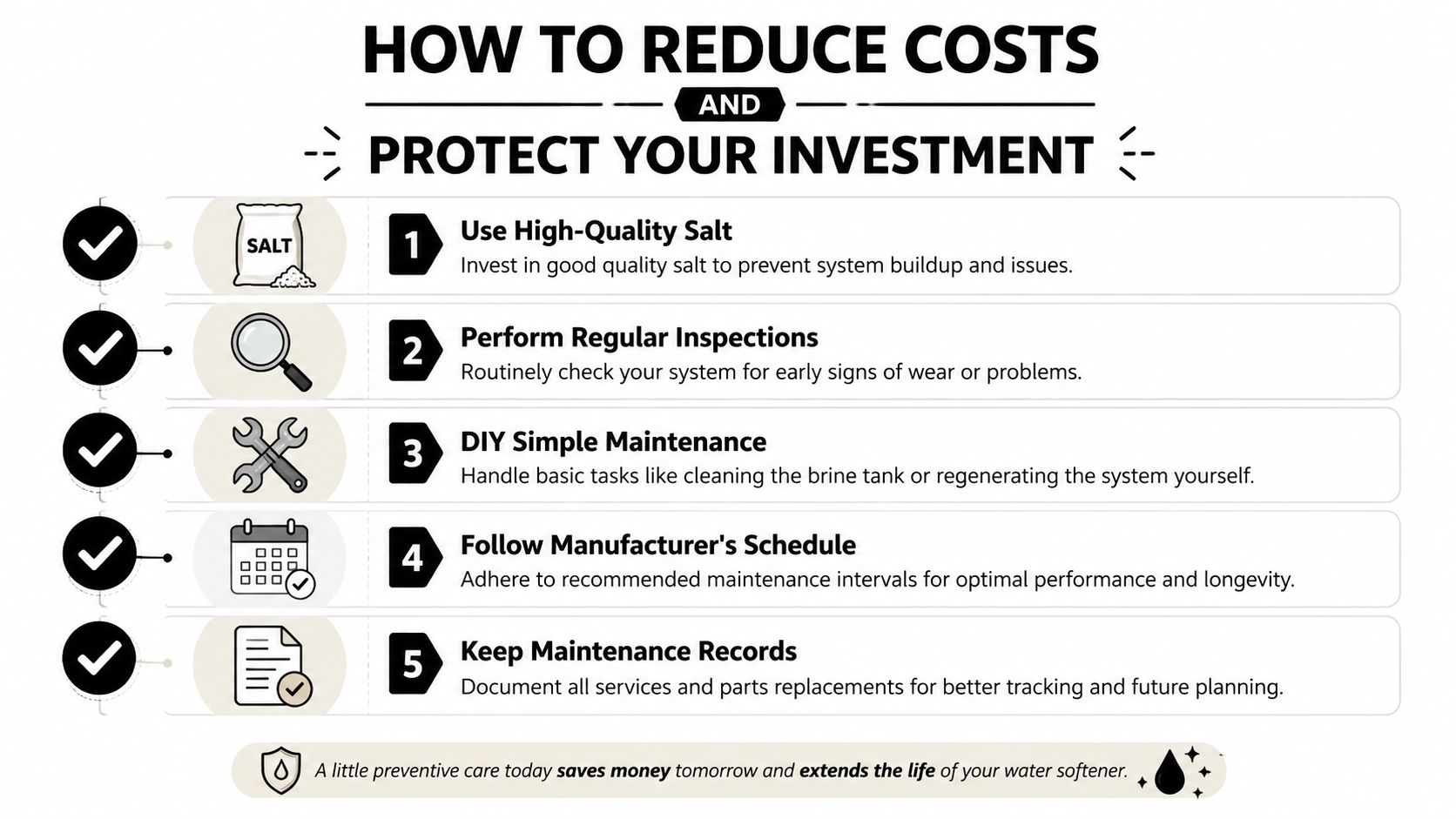
Use this checklist:
- Check salt before it becomes a problem: Don't wait until the system stops softening.
- Watch for changes in water feel and staining: New orange marks, soap performance changes, or scale can signal a developing issue.
- Keep the brine tank clean: Sludge, mush, and bridging make the system work harder than it should.
- Match maintenance to your water type: Well systems usually need closer attention than city-water systems.
- Review system efficiency periodically: If you want to understand whether the unit is operating as it should, take a look at the basics of water softener efficiency.
Maintenance records help more than most homeowners expect. If you know when salt use changed, when the tank was cleaned, and when parts were serviced, diagnosing the next issue gets easier.
When preventive service pays for itself
Preventive service makes the most sense when the water is challenging, the property is a rental, or the homeowner doesn't want to monitor the system closely. It's also useful when the home has multiple treatment components working together, such as sediment filtration, iron treatment, and softening.
What works is consistency. What doesn't work is waiting for hard water symptoms, then trying to reverse damage after fixtures, heaters, and appliances have already taken the hit.
For Central Florida homeowners, especially those on wells, the most cost-effective move is usually simple. Test the water, set the system up for the actual conditions in the home, and maintain it on purpose instead of by guesswork.
If you want a precise answer for your home instead of a broad estimate, schedule a free water test with Florida Water Management. Their team serves Central Florida homeowners with customized water treatment guidance, and the easiest next step is to reach out through the contact us page so you can get recommendations based on your actual water, not assumptions.