

You turn on the kitchen tap in your FishHawk home, fill a glass, and pause for a second before drinking it. The water may look fine. It may even taste fine. But if your home runs on a private well, that little moment of hesitation is reasonable.
A lot of homeowners in this area feel the same way. They like the independence of well water, but they also know nobody from the city is checking it for them. If the water starts leaving orange stains, drying out skin, clogging fixtures, or raising questions about safety, the uncertainty gets old fast. Good well water testing in FishHawk, FL gives you something better than a guess. It gives you a clear starting point.
Table of Contents
- Your FishHawk Well Water A Homeowner's Responsibility
- What to Test For in Your FishHawk Well
- Getting Your Water Tested The Good Better and Best Options
- How to Read Your Water Test Results
- From Results to Resolution Common Water Treatment Solutions
- Take Control of Your FishHawk Water Today
Your FishHawk Well Water A Homeowner's Responsibility
A common FishHawk situation goes like this. A homeowner moves in, the water seems usable, and nothing feels urgent. Then the shower door starts spotting, the dishwasher leaves haze on glassware, or the water develops an off smell after heavy rain. That's usually when the question comes up. Is this just normal Florida well water, or is something wrong?

If you're on a private well, the answer won't come from a utility notice in the mail. It's your responsibility to check the water and keep checking it. That's the part many homeowners don't hear clearly enough when they buy a house with a well.
Why this matters more in Florida
Florida has depended on groundwater for a long time. A historical assessment reported that by 1994 more than 8,711,000 Floridians relied on groundwater for drinking water, which helps explain why private well management is such a local issue in communities like FishHawk (UF/IFAS groundwater assessment). In practical terms, that means well conditions are shaped by the ground around you, not by a central treatment plant.
Around FishHawk, the concerns can vary from property to property. Septic influence, nearby land use, stormwater movement, naturally occurring minerals, and flooding can all affect what shows up in a sample. Two homes on the same road can have very different water.
Practical rule: If your home has a private well, don't wait for a visible problem to decide whether testing matters. Testing is the routine.
What responsibility looks like in real life
Homeowners usually think about safety first, and they should. But the day-to-day damage often gets attention sooner. Scale on fixtures, staining in toilets, rough-feeling laundry, shortened appliance life, and persistent taste issues are often what push people to act.
That's why well water testing in FishHawk, FL should be treated as more than a simple safety checkbox. Done properly, it helps you answer three separate questions:
- Is the water safe to use and drink
- Is the water damaging plumbing or appliances
- What treatment, if any, fits this water
Without those answers, people tend to buy the wrong filter, solve only half the problem, or ignore a water issue until it gets expensive.
What to Test For in Your FishHawk Well
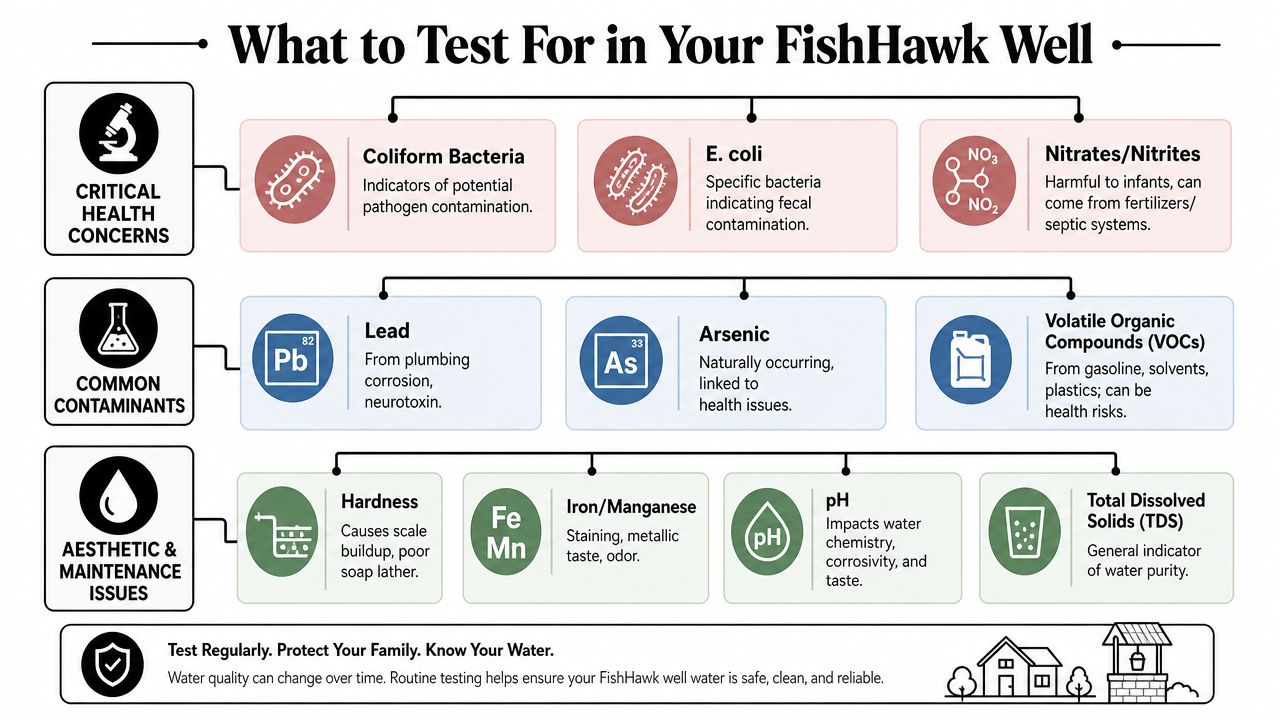
A good test panel has to cover two different jobs. First, it needs to check for health-related risks. Second, it needs to identify the water characteristics that ruin fixtures, create odors, stain surfaces, and make treatment selection harder than it needs to be.
Start with the baseline safety panel
The Florida Department of Health strongly recommends that private well owners test for bacteria and nitrates at least once per year, and for lead every three years (Florida private well guidance). That's the starting line, not an optional upgrade.
For most FishHawk well owners, the first group of tests should include:
- Bacteria: This is the basic health screen. If bacteria are present, the concern isn't cosmetic. It points to a pathway for contamination.
- Nitrates: Nitrate problems won't announce themselves with an obvious smell or color.
- Lead: Lead is often tied to plumbing components and corrosion issues, not just the well itself.
If your well has been flooded, recently repaired, or your water suddenly changes in taste, odor, or color, that's not the time to rely on what the water looks like. It's the time to test again.
Then test for what affects the home
Many homeowners get incomplete advice. They run one bacteria test and assume they've covered the whole problem. They haven't. Water can be microbiologically safe and still be hard on plumbing, fixtures, and daily comfort.
A practical FishHawk panel often includes these chemistry checks:
- pH: Helps identify whether water may be corrosive or chemically unbalanced.
- Total dissolved solids: Useful as a general measure of dissolved material in the water.
- Iron: Common when homeowners notice reddish or orange staining, metallic taste, or dingy laundry.
- Manganese: Often shows up with dark staining and can complicate treatment choices.
- Sodium and chloride: Worth considering when salty taste, corrosion concerns, or local groundwater conditions point in that direction.
- Electrical conductivity: Helpful for understanding the water's mineral profile.
- Pesticides or VOCs: UF/IFAS advises extra testing for pesticides in agricultural areas and VOCs near fuel or industrial sites when local conditions suggest a reason.
Water that looks clear can still fail the tests that matter most. Clear water isn't the same thing as verified water.
Think about comfort and equipment, not just contamination
In the field, homeowners often ask about hardness because they're tired of scale on faucets, soap that won't rinse clean, or appliances that seem to age too fast. Hardness is a treatment-design issue more than a pure safety issue, but it's still important. The same goes for sulfur odors, staining, and corrosive water behavior.
The best testing approach for well water testing in FishHawk, FL looks at both sides of the problem. Safety comes first. Usability comes right behind it. If you only test for one category, you may still end up with bad water in daily life.
Getting Your Water Tested The Good Better and Best Options
Homeowners usually pick from three paths. The simplest route is a store-bought kit. The next step up is sending samples to a certified lab or working through the county health department. The most complete option is an in-home professional assessment that pairs testing with interpretation.
Each option can make sense. They just don't solve the same problem.
Well water testing methods compared
| Feature | DIY Test Kit | Certified Lab Test | Free Professional Analysis |
|---|---|---|---|
| Convenience | Easy to buy and use at home | Requires sampling, handling, and lab coordination | Usually the easiest for the homeowner |
| Scope | Often limited | Can be very specific, depending on the panel ordered | Broad practical review of water issues in the home |
| Accuracy confidence | Varies by kit | Stronger option when samples go to a certified lab | Strong when paired with proper testing methods and expert review |
| Interpretation | Homeowner does the guesswork | Lab report may still need explanation | Results are typically explained in plain language |
| Treatment guidance | Minimal | Limited unless you already know what the numbers mean | Designed to connect findings to workable solutions |
| Best use | Quick screening | Confirming contaminants through formal analysis | Understanding the full picture in real household conditions |
The good option
DIY kits can help if you want a rough first look. They're convenient and fast, and some homeowners like that they can start immediately. The problem is that many kits oversimplify the answer.
A strip or color-change result might tell you something is off, but it usually won't tell you enough to choose equipment confidently. That's how people end up buying a sediment filter for a problem that is iron, or a carbon unit for water that needs disinfection.
The better option
The CDC says samples should be analyzed by a state-certified laboratory, and Florida guidance notes that routine collection can often be arranged through county health departments. Basic analysis is typically around $20 to $30 per sample through county health departments or certified labs (CDC well testing guidance).
That's a solid route if you're comfortable collecting samples correctly and choosing the right panel. The biggest downside is that a lab report can answer the technical question without answering the homeowner question. You may know what's in the water, but still not know what to do next.
The best option
A professional in-home analysis tends to be the most efficient route for homeowners who want clarity, not just data. It connects the sample results to what's happening in the house. Staining. Scale. Odor. Corrosion. Filter performance. Appliance wear.
That matters because water treatment isn't just about identifying contaminants. It's about matching the actual water problem to the right correction. If you want to compare service options and treatment categories in one place, review the available water services for Florida homes and businesses.
A test result only helps if someone can translate it into a decision you can trust.
How to Read Your Water Test Results
A water report can look more complicated than it really is. The key is to stop reading it like a lab technician and start reading it like a homeowner. You're trying to connect the findings to visible household problems and to the right next step.
Read for cause and effect
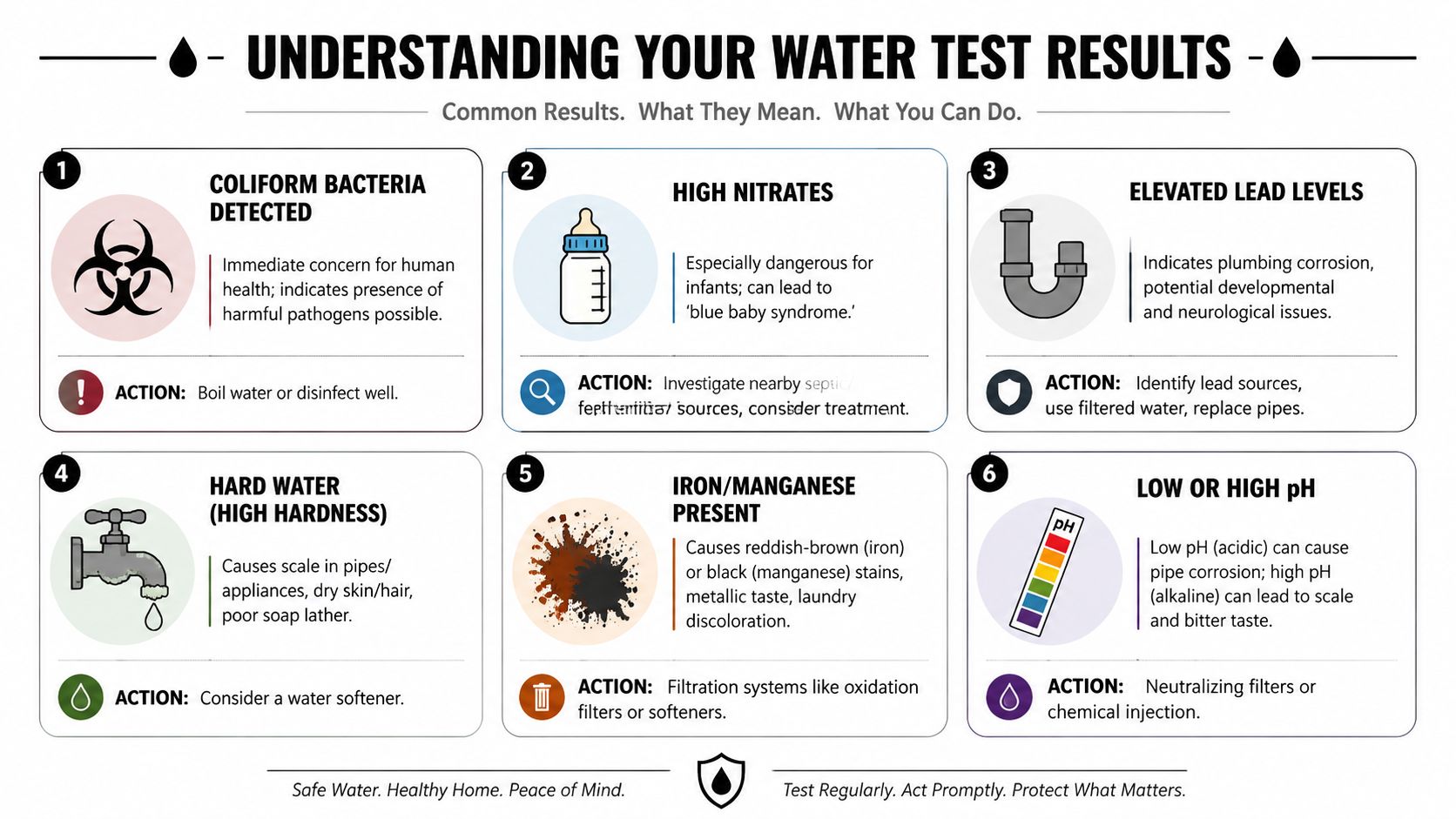
If bacteria show up, that's a safety issue. If pH is out of balance, corrosion or scale may be part of the story. If iron or manganese appear, the stains and taste complaints suddenly make sense.
Homeowners often get stuck by focusing on one item because it sounds familiar, but water problems usually overlap. A house can have hard water, iron staining, and a pH problem at the same time. Solving only one of those may leave the water frustrating to live with.
Here's a practical way to think about common findings:
- Bacteria present: Treat this as a direct safety concern that needs prompt attention.
- Nitrate concerns: Important because appearance and taste won't reliably warn you.
- Lead concerns: Often push you to look at corrosion and plumbing contact points.
- Low or high pH: Can explain corrosive behavior, fixture wear, or scale tendency.
- Iron and manganese: Usually line up with staining, discoloration, or metallic notes.
- High dissolved solids: Often point to broader mineral load and treatment planning needs.
One report rarely tells the whole story
UF/IFAS makes an important distinction that homeowners should know. A technically sound analysis must separate microbiology testing for safety from chemistry testing for treatment design, because one doesn't cover the other (UF/IFAS water testing guidance).
That means a bacteria-only test doesn't tell you why your fixtures stain. A chemistry-only panel doesn't tell you whether the water is microbiologically safe. Both matter.
If your report answers only one question, don't assume it answered all of them.
Match the report to the symptoms in the house
The easiest way to interpret results is to compare them with what you already see every day:
| Household symptom | What the report may help explain |
|---|---|
| Orange or brown staining | Iron-related issues |
| Dark staining or residue | Manganese-related concerns |
| Scale on fixtures and glass | Mineral load and hardness-related treatment needs |
| Metallic taste | Often tied to dissolved metals or corrosive conditions |
| Dry skin and poor soap rinse | Hard water conditions |
| Pinhole leaks or fixture wear concerns | pH and corrosion clues |
If you're trying to move from report reading to solution planning, it helps to review practical water filtration options for Florida homes. The right interpretation should make the next decision simpler, not more confusing.
From Results to Resolution Common Water Treatment Solutions
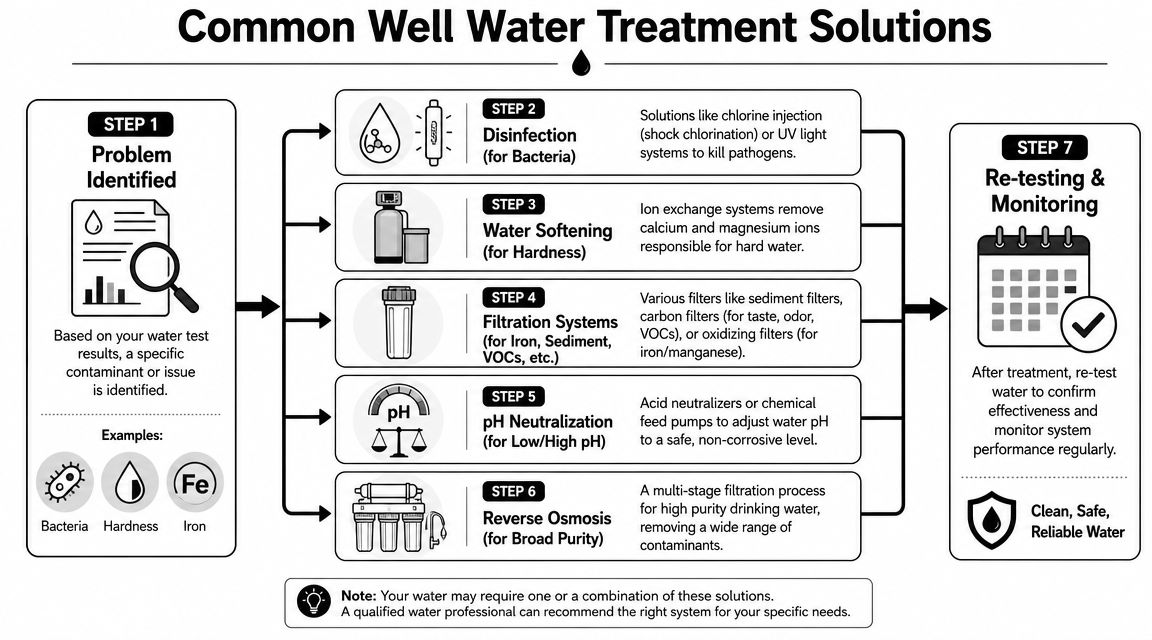
Once the test results are clear, the treatment path usually gets a lot less mysterious. The mistake is assuming one filter fixes every problem. It doesn't. Well water treatment works best when the equipment matches the actual water conditions in the home.
Common problem and solution matches
Some pairings are straightforward.
- Bacteria concerns: Disinfection methods such as UV treatment or well disinfection are often part of the fix.
- Hard water: A water softener is usually the core solution when scale, soap inefficiency, and mineral buildup are the main complaints.
- Iron or manganese: Targeted filtration, often with oxidation-based treatment, is commonly needed.
- Sediment: Sediment filtration helps protect fixtures and downstream equipment.
- Taste and odor issues: Carbon-based treatment may be appropriate, depending on the cause.
- Drinking water polishing: Reverse osmosis is often chosen for high-purity water at a dedicated tap.
- pH imbalance: Neutralizing equipment or other correction methods may be needed when corrosion or scaling behavior points that way.
What doesn't work well
The most common bad outcome comes from buying equipment before understanding the water. A big-box cartridge may help one symptom while ignoring the issue that's causing the damage.
A few examples:
- A softener alone may not solve bacterial concerns.
- A sediment filter alone won't correct dissolved iron just because the water looks rusty.
- A carbon filter alone may improve taste while leaving scale, staining, or microbial risk untouched.
- A drinking-water unit at one sink won't protect the water heater, plumbing, laundry, or showers.
That's why treatment should be built from the results backward, not from the product shelf forward.
Good treatment design is custom, not generic
In FishHawk homes on well water, one system often feeds another. Sediment protection may be placed ahead of iron treatment. Softening may protect appliances after upstream filtration handles nuisance contaminants. A separate reverse osmosis unit may handle drinking water while the whole-home system protects the rest of the house.
That layered approach tends to work better because it solves the problem at the right point in the water line. It also makes service more predictable over time.
The best treatment system isn't the one with the most parts. It's the one that matches the test results and solves the specific problems in your home.
If you want to see how whole-home and point-of-use equipment can be matched to private well conditions, explore well water treatment solutions for Florida properties.
Take Control of Your FishHawk Water Today
Owning a private well in FishHawk means you control your water, but you also carry the responsibility for checking it. That can feel like a hassle at first. In reality, it's one of the smartest preventive steps you can take for your family, your plumbing, your appliances, and your peace of mind.
The right process is straightforward. Test for the health essentials. Look at the chemistry that affects comfort and equipment. Read the results in plain household terms. Then choose treatment based on evidence, not guesswork.
That last part matters most. A lot of water problems stick around because the homeowner got only half the picture. They tested for safety but not for treatment design. Or they bought treatment equipment before they knew what the water was doing. Good well water testing in FishHawk, FL fixes that by giving you a full baseline you can act on with confidence.
If you're tired of wondering whether your water is safe, hard on appliances, or causing the stains and odors you keep noticing, now is the right time to get answers.
Florida Water Management offers a free water test for homeowners who want clear answers about their well water and practical guidance on what to do next. If you want professional help evaluating your water in FishHawk, reach out through the Florida Water Management contact page.