

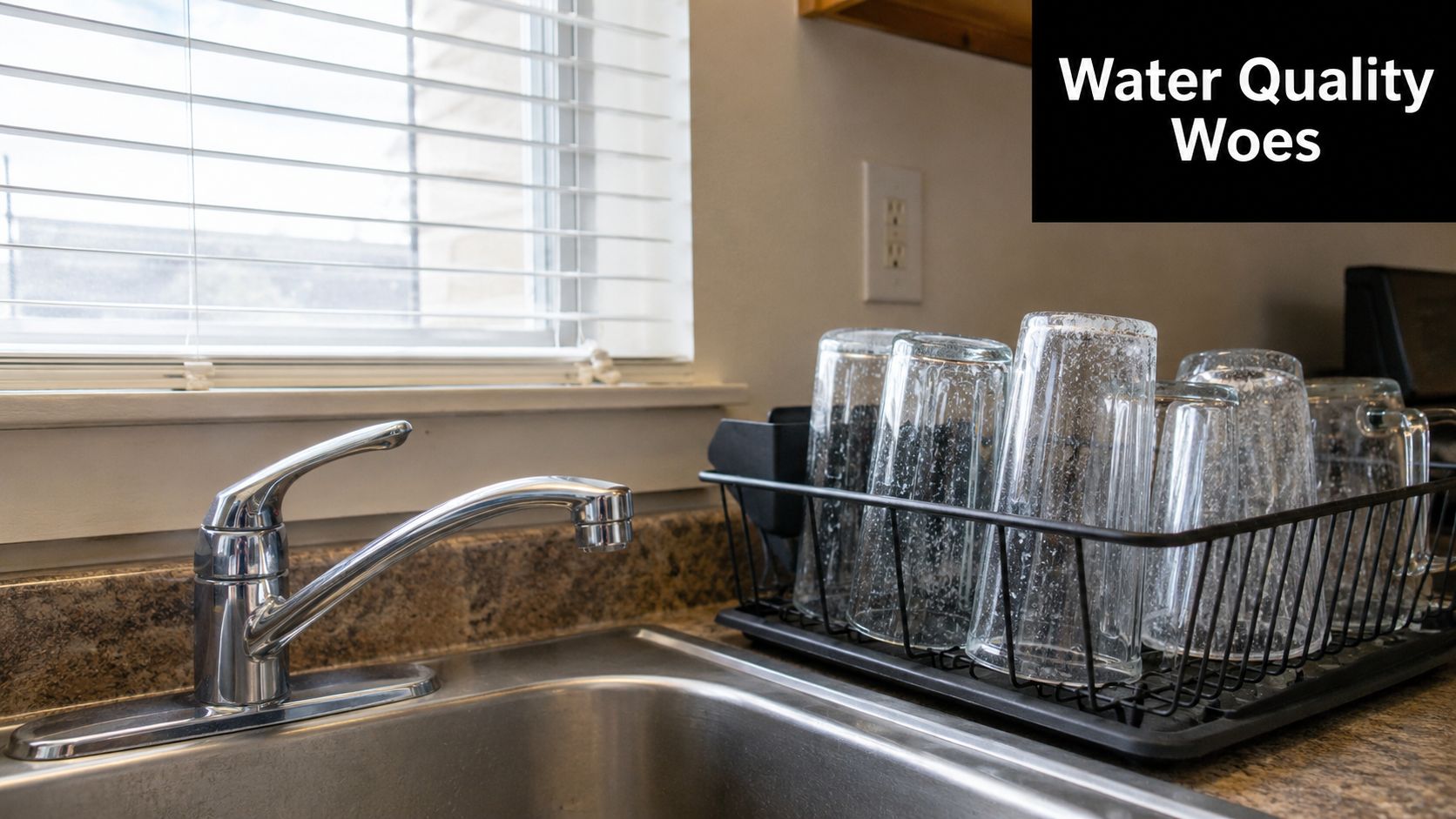
You see it on a normal Tuesday night. Clean glasses come out of the dishwasher with a dull film. The shower door keeps spotting up. Coffee tastes flatter than it should. If you are on a private well, you may also catch a sulfur smell one week and rusty staining the next.
That is how water problems usually show up in Winter Haven. Not as a lab report first, but as a string of small signs around the house. The hard part is that those signs do not point to one universal fix. Cloudy glassware can come from hardness. Odor can come from chlorine, sulfur, or well-related bacteria issues. Staining might be iron, manganese, or corroding plumbing. The right answer depends on what is in the water.
A good water treatment company in Winter Haven, FL should diagnose before recommending equipment. That matters even more here because local homes may be on city water or private wells, and those two starting points can lead to very different treatment plans. I have seen homeowners spend money on a softener when the bigger problem was iron. I have also seen people add a carbon filter for taste when the scale buildup was what was wrecking the water heater.
The practical first step is simple. Test the water, then choose the system based on the results. That approach avoids guesswork, helps separate cosmetic issues from equipment-damaging ones, and gives private well owners a clearer starting point when the water changes with season, rainfall, or pump conditions.
Table of Contents
- Why Your Water Quality in Winter Haven Matters
- Decoding Common Winter Haven Water Problems
- Your First Step A Free Professional Water Test
- Choosing the Right Water Treatment System for Your Home
- How to Vet Your Water Treatment Company
- Beyond Installation Maintaining Your System for Peak Performance
Why Your Water Quality in Winter Haven Matters
You notice it on a normal Tuesday. The dishwasher finishes, but the glasses still look cloudy. Soap in the shower feels like it never rinses clean. A newer coffee maker starts acting older than it should. In homes across Winter Haven, that pattern usually points back to the water, not the appliance or the brand of soap.
Local water problems are rarely just about taste. They show up as extra cleaning, shorter appliance life, stubborn scale, dry skin, and fixtures that never seem to stay clean for long. If the home is on a private well, the range of possibilities gets wider. Mineral hardness may be part of it, but so can iron, sulfur, sediment, or a combination that needs a different fix altogether.
Groundwater changes what to check first
Winter Haven homes are largely dealing with groundwater-related conditions, whether the water comes through municipal treatment or straight from a private well. That matters in practice because groundwater often carries dissolved minerals and other nuisance contaminants that are hard on plumbing and hard to identify by guesswork alone.
I see homeowners spend money in the wrong order all the time. They replace a water heater element, switch detergents, add a faucet filter, or buy bottled water for drinking while the underlying house-wide issue keeps working in the background. The better approach is to treat the water like a diagnostic job. Start with what you can observe, then confirm it with testing before choosing equipment.
Practical rule: If you are treating symptoms without testing the water first, you are usually treating only part of the problem.
Two homes a few streets apart can need very different solutions. One may need straightforward hardness reduction. Another may need carbon filtration for taste and odor. A well owner may need sediment filtration plus oxidation or disinfection. The right answer depends on the actual water, the plumbing setup, and how the family uses water each day.
Water quality affects the whole house
Poor water quality creates wear you can see and wear you cannot. Scale on heating elements cuts efficiency. Mineral buildup inside valves and fixtures can shorten service life. Staining and odor issues turn into constant maintenance. Even laundry, bathing, and cooking can feel off when the water is not matched with the right treatment.
Winter Haven homeowners are better served by a decision tree than a sales pitch. Start with the source. City water and private well water come with different unknowns. Then look at the symptoms. Spots, staining, odor, sediment, or chlorine taste each point in a different direction. A free professional water test is the step that turns those clues into a correct plan.
Decoding Common Winter Haven Water Problems
A lot of water complaints sound similar at first. “The water tastes weird.” “My sinks stain.” “My shower never feels clean.” The cause can be very different from one house to the next, which is why water treatment has to start with diagnosis.
Winter Haven area water concerns also sit inside a documented quality-reporting context. One water quality source states that Winter Haven Water Department has reported 2 contaminants above EPA health-based guidelines and has 1 MCL violation on record, with listed contaminants of concern including dibromomethane, naphthalene, monochloroacetic acid, and diisobutyl phthalate (Winter Haven tap water data). That doesn't tell you what your house needs by itself, but it does reinforce why generic one-size-fits-all treatment claims miss the mark.
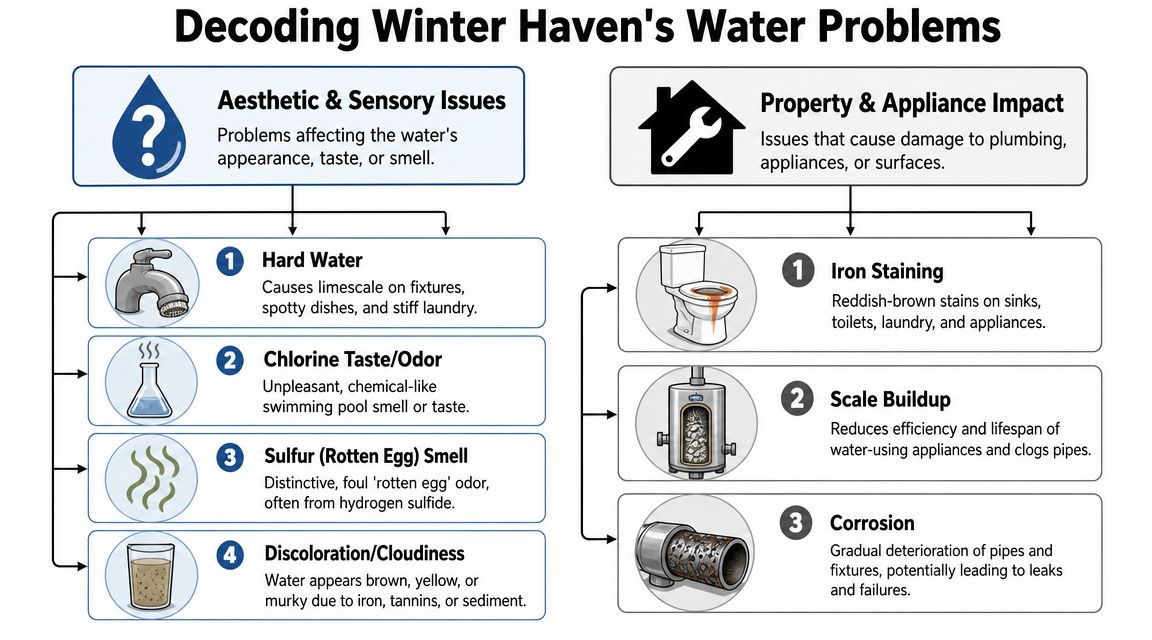
Hard water and mineral buildup
This is the issue most residents recognize first. Dishes come out spotted. Soap doesn't lather the way it should. Skin can feel dry after a shower, and white crust starts collecting around faucets and showerheads.
The cause is dissolved minerals, typically associated with groundwater supplies in this region. In the home, the impact goes beyond appearance. Scale can collect inside fixtures and water-using appliances, which reduces efficiency and can make equipment work harder than it should.
Chlorine taste and odor
Municipal customers often describe this as a swimming-pool taste or a chemical smell, especially first thing in the morning or after water sits in household plumbing. Some people notice it most in drinking water. Others smell it in the shower.
This is usually an aesthetic complaint first, but it changes daily comfort in a hurry. If water smells harsh, people stop enjoying it, buy bottled water, or avoid using the tap for cooking.
Iron staining and discoloration
When water leaves orange, red-brown, or yellow marks in toilets, sinks, tubs, or laundry, iron is one of the first suspects. Some homeowners only notice it after irrigation or after a fixture sits unused for a while.
The trouble with iron is that it doesn't just look bad. It can foul fixtures, stain fabrics, and create a house-wide impression that nothing is ever fully clean. Standard softening may help in some cases, but iron problems often need a more specific approach.
Sulfur odor and nuisance smells
If the water smells like rotten eggs, people usually think something is wrong with the plumbing. Sometimes the source is the water itself. Sometimes it's a reaction inside the water heater. On private wells, sulfur odors can be persistent and can worsen when water sits in lines.
A bad smell changes behavior fast. Families take shorter showers, avoid guests using certain bathrooms, and stop trusting the water even when it looks clear.
Water that looks fine can still be the wrong water for your home's plumbing and your daily use.
Sediment and fine particles
Sediment is easy to underestimate because the first signs are subtle. Faucet aerators clog more often. Ice cubes look cloudy. A glass of water may seem hazy right after filling and settle later.
Sediment matters because it can interfere with downstream equipment. If a home has carbon filtration, reverse osmosis, or specialty media, grit and fine particles can shorten service life and reduce performance if they aren't handled in the right order.
Your First Step A Free Professional Water Test
The biggest mistake homeowners make is buying treatment equipment based on one symptom. Spotty dishes lead to a softener purchase. Bad taste leads to an under-sink filter. Odor leads to a random cartridge swap from the hardware store. Sometimes that helps a little. Often it doesn't solve the whole problem.
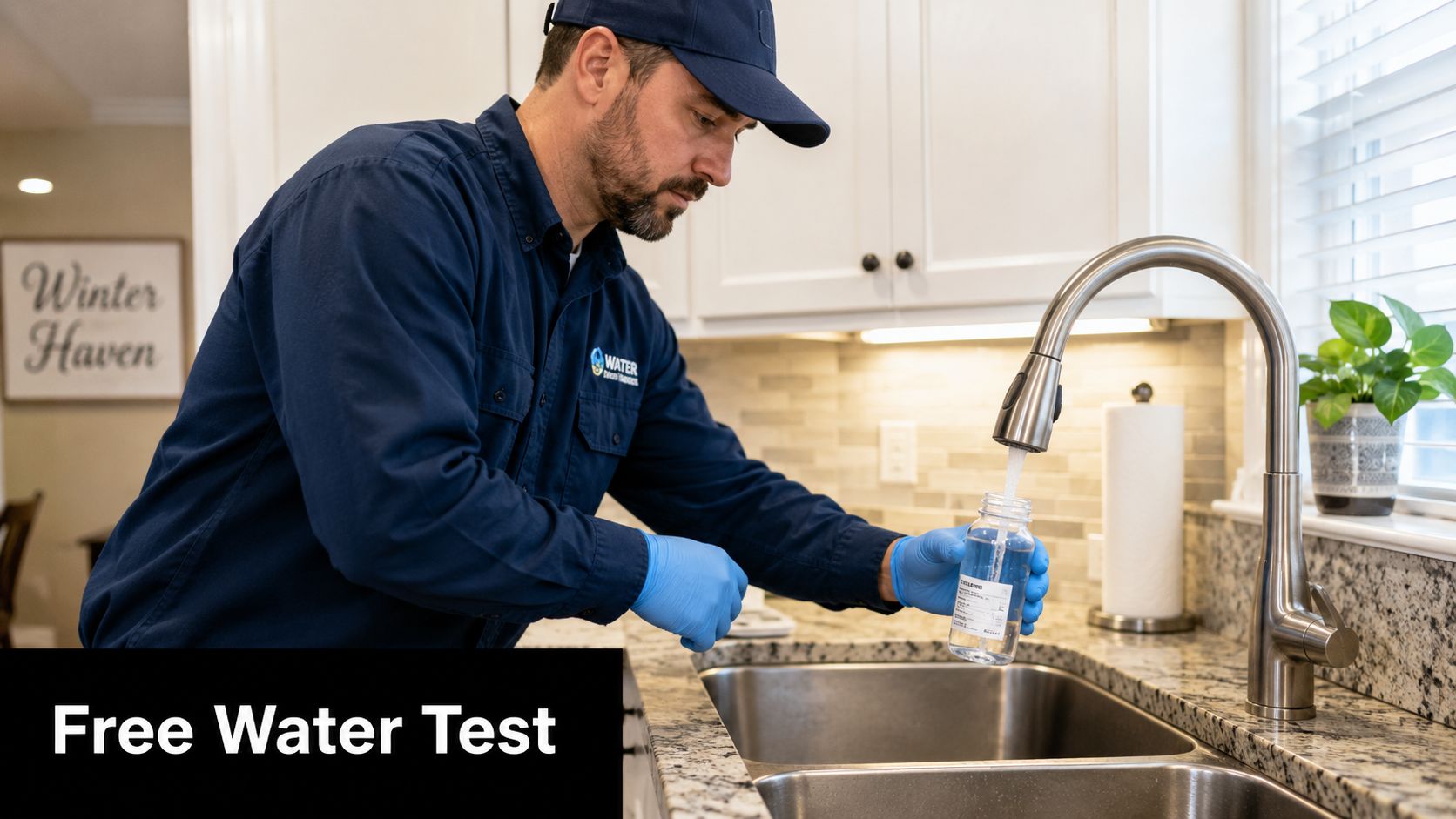
A proper test changes the conversation from guessing to measuring.
Why guesswork usually costs more
Cheap strips and broad online quizzes can point you in a direction, but they rarely tell you enough to size a system correctly or choose the right media sequence. That's where people overspend on equipment they don't need, or underspend on equipment that can't keep up with the home.
Testing also helps separate overlapping issues. Hardness can exist with chlorine. Sediment can exist with iron. A private well can have odor, staining, and microbial concerns at the same time. A single symptom rarely tells the full story.
For homeowners comparing options, it helps to understand how treatment systems are built and what affects cost over time. A nearby example is this overview of home water filtration system cost factors, which shows why the water profile matters more than the product label.
What a useful professional test should tell you
A professional residential evaluation should give you more than a sales sheet. It should identify the problem in a way that leads to a workable design for your plumbing and water use.
Look for a test process that helps answer questions like these:
- What's happening at the point of entry: City water and well water can need very different treatment paths.
- Which nuisance issues are present: Hardness, chlorine, sediment, iron, sulfur odor, taste problems, or a combination.
- How the home uses water: A system has to keep up during showers, laundry, and kitchen use at the same time.
- Whether drinking water needs a separate solution: Whole-home treatment and point-of-use drinking water treatment often do different jobs.
What to ask for: A recommendation tied to your water results, your home's peak demand, and the equipment's maintenance requirements.
A free water test is worth doing because it reduces the chance of buying the wrong equipment. It also gives you something better than a sales promise. It gives you a starting point you can verify.
If you want clear answers for your home, request a free test through the contact page for Florida Water Management.
Choosing the Right Water Treatment System for Your Home
The right system depends on what the test shows. That sounds obvious, but plenty of treatment mistakes happen because someone tries to solve every water problem with one piece of equipment.
The technical benchmark is straightforward. A sound treatment workflow starts by profiling raw water, then selecting media by contaminant class, sizing equipment to peak flow, and checking performance after installation. One local public water reference also notes that the most common failure points are undersizing the service flow and using the wrong media order, which can lead to pressure drop, channeling, or early media exhaustion (Winter Haven drinking-water treatment context).
Match the equipment to the problem
A water softener is built for hardness control. It's the usual answer when the main complaints are mineral spotting, scale, soap inefficiency, and stiff laundry. It does not act as a catch-all filter for every contaminant in the water.
A whole-home carbon filter is commonly used when chlorine taste and odor are the main complaints on municipal water. It improves everyday usability at sinks and showers, but it isn't meant to replace hardness treatment if mineral buildup is still the core issue.
A sediment filter protects plumbing and downstream treatment equipment from sand, grit, and suspended particles. On some homes, this is the first stage, not the whole answer.
A reverse osmosis system usually belongs at a drinking water point, such as the kitchen sink. It's a focused solution for drinking and cooking water when the goal is a higher level of reduction for taste-related or dissolved-contaminant concerns.
An iron or sulfur treatment system is more specialized. If your house has staining, odor, or both, the equipment choice depends heavily on the water chemistry. Such guesswork creates the most wasted money.
A UV sterilizer is typically considered where microbial control is part of the treatment plan, which comes up more often on private wells or in specific risk scenarios. It only works well when upstream filtration is designed correctly.
One option available to homeowners in the area is Florida Water Management's water treatment services and system guidance, which covers softening, filtration, reverse osmosis, and sterilization for homes and small businesses.
Winter Haven water solutions at a glance
| Common Problem | Primary Solution | Best For |
|---|---|---|
| Hard water and scale | Water softener | Homes with spotting, scale, soap inefficiency, and rough-feeling laundry |
| Chlorine taste or odor | Whole-home carbon filtration | Municipal water customers who want better-smelling and better-tasting tap water |
| Sediment or grit | Sediment prefiltration | Homes with cloudy water, clogged aerators, or equipment that needs particulate protection |
| Drinking water taste concerns | Reverse osmosis | Kitchens where the goal is cleaner drinking and cooking water at a single tap |
| Iron staining | Iron-focused treatment system | Homes with red-brown or yellow staining on fixtures, toilets, or laundry |
| Sulfur smell | Sulfur-focused filtration or oxidation setup | Homes with rotten-egg odor at taps or in hot water |
| Microbial concern on a well | UV plus proper pretreatment | Well systems where testing shows a need for disinfection as part of the treatment train |
What works and what usually does not
What works is matching the treatment train to the actual issue. If hardness is moderate but chlorine is the main complaint, a carbon system may be the main upgrade. If hardness is severe and chlorine is also present, the order of treatment matters. If sediment is heavy, it should be handled before sensitive downstream equipment.
What usually does not work is buying “whole-house filtration” as a vague promise. That phrase gets used loosely. A useful system should answer three direct questions: what it removes, how much flow it can handle, and what maintenance it needs.
Another common problem is undersizing. A unit can look fine on paper and still fail in a real house if multiple bathrooms, laundry, and kitchen demand hit at once. The result is pressure complaints, breakthrough, or media that wears out before the owner expected.
How to Vet Your Water Treatment Company
Good equipment installed poorly still performs poorly. That's why choosing a water treatment company in Winter Haven, FL should feel more like hiring a tradesperson than shopping for a gadget.
You want a company that can explain the diagnosis, the equipment choice, and the maintenance in plain language. If a salesperson skips those steps and jumps straight to a package price, slow down.
Questions worth asking before you sign anything
Use these questions to separate a real water treatment professional from a product seller:
- How did you diagnose my water issues: Ask what was tested and how those results changed the recommendation.
- What exactly is each component doing: A trustworthy company should explain each stage in the treatment train, not hide behind brand jargon.
- How was this system sized for my home: Ask how peak household flow was considered.
- What maintenance will I handle myself: Salt additions, filter changes, sanitizing steps, and service intervals should be clear before install day.
- What happens if my water changes: This matters for homes with wells, seasonal occupancy, rental turnover, or plumbing updates.
- Can I see local customer feedback: Reviews won't replace technical planning, but they do show how the company communicates and follows through. You can compare that against customer reviews for Florida Water Management.
The companies worth hiring don't get irritated by detailed questions. They answer them.
A strong installer should also explain trade-offs. For example, point-of-entry and point-of-use systems serve different purposes. A larger system isn't always better. A cheaper system isn't always cheaper after maintenance and replacement intervals are factored in.
A better checklist for private well owners
Private well homes need a different level of caution. Public guidance places testing responsibility on the owner, and a local information gap remains because many companies still reduce well discussions to hardness alone. A local reference tied to Winter Haven's reuse-water guidance notes that private well owners often lack a clear decision tree, even though regional groundwater can involve concerns beyond basic mineral content (Winter Haven reuse program context and well-owner information gap).
For well owners, ask these questions too:
- Was the recommendation based on a current water test: Well water can change.
- Are bacteria or microbial concerns part of the evaluation: Don't assume odor and staining are the only issues.
- What pretreatment does the disinfection system require: UV is not a magic box if sediment or fouling is present upstream.
- Will the company retest after installation when needed: Verification matters more on complex well treatment setups.
That last point matters because well treatment is often a sequence, not a single product. If the company can't explain the sequence, keep looking.
Beyond Installation Maintaining Your System for Peak Performance
A treatment system isn't something you install and forget. The homes that get the best results are the ones where the owner understands a few simple maintenance habits and gets service before performance slips.
That's true whether the system is a softener, a carbon unit, reverse osmosis, UV, or a multi-stage setup. Every one of them depends on clean media, proper settings, and occasional verification that the system is still doing the job it was chosen to do.
The systems that get neglected first
Softeners get ignored when salt runs low or settings drift after a plumbing change. Reverse osmosis units get ignored because the water still seems fine until the filters are overdue. Sediment filters get ignored until pressure drops enough that someone finally notices.
The problem is that neglected maintenance can mimic a bad installation. Homeowners often think the system “stopped working,” when the issue is a cartridge, media bed, lamp, prefilter, or service interval that got missed.
A treatment system should make water easier to live with. If it's creating pressure problems, odor return, or taste changes, it needs attention.
A simple long-term approach
A practical routine looks like this:
- Test first: Start with actual water conditions instead of assumptions.
- Choose correctly: Match the equipment to the contaminants and the home's water demand.
- Vet the installer: Make sure the company can explain sizing, sequence, service, and verification.
- Maintain on schedule: Keep filters, media, disinfection components, and settings where they should be.
That approach saves more frustration than chasing symptoms one by one. It also gives you a better chance of keeping appliances cleaner, plumbing happier, and drinking water more pleasant over the long term.
If you're dealing with hard water, chlorine taste, staining, sulfur odor, sediment, or private well uncertainty, start with the step that gives you real answers. Contact Florida Water Management to schedule a free water test and get a treatment recommendation based on your home's actual water.