

You pull a well-water sample, wait for the lab report, and then see the word that makes your stomach drop, coliform detected. For a lot of Central Florida homeowners, that's the moment the kitchen table turns into a decision point, because now every glass of water, every pot of pasta, and every shower starts to feel a little different. The good news is that a positive result is not a verdict by itself. It is a signal, and the right response is usually a mix of confirmation, inspection, and the right kind of treatment, not panic.
Table of Contents
- Why a Single Test Result Can Change How You Use Your Water
- Total Coliforms, Fecal Coliforms, and E. coli Explained
- Health Risks Linked to Coliforms in Drinking Water
- Regulatory Standards for Public Systems and Private Wells
- How Coliform Bacteria Are Detected and Tested
- Common Causes of Coliform Contamination in Wells and Plumbing
- Remediation Options From Boiling to Whole-Home Treatment
- A Homeowner's Action Plan After a Positive Coliform Test
Why a Single Test Result Can Change How You Use Your Water
A homeowner in Polk or Highlands County gets the lab sheet back and sees one small word beside a number, detected. That result can change how they cook dinner, whether they hand the kids a glass from the tap, and whether they call a technician before the weekend ends. This reaction is justified because public-health agencies treat coliform testing as a warning system, not a casual check box. The U.S. EPA's microbiology standard historically set treated drinking water at 0 CFU/100 mL, and Canada's guideline says total coliforms should be none detectable per 100 mL in treated water leaving a plant and in non-disinfected groundwater leaving the well (PubMed summary of public-health guidance).
Why the result matters even when nobody feels sick
Coliform bacteria are not one germ; they are a group of indicator organisms. A positive result does not automatically mean illness, but it does mean something in the system deserves attention. Health Canada treats coliforms as an operational indicator of treatment performance and water-quality decline, while the EPA's standards discussion says any coliform in treated water should not be tolerated because it can point to inadequate treatment or post-chlorination contamination (EPA standards discussion).
Practical rule: a coliform-positive report is less like a diagnosis and more like a dashboard light. You do not ignore it, and you do not assume the worst without checking the rest of the system.
For private wells in Central Florida, that warning carries extra weight because the owner, not a utility, is responsible for monitoring and follow-up. Once the report is in your hands, the useful questions are simple, where did the pathway open, and what has to be fixed so the problem does not come back?
Total Coliforms, Fecal Coliforms, and E. coli Explained
Think of the coliform family the way a neighborhood watch works. Total coliforms are the general alarm. Fecal coliforms narrow the search. E. coli is the strongest clue that fecal contamination is involved. That hierarchy matters because a lab report can look alarming when the underlying message is more nuanced than “your water is dangerous right now.”
The broad group and the narrower one
Coliforms are Gram-negative, non-spore-forming rods that ferment lactose with acid and gas, which is why labs can culture them reliably in routine monitoring (Health Canada technical document). They're common in soil, plants, and the intestines of warm-blooded animals, so a positive total coliform result does not prove sewage contamination by itself. It does, however, tell you that sanitary integrity may have been compromised somewhere along the path from source to tap.
How to read the report without overreacting
A useful way to sort it out is this:
- Total coliforms: a warning sign that the system may be exposed.
- Fecal coliforms: a stronger warning that contamination may be linked to warm-blooded animal waste.
- E. coli: the most specific indicator in this group, and the one that raises the concern level the fastest.
That distinction isn't academic. Private-well guidance from Wisconsin State Laboratory of Hygiene treats total coliforms as a pollution indicator that warrants follow-up testing, while public-system guidance is stricter still, with no samples allowed to test positive for fecal coliform or E. coli (Wisconsin State Laboratory of Hygiene; Utah State University extension summary of EPA rules).
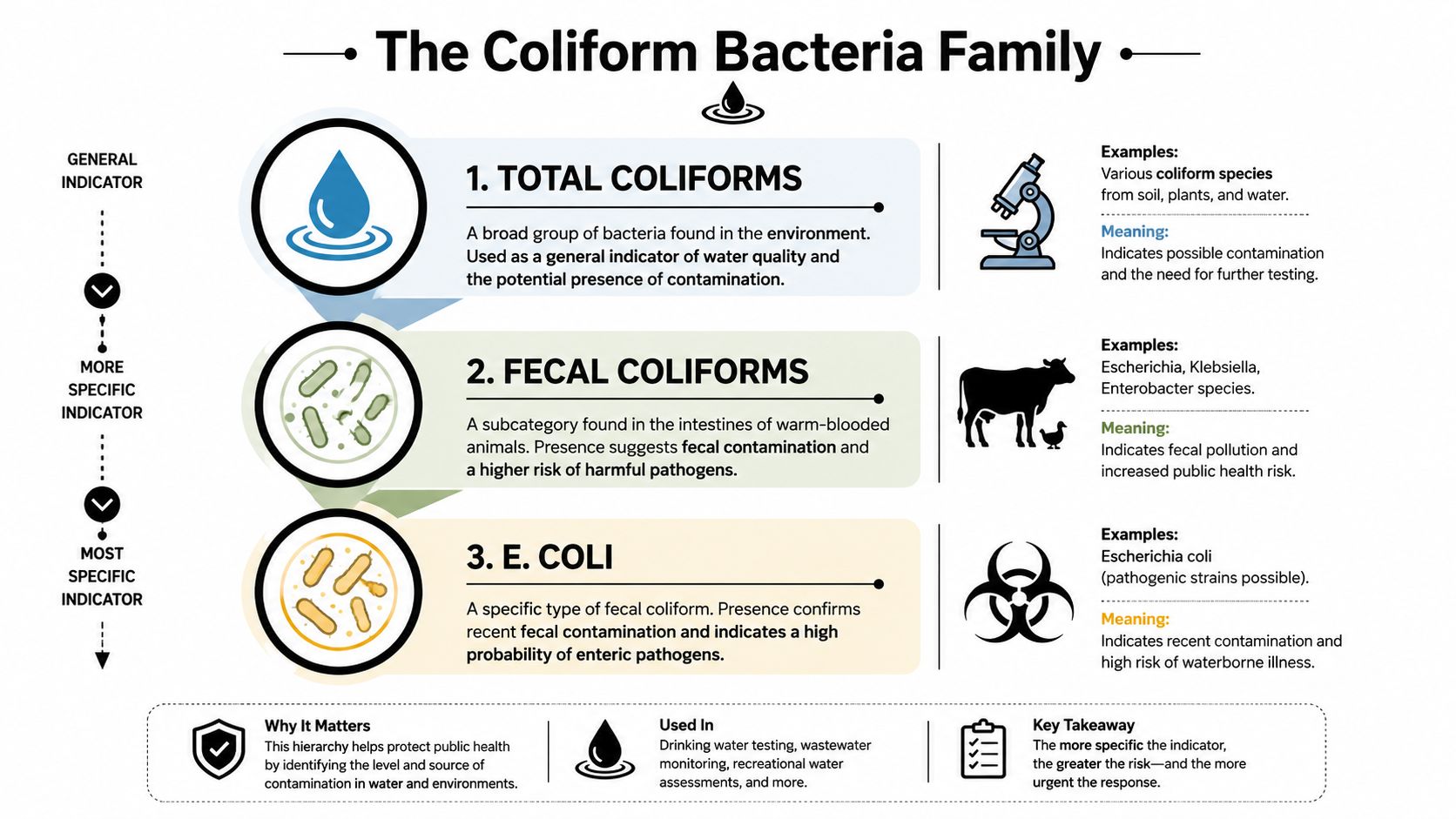
So if a report says total coliforms were detected, that's not the same as saying sewage is in the kitchen sink. It means the system deserves a closer look, and if E. coli shows up too, the tone changes fast.
Health Risks Linked to Coliforms in Drinking Water
A positive total coliform result is mainly a signal, not proof of disease. That is where a lot of homeowners get tripped up. They hear “bacteria,” think “immediate sickness,” and either overreact or shrug it off. However, the situation is more nuanced. Total coliforms usually point to a pathway problem, while E. coli is a much stronger clue that fecal contamination is involved and that the risk picture is more serious.
What regulators are really trying to prevent
EPA guidance on treated water treats any coliform finding as a warning that something in the system is not working the way it should, whether the problem is incomplete treatment or contamination after disinfection. That strict posture makes sense because water systems do not wait for a confirmed pathogen before acting. They use indicator organisms to catch failures early, before a hidden problem becomes a broader exposure event.
For healthy people, total coliforms themselves typically are not the thing causing illness. The primary concern is what their presence implies, a breach somewhere in source protection, plumbing, treatment, or storage. Once that breach exists, other organisms can share the same route into the water.
Why the risk level changes with the type of result
The practical tiers look like this:
- Total coliform detected: something in the system is off, but the cause could be structural, environmental, or related to maintenance.
- Fecal coliform detected: the contamination pathway looks more directly tied to waste.
- E. coli detected: the concern rises because the finding is tied more closely to fecal contamination and a higher likelihood of harmful exposure.
That is why the key question after a positive report is not, “Did this one bacterium make us sick?” It is, “What else could be getting through the same opening?” If the answer points to a cracked cap, a failed seal, a cross-connection, or a distribution issue, the fix should target that cause, not just the test result.
A safe response starts with the pathway, not the panic.
Regulatory Standards for Public Systems and Private Wells
Municipal water and private wells live under very different rules, and homeowners need to know which world they're in. A city utility gets monitored on a schedule with compliance thresholds built into the system. A private well is the owner's responsibility, which means the burden shifts from the utility operator to the household. That's why the same word, coliform, can have very different implications depending on where the water comes from.
Public systems follow a compliance framework
For public drinking-water systems, the EPA/extension guidance summarized by Utah State University says systems collecting fewer than 40 total coliform samples per month may have no more than one positive sample, while systems collecting more than 40 samples per month must keep positives at 5% or less. The same guidance says no samples should test positive for fecal coliform or E. coli (Utah State University extension summary of EPA rules). That's a compliance framework, not just a suggestion.
Private wells are owner-managed
For private wells, the CDC recommends testing at least once every year for total coliform bacteria, nitrates, total dissolved solids, and pH (CDC well-water testing guidance). In plain language, that means the homeowner is the monitoring program. If the well is on a property in Sebring, Avon Park, Lake Wales, Winter Haven, or Frostproof, nobody else is automatically watching it for you.
| Setting | Acceptable Level | Monitoring Frequency | Who Is Responsible |
|---|---|---|---|
| Public system | No coliform in treated water, no fecal coliform or E. coli, and compliance limits for positives based on monthly sample count | Routine regulated sampling | Utility operator |
| Private well | At least 0 total coliform should be the goal, with investigation if detected | At least once per year for core parameters | Homeowner or property owner |
That table is the clearest way to see the split. The public system is managed like a utility process. The private well is managed like equipment on your property, which means a result has to lead to action, not just a file folder.
How Coliform Bacteria Are Detected and Tested
A coliform test is much less mysterious once you know what happens in the lab. A technician starts with a 100 mL sample, then filters it and places the filter on selective media such as m-Endo or LES Endo. The plate is incubated at about 37 °C for roughly 24 hours, and some methods add a 44 °C confirmation step to distinguish fecal indicators (introductory water-analysis lab manual/01:_Labs/1.09:_Bacteriological_Analysis_of_Water)).
What CFU and MPN mean in plain English
CFU means colony-forming units. That's a count of visible colonies that grew from the sample. MPN means most probable number, a statistical estimate used by some test methods. Either way, the number matters because 0 CFU/100 mL or 0 MPN/100 mL is the target for potable water, and anything above zero tells the lab that contamination was present in that sample.
That's why “detected” is such a loaded word. It doesn't mean the water is automatically making people sick right this second. It means the sample contained organisms that should not have been there, and the system should be checked before anyone assumes the issue is harmless.
What a homeowner can realistically do
Most homeowners either send a sample to a certified lab or use a private well-water testing service. The important part is not the brand of bottle, it's the chain of custody and the sample quality. If the sample is collected poorly, you can get a misleading result, which is why lab instructions matter so much.
Best practice: collect the sample exactly as instructed, then act on the result as if it were a system check, not just a number on paper.
If you're in the Fish Hawk area and want a local example of how a well-water test is booked and explained, this well-water testing page shows the kind of service homeowners typically look for after a confusing result.
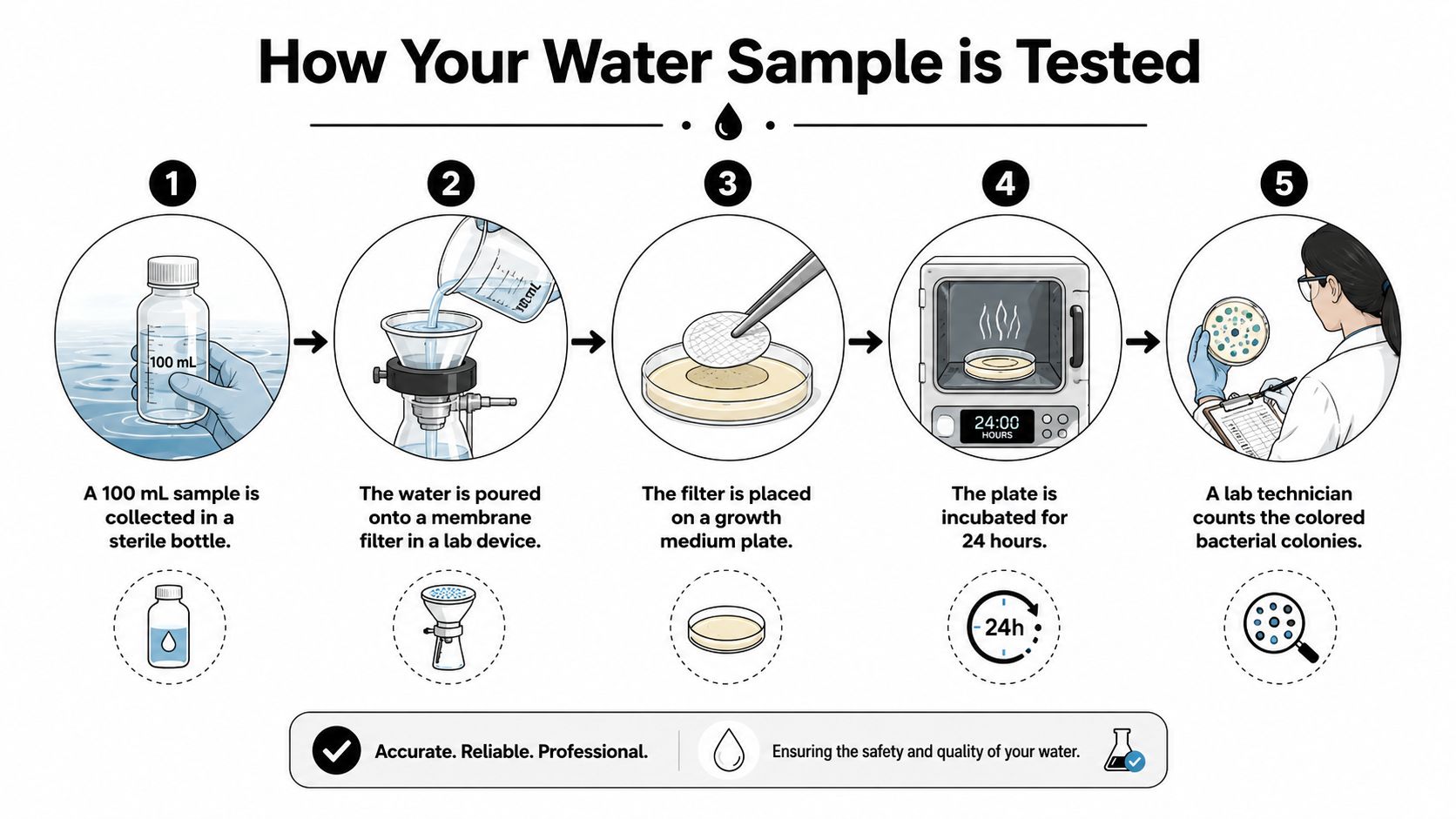
The science is standardized for a reason. When a test is this repeatable, regulators can use it as a real decision point instead of a vague warning.
Common Causes of Coliform Contamination in Wells and Plumbing
A positive result usually points to a cause, not a mystery. In private wells, the usual suspects are pretty practical. Wet-weather infiltration, a cracked or missing well cap, a loose seal, deteriorated casing, cross-connections, nearby septic systems, livestock, flooding, and stale plumbing in a rarely used building can all open a path for coliforms to enter the water. That's why a lab report should be read like a symptom sheet, not a standalone verdict.
Match the cause to the cure
If rainwater gets in around the wellhead, the fix is not the same as if bacteria are entering through a plumbing cross-connection. If a guest house sits unused for months, stagnant lines can show a problem that doesn't look like a source-water issue at all. In municipal systems, the pattern shifts again, because contamination after treatment can come from distribution-system repairs, biofilm, low-pressure events, or aging mains.
That's why a good technician looks at the site, not just the report. The issue might be as visible as a damaged well cap, or as hidden as a backflow pathway tied to irrigation.
- Wellhead damage: cracked caps, loose seals, or casing problems can let water enter.
- Land and weather exposure: flooding, heavy rain, and runoff can push contamination into vulnerable wells.
- Plumbing faults: cross-connections and backflow can move dirty water where it shouldn't go.
- Idle plumbing: unused branches can develop water-quality issues even when the well itself is sound.
The management plan on a Central Florida property often starts with a simple inspection, because if the pathway stays open, the bacteria can come back. That's the reason repeated positives are often a system-integrity problem instead of a one-time bacteria event. For a practical overview of corrective thinking, this contamination-reduction guide is a useful companion reference.
Remediation Options From Boiling to Whole-Home Treatment
A positive coliform result calls for layers of response. Boiling water gives you immediate protection, but it does not correct the cause, and a permanent fix may still be needed after the short-term safety step is in place. If the lab confirms contamination, boiling water for one minute is the immediate protection step for drinking, cooking, brushing teeth, making ice, washing fruits and vegetables, and preparing infant formula.
Start with the immediate step
Boiling solves the “I need safe water tonight” problem. It does not repair a cracked well cap, a plumbing cross-connection, or a failed seal, so it should be treated as a temporary safety measure while the source of the problem is tracked down.
Then move to the corrective steps
Shock chlorination is commonly used after a contamination event or well service, especially when a one-time intrusion is suspected. After that, retesting matters, because a system that still has an open pathway can show the same positive result again. Michigan's well sampling guidance says repeated positives point to correcting the underlying cause, not just adding more chlorine (Michigan EGLE well sampling guidance).
Match the treatment to the problem
- Point-of-use treatment: reverse osmosis or a UV unit at the kitchen tap can protect the water you drink and cook with.
- Whole-home treatment: filtration paired with UV or another sterilization approach is better when the contamination risk affects the whole house or keeps returning.
- Permanent correction: repairs to the well, casing, cap, seals, or cross-connection points are often the definitive fix when contamination repeats.
For homeowners comparing sterilization options, this UV water-sterilization page shows the kind of point-of-entry treatment many wells use when the goal is protection at the whole-house level.
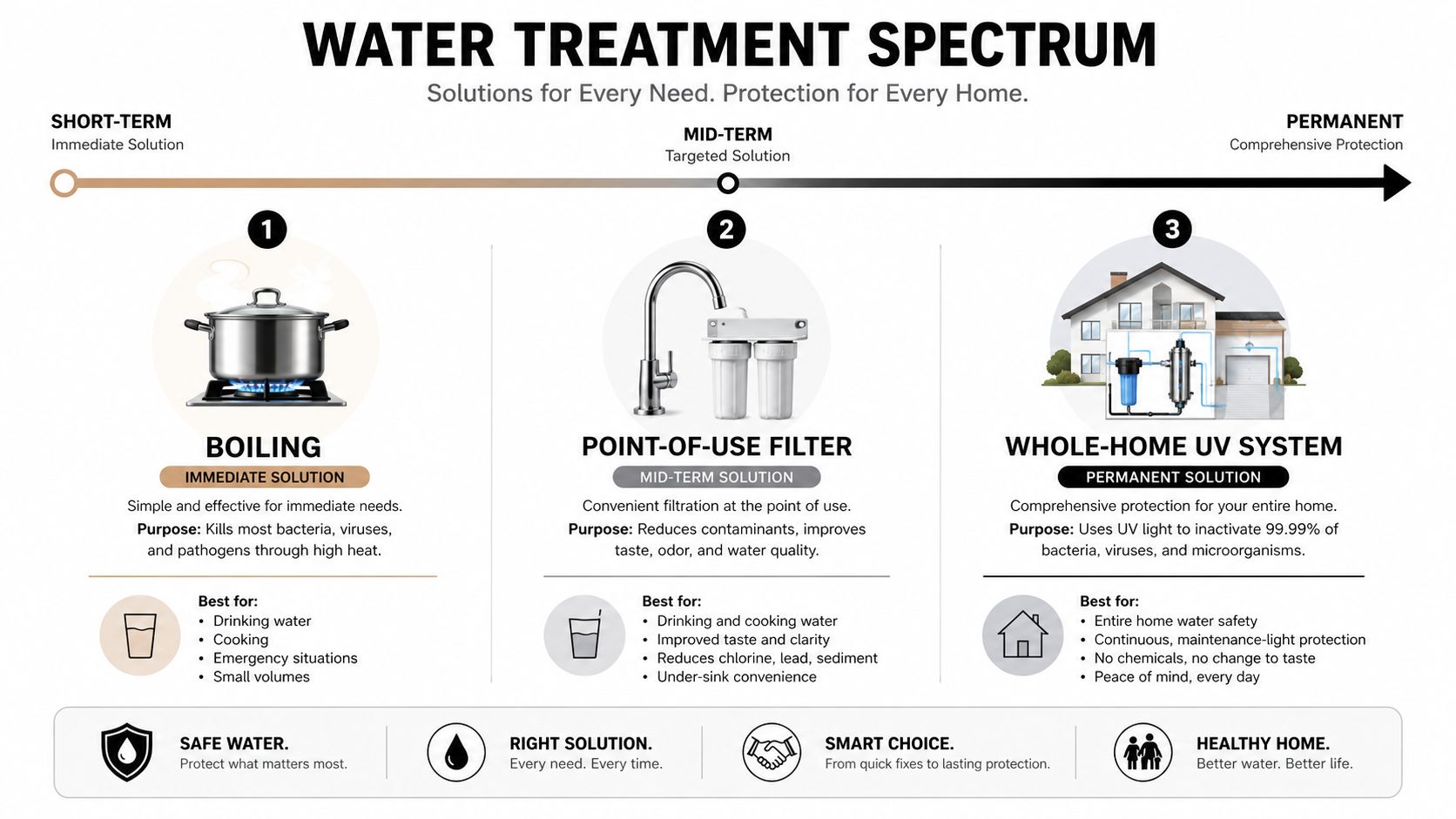
Chlorine is not a magic reset button. If the structure is still compromised, coliform can come back.
A Homeowner's Action Plan After a Positive Coliform Test
A positive coliform result can feel like a false alarm at first, especially if the water still looks clear and smells normal. Start by confirming the result with a second sample from the same tap, because a sampling slip or handling problem can create confusion. Then look at the well cap, casing, seals, and the ground around the well for pooling water, runoff, or anything else that could let contamination enter the system. If the result and site conditions point to a real problem, shock chlorinate, then retest after the chlorine smell is gone, following local guidance such as retesting two to three days after the smell of chlorine is gone when that timeline is recommended.
A clean sequence beats guesswork
- Confirm the result with a second sample.
- Inspect the wellhead and nearby land use for obvious entry points.
- Disinfect if indicated by the situation and your local guidance.
- Retest after treatment to see whether the fix worked.
- Move to permanent treatment if positives keep returning.
This escalation is critical in Central Florida, where private wells face recurring pressure from weather, soil conditions, older equipment, and aging plumbing. If the water keeps testing positive, a permanent point-of-entry or point-of-use solution matched to the actual cause is the better path than repeating the same test-and-treat cycle.
Repeated positives usually mean the system still has a weak point.
If you live on a private well and want a clear answer instead of another confusing lab slip, Florida Water Management can test your water, explain what the result means, and recommend the right fix for your home. Visit Florida Water Management to book a free professional water test and get a treatment plan built around your water, your well, and your household's daily use.