

You can hold a small TDS pen over a glass of tap water in Central Florida, watch the number settle, and still not know whether the water is fine, hard, salty, mineral-heavy, or worth a closer look. That's why tds meter readings matter. They're not a verdict, they're a first clue, and once you know how to read them correctly, you stop guessing and start asking the right follow-up questions about your home's water.
A lot of homeowners get stuck on the number itself. A better habit is to ask what the number is telling you about dissolved material in the water, then decide whether you need more specific testing for iron, hardness, sulfur, chlorine byproducts, or microbial risk. If you want a broader look at contamination concerns while you compare your reading, this guide on how to reduce water contamination is a useful companion.
Table of Contents
- Why TDS Readings Matter at Your Kitchen Sink
- What a TDS Meter Actually Measures
- How to Take a Reliable Reading at Home
- Typical TDS Ranges in Central Florida Homes
- Calibrating and Trusting Your Meter
- What TDS Cannot Tell You About Your Water
- Matching a Reading to the Right Treatment
- TDS Reading Questions Homeowners Ask Most
Why TDS Readings Matter at Your Kitchen Sink
A homeowner in Sebring or Winter Haven usually reaches for a TDS meter at the kitchen sink after noticing one of three things, the coffee tastes off, the shower leaves spots, or the tap water just looks different from last month. The meter gives an immediate number, which feels reassuring, but that number is only the beginning of the story. It tells you whether the water carries a lot or a little dissolved material, not whether the water is safe, unsafe, soft, hard, or balanced for your plumbing.
The right way to think about the first number
A TDS reading is a screening signal, not a diagnosis. That matters because the same reading can come from very different mixtures of dissolved substances, and those mixtures don't behave the same way in the home. One household may see a modest reading and still deal with staining or odor, while another may see a higher reading and mostly notice scale.
Practical rule: treat the number as a starting point, then ask what other symptoms are showing up with it.
That simple shift saves homeowners from two common mistakes. First, it keeps people from buying a treatment system just because a number looked scary. Second, it keeps people from ignoring a reading that deserves more targeted testing.
For homeowners in Central Florida, that's especially useful because well water and municipal water can both vary by neighborhood and source. A reading by itself can't tell you whether the next question is iron, hardness, sulfur, chlorine, or bacteria. It only tells you that the sample contains dissolved material worth understanding more carefully.
What confidence looks like
Confidence doesn't come from chasing a perfect number. It comes from knowing what a reading can and can't do, then deciding whether you need a more specific test. If you can do that, you're already ahead of many who only look for a “good ppm” and stop there.
The rest of this guide moves from the basic concept to reliable home testing, then into how Central Florida homeowners can use the number to choose the right next step without overreacting.
What a TDS Meter Actually Measures
A TDS meter does not measure dissolved solids directly. It measures the water's electrical conductivity, then converts that signal into an estimated TDS value, usually displayed as ppm or mg/L. That conversion makes the number useful for everyday comparison, but it also means the meter is giving you an estimate of the overall ionic load, not a chemical inventory of the sample. The result can reflect minerals like calcium, magnesium, sodium, and chlorides, while still leaving you blind to exactly which substances are present.
Why the same number can mean different things
Think of two soups that look nearly identical in a bowl. One is lightly salted, the other is heavily seasoned with several dissolved ingredients. A spoonful from each may look the same, but your mouth tells a different story. A TDS meter is closer to a quick taste test of the broth than a full ingredient list. It can tell you the water has more or less dissolved material, but not what that material is.
That's why TDS readings in drinking water need context. The U.S. EPA's secondary standard is 500 ppm, while Health Canada notes that higher TDS can make water unpalatable to many consumers, according to EcoPure's overview of TDS in drinking water. Those figures help anchor the conversation, but they still don't tell you whether the dissolved material is mainly harmless hardness minerals or something you'd want tested more carefully.
Temperature and conversion matter too
Many meters use automatic temperature compensation, because conductivity shifts as water temperature changes. That's one reason a number can move a little even when the water source hasn't changed. Bench instruments can be even more configurable, with multi-range auto-selection, sub-ppm-to-g/L resolution, and adjustable conversion settings. A laboratory meter may list a TDS range of 0–19,999 g/L, resolution from 0.01 mg/L to 1 g/L, ±0.5% ±2 digits accuracy, and selectable EC ratio 0.50–0.80 with reference temperatures of 18, 20, or 25°C as shown in Jenway's bench meter data sheet.
That's the core idea. A TDS meter gives you a useful proxy, not a complete answer.
How to Take a Reliable Reading at Home
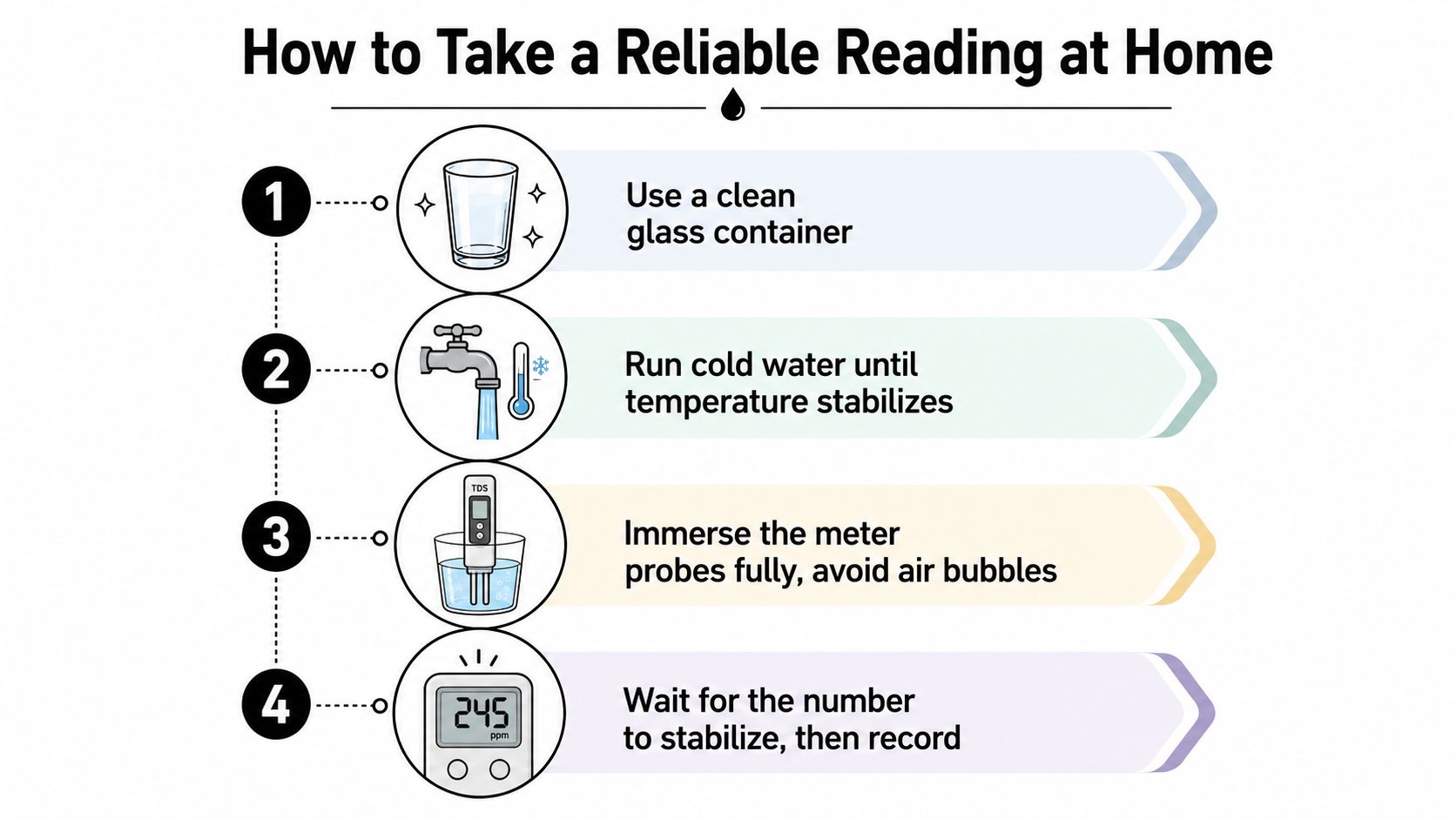
A good reading starts before the probe touches water. Use a clean glass container, not a cup that might still have soap residue or old mineral deposits clinging to the inside. Run the tap until the water temperature has settled, then fill the glass and test that sample instead of trying to read straight from a moving stream.
The clean-sample method
Consumer TDS guides recommend waiting about 5 to 10 seconds for the reading to stabilize, using a clean glass container, immersing the probe only to the marked line, and rinsing the probe with distilled or filtered water between measurements as outlined by Ampac. That advice sounds fussy until you compare two readings taken the same way and two readings taken carelessly. The meter is only as honest as the sample in front of it.
A practical routine looks like this:
- Use a clean glass: A dirty cup can leave residue that nudges the number.
- Run the water first: Let the sample temperature settle before you test.
- Immerse the probe correctly: Keep it to the marked line and avoid the sides or bottom.
- Wait for stability: Let the display settle before you write anything down.
- Rinse between samples: Distilled or filtered water helps reduce carryover.
The same guide also recommends taking 2 to 3 readings to confirm consistency. That habit matters because a single shaky number can send you chasing a problem that isn't really there.
A meter that bounces around is often telling you about technique, not water quality.
How to record the reading
Write down the number, the date, and where the sample came from, such as kitchen tap, bathroom sink, hose bib, or well spigot. That tiny record becomes useful later when you compare seasonal changes or split the home into different plumbing zones. A sloppy procedure can easily make one sample look noticeably different from the next, which is why the same water should be tested the same way every time.
Once your method is clean and repeatable, the number starts to mean something.
Typical TDS Ranges in Central Florida Homes
Central Florida water doesn't behave like a textbook example. A reading that feels low in one house may be perfectly ordinary in another, especially when you compare a private well with a municipal supply. The value matters most when you put it beside what the homeowner notices: taste, scale, staining, or appliance wear.
A practical local table
| TDS Range (ppm) | What It Often Means Locally | What You May Notice at Home |
|---|---|---|
| Lower range | Often cleaner-tasting water, sometimes with softer-feeling water | Less visible scale, but water can still be corrosive or need more testing |
| Mid range | Common in much of Central Florida's municipal supply | Usually fewer taste complaints, occasional mineral buildup over time |
| Higher range | More common in some private wells and lake-fed communities | Scale on fixtures, shortened water-heater life, spotty laundry |
A reading in the lower range can feel encouraging, but it doesn't automatically mean the water is gentle on plumbing. A low TDS number can still coexist with water that behaves aggressively in pipes or with a problem that TDS cannot see. On the other end, a higher reading often lines up with more visible mineral evidence in the house, which is why homeowners notice white film on fixtures before they ever think about the meter.
Why local geology matters
Central Florida's groundwater is shaped by the mineral profile of the Floridan aquifer, so private wells often tell a different story than city water. That doesn't mean every well is problematic. It means the same reading needs to be interpreted with the home's source, plumbing, and visible symptoms in mind.
If you're comparing your number with what feels normal in the region, it helps to look at mineral symptoms alongside it. The water hardness level guide gives a useful next lens when the reading and the symptoms seem out of sync.
The safest interpretation is simple. In Central Florida, a TDS number tells you where to look next, not what to buy.
Calibrating and Trusting Your Meter
A meter that sat in a drawer for months can drift without looking broken. I've seen homeowners pull out a pen-style meter, test the same tap twice, and get a different answer because the instrument hadn't been checked against anything reliable in a long time. That's not a water problem. It's a tool problem.
Verify the instrument before you trust the result
Reliable field testing depends on calibration and repeatability. North Dakota State University's water-testing guide recommends checking meters with a prepared standard and notes a test solution expected to read between 2,400 and 2,700 mg/L. If a sample reaches 4,500 ppm TDS or higher, the guidance says to submit it for laboratory analysis per NDSU's water-testing guide. That threshold is a good reminder that a field pen has limits.
If the meter hasn't been verified lately, don't use it as a final authority.
For homeowners, the practical takeaway is straightforward. If the meter is reading strangely, check the standard, confirm the probe is clean, and see whether repeated samples agree. If they don't, the instrument may need recalibration or replacement.
Why bench meters feel different
Curious readers often ask why professional instruments seem more precise. Bench meters are built for broader operating ranges and tighter control over conversion settings. The configurable EC ratio and the chosen reference temperature can change the displayed TDS even when the underlying conductivity hasn't changed. That matters because two devices can report slightly different results from the same sample because they're using different assumptions.
That doesn't make the field meter useless. It means the meter is a tool with a job, not a permanent authority. For routine homeowner screening, it's fine when it's checked and used properly. For high readings, uncertain samples, or water that looks and smells concerning, a lab-backed follow-up is the right next move.
What TDS Cannot Tell You About Your Water
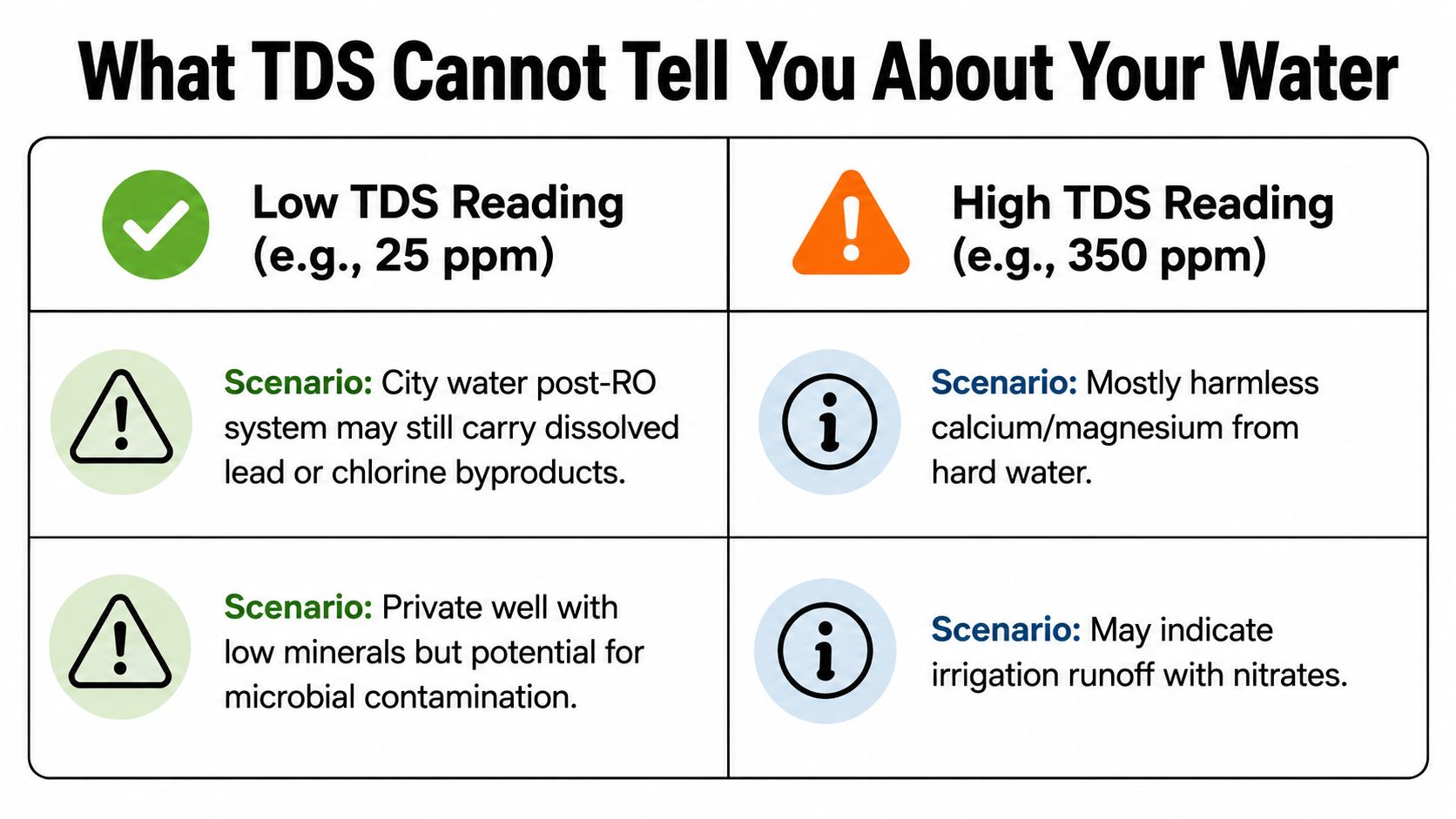
A low number can lull people into a false sense of security. I've seen homeowners look at a modest reading and assume the water must be safe, while the actual issue was somewhere else entirely, iron staining, chlorine-related taste, sulfur odor, or microbial concerns that a conductivity-based meter could never identify.
Low TDS is not the same as safe water
Consumer guidance is clear that a TDS meter tells you whether water contains more or less dissolved material, but not which solids or contaminants are present as explained by Viomi's guide on TDS variation. That matters because a private well can post a low reading and still carry bacteria that the meter cannot detect at all. A municipal blend can also taste fine while still needing a separate look at specific byproducts or treatment issues.
The same goes for iron. A homeowner can see staining and still get a number that looks calm. The meter may be telling the truth about dissolved load, but it's not telling the whole truth about what the water is doing in the house.
High TDS is not automatically dangerous either
A higher number often means more dissolved material, but that material may be mostly calcium and magnesium from hard water. In other cases, a higher reading can point you toward runoff or other conditions that deserve specific testing. The number is a clue, not a label.
The question isn't whether the number is high or low. The question is what follow-up test the number just earned.
That is the useful homeowner mindset. If the reading comes with taste, odor, staining, or plumbing symptoms, the next step is rarely to stare at the number longer. It's to pair the meter with more specific testing for the concern you have.
Matching a Reading to the Right Treatment
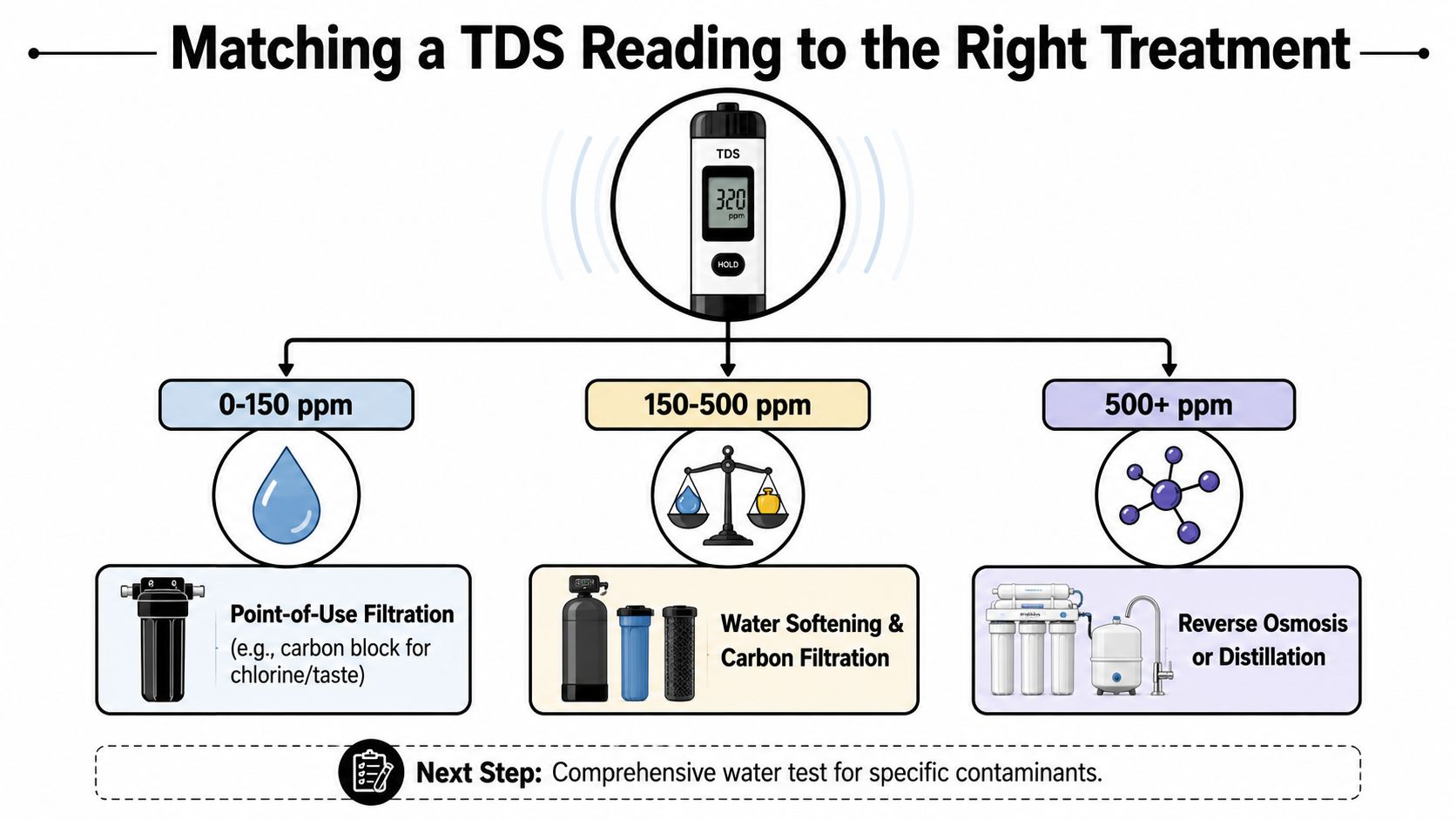
A TDS number becomes useful when it helps you choose the next conversation. If the water feels hard and the reading lines up with scale, softening becomes a logical topic. If the water tastes flat or carries odor, point-of-use treatment can make sense at the kitchen sink. If the water source raises broader concerns, whole-home filtration or sterilization enters the picture.
Read the symptom, not just the number
The useful pattern is simple. Hard water symptoms plus elevated TDS often point toward a softener conversation. Taste or odor complaints plus a concerning reading can justify reverse osmosis at the kitchen tap. Whole-home filtration is the right idea when chlorine, sulfur, or sediment are part of the complaint, because the issue is broader than drinking water alone.
For homes on wells, the treatment discussion gets even more specific. Iron staining, sulfur odor, and microbial worry each call for different equipment or follow-up testing. TDS doesn't separate those categories for you, which is exactly why a one-number approach falls short.
Think of the meter as the fork in the road
The meter doesn't pick the treatment. It points to the right fork. Once you know that, the rest becomes much easier to explain to a technician or to family members who are trying to decide whether the house needs a softener, a kitchen system, or a full water-quality review.
For homeowners comparing options for better drinking water from a well, reverse osmosis for well water is often part of that conversation when taste or dissolved load are the issue. The important part is choosing treatment after the testing, not before it.
When TDS lines up with visible symptoms, you've got a good reason to ask for a more complete water profile. That's the bridge from a reading to a real plan.
TDS Reading Questions Homeowners Ask Most
Can a TDS reading tell me my water is safe to drink
No. It can tell you the water has more or less dissolved material, but it can't identify contaminants or confirm safety. If safety is the question, you need more specific testing.
How often should I test
Test when something changes, new odor, new staining, new taste, or a change in source. Seasonal checks also help if your home relies on a well or if your area tends to swing between source types.
Will filtered or reverse-osmosis water read near zero
Often it will read much lower than untreated water, but the exact result depends on the system and the water feeding it. A lower number is expected, but the reading still needs to be taken correctly and interpreted with the system in mind.
What if two readings don't match
Clean the probe, rerun the sample, and take another 2 to 3 readings. If the numbers stay inconsistent, treat that as a meter or technique issue before you assume the water changed.
A TDS meter is a strong first tool because it turns a vague concern into a measurable clue. The next step is turning that clue into a complete picture with a professional water test, so you know whether the fix is softening, filtration, reverse osmosis, sterilization, or a more targeted follow-up.
If you want a clear answer for your own water, schedule a free in-home water test with Florida Water Management. Their team can help you turn a confusing TDS number into a practical plan for your home.