

You're probably dealing with more than one water problem at the same time.
A Parrish homeowner notices white spots crusting up on the shower door, soap that won't rinse clean, and laundry that feels rough even after a full wash cycle. Then there's the other complaint. The tap water may taste off, smell like chlorine, or, on a private well, carry that rotten egg sulfur note that makes every sink use a reminder something isn't right.
That's where people get stuck on the question of water softener vs filtration in Parrish, FL. They sound similar, many companies blur the difference, and the underlying problem can be left untouched. A softener can fix scale and still leave taste or contaminant issues behind. A filter can improve taste and still let hardness keep damaging fixtures and appliances.
The answer usually isn't as simple as picking one box and being done. In Parrish, especially on private wells, layered treatment is often the setup that works in the field. If you're trying to make sense of buildup, odor, staining, or drinking water concerns, it helps to start with your local water hardness levels in Florida and then match the system to the problem.
Table of Contents
- Is Your Parrish Water Working Against You
- The Unique Water Profile of Parrish FL
- Water Softeners What They Do and Dont Do
- Water Filtration A Spectrum of Solutions
- Direct Comparison Softener vs Filter for Parrish Homes
- Choosing Your System When You Need Both
- Your Next Step Get a Free Professional Water Test
Is Your Parrish Water Working Against You
A lot of water issues start small enough to ignore.
You wipe down the faucet and the white film comes back. Your dishwasher runs, but glasses still look cloudy. You buy body wash and shampoo that promise better results, but your skin still feels dry and your hair feels dull. Then the kitchen tap reminds you there may be another issue entirely because the water still doesn't taste the way you want it to.
That combination is what confuses most homeowners. One symptom points to hardness. Another points to odor, chlorine, sediment, or a contaminant issue. If you treat only one side of that problem, the house still won't feel right.
A common Parrish pattern
In homes on municipal water, the first complaint is often scale on fixtures and poor soap performance. In homes on private wells, the list tends to get longer. Hardness shows up along with iron staining, sulfur odor, or water that doesn't inspire confidence for drinking.
Practical rule: If your water is damaging appliances and also tastes or smells bad, you're likely not choosing between a softener and a filter. You're identifying which job each system needs to do.
What homeowners usually want fixed
A useful way to think about the problem is to separate household performance from water quality concerns.
- Scale and mineral buildup: This points toward hardness.
- Taste and odor issues: This points toward filtration.
- Staining or sulfur smells on a well: This usually means a specialty filter stage is needed.
- Drinking water concerns: This often calls for a separate point-of-use solution rather than relying on a softener.
That's the starting point for water softener vs filtration in Parrish, FL. The right system depends less on the label on the tank and more on what your water is doing in your home.
The Unique Water Profile of Parrish FL
Parrish homeowners don't deal with generic water. Local conditions shape the problems you see at the sink, in the shower, and inside your plumbing.
Why hardness shows up so often
Across Florida, hardness is a normal part of the water conversation. One supporting reference states that Florida's water is naturally hard across the state, making a water softener essential for homes to prevent mineral buildup, while a carbon filtration unit specifically addresses colors, taste, and odors in both well and municipal water supplies in this Florida community water discussion.
That tracks with what homeowners see in real houses. Hard water leaves scale on shower glass, around faucets, on heating elements, and inside plumbing. It also changes how soap behaves. People often describe it as water that never feels fully rinsed off.
City water and well water create different headaches
Municipal water and private well water can both be frustrating, but they usually frustrate people in different ways.
With city water, the complaints often center on mineral buildup plus taste or odor. Homeowners may hate the chlorine note at the tap or notice that cooking water affects coffee, tea, and ice. In that setting, a softener and a carbon filter handle different jobs.
Private wells are where the simple softener-versus-filter debate usually breaks down. Well water can carry hardness, sediment, iron, sulfur odor, and microbial concerns at the same time. That means one piece of equipment may solve one symptom while leaving the others untouched.
- Municipal water homes: Commonly focus on hardness, chlorine taste, and odor.
- Private well homes: Often need treatment for a mix of hardness and nuisance contaminants.
- Appliance protection: Usually ties back to hardness control.
- Drinking confidence: Usually depends on filtration or a more targeted treatment stage.
Water that feels bad and water that may contain unwanted contaminants are not the same problem. Homes often need separate solutions for each.
That local reality matters because many homeowners buy a system based on the loudest symptom. If scale is the loudest symptom, they install a softener. If taste is the loudest symptom, they install a filter. In Parrish, those partial fixes often leave half the problem behind.
Water Softeners What They Do and Dont Do
A water softener has one primary job. It reduces hardness minerals.
That's important, and for many homes it's worth doing. But it's also where confusion starts. People often expect a softener to “clean” water in a broad sense, and that's not what the equipment is designed to do.
What a softener fixes well
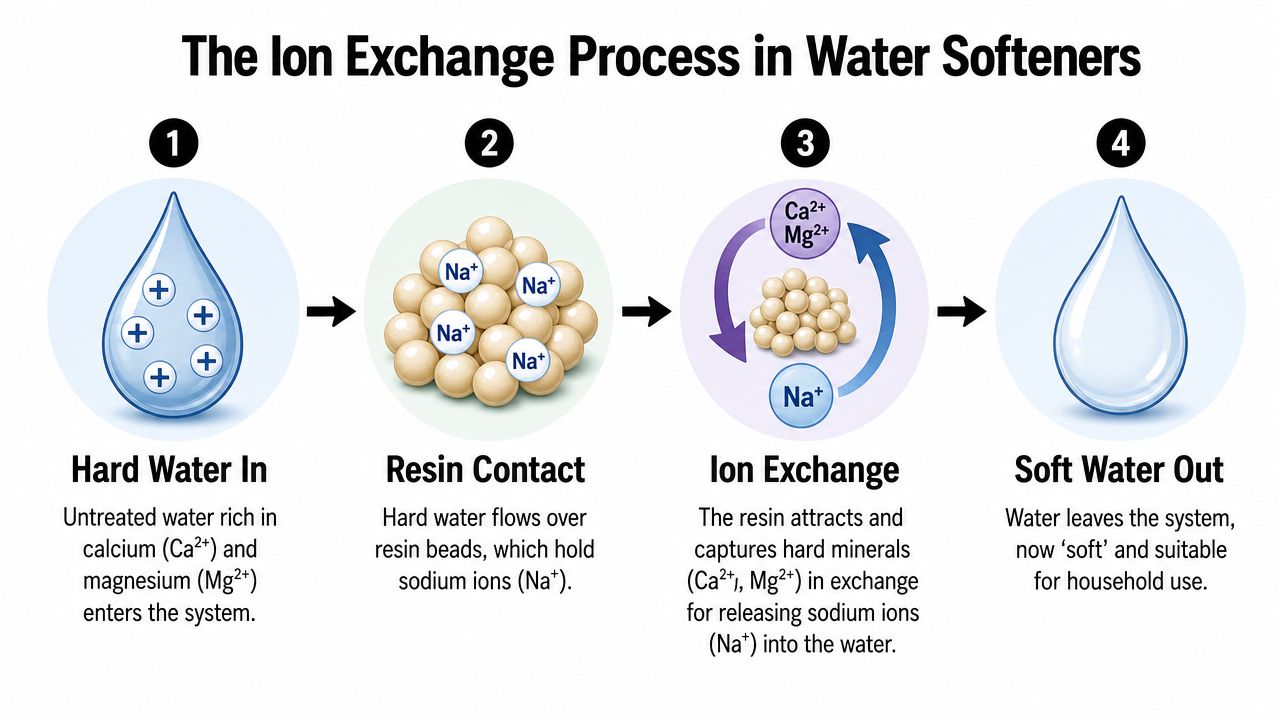
A softener is technically not a filter. Its function is to reduce hard water by removing calcium and magnesium minerals, which helps prevent scale buildup in water heaters and plumbing, while filtration systems target contaminants such as chlorine, lead, and bacteria, as explained in this Florida water treatment guide.
Salt-based ion exchange softeners can achieve up to 98% hardness reduction by replacing calcium and magnesium ions with sodium ions, according to these water softener performance rankings. That same source notes that modern demand-initiated regeneration systems such as the HydroClean3 remove 35,000 grains per cycle while using 86% less water for regeneration than traditional systems like the Fleck 5600.
Those numbers matter for one reason. A good softener can make a major difference in scale control and system efficiency when hardness is the actual problem.
A softener usually helps with:
- Scale prevention: Less mineral buildup on fixtures, plumbing, and water-using appliances.
- Bathing comfort: Soap rinses better, and many homeowners notice softer-feeling skin and hair.
- Laundry performance: Fabrics often feel less stiff.
- Equipment protection: Water heaters and plumbing components don't have to fight as much mineral accumulation.
If your biggest frustration is hard water behavior, a softener is the right tool.
What a softener does not fix
This is the part homeowners need stated plainly. A softener doesn't make unsafe water safe to drink, and it doesn't remove the full range of contaminants people worry about.
Most homeowners in Florida assume softening removes contaminants like PFAS, lead, or bacteria, but the data in this comparison of softening and filtration says softeners only swap hardness minerals through ion exchange and do not filter impurities. The same source says 99% of total dissolved solids, including lead and fluoride, require reverse osmosis rather than softening.
A water softener is a scale-control device. It is not a drinking water safety system.
That's why anyone asking do I need a water softener should also ask a second question. What else is in the water besides hardness?
If the answer includes taste, odor, iron, sulfur, sediment, PFAS concerns, lead concerns, or microbial concerns, a softener alone won't finish the job. It may improve the feel of the water while leaving the health-related or nuisance issue untouched.
Water Filtration A Spectrum of Solutions
“Water filtration” sounds like one product, but it isn't. It's a category of tools, and each tool is built for a different problem.
That matters in Parrish because filtration can mean anything from a simple whole-home carbon setup for taste and odor to a more targeted system for well water issues or drinking water purification.
Whole home filtration for general water quality problems
For many Florida homes, a whole-home filter is the first step for improving taste, odor, and nuisance contaminants.
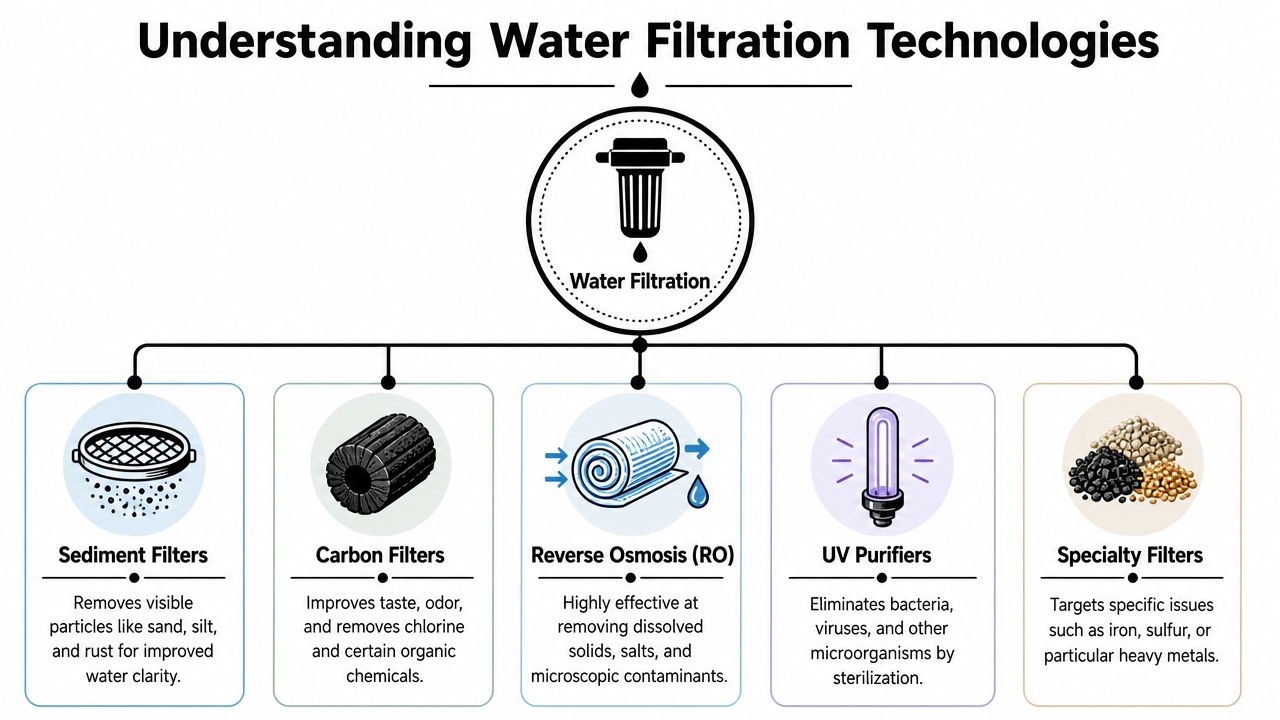
The Florida Department of Environmental Protection notes in its overview of residential water filtration systems that granulated activated carbon filters are extremely effective at removing volatile organic compounds from groundwater, which is important for Florida private wells. That same reference describes a standard home filtration configuration as a 54-inch tall by 10-inch diameter GAC tank, a five-micron pre-filter, and an ultra-violet light for disinfection, with a capacity of 6 gallons per minute.
That's a useful real-world example because it shows filtration often works in stages.
- Sediment pre-filter: Handles visible particles before they foul downstream equipment.
- Carbon tank: Targets taste, odor, and certain organic contaminants.
- UV disinfection: Addresses microbial concerns when that's part of the water profile.
- Specialty media: Used when the water has a specific nuisance issue such as iron or sulfur.
Point of use filtration for drinking water
Whole-home treatment and drinking water treatment are not always the same thing. A lot of homeowners do best with broad treatment at the entry point and more aggressive purification only where they drink and cook.
Reverse osmosis fits that role well. It's a point-of-use option for the kitchen tap when the goal is cleaner drinking water, not just better bathing or less scale. If you're comparing options, this breakdown of reverse osmosis vs filtered water helps clarify where RO belongs.
Use filtration to target the problem you actually have. Carbon for taste and odor. Specialty media for specific nuisance issues. Reverse osmosis where drinking water purity matters most.
The practical takeaway is simple. Filtration is not a substitute for softening when hardness is the issue, and softening is not a substitute for filtration when the issue is taste, odor, or contaminants.
Direct Comparison Softener vs Filter for Parrish Homes
The best way to compare systems is to judge them by the job they perform, not by marketing language.
For a Parrish homeowner, the most useful question isn't “which one is better?” It's “better at what?” A softener protects plumbing and appliances from hardness. A carbon filter improves general water quality characteristics such as taste and odor. Reverse osmosis is usually reserved for high-quality drinking water at a specific tap.
Water Softener vs Water Filtration at a Glance
| Criterion | Water Softener (Ion Exchange) | Whole-Home Filter (Carbon) | Reverse Osmosis Filter (Point-of-Use) |
|---|---|---|---|
| Primary purpose | Reduces hardness minerals | Improves taste and odor, targets certain contaminants | Improves drinking water purity at a single location |
| Best for | Scale buildup, soap performance, appliance protection | Chlorine taste, odor, some organic compounds, broad water quality improvement | Drinking and cooking water when dissolved solids or contaminant reduction is the goal |
| What it does not do well | Doesn't function as a full contaminant filter | Doesn't remove hardness minerals | Doesn't soften the whole house |
| Typical placement | Main water line entering the home | Main water line entering the home | Under the kitchen sink or at a dedicated drinking tap |
| Impact on fixtures and appliances | Strong for reducing scale | Limited for hardness-related scale | Limited to the tap it serves |
| Health-related role | Limited, because it is not designed as a contaminant filter | Depends on media and water profile | Strongest fit for dedicated drinking water treatment |
How to think about cost and sizing
Installation cost matters, but cost only makes sense if the system is sized and selected correctly.
According to local Parrish installation cost data, the average cost to install a water softener system in Parrish, FL is $1,500, with a typical range between $200 and $6,000, while labor alone costs between $150 and $1,000. That same source says an average household member uses about 75 gallons of water per day, and a common sizing method multiplies that number by the number of residents and a standard factor of 10 grains per gallon to estimate needed grain capacity.
That sizing point is more important than many homeowners realize. An undersized softener regenerates too often and won't perform the way it should. An oversized or misapplied system can waste money without solving the underlying issue.
A practical way to compare the options:
- Choose a softener if scale, fixture crusting, and hard-water performance issues are the main complaint.
- Choose a whole-home carbon filter if taste, odor, or general water character is the main complaint.
- Choose reverse osmosis at the tap if your top priority is drinking water quality.
- Choose a combination if you have both household performance problems and water quality concerns.
That last category is where many Parrish homes land.
Choosing Your System When You Need Both
The most common mistake in water softener vs filtration in Parrish, FL is treating it as a strict either-or choice.
That works only when the water problem is simple. Many homes don't have simple water. A city-water home can have hardness plus unpleasant taste. A well-water home can have hardness plus sediment, iron, sulfur odor, and microbial concerns. In those situations, layered treatment isn't overkill. It's the setup that matches the water.
Best fit for common Parrish scenarios
Some homes need only one main system. Others need a sequence.
The most overlooked fact is that Florida well water often combines hardness above 7 GPG with sediment, iron, and sulfur odor, which means both types of treatment may be needed, according to this guide on water softener vs water filter choices. The same source notes that using only a softener for well water leaves iron staining and sulfur odors untreated, while filters alone can't prevent scale buildup on appliances.
Here's how that plays out in practice:
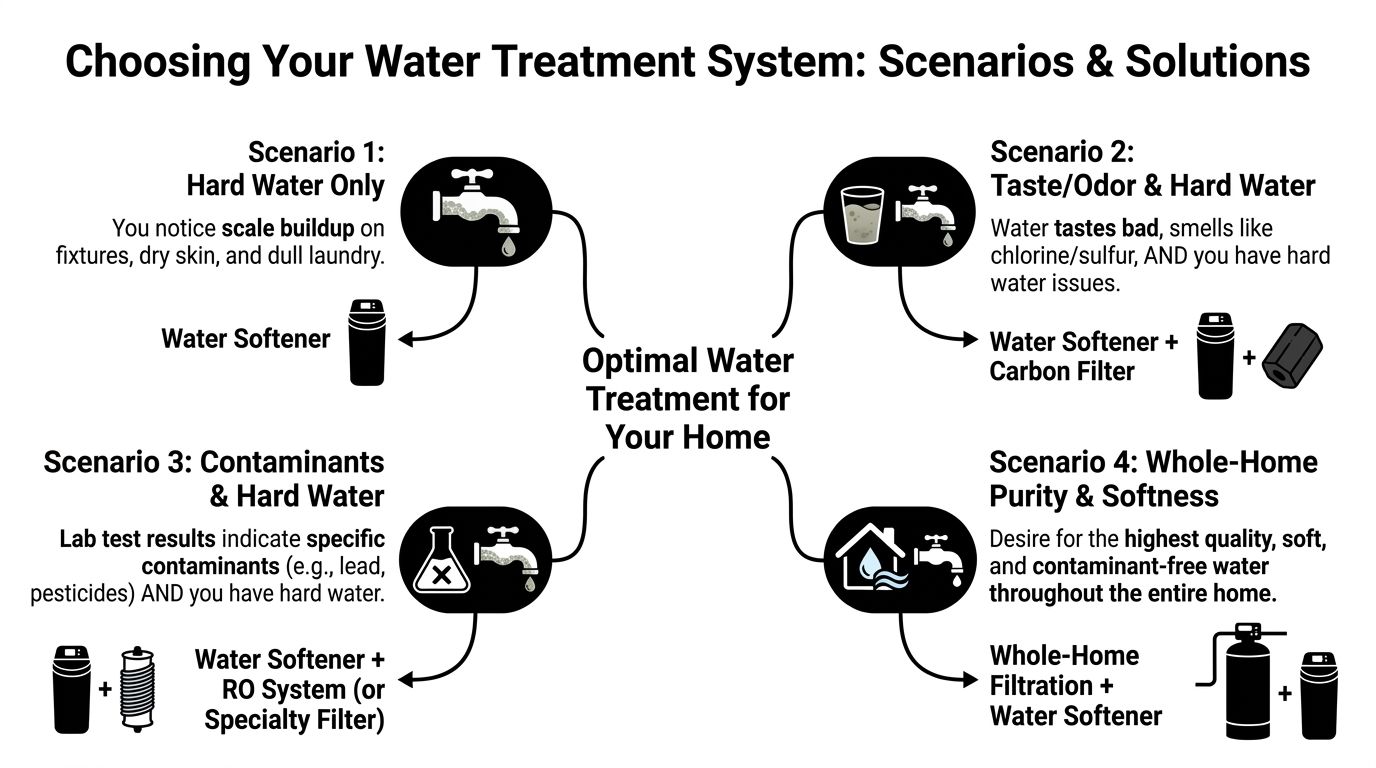
- Hard water only on city water: A softener may be enough if the complaint is scale and poor soap performance.
- Bad taste or odor on city water: A whole-home carbon filter may be the better priority.
- City water with both issues: A carbon filter plus a softener is often the cleaner solution.
- Private well with multiple symptoms: A layered system is usually the right move because one tank won't handle every problem.
If your well water stains fixtures or smells like sulfur, don't put a softener in and hope for the best. Treat the nuisance contaminants before asking the softener to do its part.
A practical order for layered treatment
Order matters. Putting equipment in the wrong sequence can shorten media life or reduce performance.
For well applications, a sensible approach often looks like this:
- Sediment or pre-treatment first if the water carries visible particles.
- Iron or sulfur treatment next when staining or odor is present.
- Softener after that to deal with hardness.
- RO or another point-of-use purifier at the kitchen if drinking water quality needs an extra level of treatment.
- UV where appropriate when microbial protection is part of the water profile.
For municipal water, the layout is often simpler:
- Carbon first for taste and odor improvement.
- Softener next for hardness control.
- RO at the sink if you want higher-quality drinking water than whole-home treatment alone can provide.
That layered approach is what many generic articles miss. They compare products as if the homeowner must pick one winner. In real Parrish homes, the better answer is often a team of systems, each solving a different part of the water problem.
Your Next Step Get a Free Professional Water Test
No article can tell you exactly what your house needs from symptoms alone.
White spotting suggests hardness. Chlorine taste suggests a filtration need. Iron staining or sulfur odor points toward well-water treatment stages. But the correct setup depends on the actual water profile entering your home and the order in which equipment should be installed.
That's why a professional water test matters. Store-bought kits can be useful for a quick read, but they don't replace a full assessment when you're trying to decide between a softener, a filter, reverse osmosis, or a layered system. Good system design starts with identifying the issue, not guessing from one symptom.
If you want a cost-effective answer, get the water tested first and build the solution from there. That prevents the most expensive mistake homeowners make, which is installing the wrong equipment and still living with bad water.
The simplest next step is to schedule a free water test through the contact page. That gives you a clearer picture of whether you need softening, filtration, or a properly layered combination specific to your Parrish home.
Florida Water Management helps homeowners across Central Florida match the right system to the right problem. If you're dealing with hard water, chlorine taste, sulfur odor, iron staining, sediment, or drinking water concerns, schedule your free water test through Florida Water Management and get a practical recommendation based on your actual water, not a guess.