

You turn on the kitchen tap in Sebring, fill a glass, and that sulfur smell hits immediately. Or maybe it shows up strongest in the shower, where the hot water seems to make the rotten egg odor even worse. If you're on a private well in Central Florida, that problem is familiar, frustrating, and usually fixable.
Around Sebring, Avon Park, Lake Wales, Frostproof, and nearby communities, sulfur odor in well water often traces back to the same few causes. The key is not guessing. The key is figuring out whether the smell starts in the aquifer, in the well system, in the softener, or inside the water heater. Once you know where it starts, the right fix becomes much clearer.
Table of Contents
- That Unmistakable Rotten Egg Smell in Your Water
- Why Your Sebring Well Water Smells Like Sulfur
- Is the Sulfur Smell Harmful to Your Health or Home
- How to Pinpoint the Source of the Smell
- Practical Treatment Options for Sulfur Smell
- What to Expect for Treatment Costs and Upkeep
- Take Control of Your Well Water with a Local Expert
That Unmistakable Rotten Egg Smell in Your Water
If you're dealing with sulfur smell well water in Sebring FL, you probably don't need anyone to tell you what it smells like. It's the kind of odor that makes you hesitate before brushing your teeth, running a bath, or serving water to guests. It can make perfectly clear water feel dirty, even when the issue is more about odor than appearance.
In this part of Florida, homeowners on private wells run into this often because local groundwater has its own personality. Sebring and the surrounding Central Florida area sit on aquifer water that can carry sulfur-related compounds naturally. That means the smell isn't always a sign that you did something wrong or that your well suddenly failed.
What matters is where the odor starts.
Sometimes the smell is coming from the raw well water itself. Sometimes bacteria have taken hold somewhere in the plumbing. Sometimes the whole problem is inside the water heater, and that's why the hot side smells worse than the cold side.
Practical rule: Don't buy treatment equipment before you identify whether the smell comes from the well, the plumbing, the softener, or the heater.
That distinction saves money. It also keeps people from installing the wrong fix and then wondering why the rotten egg smell is still there a month later.
A good diagnosis usually begins with a few simple observations at home. Does the smell show up at every fixture or just one? Is it strongest after water sits in the pipes? Does it fade as water runs, or stay constant? Those clues tell you a lot before any equipment gets touched.
Why Your Sebring Well Water Smells Like Sulfur
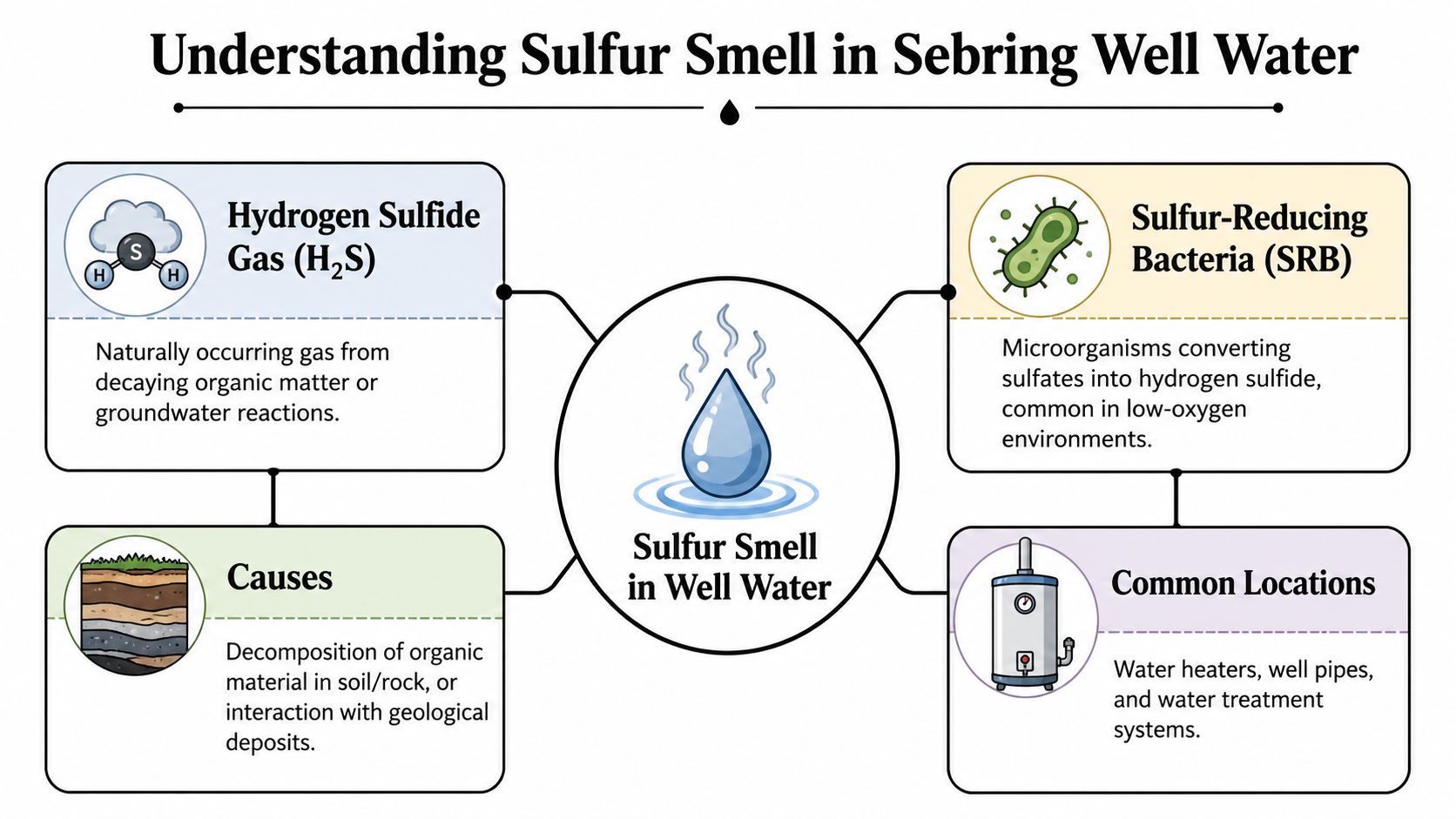
The rotten egg smell usually comes from hydrogen sulfide gas, often written as H₂S, or from sulfur bacteria living somewhere in the system. Homeowners often lump those together, but they're not the same problem and they don't respond to the same treatment.
Two causes that get confused all the time
Think of hydrogen sulfide gas as a smell that's already in the water when it comes out of the ground. Think of sulfur bacteria as growth that can develop in the well, plumbing, softener, or water heater.
For Sebring well owners, that first category is common. Hydrogen sulfide gas is naturally present in Florida groundwater, particularly in areas using private wells like Sebring, and people can detect it at concentrations as low as 0.05 mg/L. It also becomes more pronounced when water is heated, according to this Florida groundwater explanation of sulfur odor.
That “stronger in hot water” detail matters. People often assume hot water smells worse because the heater is always the problem. Sometimes it is. But heated water also releases sulfur odor more aggressively, so source water with hydrogen sulfide can seem much worse in the shower than at the cold kitchen tap.
Why it shows up so often in Central Florida
Sebring sits in the same broader groundwater reality as Avon Park, Lake Wales, and other nearby communities. The Floridan Aquifer can carry naturally occurring sulfur compounds, so the odor isn't rare in private well systems. When water sits in household plumbing or in a water heater, the smell can become more noticeable.
Sulfur bacteria complicate the picture because they don't always stay put. They can colonize sections of the system and create odor patterns that feel random to the homeowner. One house may smell at every tap. Another may only have odor on the hot side. A third may notice it mostly after the house has been sitting overnight.
Water that smells bad for one reason can get treated badly if the diagnosis is too broad. “Sulfur” is a symptom category, not a single root cause.
That's why two homes on the same road can need different remedies. One may need an oxidizing filter because the issue starts in the incoming well water. Another may need disinfection and system cleanup because bacteria have settled in the plumbing or treatment equipment. A third may only need a water heater correction.
Is the Sulfur Smell Harmful to Your Health or Home
Most homeowners ask two questions right away. Is this dangerous to my family, and is it damaging the house? Those are fair questions.
What most homeowners need to know first
In many residential well situations, sulfur odor is a nuisance problem first. It affects smell, taste, shower comfort, and confidence in the water. That said, nuisance doesn't mean ignore it.
Conditions that let sulfur-related bacteria grow can also signal that parts of the well or plumbing system need attention. And one practical issue gets missed all the time. Sulfur odor can distract from contaminants you can't smell. If your well water has a strong rotten egg odor, that shouldn't replace proper testing for the things odor won't reveal.
For private well owners in this region, a measured approach is smarter than panic. Don't assume every sulfur smell is a health emergency. But don't treat odor as harmless background noise either, especially if you've never had the well checked thoroughly.
What it can do to plumbing and fixtures
The household impact is where many families feel the problem most. Sulfur water can leave bathrooms and kitchens feeling unclean even right after cleaning. It can affect beverage taste, make cooking unpleasant, and turn a normal shower into something you want to rush through.
It can also be rough on equipment. Over time, sulfur-related water issues often contribute to corrosion problems in metal plumbing parts and water-using appliances. Homeowners also notice tarnishing on silverware, odor transfer to laundry, and recurring fixture complaints that never seem fully solved.
A short list of common home effects includes:
- Hot water odor complaints: Showers and tubs often trigger the strongest reactions because heat intensifies the smell.
- Appliance wear: Water heaters, softeners, and valves can suffer when sulfur issues go untreated.
- Staining and residue: Fixtures and laundry may pick up unpleasant effects depending on the rest of the water chemistry.
- Daily annoyance: Even when the water looks clear, the odor changes how people use it.
If the smell has been lingering for a while, fixing it usually improves more than comfort. It often improves trust in the water throughout the house.
How to Pinpoint the Source of the Smell
The fastest way to solve sulfur odor is to narrow down where it begins. Don't start by shopping for filters. Start by observing the pattern.
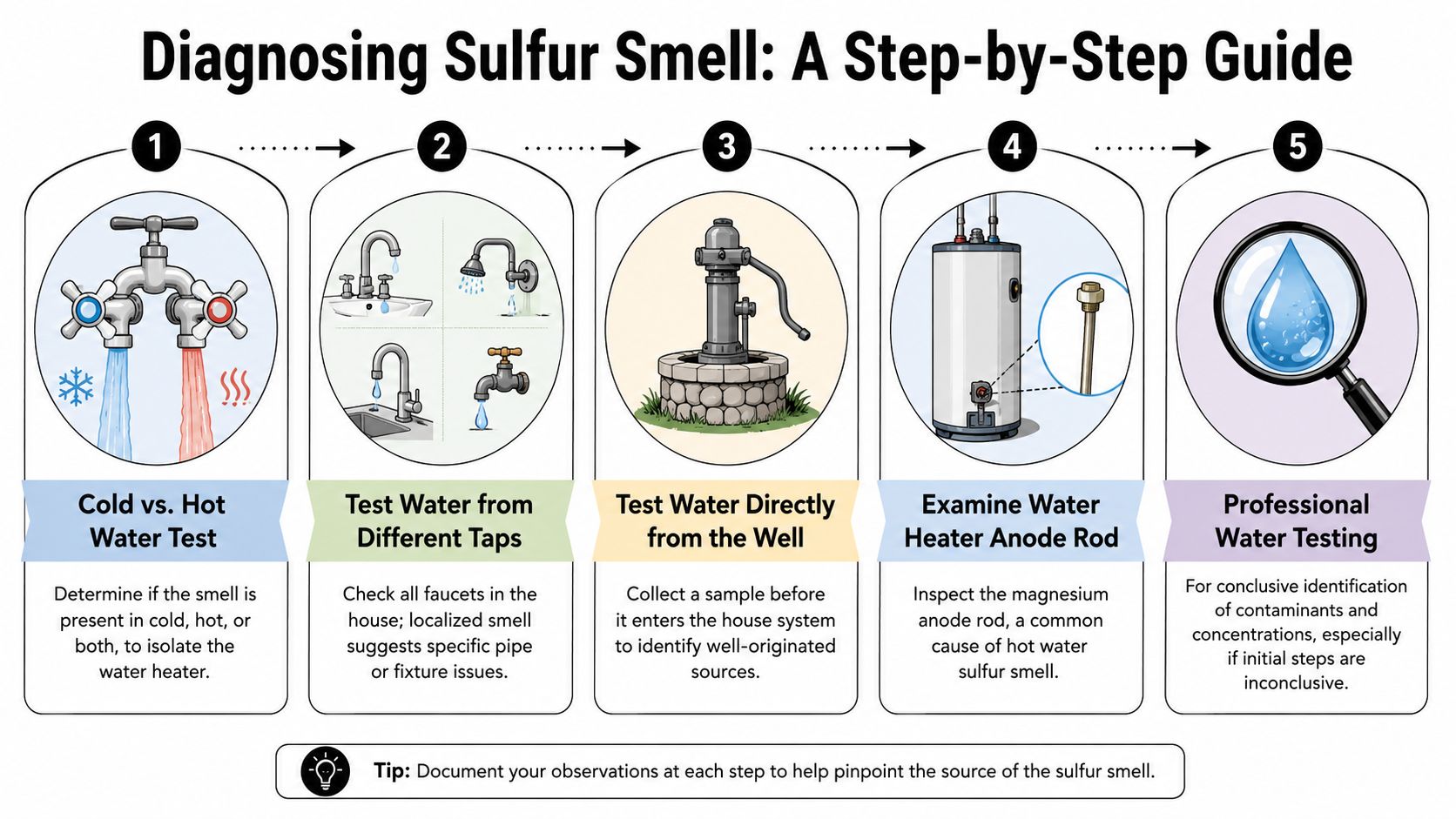
Start with hot water versus cold water
If only the hot water smells, the water heater moves to the top of the suspect list. The Florida Department of Health notes that if only the hot faucet emits the odor, the problem likely resides in the water heater, and homeowners can disinfect the heater with chlorine bleach or raise the temperature to 160°F (71°C) for several hours in bacteria-related cases, as outlined in this Florida well water odor guidance.
That doesn't always mean bacteria are the only cause, but it's a strong clue. A heater can concentrate odor problems that aren't obvious elsewhere.
Check whether the smell is everywhere or isolated
Use this simple field check around the house:
- Run cold water at the kitchen sink. If you smell sulfur there, the incoming water may be carrying the problem.
- Test hot water at that same sink. If the odor is only on hot, suspect the heater first.
- Try several fixtures. A smell at one faucet but not others points more toward a local plumbing issue.
- Notice whether the smell fades after water runs. If it diminishes, bacteria in plumbing or equipment become more likely.
- Think about treatment equipment already installed. If both hot and cold water smell only on water that's passed through a softener, the softener may be involved.
A localized smell and a whole-house smell are very different service calls. So are “constant sulfur from the moment the tap opens” and “odor that fades after a short flush.”
If the odor pattern changes from fixture to fixture, don't assume one filter will fix the entire house.
If you're already trying to reduce broader well water risks, it also helps to understand how to reduce water contamination in a private water system. Odor diagnosis works best when it's part of a full water-quality check, not a one-symptom guess.
When a free water test saves time and money
Home clues are useful, but they aren't the final word. Sulfur odors can overlap with iron bacteria, heater issues, softener contamination, and raw well water conditions. A professional water test helps separate those causes before you spend money on the wrong equipment or keep disinfecting the same components without lasting results.
For most homeowners, that's the point where a free water test makes sense. It turns guesswork into a treatment plan.
Practical Treatment Options for Sulfur Smell
Once the source is clear, the treatment path gets much simpler. The right fix depends on whether the odor starts in the heater, in the raw well water, or in bacteria growing somewhere in the system.
When the water heater is the problem
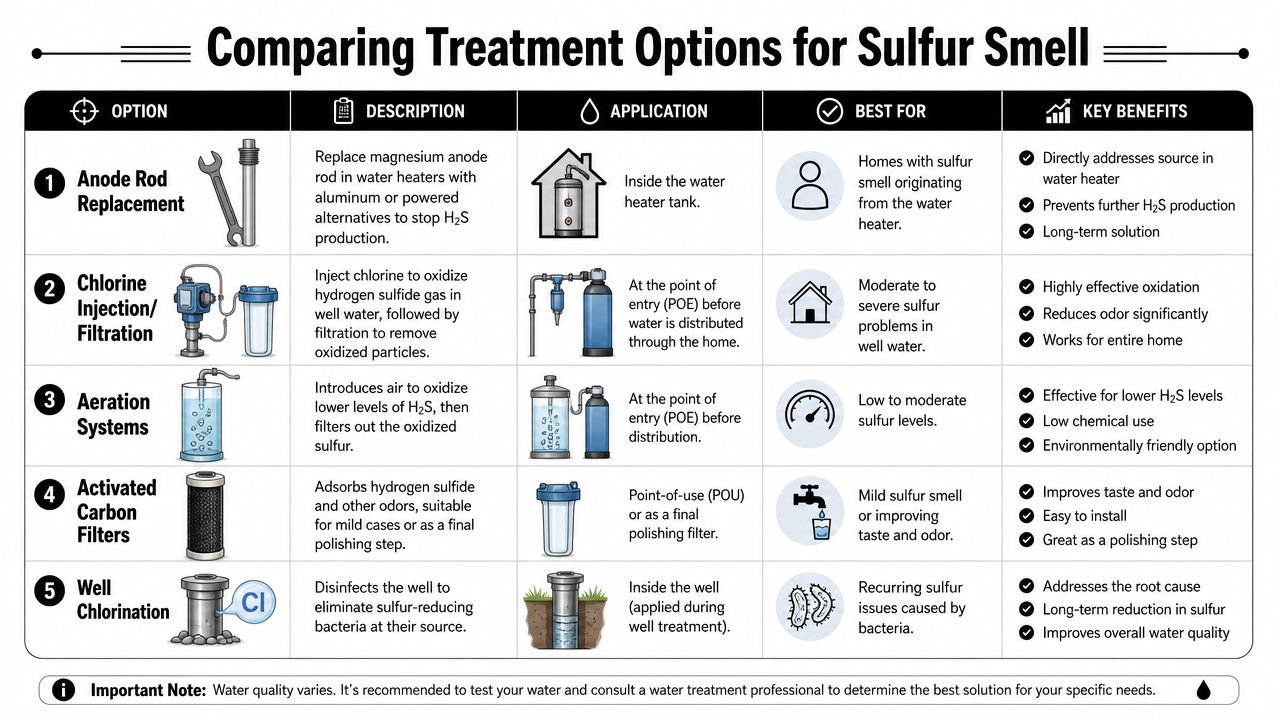
A very common hot-water-only issue involves the magnesium anode rod inside the heater. A verified technical reference notes that the reaction between hydrogen sulfide and magnesium anode rods can worsen sulfur odor, and replacing the magnesium anode with a zinc-aluminum or powered anode rod can eliminate that specific odor. The same source states that oxidizing filters such as greensand can remove up to 95% of H₂S at concentrations at or below 6 mg/L, according to this hydrogen sulfide well water treatment reference.
If the smell is limited to hot water, anode rod replacement is often more logical than installing whole-house treatment first. In some homes, a heater flush and disinfection step may also be needed if bacteria are part of the problem.
When the whole house water smells
If cold and hot water both carry the odor across the house, treatment usually needs to happen before the water spreads through the plumbing.
Here's how the main options compare:
| Treatment option | Best fit | What it does | Trade-off |
|---|---|---|---|
| Aeration system | Lower sulfur levels | Adds air so sulfur compounds can oxidize before filtration | Needs proper sizing and follow-up filtration |
| Oxidizing media filter | Raw well water with hydrogen sulfide | Converts sulfur into particles the media can capture | Media requires service and, in some cases, regeneration |
| Continuous chlorination with filtration | Stronger sulfur issues or bacterial problems | Oxidizes sulfur and disinfects, then filters the water | More components, more upkeep |
| Shock chlorination of the well | Bacteria events or system contamination | Cleans the well and plumbing temporarily | May not be a lasting fix if the root cause remains |
For homes that need a custom whole-house approach, Florida Water Management installs and services treatment systems for sulfur odors, iron, sediment, and related private well issues in the Sebring area.
What usually does not work well by itself
A lot of homeowners start with a basic carbon filter because it sounds simple. Carbon has a place, but it's often not the right first answer for true sulfur gas in well water. On its own, it usually works better as a polishing stage than as the primary sulfur solution.
That's especially true when the odor is heavy, widespread, or tied to bacterial activity. In those cases, pre-oxidation or disinfection often matters more than adding a standard cartridge.
If you're comparing treatment approaches for drinking water and whole-house quality, it also helps to understand how reverse osmosis fits into a well water setup. Reverse osmosis is useful in the right role, but sulfur odor treatment for an entire home usually starts upstream with the main well water problem.
Field note: The system that removes sulfur smell effectively is the one matched to the source of the odor, not the one with the most parts.
What to Expect for Treatment Costs and Upkeep
The price depends less on the word “sulfur” and more on what's causing the odor. A hot-water-only anode rod issue is a different project than a house-wide hydrogen sulfide problem that needs oxidation, filtration, and disinfection.
What changes the price
Several factors move the investment up or down:
- Source of the problem: Water heater corrections are usually simpler than whole-house treatment.
- Severity of odor: Stronger sulfur problems often need more than one treatment stage.
- Other water issues present: Iron, sediment, hardness, and bacteria can change system design.
- Household demand: Larger homes and higher water use may require bigger equipment and more durable control valves.
This is why ballpark pricing without testing isn't very useful. Two Sebring homes can report “rotten egg smell” and need completely different hardware.
What ongoing maintenance looks like
Every sulfur treatment method comes with upkeep. Oxidizing media has to be maintained. Chlorination systems need chemical monitoring and service. Aeration systems need periodic inspection and cleaning. Water heaters need occasional attention if the odor is isolated there.
Homeowners should expect maintenance in these categories:
- Media or component replacement: Filters and treatment media don't last forever.
- Disinfection follow-up: Bacteria-related issues may need repeat service if the system isn't fully corrected.
- Performance checks: Odor returning after a short period usually means the original diagnosis missed something.
- Annual well testing: Especially for private wells, testing remains part of responsible ownership.
The best way to avoid wasted spending is to tie the equipment choice to actual water conditions, then plan for routine service instead of waiting for the smell to come back.
Take Control of Your Well Water with a Local Expert
Sulfur odor sounds simple until you trace all the ways it can start. In practice, homeowners in Sebring often deal with a mix of local groundwater conditions, water heater reactions, sulfur bacteria, and older plumbing components that blur the symptoms. That's why trial-and-error fixes so often drag on.

Local diagnosis matters
A local water specialist already knows what shows up in private wells around Sebring, Avon Park, Lake Wales, and nearby communities. That matters because treatment isn't just about removing odor. It's about choosing the right point of attack.
A heater problem needs one response. Aquifer-based sulfur in incoming water needs another. Bacteria in a softener or plumbing loop need something else again. If those get mixed together, homeowners can spend money and still keep smelling rotten eggs every morning.
The right answer usually starts with one question. Where is the smell being created?
If you're dealing with sulfur smell well water in Sebring FL and want a clearer path forward, review your options for a water filtration system in Sebring FL and then get the water tested before committing to equipment.
Take the easy first step
You don't need to keep guessing, and you don't need to keep living with water that smells wrong. A professional test can tell you whether you're dealing with source-water hydrogen sulfide, sulfur bacteria, a water heater issue, or a combination of problems.
That gives you a treatment plan based on evidence, not assumptions. It also helps you avoid buying equipment that treats the wrong part of the system.
If your well water smells like rotten eggs, the fastest next step is to schedule a free water test with Florida Water Management. Use the contact us page to set it up, get clear answers about what's causing the odor, and find a treatment plan that fits your home.