

If you're on a private well in Avon Park, you probably didn't start by thinking about aquifers, treatment stages, or lab reports. You started with something annoying. A rotten-egg smell in the shower. Orange staining around a faucet. Water spots that won't quit. Maybe the water looks fine, but you're still wondering what's coming out of the tap.
That's the point where most homeowners get pushed toward a pre-packaged unit. A softener, a carbon tank, maybe an RO system, all sold before anyone has properly identified the water problem. That's backwards. For a private well in Avon Park, the first job isn't buying equipment. It's finding out what your water contains.
Table of Contents
- Understanding Your Avon Park Well Water Source
- Decoding Common Central Florida Well Contaminants
- A Guide to Well Water Filtration Technologies
- How to Choose the Right System The Professional Way
- Installation and Maintenance Guide for Your System
- The Florida Water Management Difference for Avon Park
- Your Avon Park Well Water Questions Answered
Understanding Your Avon Park Well Water Source
You move into a house in Avon Park, turn on the tap, and the water looks clear. A week later, the shower door starts hazing over, the toilet picks up staining, or the water heater starts pushing out a sulfur smell. That is a common well-water story here. The mistake is buying equipment before finding out what the well is producing.
Avon Park homes on private wells often draw from the same regional groundwater system as nearby public supplies, the Floridan Aquifer. The source may be shared in a broad geologic sense, but the responsibility is not. A city supply is tested, treated, and monitored by the utility. A private well owner has to do that work at the property level, starting with the water test.
That difference matters more than many homeowners realize.
Why Avon Park well water behaves the way it does
Groundwater in Central Florida spends time in mineral-rich formations. In the field, that usually shows up as hard water, iron staining, sulfur odor, scale buildup, and fine sediment. Some wells stay fairly stable for years. Others change with rainfall, pump work, casing issues, or shifts in the aquifer.
Clear water proves very little.
A lot of bad system choices start with assumptions. Homeowners see orange staining and buy a softener when the underlying problem is iron in a form the softener will not handle well. They smell sulfur and add a carbon filter when the water also has iron or manganese, which changes the treatment plan. They install an under-sink unit for taste while untreated hard water keeps damaging plumbing and appliances throughout the house. The right equipment depends on the actual mix in that well, not on a neighbor's setup or a big-box recommendation.
Private well owners need a test-first plan
Private wells are not regulated like municipal water service, so there is no utility tracking day-to-day treatment for you. That is the gap many filtration sales pitches skip over. They start with a pre-packaged system. The professional approach starts with measurement.
A useful first pass looks like this:
- Note what you can observe, including odor, staining, cloudiness, scale, and any change in taste.
- Test the water before choosing equipment.
- Match the treatment to the confirmed problem, because hardness, iron, sulfur, bacteria, and nitrates are handled in different ways.
- Decide whether the issue belongs at the whole-house level, the drinking-water level, or both.
For example, reverse osmosis can be an excellent point-of-use option for drinking water, but it is not a fix for iron staining in showers or hard water scale on fixtures. If you want to understand where that technology fits, this guide to reverse osmosis for well water explains the role clearly.
In Avon Park, the smartest money is spent on testing first and equipment second. That order prevents overtreatment, undertreatment, and the very common problem of paying for a system that solves the wrong issue.
Decoding Common Central Florida Well Contaminants
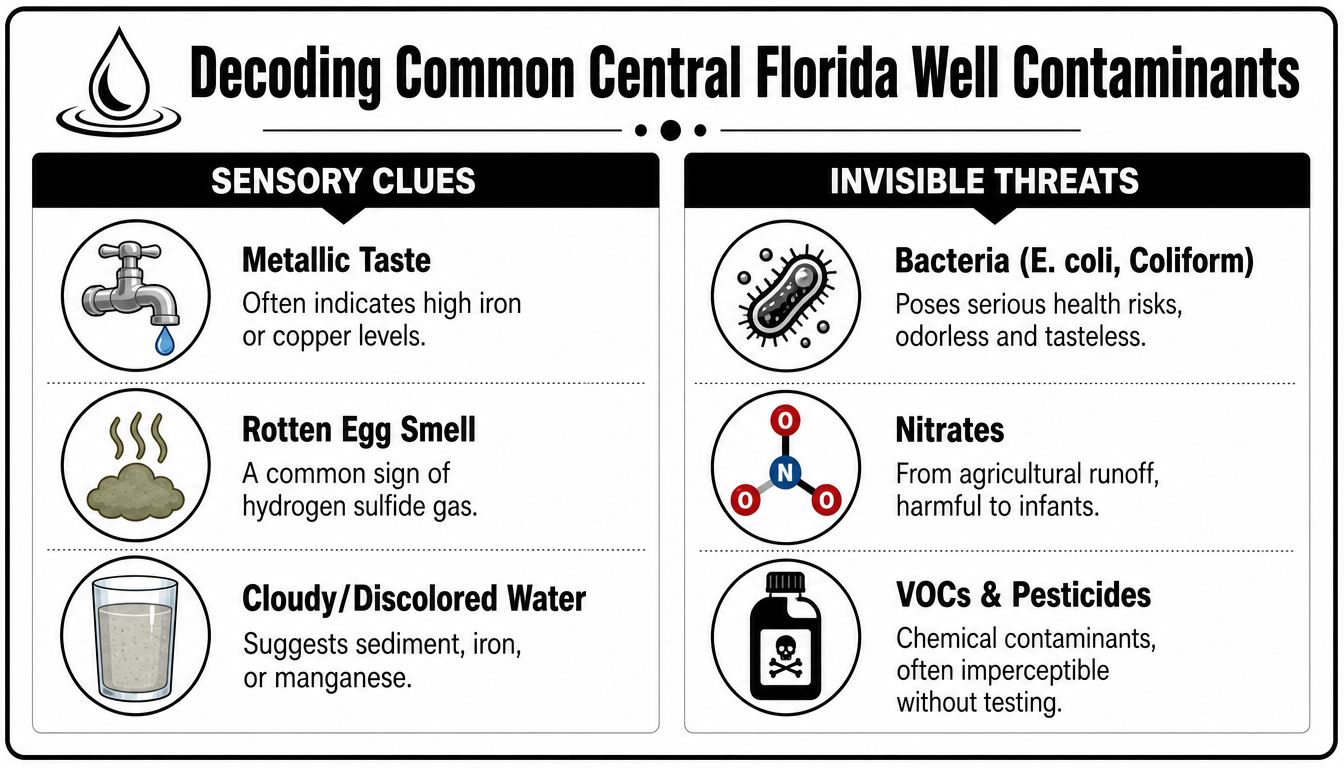
Most Avon Park well problems fall into two groups. The first group announces itself. The second stays quiet until a test reveals it.
Sensory clues you can notice at home
If the water smells like rotten eggs, hydrogen sulfide is often part of the story. If sinks and toilets pick up orange or brown staining, iron is a common suspect. If the water leaves film on glass or scale on fixtures, hardness minerals are usually involved.
These clues matter because they help narrow the field, but they don't give a full diagnosis. Iron can appear in more than one form. Sulfur odor can be stronger in hot water. Sediment may point to well or plumbing issues, not just water chemistry. If you're dealing with staining, this guide on how to remove iron from water gives a useful look at treatment options once the problem is confirmed.
Silent threats that need testing
The bigger mistakes usually happen with contaminants you can't see, smell, or taste. Bacteria, nitrates, and chemical contaminants don't give you much warning.
Recent 2026 water quality reporting for Avon Park confirmed detection of PFAS compounds, specifically PFOA and PFOS, in tap water supplies, and noted the need for filtration systems certified to reduce those specific contaminants, according to this Avon Park 2026 water quality report. That's city tap water reporting, not a blanket finding for every private well, but it reinforces the basic point. Chemical contaminants are not something you diagnose by taste.
A quick field guide helps:
| Category | Common sign | Likely issue | What it affects |
|---|---|---|---|
| Visible staining | Orange, brown, black marks | Iron or manganese | Fixtures, laundry, toilets |
| Odor | Rotten egg smell | Sulfur compounds | Showers, sinks, hot water use |
| Scale | White buildup, spotting | Hardness minerals | Heaters, plumbing, appliances |
| No obvious sign | Water seems normal | Bacteria, nitrates, PFAS, VOCs | Health risk, drinking water quality |
Water that looks fine can still be the water that needs the most careful treatment plan.
The mistake is assuming one symptom equals one solution. It doesn't. A homeowner may have sulfur odor and hardness. Another may have staining plus nitrate concerns. That's why a professional test beats guesswork every time.
A Guide to Well Water Filtration Technologies
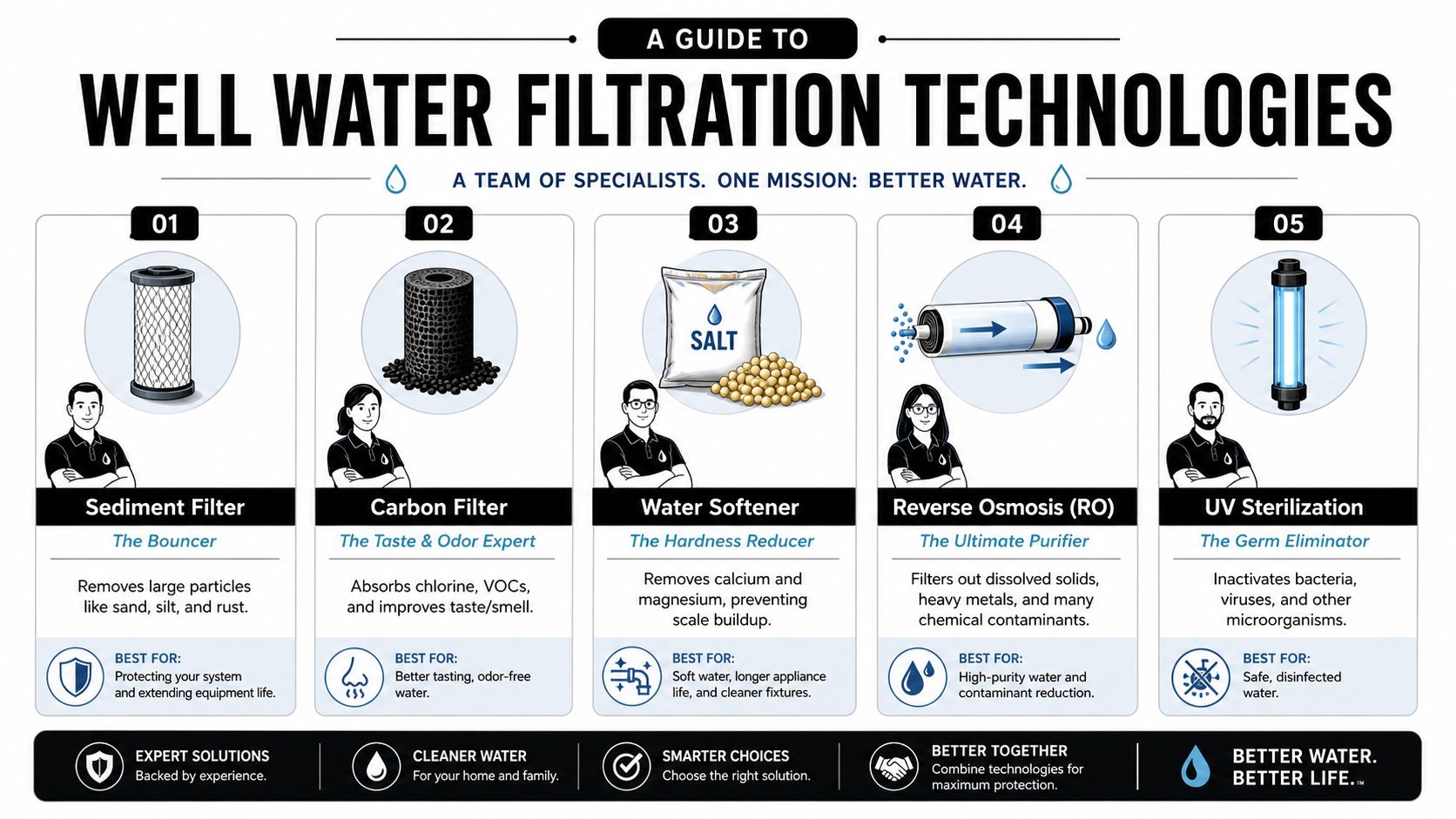
No single filter handles every Avon Park well problem. A good system works like a team of specialists. Each piece has a specific job, and the order matters.
What each technology actually does
A sediment filter is the front-line defender. It catches sand, silt, rust, and suspended debris before they load up the rest of the equipment.
A carbon filter handles taste, odor, and many chemical contaminants. In the right application, granulated activated carbon is often used for solvents and petroleum compounds. The Florida Department of Environmental Protection notes that point-of-entry GAC systems are standard for ingestion risks involving pesticides and solvents, while point-of-use reverse osmosis is used when inorganic contaminants such as nitrate, arsenic, or lead exceed maximum contaminant levels, as described by Florida DEP's water filtration systems guidance.
A water softener targets hardness. It removes calcium and magnesium that cause scale buildup in plumbing, heaters, and fixtures.
An iron or sulfur filter addresses nuisance issues that make well water unpleasant or damaging. The exact media depends on what testing shows.
A UV system is there for microbial control. It doesn't remove sediment or hardness. It inactivates microorganisms, so it has to be installed in a system that already delivers clear water to the UV chamber.
The sodium trade-off homeowners often miss
Softeners help a lot in hard water areas, but they aren't neutral devices. Many Avon Park homeowners don't realize that common ion exchange softeners remove hardness by adding sodium to the water, which matters for people on low-sodium diets or those watering sensitive plants, as explained in this discussion of home water treatment questions.
That doesn't mean softeners are bad. It means they have a trade-off.
Here is the practical comparison:
- Water softener: Good for hardness control and scale prevention, but adds sodium.
- Iron filter: Better when iron is the primary issue and you don't want to treat the whole problem as “hard water.”
- Carbon system: Useful for taste, odor, and many organics, but not a replacement for microbial treatment.
- Reverse osmosis: Excellent for drinking water applications where dissolved contaminants are the concern. If you're weighing that option, this overview of reverse osmosis for well water helps clarify where RO fits and where it doesn't.
What works and what doesn't
What works is matching the device to the contaminant. What fails is asking one tank to do four jobs it wasn't built to do.
A few common examples:
- Works well: Sediment pre-treatment followed by the right media for the specific contaminant load.
- Usually disappoints: A generic big-box cartridge setup trying to solve sulfur, hardness, bacteria, and nitrates at the same time.
- Works for drinking water only: Point-of-use RO at the kitchen sink.
- Works for whole-home protection: A properly designed point-of-entry system when the problem affects bathing, laundry, plumbing, or appliances.
One practical option for local homeowners is a professionally designed system from Florida Water Management that combines treatment stages based on actual test results rather than a stock package. That's the difference between equipment installed in your house and equipment selected for your water.
How to Choose the Right System The Professional Way
A new Avon Park homeowner usually starts with the symptom. Rotten egg smell. Orange staining. Scale on fixtures. Bad taste at the kitchen sink. Then a salesperson shows up with a standard package and a promise that it will handle "well water."
That is how people spend money twice.
Private wells are unregulated at the home level, so the first job is identifying what is in the water. Odor and staining help with clues, but they are not a diagnosis. Sulfur odor can show up with iron. Hardness can exist without obvious staining. Water that looks clear can still have nitrate, bacteria, or other dissolved contaminants that need a different treatment approach.
The right order of decisions
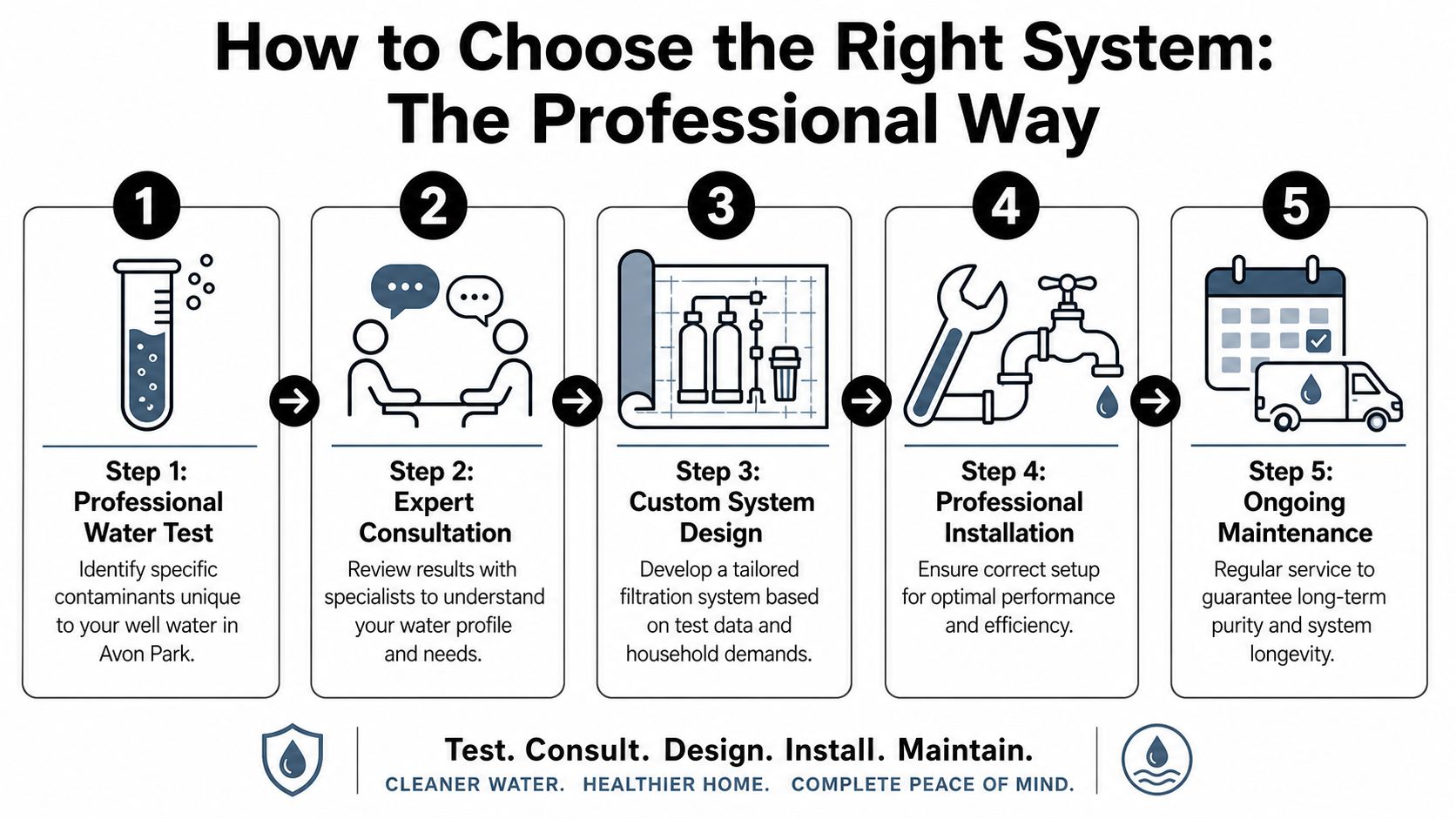
The professional process starts with testing, then system selection. Not the other way around.
That matters in Avon Park because two houses a few roads apart can have very different well profiles. One may need iron and sulfur treatment for the whole house. Another may need a softener plus sediment control. Another may need point-of-use treatment at the kitchen sink for dissolved contaminants while the rest of the house only needs nuisance treatment.
A sound sequence looks like this:
Test the raw well water
Check the untreated water before recommending equipment. That is the only way to know whether the problem is hardness, iron, manganese, sulfur, bacteria, nitrate, pH imbalance, sediment, or a combination.Separate nuisance problems from health-related concerns
Staining and odor affect comfort. Bacteria and nitrate affect safety decisions. Those are not treated the same way, and they should not be sold the same way.Size the system to the house
Flow rate, bathroom count, irrigation tie-ins, and family water use all affect equipment choice. A system that is too small disappoints. A system that is too large can add unnecessary cost and service.Set the treatment point correctly
Some issues belong at the point of entry for the whole house. Others are better handled at one tap. Treating the whole home for a problem that only affects drinking water is often wasteful.Plan for upkeep before installation
Every system has maintenance. Media changes, salt use, sanitizing, lamp replacement, and follow-up testing should be clear before the equipment goes in.
Why packaged systems miss the mark
Packaged systems are built for sales efficiency, not for the water in your well.
I see the same mistake over and over. A homeowner buys one all-purpose unit expecting it to fix sulfur odor, hardness, iron staining, and drinking water quality at once. Sometimes one symptom improves, but another stays put because the media was chosen for the wrong problem. In other cases, the system technically works for a while but costs more to maintain because it is doing a job it was never designed to do.
The trade-offs are real. A softener can help with hardness and some ferrous iron, but it is not the right answer for every sulfur problem. Carbon can improve taste and odor, but it does not replace disinfection where microbial risk is present. Reverse osmosis is excellent at one tap for certain dissolved contaminants, but using it as a whole-house answer is usually the wrong move.
The gap in this market is simple. Too many companies sell equipment first and test second, or never test at all.
What a responsible recommendation should include
A proper recommendation should explain the water findings, the treatment goal, and the reason each stage is included. If that explanation is vague, the design probably is too.
Ask these questions before agreeing to any system:
- What was found in the raw water test?
- Which problems are nuisance issues, and which affect health decisions?
- Why is each treatment stage included?
- Is this designed for whole-house treatment, one tap, or both?
- What routine service will the homeowner need to keep performance up?
- How will we confirm the system is still treating the water correctly over time?
Florida Water Management uses that test-first approach because it prevents guesswork. It also keeps homeowners out of the cycle of replacing cartridges, adding equipment, and still not fixing the underlying problem.
The right well water filtration system in Avon Park FL is the one matched to the test results, the house, and the way the family uses water. That is the professional way to choose equipment, and it is usually the less expensive path in the long run.
Installation and Maintenance Guide for Your System
A well system doesn't succeed on equipment alone. It succeeds on layout, sequencing, and routine service. That's where a lot of homeowner frustration starts. The equipment may be good, but the install order is wrong, or maintenance gets ignored until water quality slips.
Installation that protects the rest of the system
For Central Florida private wells, effective filtration requires a multi-stage configuration with sediment pre-treatment upstream of other media. Without that first stage, high-performance filters can lose efficacy within weeks because particulate clogging loads the media too quickly, as noted in this treatment specification on sediment pre-treatment and filter loading.
That has real consequences in the field. If sediment hits carbon, ceramic, specialty media, or UV equipment before being controlled, performance drops fast and service costs rise.
A professional installation usually pays attention to:
- Component order: Sediment first, then treatment media, then any point-of-use polishing where needed
- Service access: Enough room to change cartridges, load salt, replace lamps, or swap media
- Bypass planning: The ability to isolate equipment during maintenance
- Drain and flow setup: Critical for backwashing filters, softeners, and long-term function
Maintenance that keeps treatment honest
Owning a filtration system means keeping it serviced. Sediment filters load up. Carbon media exhausts. UV lamps age. Softeners need salt and periodic inspection. Iron and sulfur systems need attention before symptoms return.
That isn't bad news. It's normal.
If a treatment system never needs service, it usually isn't treating very much.
A smart maintenance plan is simple and predictable:
- Watch for symptom return: Odor, staining, taste change, or spotting often shows up before complete failure.
- Service pre-filters on time: They're inexpensive compared with the equipment they protect.
- Keep specialty systems maintained: UV, backwashing filters, and softeners each have specific service needs.
- Use a schedule, not memory: This helps avoid running media past its useful life.
For homeowners who want a practical service reference, this guide to whole-house water filter maintenance covers the basic upkeep issues that most well systems eventually face.
The Florida Water Management Difference for Avon Park
A typical Avon Park call starts with a homeowner who's tired of living around the water instead of using it. The common complaints are familiar. Sulfur smell in the shower, iron staining on fixtures, buildup on appliances, and uncertainty about whether the water only looks bad or is unsafe in a more serious way.
The fix usually starts the same way too. Test the water first. Then design around what the results show.

One representative Avon Park situation involves a home dealing with heavy iron staining and persistent sulfur odor. A generic off-the-shelf package wouldn't answer the key question, which is whether the issue is just nuisance water or a broader treatment problem. After testing identifies the actual combination of water issues, the system can be built with the right stages in the right order, such as iron treatment paired with odor-focused media and proper sediment protection up front.
That process matters more than branding on the tank. Homeowners need a local company that will diagnose, install, and keep the system maintained over time, not just drop off equipment and leave them to figure out why the smell came back.
For Avon Park properties on private wells, the advantage is straightforward. A responsible water specialist doesn't start with a package. They start with the water.
Your Avon Park Well Water Questions Answered
How long does installation usually take
Installation time depends on the treatment setup and the plumbing in the home. A basic filter install can be straightforward. A full well-water treatment setup with multiple tanks, UV, or reverse osmosis takes more planning and more time to place correctly. In Avon Park, the bigger mistake is rushing into equipment before the water has been properly tested.
Can I install a system myself to save money
Some homeowners can install basic filters on their own. The problem is that private well treatment is rarely just about attaching a tank to a pipe. I see DIY setups with the wrong media, the wrong order of equipment, no bypass, poor drain routing, or no pretreatment for sediment. The system looks finished, but the odor, staining, or bacteria risk is still there.
How do I know when my system needs service
The water usually gives warning signs. Odor coming back, orange or black staining, lower pressure, scale buildup, or a change in taste all point to service needs. Good maintenance should happen on schedule, not only after the water gets bad again.
Do I need a whole-house system or just drinking water treatment
That depends on where the problem shows up and what testing finds. If the issue affects showers, toilets, laundry, water heaters, or plumbing fixtures, whole-house treatment is usually the right call. If the concern is limited to drinking and cooking water, a point-of-use system may be enough. The right answer comes from test results, not from a prebuilt package.
Is a free water test actually useful
It is useful if it leads the equipment choice. On a private well, that first step matters because there is no city utility monitoring the water for you. A real test helps identify whether you are dealing with nuisance issues like iron and sulfur, harder-water scaling, or a problem that needs a different level of treatment. If every home gets the same recommendation regardless of results, the test was just part of the sales pitch.
If your Avon Park well water has started staining fixtures, smelling off, or leaving you unsure what is coming out of the tap, start with testing. Florida Water Management handles water testing, system design, installation, and ongoing service for Central Florida homes. The right system starts after the water has been identified, not before.