

You've probably stood at the kitchen sink, filled a glass, and noticed one of two things. The water smells a little like a pool, or it tastes flat and slightly off. If you live in Central Florida, that moment usually leads to the same question: what's in this water, and what do I need to remove before I spend money on a filter?
The answer depends on whether you're dealing with chlorine, fluoride, or both. They're often mentioned together, but they're not the same problem, they don't come from the same place, and they don't get solved with the same equipment. That's the part most homeowners miss, and it's where a lot of wasted filter purchases start.
Table of Contents
- Why Your Tap Water Contains Chlorine and Fluoride
- How Chlorine and Fluoride Actually Work in Water
- Health Impacts and Regulatory Safety Limits
- Treatment Options That Actually Remove Each Contaminant
- Testing Your Water and Maintaining Your System
- Getting Expert Help for Your Central Florida Water
Why Your Tap Water Contains Chlorine and Fluoride
A homeowner usually notices chlorine and fluoride in very different ways. Chlorine announces itself with a smell, a taste, or dry skin after a shower. Fluoride usually stays invisible until someone tests the water, reads a utility report, or starts asking why one filter didn't change the drinking water the way they expected.
Chlorine arrives because water utilities need a disinfectant
Municipal systems add chlorine to protect people from waterborne disease. Chlorine entered U.S. drinking-water practice in 1908 with the first municipal application in Jersey City, and the Chlorine Institute says adding less than 1 part per million to municipal drinking water virtually eliminated waterborne typhoid fever in the United States (history of chlorine use). That's a big reason chlorine is still so common in public systems.
It also helps after treatment, not just during it. NIH notes that chlorine is by far the most commonly used chemical for disinfecting water supplies, and it's also used to prevent algal, bacterial, and slime growth, plus control tastes, odors, iron, manganese, and color (chlorine use in water supplies).
For many households, that means the chlorine you notice at the tap is a sign the system is trying to keep water biologically safe all the way to your house.
Fluoride enters water for a different reason
Fluoride follows a separate path. In some places it's naturally present in groundwater, and in others it's intentionally added in controlled amounts to help prevent tooth decay. The first city to do that on purpose was Grand Rapids, Michigan, in 1945, when community water fluoridation began (WHO fluoride background).
That history matters because fluoride isn't mainly about disinfection. It's about dental health, though naturally occurring fluoride can also show up in wells and groundwater. The World Health Organization notes that fluoride can reduce dental caries by about 20% to 40% when used appropriately in drinking water or other preventive programs (WHO fluoride fact sheet).
In Central Florida, that distinction matters even more. A public system may add fluoride, a private well may already contain it, and a treatment system may change one but not the other. If you don't know which source you have, you can end up buying a filter that solves the smell and leaves the fluoride untouched.
How Chlorine and Fluoride Actually Work in Water
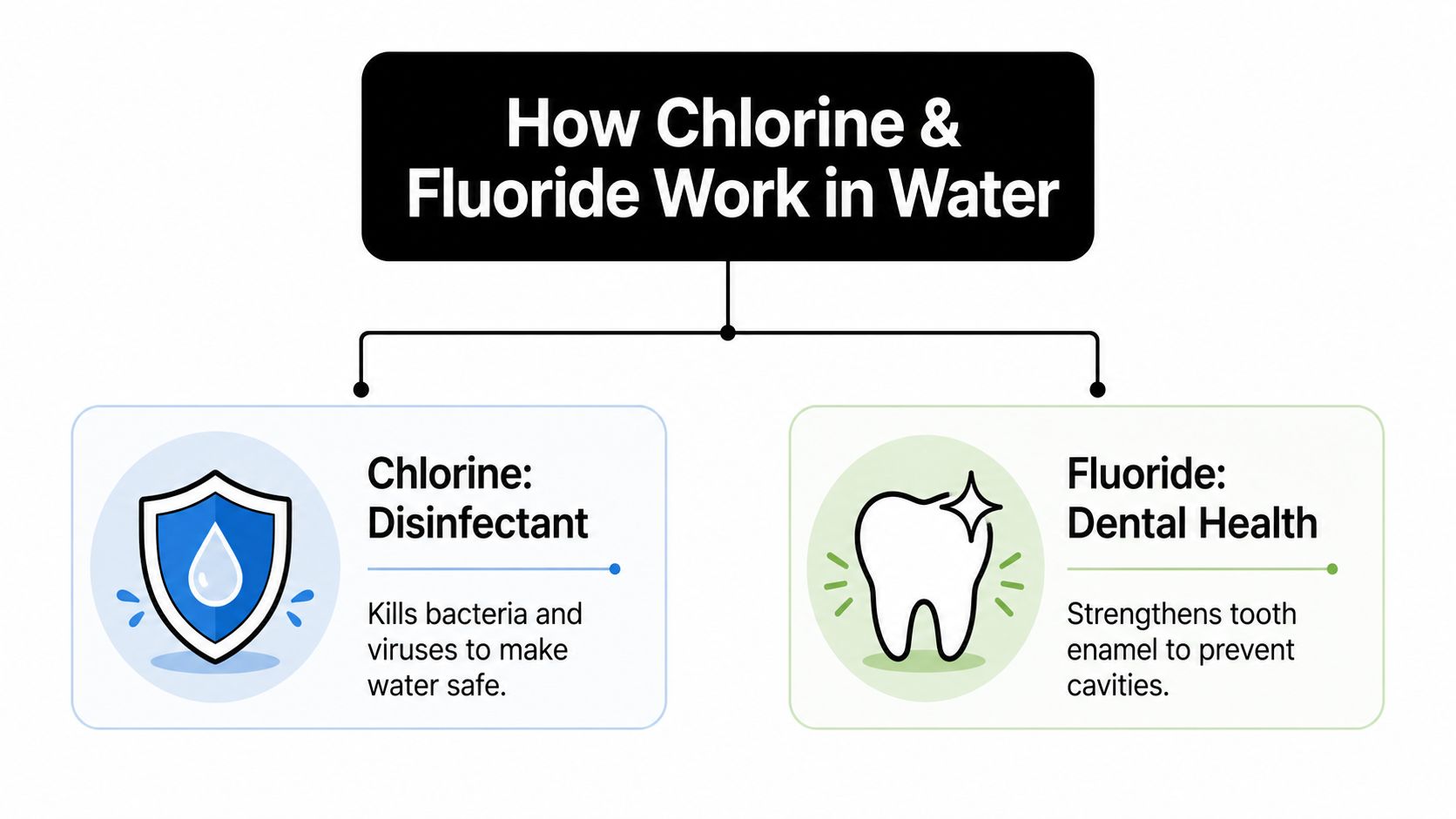
Chlorine and fluoride are easy to confuse if you only look at a label, but in water they behave like different tools in a toolbox. Chlorine is a disinfectant. Fluoride is a concentration issue tied to dental protection and overexposure risk. If you understand that basic split, the rest of the treatment conversation gets a lot clearer.
Chlorine works like a guard at the gate
In water treatment, chlorine forms hypochlorous acid, or HOCl, which is the much more effective disinfectant than hypochlorite ion, OCl− (chlorine chemistry). As pH rises, the HOCl fraction falls, so disinfection effectiveness drops and operators often need more contact time or a higher dose to get the same microbial kill.
That pH dependence is why chlorine isn't just a “dump it in and forget it” chemical. Utility operators have to balance dose, pH, and contact time. If they miss that balance, chlorine may still be present, but it won't work as efficiently, and it can also create more byproducts when it reacts with natural organic matter.
A security guard must remain on duty long enough to keep the building safe. If the guard leaves too early, trouble gets in. If the guard is overly aggressive, you get side effects from the control strategy itself.
Fluoride behaves more like a dose control problem
Fluoride doesn't disinfect anything. In community systems, it's managed for dental benefits, and in groundwater it may already be there because of local geology. The technical question isn't whether fluoride kills germs. It's how much is present and whether that level is appropriate for the water source and household needs.
That's why fluoride concerns usually show up in testing and regulation, not in smell or taste. The U.S. Public Health Service has recommended 0.7 to 1.2 mg/L for the prevention of dental decay since 1962, and the U.S. EPA maximum contaminant level for fluoride in drinking water is 4.0 mg/L (CDC fluoride page).
Practical rule: if your water smells like chlorine, you're usually dealing with a disinfection issue. If you're worried about fluoride, you need a number from a test or utility report.
Health Impacts and Regulatory Safety Limits
A homeowner can smell chlorine, but fluoride usually gives no warning at all. That difference is why the health questions around these two chemicals are handled in very different ways. Chlorine is about disinfection, taste, odor, and the byproducts it can create. Fluoride is about concentration, dental benefit, and what happens if the level gets too high.
The numbers that actually matter
For fluoride, the benchmarks are clear. The CDC says the EPA maximum allowed fluoride level in drinking water is 4.0 mg/L, and the U.S. Public Health Service recommendation for community fluoridation is 0.7 to 1.2 mg/L for prevention of dental decay (CDC fluoride guidance). The World Health Organization guideline is 1.5 mg/L, because risk rises above that level (WHO fluoride fact sheet).
Chlorine is handled differently because its job is to keep water safe as it moves through the system. It became a standard part of drinking-water treatment because it changed the public-health picture for the better, and its continued use reflects that role in disinfection (history of chlorine use). At home, the usual concerns are taste, smell, and the way chlorinated water feels on skin and hair. That is different from a fluoride issue, which usually needs a test result or utility report before you can judge it.
What overexposure looks like
Fluoride becomes a concern when the concentration climbs beyond the intended range. The CDC toxicology summary treats fluoride in drinking water as a chronic ingestion issue, while industrial fluorine and hydrogen fluoride exposures are handled differently because they are acute inhalation hazards (CDC toxicology summary). The World Health Organization also notes that naturally occurring fluoride can be high in groundwater in some regions, and levels above 1.5 mg/L are a health concern (WHO fluoride fact sheet).
Chlorine raises a different long-term concern. The molecule itself is not usually the main problem at normal municipal levels. The issue is what chlorine can form when it reacts with natural organic matter in the water. The disinfectant can create side products if the water chemistry gives it the raw material. That is why many homeowners notice odor and taste first, while utilities watch the broader treatment system to keep the water safe.
| Chemical | EPA Maximum (mg/L) | Recommended Level (mg/L) | WHO Guideline (mg/L) |
|---|---|---|---|
| Fluoride | 4.0 | 0.7 to 1.2 | 1.5 |
Simple takeaway: chlorine is mostly a distribution and byproduct question. Fluoride is mostly a concentration question.
Treatment Options That Actually Remove Each Contaminant
A filter can be excellent at chlorine and nearly useless at fluoride, or the reverse, depending on the media inside it. The label on the box matters less than what the media is built to do, and that is the part homeowners need to match before spending money.
Carbon is great for chlorine, not for fluoride
Standard activated carbon handles chlorine well. That is why carbon filters are so common for improving taste and odor. They are designed for the kind of chemistry chlorine brings to the water, so they fit well when the main complaint is the smell from the tap or shower.
They do not solve fluoride by themselves. Fluoride ions do not behave like chlorine, so a basic carbon pitcher or refrigerator filter can leave fluoride unchanged even while the water tastes better. That is the trap many homeowners run into.
Reverse osmosis and specialty media solve different problems
Reverse osmosis is one of the most practical options when you want to reduce both chlorine and fluoride at the drinking-water tap. It works as a point-of-use system under the sink, which makes it a common fit for homeowners who care most about what they drink and cook with. A point-of-use RO unit can be a smart choice when you want targeted treatment without filtering every gallon entering the home. If you are comparing setups for a private well, reverse osmosis for well water deserves a close look because the source water often needs a different approach than city water.
Activated alumina is another fluoride-specific option. It works best around pH 5.5 to 6.5, which means local water chemistry matters a lot. If the pH is outside that range, performance can drop.
A whole-home carbon system can make sense if chlorine, taste, odor, and shower exposure are the main problems. Florida Water Management also offers whole-house water purification for households that want treatment before water reaches any tap.
If your goal is cleaner drinking water only, point-of-use RO can be enough. If your goal is to stop chlorine at every fixture, a whole-house approach is the better fit.
A quick comparison homeowners can use
- Activated carbon: good for chlorine, taste, and odor, not a fluoride solution.
- Reverse osmosis: handles chlorine and fluoride at the drinking-water tap.
- Activated alumina: targets fluoride specifically, but pH matters.
- Whole-house carbon: helps with chlorine across the home, not fluoride removal on its own.
Testing Your Water and Maintaining Your System
Guessing is expensive in water treatment. A homeowner can buy the wrong size filter, treat the wrong problem, or replace media too late and never get the performance they paid for. The safer move is to test first, then match the equipment to the actual water profile.
Start with the right kind of test
DIY strips can give a quick check for basic parameters like chlorine and pH. They're useful for a first look, especially if you're trying to confirm a chlorine smell or see whether a filter is doing anything at all. They're not the whole picture.
A detailed lab analysis gives you a better baseline for fluoride and other contaminants. That matters because fluoride is usually a concentration question, not a smell test. If you're on a private well in Central Florida, a professional water test is even more helpful because well chemistry can shift from one property to the next.
Don't ignore the maintenance side
Every treatment system has a service life. Carbon media eventually exhausts, reverse osmosis membranes need periodic replacement, and filter housings need inspection. If maintenance gets skipped, the system can still look fine while performance drops.
The same is true for sizing. A unit that's too small may work on day one but struggle as water use rises. A unit that's correctly matched to household demand keeps doing the job without constant attention.
For homeowners who want a maintenance reference, the details in whole-house water filter maintenance are a useful reminder that a filter is a system, not a one-time purchase.
What to keep on your checklist
- Test before buying: Know whether your issue is chlorine, fluoride, hardness, or something else.
- Match technology to the contaminant: Carbon and RO solve different problems.
- Plan for replacement: Media and membranes don't last forever.
- Recheck after installation: Confirm that the system is doing what you paid it to do.
Getting Expert Help for Your Central Florida Water
Central Florida homeowners don't need a theory lesson as much as they need a clean answer. If your water smells like chlorine, a carbon-based approach may be enough. If fluoride is the concern, reverse osmosis or another fluoride-targeted method is usually the conversation to have. If both are in play, the right setup depends on where you want treatment, at the whole house or just at the drinking tap.
That's where a professional water test saves time. Florida Water Management offers water testing, system sizing, installation, and service for homes and small businesses across the region, including whole-home treatment and reverse osmosis drinking systems. If you're comparing options for chlorine, fluoride, hard water, or a private well, that kind of baseline keeps you from guessing.
For property managers, landlords, and small business owners, the stakes are slightly different. A rental property, salon, or restaurant may need a different treatment layout than a single-family home, and a one-size-fits-all filter usually isn't the right answer.
If you're ready to stop guessing, start with a free water test and get a clear look at what's in your water. Visit Florida Water Management to ask about chlorine, fluoride, and the right treatment setup for your home or property.