

If you've got a shiny alkaline unit under the sink, or you've been eyeing one because the water tastes flat, the first question usually isn't about the machine. It's about the water coming into the house. In Central Florida, that matters more than most online guides admit, because a system that works fine on one tap can struggle fast when it meets hard well water, iron, sulfur, and sediment.
Homeowners in Sebring, Winter Haven, Avon Park, Lake Wales, and Frostproof run into the same pattern again and again. They buy a sleek ionizer or RO plus alkaline unit, expect better-tasting water, then discover the issue is upstream. A home alkaline water system is useful, but only when it's the final polish on a treatment train that fits the source water. For a broader look at what hardness does to plumbing and fixtures, a practical starting point is this overview of water hardness levels.
Table of Contents
- Why Central Florida Homeowners Are Asking About Alkaline Water
- What an Alkaline Water System Does
- Comparing Ionizers, Remineralizers, and RO Plus Alkaline Systems
- Health Claims Versus What the Evidence Shows
- Matching the System to Central Florida Source Water
- Realistic Costs and Ongoing Maintenance
- How to Choose and Size the Right System
- Your Next Step Is a Free Local Water Test
Why Central Florida Homeowners Are Asking About Alkaline Water
A lot of people start with taste and end up learning about water chemistry the hard way. A homeowner buys a premium ionizer, hears the water should taste softer and cleaner, then watches the plates scale up because the well water is already loaded with hardness and iron. The machine isn't “bad,” but it was dropped into the wrong environment.
That's the part most alkaline content skips. In Central Florida, especially on private wells, the water isn't just “water.” It may carry minerals, sediment, chlorine if it's municipal, and sometimes sulfur odor, all of which change how a home system behaves. An alkaline stage can improve taste and buffering, but it can't magically erase a source-water problem that should have been treated first.
The local mistake is treating alkaline as the whole solution
The question isn't whether alkaline water sounds healthy or trendy. It's whether the home needs a treatment train, a sequence of steps that makes the water fit for drinking before the alkaline stage does its finishing work. In hard-water areas, that usually means dealing with sediment, iron, sulfur, or excess hardness before the water ever reaches the alkaline media or ionizing plates.
Practical rule: If the source water is rough, the alkaline stage should be the last stop, not the first one.
That's why local homeowners keep searching for answers. They're not just chasing a different pH number. They're trying to stop scale, improve taste, protect plumbing, and avoid buying a system that looks impressive but gets fouled by the same water it's supposed to improve. Central Florida makes that decision more complicated, but also more solvable, once you know what's in the tap.
What an Alkaline Water System Does
A homeowner usually notices the change first at the tap. The water can taste softer on the tongue, with less of the sharp edge that comes from lower pH. That is the basic job of an alkaline system, it shifts the water's chemistry so the finished drinking water feels less acidic and more buffered.
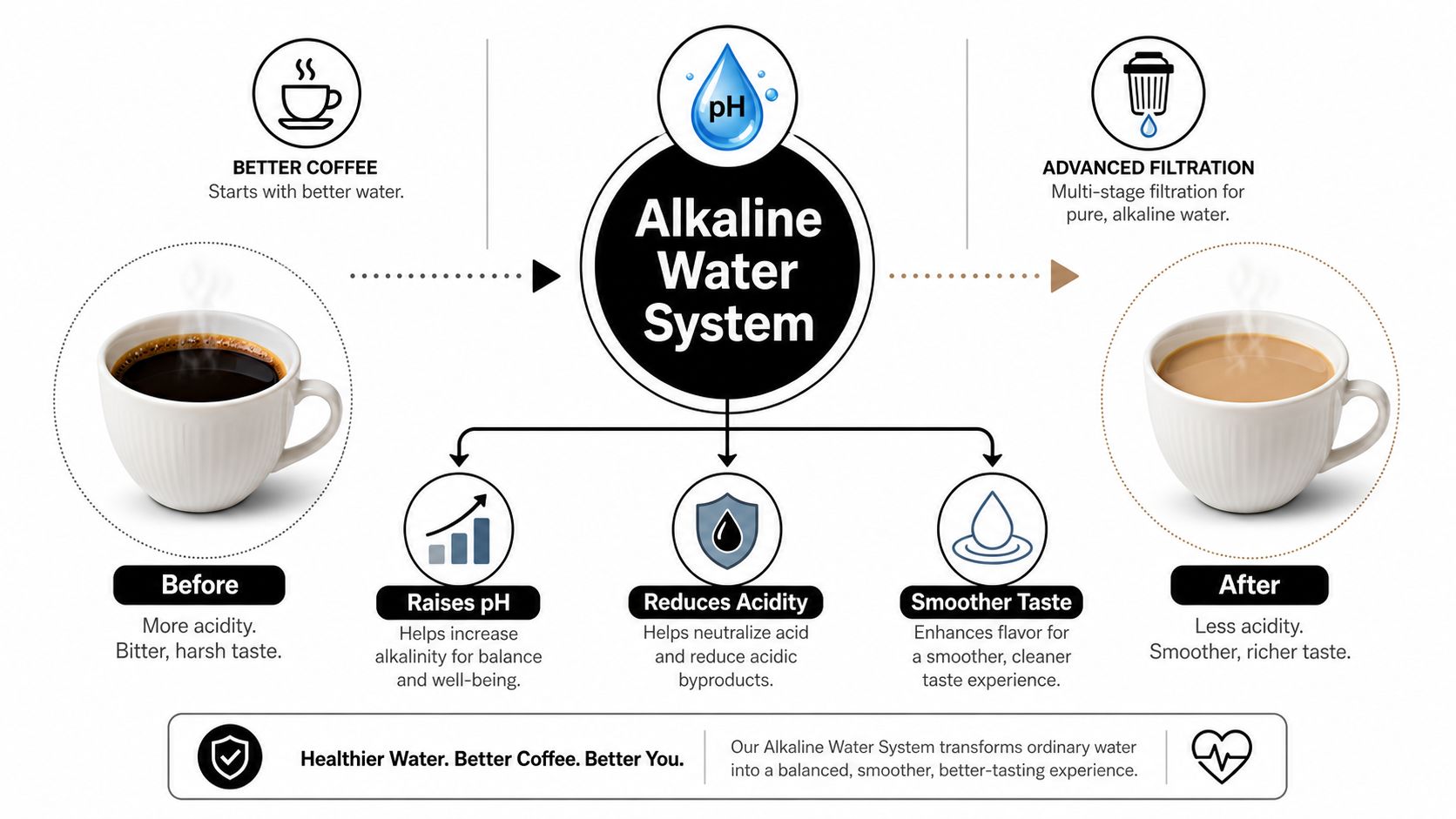
Two common ways homes raise pH
One approach is electrolysis, which uses titanium plates to separate water into different streams. The alkaline stream is the one people typically drink, while the other stream is directed elsewhere. These units are often called ionizers, and they depend heavily on the quality of the water entering the machine. If the water is mineral-heavy or already carrying fouling from hard well conditions, performance can suffer.
The other common approach is passive mineral contact. Water moves through calcite or corosex media, which slowly release calcium and magnesium back into the water. That method is mechanically simpler, so it shows up in both whole-house systems and point-of-use units. Typical drinking-water systems often target a 7.5 to 9.5 pH range according to whole-house alkaline system descriptions, though the final result still depends on source water and contact time.
A useful way to frame it is this, one method changes the water with electricity, the other changes it by contact with minerals. In practice, both are trying to solve the same homeowner complaint, water that tastes flat, sharp, or out of balance.
What the label doesn't always tell you
An alkaline water system for home can mean very different things depending on whether it is an ionizer, a remineralizer, or a reverse-osmosis setup with alkaline polishing. The chemistry outcome may look similar on a brochure, but the mechanics are not. That difference matters because a machine that adds minerals back after filtration behaves very differently from one that tries to shift pH electrochemically.
The source water sets the stage. A home with clean municipal water, a hard well, or water with iron and sulfur will push the system in different ways, just as a filter on a sandy jobsite fills differently from one in a clean workshop. An alkaline stage can improve taste and buffering, but it works best after the water has already been cleaned up by the earlier steps in the treatment train. For that reason, many homeowners start by comparing reverse osmosis versus filtered water before they choose the alkaline finish.
If you want the plain-English version, alkaline water is a chemistry result, not a stand-alone promise. It can be useful, but only when the filtration method matches the water coming into the house.
Comparing Ionizers, Remineralizers, and RO Plus Alkaline Systems
The best way to compare these systems is by asking what the water looks like before the alkaline step. That one question usually separates a smart purchase from an expensive disappointment. A clean municipal supply and a private well with iron staining are not the same problem, so they shouldn't get the same equipment.
The clearest example is the under-sink RO plus alkaline setup. One alkaline RO system is rated at 50 GPD, about 2 gallons per hour, with a 3.2-gallon storage tank and an inlet pressure range of 50 to 100 PSI. That kind of system is built to treat first, then polish. For more on why many homeowners prefer filtration before remineralization, see this guide on reverse osmosis versus filtered water.
Side-by-side comparison
| System Type | How It Raises pH | Best Source Water | Main Limitation |
|---|---|---|---|
| Ionizer | Uses electrolysis and titanium plates to create an alkaline stream | Already clean, soft water | Hardness, iron, and chlorine can stress the plates |
| Remineralizer cartridge | Adds minerals back after filtration | Homes that already have a strong filtration stage | Doesn't remove contaminants on its own |
| RO plus alkaline system | Removes contaminants first, then adds minerals back | Most point-of-use drinking setups | Needs pressure, pretreatment, and membrane care |
Which one fits a real house
Ionizers can be appealing because the interface is simple and the water output is instant, but they're usually the pick for water that's already in decent shape. Remineralizer cartridges are not primary filters, they're finishers. They make the water feel less stripped after reverse osmosis.
RO plus alkaline systems are often the most practical packaged option for homeowners because they handle both sides of the job. They reduce contaminants and then put back the minerals that make the water taste better and buffer better. If the source water is messy, this category usually makes more sense than chasing pH alone.
Rule of thumb: Choose by source water, not by marketing copy.
Health Claims Versus What the Evidence Shows
Homeowners often ask about alkaline water because they want something beyond a better-tasting glass. They may be hoping for gentler hydration, less acidity, or relief from reflux. Those questions are reasonable, but the evidence should lead the decision, not the marketing.
Harvard Health says there is no evidence to choose alkaline water over safe tap water or regular bottled water, and WebMD says the scientific evidence for many claimed benefits is very limited. That is the clearest summary for a homeowner who wants the straight answer without the sales pitch. You can read the WebMD overview of what alkaline water is.
What the system is doing
Many home systems do not create a health breakthrough. They raise pH by adding minerals back after reverse osmosis, which mainly changes taste and buffering. In a kitchen glass, that can make the water feel less flat and less stripped, especially when the original water already tastes thin or overtreated.
What it does not do is turn water into medicine. A fair description is that a well-designed system can make household water more pleasant to drink and more consistent from glass to glass. If someone expects it to solve a health problem on its own, the claim runs ahead of what the equipment can support.
A better way to frame it is simple. Alkaline water is a home water quality choice, not a medical treatment. If the filtration is solid and the source water has already been handled, it can be a sensible finishing step. If untreated water is feeding the unit and the machine is being asked to do everything, the health message is outrunning the plumbing.
Matching the System to Central Florida Source Water
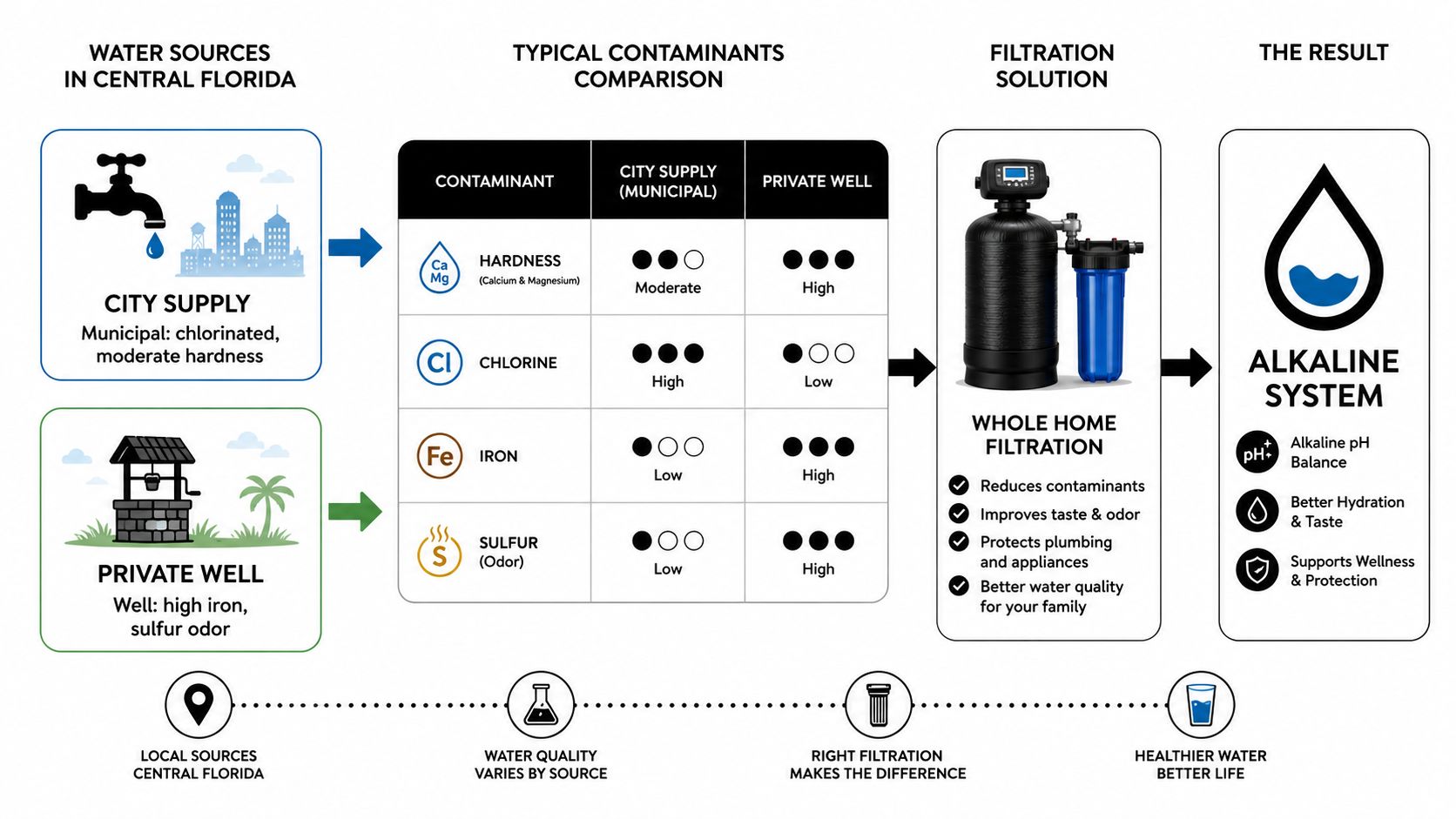
Central Florida water can be deceptively tricky. A municipal supply might bring chlorine and moderate hardness, while a private well can bring iron, sulfur odor, sediment, and enough hardness to foul equipment faster than a homeowner expects. That's why the treatment train matters more here than in many national product reviews.
Start with the water before the alkaline stage
The usual sequence is straightforward. Sediment filtration comes first to catch grit and protect the downstream parts. If the water has iron or sulfur, that stage needs to be addressed next, because those issues can clog media and affect taste. If hardness is high enough to threaten an RO membrane, a water softener or other conditioning step may be needed before reverse osmosis.
After that comes the main filter, often RO, and only then the alkaline polishing stage. That order matters because alkaline systems are not designed to rescue badly conditioned feed water. They work best when the upstream problems have already been handled.
For homes on wells, one technical benchmark is worth keeping in mind. A 10-stage RO plus UV alkaline unit lists a recommended feed TDS up to 2000 mg/L, hardness up to 600 mg/L, turbidity up to 5 NTU, iron below 0.3 mg/L, free chlorine below 0.2 mg/L, and feed pressure from 6 to 30 psi, while delivering up to 25 L/h, at least 40% recovery, and at least 90% TDS reduction. Those numbers make one thing obvious, pretreatment isn't optional when the source water is rough. For well-water planning, this is a useful companion to reverse osmosis for well water.
Why pressure and flow matter in a real kitchen
Performance specs are only useful if they match the household. One under-sink alkaline system is rated at 3 L/min flow, an ORP down to −800 mV, a 7-platinum-coated titanium electrode stack, and a 10-stage filter rated for 4,800 L capacity. That tells you the unit is built for a certain pace of use, not unlimited demand.
A family that drinks from one tap every day needs enough flow to keep up without stalling. A well house with variable pressure needs stabilization before any of this gear will behave consistently. In Central Florida, the alkaline stage is often the last 10 percent of the system, not the whole system.
Realistic Costs and Ongoing Maintenance
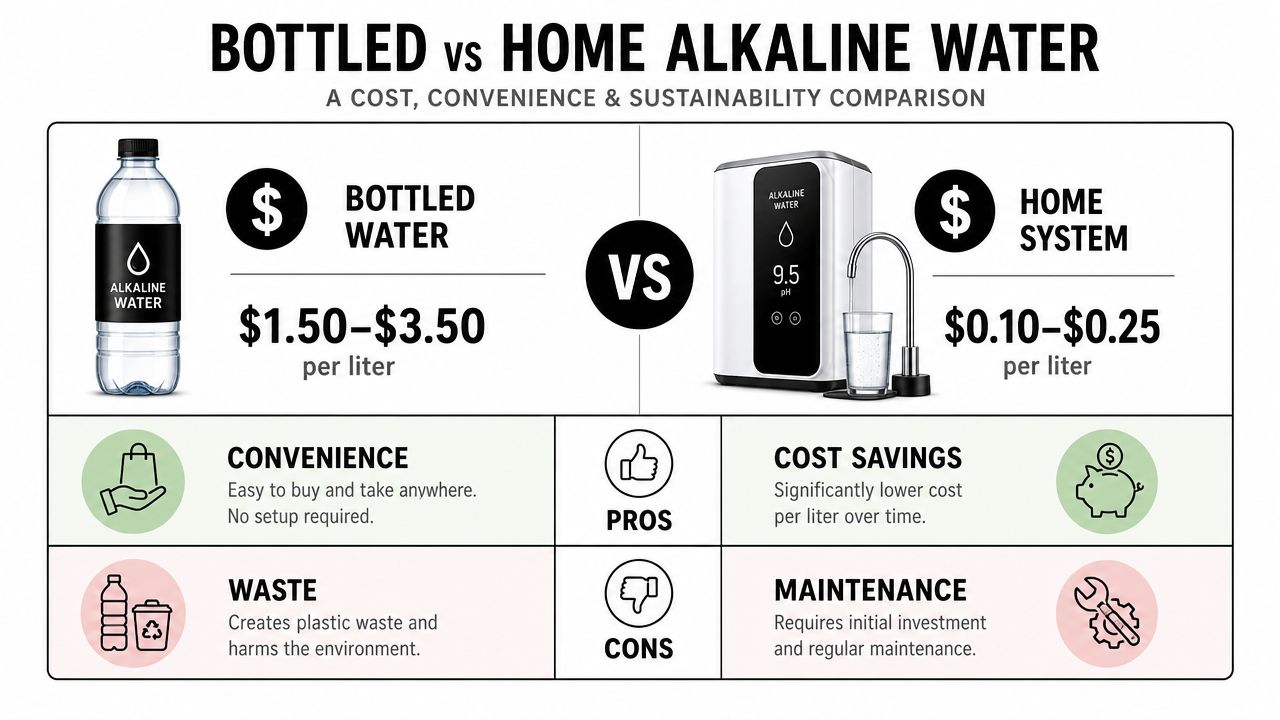
The cost conversation gets clearer when you compare bottled water with installed filtration. Bottled alkaline water typically runs USD 1.50 to USD 3.50 per liter, while a home system can start around USD 30 to USD 500 for basic configurations and USD 1,000 to USD 3,000 for premium under-sink or whole-house ionization systems. That gap is why so many families stop treating alkaline water like a specialty purchase and start treating it like household infrastructure. The market data on the category also shows the shift from niche to mainstream, with estimates of USD 1.5 billion in 2023 growing to USD 3.2 billion by 2032 at 8.7% CAGR, and another estimate placing it at USD 3.5 billion in 2025 growing to USD 6.8 billion by 2034. Those figures come from the tracked home alkaline water filter market report.
What the math looks like at home
A family using 30 liters per month could spend USD 45 to USD 105 monthly on bottled alkaline water, while a home system can bring the effective cost down to about USD 0.10 to USD 0.25 per liter after amortization. That's the value story, convenience plus lower long-term cost. The machine may cost more up front, but the recurring retail run stops.
Maintenance is the part people forget
A realistic upkeep plan usually looks like this. Pre-filters need replacement every six months or so, the RO membrane commonly lasts two to three years, and the alkaline cartridge is often an annual item. The exact schedule depends on usage and source water, but maintenance is predictable if the system was sized correctly in the first place.
Budgeting insight: The cheapest system to buy is not always the cheapest system to own.
For homeowners in hard-water areas, maintenance can feel like a nuisance until you compare it with bottled-water errands, storage, and waste. Once the costs are laid out plainly, the choice becomes less emotional and more practical.
How to Choose and Size the Right System
Start with four questions. How many people will drink from the tap every day. What is the source water carrying. Do you want alkaline water at one drinking tap or at every fixture. And how much upkeep are you willing to handle.
If the goal is better drinking water at one sink, an under-sink RO plus alkaline system is usually the most efficient fit. If the goal is a more uniform experience across the home, whole-house calcite or corosex systems make more sense because they treat water before it reaches the fixtures. A whole-house setup doesn't replace point-of-use drinking filtration in every case, but it does make sense when the priority is consistent pH and mineral contact at scale.
Match the category to the home
- Small household, one drinking tap: Look for a compact RO plus alkaline unit with enough tank capacity for daily use.
- Well water with iron or sulfur: Prioritize pretreatment before the alkaline stage, or the system will spend its life fighting the source water.
- Whole-home preference: Consider passive mineral-contact treatment if the goal is broad pH adjustment rather than a single drinking faucet.
- Busy household with limited maintenance tolerance: Choose a simpler system that fits the water profile without constant service calls.
Pressure and flow matter just as much as size. A system with the wrong inlet pressure window or a tank too small for the family's peak demand will frustrate everyone, even if the water chemistry looks good on paper. The better question is not “How alkaline can it get?” The better question is “Will it keep up with our home, our water, and our routine?”
Your Next Step Is a Free Local Water Test
A homeowner can buy the wrong alkaline system very easily if the starting water is a mystery. The first sample tells the story. A proper test should check hardness, iron, sulfur, TDS, pH, chlorine, and microbial indicators, because those results show whether the home needs sediment filtration, softening, reverse osmosis, disinfection, or only a final alkaline stage. Online reviews cannot see what comes out of your faucet, and they cannot tell you how Central Florida source water will behave in your pipes.
Bring a recent water bill, the well depth if you know it, and a short list of taste, odor, or staining problems. If the water leaves orange marks, smells like rotten eggs, or tastes flat after filtering, those clues help narrow the treatment path before anyone recommends equipment. Schedule a free local test through Florida Water Management, so the next recommendation is based on your actual water, not a generic product pitch.
For a home in Central Florida, that first test works like a map before a road trip. It shows whether the issue starts with hard well water, sulfur, iron, or something else that an alkaline unit alone cannot correct. Once you know that, you can choose a treatment train that fits the house instead of guessing at a one-box fix.