

You turn on the tap and expect clear water. Instead, you get a rusty burst in the sink, a blue-green ring around a drain, or a tiny leak that wasn't there last month. In Central Florida, those signs often point to corrosion in water pipes, and the frustrating part is that the problem can hide for a long time before it becomes obvious.
For homeowners, the stakes go beyond nuisance stains. Corrosion can affect what comes out of the faucet, how long plumbing lasts, and whether a small issue turns into a bigger repair. The good news is that pipe corrosion usually leaves clues, and once you understand those clues, you can make a better decision about testing, treatment, or replacement.
Table of Contents
- That Discolored Water Is Telling You Something
- What Is Pipe Corrosion and How Does It Happen
- Four Common Types of Pipe Corrosion in Florida Homes
- Why Central Florida Water Can Be Hard on Your Pipes
- Identifying Corrosion Signs and How to Test Your Water
- Practical Solutions for Preventing and Fixing Corrosion
- When to Call a Professional for Your Pipe Corrosion Issues
That Discolored Water Is Telling You Something
A homeowner in Sebring might notice the shower runs clear at first, then turns yellow-brown after the water sits overnight. Someone in Avon Park may wipe away a blue-green stain from a sink basin and think it's just soap residue. A landlord in Winter Haven may get a call about a pinhole leak under a cabinet and only then realize the plumbing has been under stress for years.
Those aren't random annoyances. They're warning signs that the water, the pipe material, or both are reacting in ways that shouldn't be ignored. In older homes, especially those with mixed metals, brass fixtures, or sections of stagnating water, corrosion can show up as discoloration, metallic taste, or recurring leaks.
The important shift is to stop treating the symptom as the whole story. Rusty water, blue-green staining, and tiny leaks often point to a larger pattern inside the plumbing, and that pattern is usually tied to water quality and pipe condition together. If you want a practical first step, looking at iron-related discoloration can help frame what's happening in the system, and this guide on removing iron from water is a useful place to start.
Practical rule: If the same fixture keeps staining or leaking, don't assume it's “just age.” Repeated clues usually mean the plumbing is telling the same story in a few different ways.
Corrosion is also why a simple visual fix rarely solves the full issue. A stain can be cleaned, but the underlying metal loss keeps going unless the source is identified. That's why the first question shouldn't be “How do I hide this?” It should be, “What is the water doing to my pipes?”
What Is Pipe Corrosion and How Does It Happen
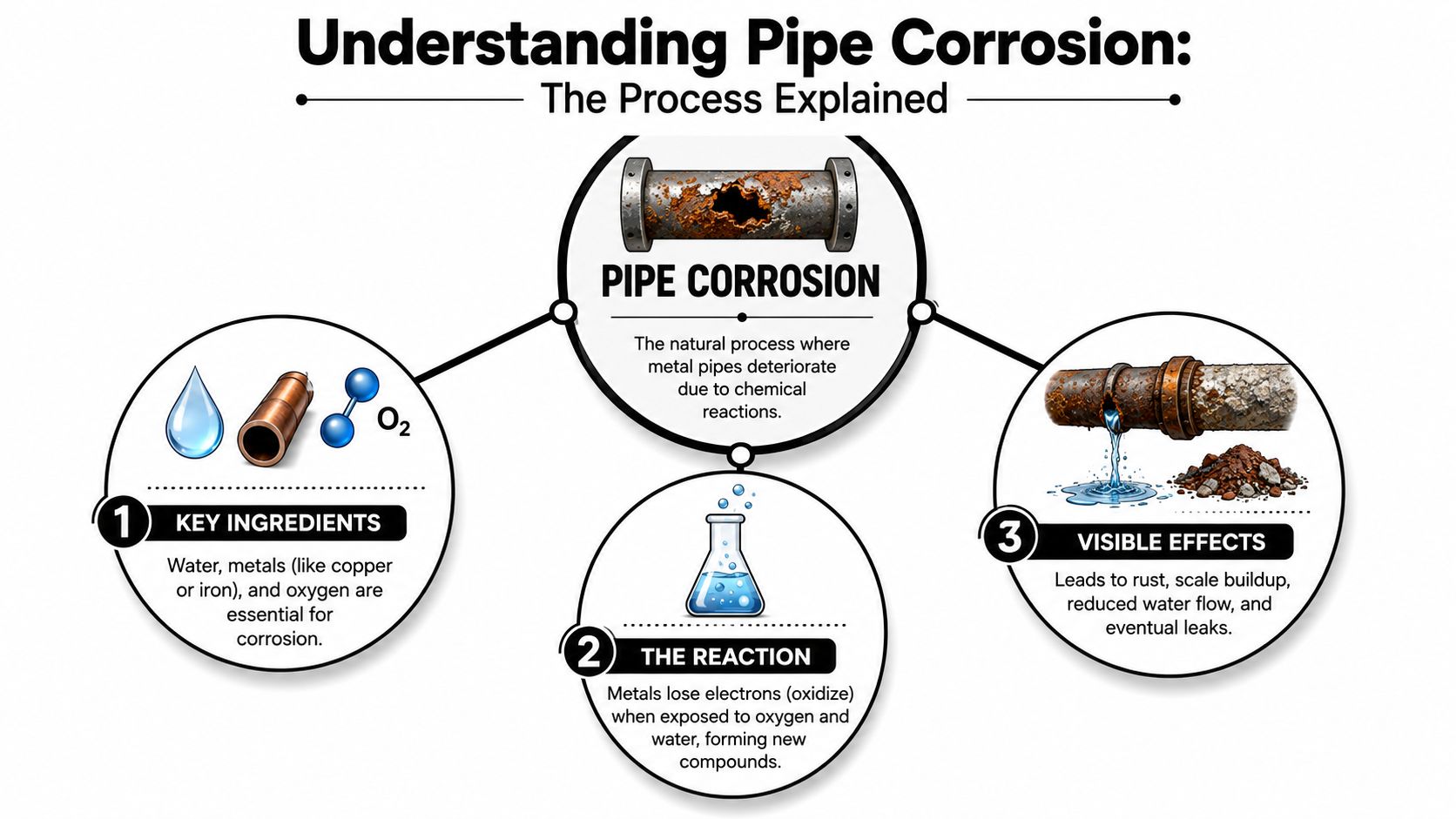
Pipe corrosion is a chemical reaction that happens inside the plumbing, and it starts long before a leak shows up. Metal, water, and oxygen interact at the pipe surface, and that interaction slowly pulls material out of the pipe wall and into the water. The process is a bit like a tiny battery inside the pipe, where the metal keeps losing particles because the water chemistry keeps the reaction going.
Why the pipe surface starts breaking down
The first stage usually happens out of sight. Water carries dissolved gases and minerals, and when the chemistry is aggressive enough, the pipe wall begins to lose metal little by little. That can happen in copper, iron, galvanized steel, and other metallic plumbing materials.
Once the surface is disturbed, the pipe stops behaving like a smooth conduit. It becomes easier for more corrosion to continue, scale can build up, the inside can turn rough, and leaks or pressure loss can follow. In a practical sense, the pipe wall starts acting less like a clean passage and more like a worn tunnel with weak spots.
Central Florida homeowners run into this sooner than they expect when hard water, low alkalinity, or well water contaminants are part of the picture. Hard water can leave behind mineral scale, low alkalinity can leave water less buffered against change, and well water can bring its own mix of minerals and gases that affect how metal surfaces react. Those conditions do not all create the same kind of damage, but they can set the stage for the same result, metal loss inside the pipe.
Why the reaction matters at the tap
Health Canada notes that corrosion-related metal release can rise sharply when water sits still in plumbing, and that the first water out of the tap can show the highest concentration after stagnation Health Canada corrosion guidance. That is why flushing the tap before use can matter, especially in homes with older plumbing, mixed metals, or fixtures that go unused for long stretches.
Water that sits in a pipe is not the same as water that keeps moving. Stagnation gives corrosion more time to change what reaches your faucet.
A homeowner may notice the change as stained fixtures, a metallic taste, or water that looks different first thing in the morning. Those clues do not mean the problem is only at the tap. They usually mean the water and the pipe have been reacting inside the system for some time.
The bigger point is simple. Corrosion in water pipes starts as chemistry, becomes a plumbing issue, and then shows up as a water-quality problem. Once that chain starts, you need to know what is driving it before you can choose the right fix.
Four Common Types of Pipe Corrosion in Florida Homes
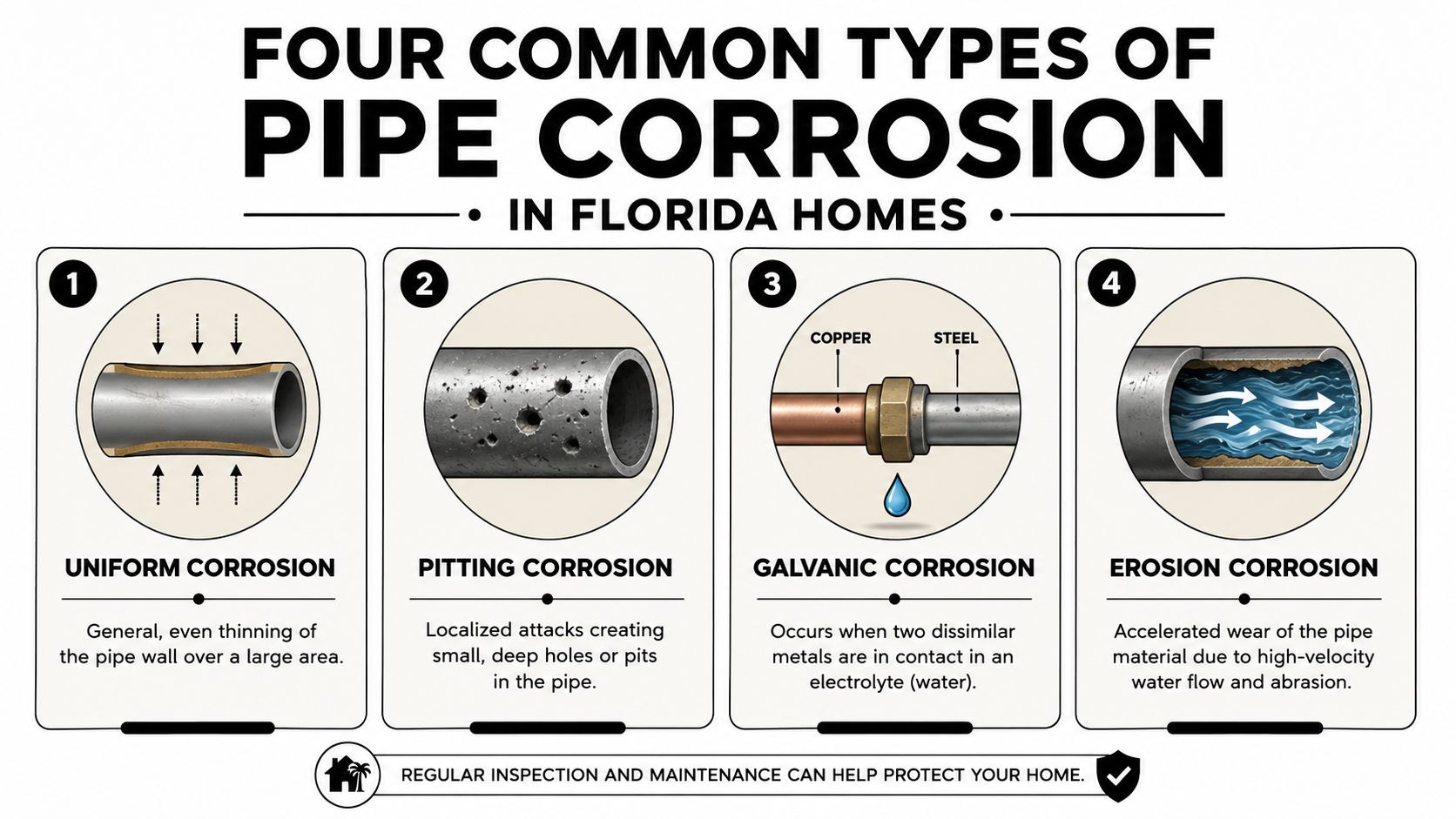
Not every corroded pipe fails the same way. In Florida homes, you'll usually see one of four patterns, and each one leaves different clues behind. Knowing the difference helps you avoid the common mistake of treating all corrosion like the same problem.
Uniform corrosion
Uniform corrosion is the even, gradual thinning of the pipe wall over a large area. It tends to affect older metal pipes that have been exposed to aggressive water for a long time. You may not see one obvious hole, but the pipe is slowly losing thickness across the whole section.
That kind of damage is especially frustrating because it can stay hidden until the pipe weakens enough to leak. When the failure comes, it can look sudden even though the process has been going on for years.
Pitting corrosion
Pitting corrosion is more localized. Instead of thinning the whole pipe evenly, it creates small, deep holes that can turn into pinhole leaks. Copper plumbing is a common place to see this pattern, and homeowners often notice it first when a cabinet, ceiling, or floor shows water damage with no obvious source.
This type is easy to underestimate because the visible damage is small compared with the amount of water it can release over time. A tiny pit can be the start of a recurring leak problem.
Galvanic corrosion
Galvanic corrosion happens when dissimilar metals touch in the presence of water. Copper connected to steel, or old repairs tied into mixed materials, can set up the conditions for one metal to corrode faster than it should.
The trouble usually shows up around joints, fittings, or transitions between pipe types. In real homes, this is one of those issues that looks like a repair detail but behaves like a chemistry problem.
Microbiologically influenced corrosion
Microbiologically influenced corrosion is linked to microbial growth, which can matter more for private wells and stagnant sections of plumbing. The key issue is not just the presence of bacteria, it's the way biofilm can create conditions that accelerate metal loss.
That's why well owners often need to look at more than one concern at once. Iron, sulfur, sediment, and bacterial activity can all complicate the picture, especially where plumbing sits unused for long periods.
Why Central Florida Water Can Be Hard on Your Pipes
A Central Florida home can have perfectly ordinary plumbing and still develop corrosion faster than expected. The reason is often the water itself. Hard water, low buffering capacity, and well-related contaminants can all push metal pipes toward wear, especially where older sections meet newer fittings or where different metals have been tied together over time. The water chemistry does not create the problem on its own, but it can expose a weak spot in the system sooner.
The chemistry that changes pipe behavior
For a homeowner, the first thing to understand is that pH is only part of the picture. Penn State Extension says pH is the most important single term for estimating corrosivity, with water below pH 6.0 considered highly corrosive, pH 6.0 to 6.9 somewhat corrosive, pH 7.0 to 7.5 probably not excessively corrosive, and above pH 7.6 not particularly corrosive to metal plumbing Penn State Extension on water corrosivity. The same source also notes that water at pH 7.0 can still be corrosive when alkalinity is very low, specifically below 30 mg/L, because the water lacks enough buffering capacity to resist acid shifts at the pipe wall.
That is the part many people miss. Neutral pH sounds safe, but buffering capacity is the cushion that keeps water chemistry from swinging against the metal. Without that cushion, pipes can keep losing ground even when the number on a basic test strip does not look alarming.
Hardness matters too, because it changes how water behaves inside a plumbing system. For a plain-language reference on water hardness levels, it helps to compare what your water test says with what you see at fixtures, because hard water can leave scale while still allowing corrosive conditions to exist alongside it.
What field indicators can suggest
A practical field indicator is the relationship among chloride, sulfate, alkalinity, pH, and hardness. The CMSR, or chloride-to-sulfate mass ratio, is flagged as high when it is above 0.2 and below 0.5, and concern becomes significant when it is above 0.5 and alkalinity is below 50 mg/L as calcium carbonate CMSR guidance. Low-alkalinity water has a hard time buffering acid generation at the pipe wall, so internal metal loss can speed up. In a house, that can show up as a line that seems fine on the outside while slowly deteriorating where you cannot see it.
Why well water often needs special attention
Private wells add another layer, and Central Florida homeowners with wells often feel that complexity first. Iron, sulfur odors, sediment, and microbial activity can all make corrosion feel less predictable, because the plumbing is responding to both water chemistry and what is moving through the system. A one-size-fits-all treatment plan usually disappoints because the water may be asking different questions at different parts of the house.
If a problem shows up in only one branch line or one fixture, the issue may be local rather than whole-home. A single repair, transition fitting, or stretch of mixed metal can change the corrosion pattern enough to create a trouble spot that looks isolated but keeps coming back.
Identifying Corrosion Signs and How to Test Your Water
The first clues are usually visible at the faucet. Blue-green staining around sinks and tubs often points to copper influence, while reddish-brown water, flakes, or grit usually suggests iron or steel corrosion. A metallic taste, cloudy water from the first draw, or a fixture that keeps staining after cleaning can point in the same direction.
Timing matters too. Water that sits in the plumbing has more time to pick up corrosion products, so the first water out of the tap often tells the clearest story. If a glass drawn after sitting overnight tastes or looks different, that is useful information, not just a nuisance.
What to look for first
- Color changes: Reddish, yellow-brown, or blue-green water can point toward corroding metal or mineral release.
- Staining around fixtures: Repeated rings or streaks often mean the problem is ongoing.
- Taste and odor shifts: A metallic taste is a common complaint when metal release is happening.
- Recurrence after cleaning: If the mark comes back fast, the source is still active.
A visual check can narrow the problem, but it cannot tell you whether the source is the pipe material, the water chemistry, or an installation detail that keeps creating trouble. A professional water test fills in that gap because it measures what the water contains instead of guessing from the stain on the sink. In Central Florida, that matters even more because hard water, low alkalinity, and private well water can all push corrosion in different directions.
Best next step: Test the water where you drink and cook, not just at a hose bib or utility sink. Tap sampling is the most practical way to assess corrosion-linked exposure, according to Health Canada corrosion guidance.
A proper test can also show whether corrosion is affecting the whole house or staying near one fixture, line, or stagnation point. That difference changes the fix. A single branch line can act like a weak link in a chain, even when the rest of the plumbing looks fine. If a concern shows up in only one sink or shower, that clue is worth sharing with the person doing the testing.
Practical Solutions for Preventing and Fixing Corrosion
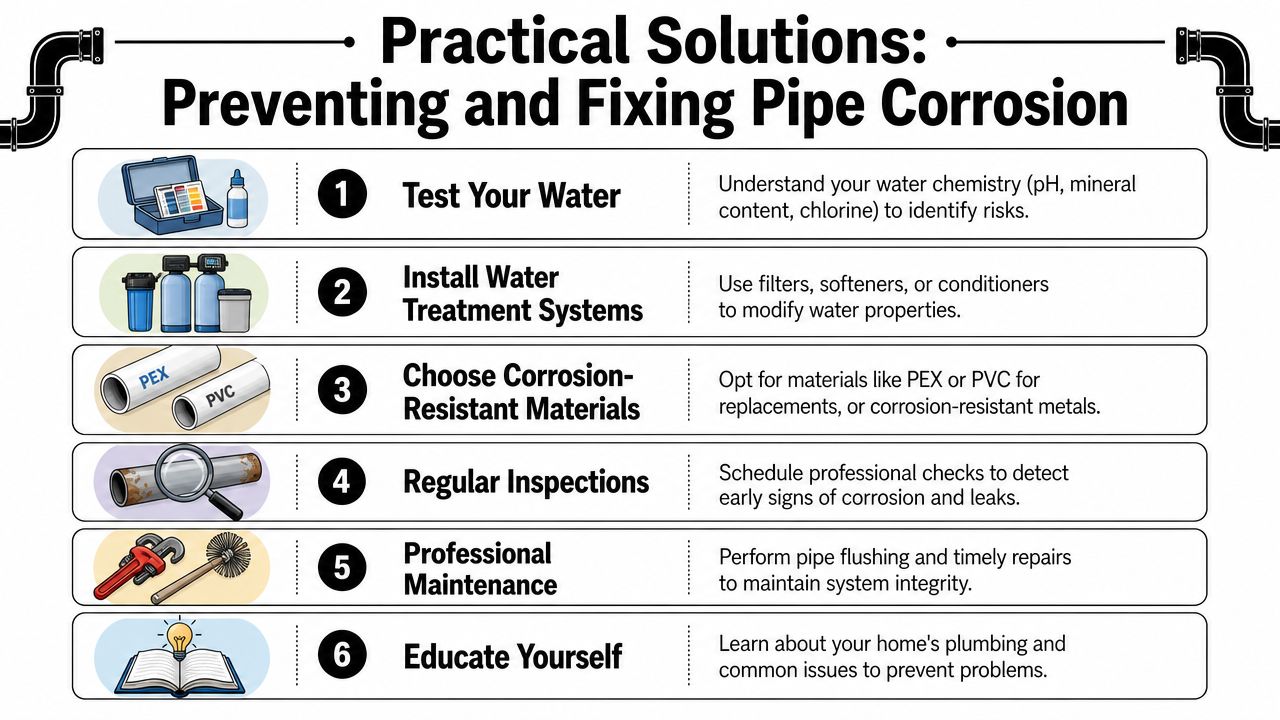
A stained sink is only the surface clue. The fix depends on what is happening inside the pipe, and in Central Florida that often means dealing with water chemistry and plumbing conditions at the same time. Hard water, low alkalinity, and well water contaminants can all push pipe corrosion in different directions, so the best answer is usually a layered one.
Start with the water
EPA guidance says corrosion control in drinking-water systems often begins by raising pH and/or alkalinity so the water becomes scale-forming enough to leave a thin protective coating on the pipe wall EPA corrosion control fact sheet. The same guidance says corrosion control treatment can also reduce chlorine demand from corrosion products and may include phosphates or silicates, depending on the system chemistry. In practice, that means the water can be adjusted so it is less aggressive to metal surfaces, much like adding a protective layer before moisture reaches bare steel.
That fit matters. A treatment plan that helps one home may do very little for another if the source water, pipe materials, or periods of stagnation are different. In Central Florida, a private well with iron or other dissolved minerals may need a different approach than a home on municipal water that has low alkalinity and leaves copper or galvanized piping exposed to steady attack.
Then look at the plumbing itself
The National Physical Laboratory warns that avoiding sharp bends, bimetallic contacts, stagnant water, over-tightened fittings, and partial filling during installation can matter as much as water treatment NPL plumbing corrosion guidance. Those details shape how water moves and where it sits. A pipe run with trapped water works like a pocket where the same corrosive water keeps touching the same metal, which is why a small layout problem can keep showing up as repeat leaks or discoloration.
That guidance also helps explain why corrosion can continue even after the water looks better on a test. If two metals are joined in the wrong way, or a fitting was installed too tightly, the plumbing itself can keep creating weak points. For a homeowner, that usually means the fix is not only about treatment equipment, it is also about correcting the sections that are acting like the weak link in the system.
Build a layered fix
A practical corrosion plan often includes:
- Water treatment: Adjusting pH, alkalinity, or using targeted inhibitors.
- Filtration: Removing iron, sediment, or other contributors before they reach plumbing.
- Material changes: Replacing vulnerable sections with corrosion-resistant options.
- Maintenance: Flushing neglected lines and correcting installation issues.
Each layer solves a different part of the problem. Water treatment changes the chemistry, filtration removes contaminants that feed staining or attack, and plumbing repairs address the physical spots where corrosion keeps restarting. If one layer is missing, the issue can return in another form, which is why a home with recurring corrosion often needs more than a quick cleanup.
For homeowners comparing options, a whole-home approach can be more stable than treating one symptom at a time. If lead-related protection is part of the concern, this overview of a whole-house water filter for lead can help frame the next conversation with a water professional.
The main point is simple. Treatment helps chemistry, but installation details and pipe materials still matter. If you only correct one side of the problem, corrosion can keep finding another path through the plumbing.
When to Call a Professional for Your Pipe Corrosion Issues
Call for help when leaks keep returning, water pressure drops without explanation, or exposed piping shows flaking, scaling, or visible deterioration. Those signs often mean the issue is no longer isolated to one fixture. If the water test looks acceptable but the same spot keeps failing, the layout or materials may be the underlying problem.
You should also get professional eyes on the system if your home has older metal plumbing, mixed-metal repairs, or a private well with recurring taste, odor, or staining issues. Corrosion doesn't usually improve on its own, and the longer it's allowed to continue, the more likely it is to spread.
A CTA for Florida Water Management. If you're seeing stains, pinhole leaks, or water that tastes off, don't keep guessing. Schedule a free water test and get a clear, local diagnosis for your home's plumbing and water chemistry.