

If you're on a private well in Wauchula, you probably know the routine. The water looks fine for a moment, then the sink starts turning orange, the toilet tank grows a rusty film, and white laundry comes out looking older than it is. A lot of homeowners put up with that for far too long because they assume iron is just part of well water here.
It is common. It is also fixable.
The problem is that most iron advice online is too generic to work for real homes in Central Florida. Wauchula wells don't all behave the same way. One house has clear-water iron that oxidizes after it hits the air. The next has visible red water. Another has slime in the toilet tank and a sulfur smell mixed in. If you install the wrong system, it may help for a short time, then the stains come right back.
This guide is built around long-term iron removal for well water in Wauchula, FL, not a temporary patch.
Table of Contents
- Why Your Wauchula Well Water Has an Iron Problem
- Reading the Signs to Identify Your Type of Iron
- Comparing Iron Removal Systems for Central Florida Wells
- Why a Professional Water Test Is Your First Step
- Maintaining Your System for Lasting Iron Removal
- Take Control of Your Wauchula Well Water Quality Today
Why Your Wauchula Well Water Has an Iron Problem
You usually see the problem before you know the cause. A tub ring shows up a few days after cleaning. The kitchen sink picks up orange streaks. White laundry starts looking dull, and the toilet tank builds rust-colored residue that keeps coming back.
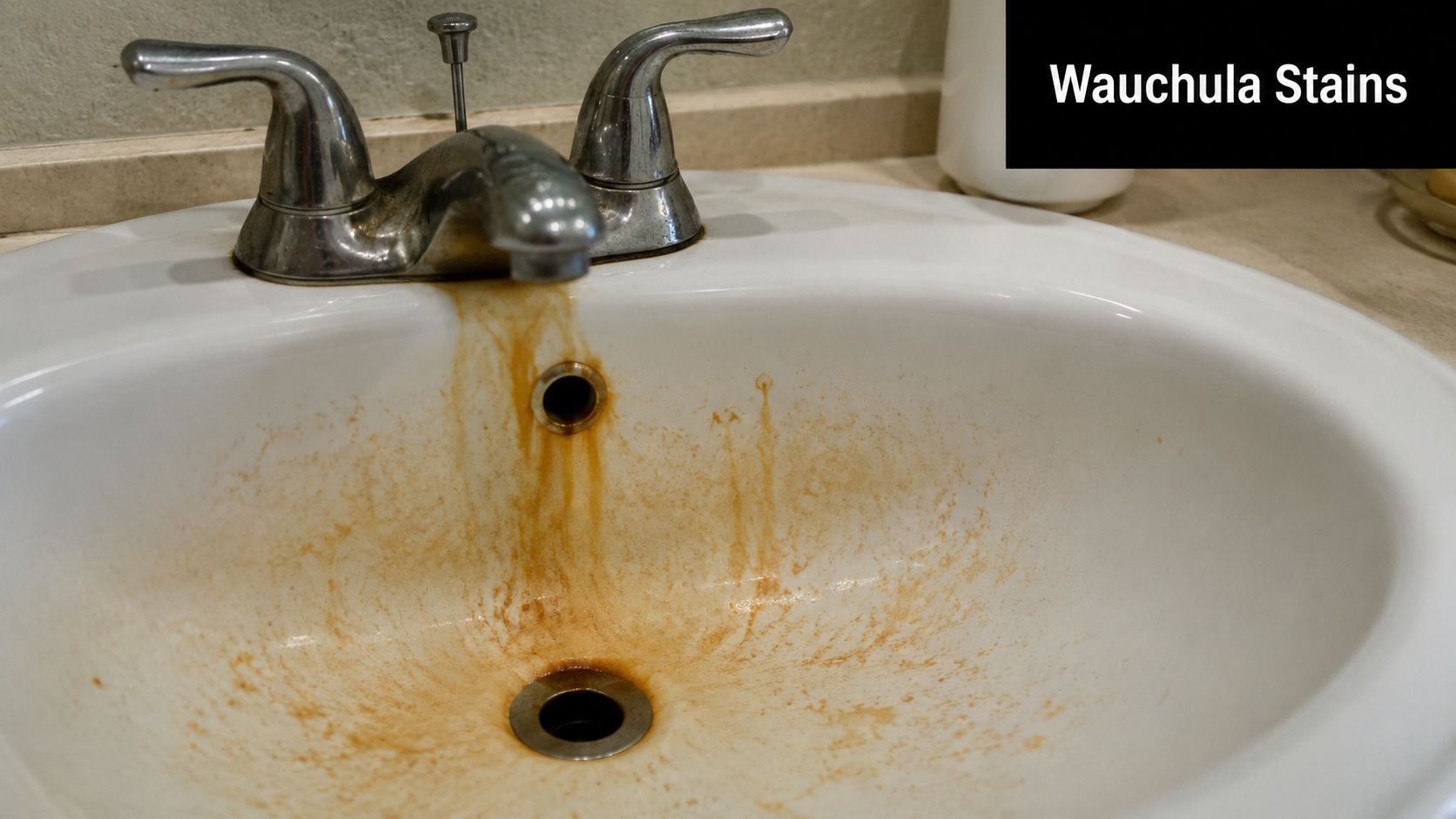
In Wauchula, that pattern is common because local well water often pulls through sandy soil and iron-bearing formations that leave dissolved or oxidized iron in the water. I see it every week in Hardee County wells. Two houses a few miles apart can have very different water, even when the stains look almost identical, because depth, casing condition, oxygen levels, and other minerals all change how iron behaves.
That local chemistry is why generic advice fails so often. A filter that works for one Central Florida well may plug up fast in another, or it may remove staining for a few months and then let the problem creep back in.
Why the same stain can come from different problems
Orange staining is the symptom. The cause can be very different.
Some wells produce iron that stays dissolved until it hits air. Some produce iron that is already oxidized and floating as particles. Some wells also have iron bacteria, which creates slime inside plumbing and fouls equipment. Older plumbing can add another layer to the diagnosis, especially in homes where corrosion is already part of the problem.
That difference matters because treatment has to match the water. I have seen homeowners swap cartridges, add a softener, or try a store-bought iron filter head, only to end up with the same stains and a system that needs constant attention. The equipment was not always bad. It was just matched to the wrong form of iron.
As noted in guidance on iron and rust problems in wells, iron issues are often grouped into broad categories. In real Wauchula well work, the better question is simpler: what is in your water, and what else is traveling with it?
Why temporary fixes keep failing
Quick fixes usually address the symptom, not the source. A sediment cartridge may catch some visible rust for a short time. A standard softener may help with light dissolved iron in one home, then foul out quickly in another home with sulfur, manganese, or bacterial buildup.
Long-term iron removal depends on building the treatment around the full water profile. That means looking at iron type, iron level, pH, hardness, sulfur odor, and any signs of bacteria before choosing equipment. Homeowners comparing well water treatment options in Central Florida get better results when they start there instead of buying hardware first.
That is how you stop chasing stains every few months and fix the problem for good.
Reading the Signs to Identify Your Type of Iron
You can learn a lot from what your water does before anyone pulls a sample. That won't replace a proper test, but it does help narrow down what kind of iron you're probably dealing with.
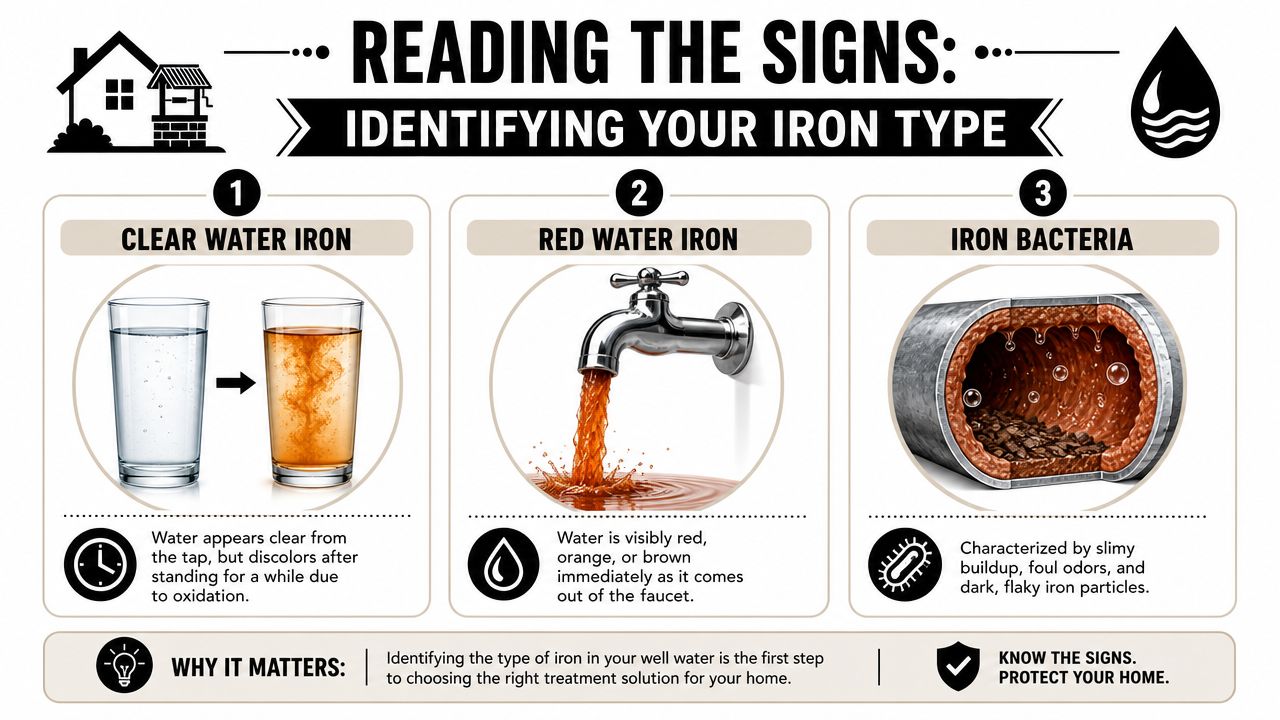
Clear water that turns rusty later
If water comes out of the tap looking normal, then turns yellow, orange, or brown after it sits, that's a strong sign of ferrous iron. It's dissolved in the water at first. Once it reacts with air, it oxidizes and becomes visible.
This is the classic situation where homeowners say, “My water looks clear, so I didn't think it was iron.” Then the toilet bowl, sink, and washing machine say otherwise.
Red or brown water right from the tap
If the water is already discolored as it comes out, you're more likely dealing with ferric iron or oxidized iron particles already suspended in the water. In that case, the treatment approach changes because now you're trying to capture particles rather than only converting dissolved iron.
A simple clue is what happens in a white bucket. If the color is there immediately, that's different from water that changes after standing.
Slime, odor, and fouled fixtures
When you see reddish slime in toilet tanks, stringy buildup, dark flakes, or a swampy odor, suspect iron bacteria or a mixed problem. These situations often foul equipment fast and create recurring complaints even after basic filters are installed.
If the toilet tank has slime instead of just stain, don't assume you only have dissolved iron.
What these signs can and can't tell you
Home observation is useful, but it's still only a first pass. The treatment method depends heavily on whether iron is in particle form or dissolved form. According to US Water Systems guidance on iron removal, greensand systems generally work best when water pH is above 7.5 and are generally sufficient for up to 10 ppm of iron, while chemical oxidation is often used when iron is above 10 mg/L.
That means the same orange stain can lead to very different equipment choices depending on iron form, pH, and how much iron is present.
A practical homeowner check looks like this:
- Watch the faucet glass: Fill a clear glass and let it sit. If it starts clear and later changes color, ferrous iron is likely involved.
- Look in the toilet tank: Slime, stringy residue, or gelatinous buildup points toward bacterial activity, not just staining.
- Notice the smell: If iron comes with sulfur odor, treatment usually needs to address more than one issue at once.
- Check multiple fixtures: One rusty sink may be a localized plumbing issue. Whole-house staining points back to the well water itself.
A lab-quality water test is what turns those clues into a treatment plan.
Comparing Iron Removal Systems for Central Florida Wells
Once you know the water profile, you can compare equipment. The absence of a thorough comparison often leads to many poor recommendations. Homeowners get sold a single tank for every iron problem, when real wells in Wauchula often need a more specific setup.
Water softeners for low ferrous iron
A softener can help when the problem is low-level ferrous iron and the rest of the chemistry is cooperative. It can be a practical solution when hardness and light clear-water iron show up together.
But the trade-off matters. Aquaclear's practitioner guidance on iron removal notes that while a softener may handle low-level ferrous iron, reliability drops above roughly 0.5 ppm. That same guidance also stresses lifecycle performance, because salt use, cleaning, and ongoing maintenance affect whether the system remains economical over time.
If iron is higher, mixed with sediment, or paired with sulfur or bacteria, softeners usually stop being the right main tool.
Air injection oxidation systems
For many whole-house iron jobs, air injection oxidation, often shortened to AIO, is a strong fit. These systems oxidize dissolved iron inside the treatment process so the filter media can capture it.
They make sense for homeowners who want whole-house treatment without continuous chemical feed in many common iron scenarios. They also tend to be a better long-term answer when staining has been persistent and a softener alone hasn't held up.
Chemical oxidation and stronger treatment trains
Some wells need more than one tank and more than one treatment step. When iron is heavier, mixed with sulfur, or combined with bacterial fouling, a chemical oxidation plus filtration setup may be the correct direction. That can involve chlorine or another oxidant ahead of filtration.
This is usually not the kind of problem you solve with an off-the-shelf filter housing from a home center. It requires sizing, contact time, and follow-through.
Greensand and specialty iron media
Manganese greensand and related iron media still have a place, especially when the chemistry lines up with the media requirements. They're often chosen for stronger iron loads where a softener would be a poor match.
One practical point many homeowners miss is that media systems are only as good as their backwash conditions and water chemistry. Good media can still fail fast if the water profile wasn't diagnosed well.
Field reality: The right equipment is only half the job. Wrong backwash settings, wrong media choice, or missed sulfur can make a good system perform badly.
Iron removal system comparison
| System Type | Best For (Iron Type & Level) | Pros | Cons | Typical Maintenance |
|---|---|---|---|---|
| Water softener | Low-level ferrous iron with hardness | Can address hardness and light clear-water iron in one system | Loses reliability as iron rises, can foul resin | Add salt, clean system as needed, inspect resin performance |
| Air injection oxidation filter | Dissolved iron that needs oxidation before filtration | Whole-house approach, avoids continuous chemical feed in many cases | Not ideal for every mixed-water problem | Backwash checks, injector and media inspection |
| Chemical oxidation plus filtration | Higher iron, sulfur, or mixed contamination | Handles tougher water profiles | More complex equipment and upkeep | Monitor oxidant, service feed components, maintain filters |
| Greensand or specialty iron media | Iron loads suited to media-based removal and matching chemistry | Can be effective for stronger iron removal | Depends on pH, backwash, and correct setup | Media care, backwash verification, eventual media replacement |
For homeowners weighing hard water and iron together, it also helps to understand how water softening systems are used in whole-home treatment. Sometimes a softener is the right piece of the solution. It just shouldn't be expected to solve every iron problem by itself.
Florida Water Management installs and services whole-home treatment systems for Central Florida wells, including configurations that combine oxidation, filtration, and softening where the water test supports that approach.
Why a Professional Water Test Is Your First Step
A Wauchula homeowner calls after replacing toilet parts twice, scrubbing orange stains every weekend, and swapping a cartridge filter that never fixed the problem. That usually means the house was treated for the symptom, not the water.
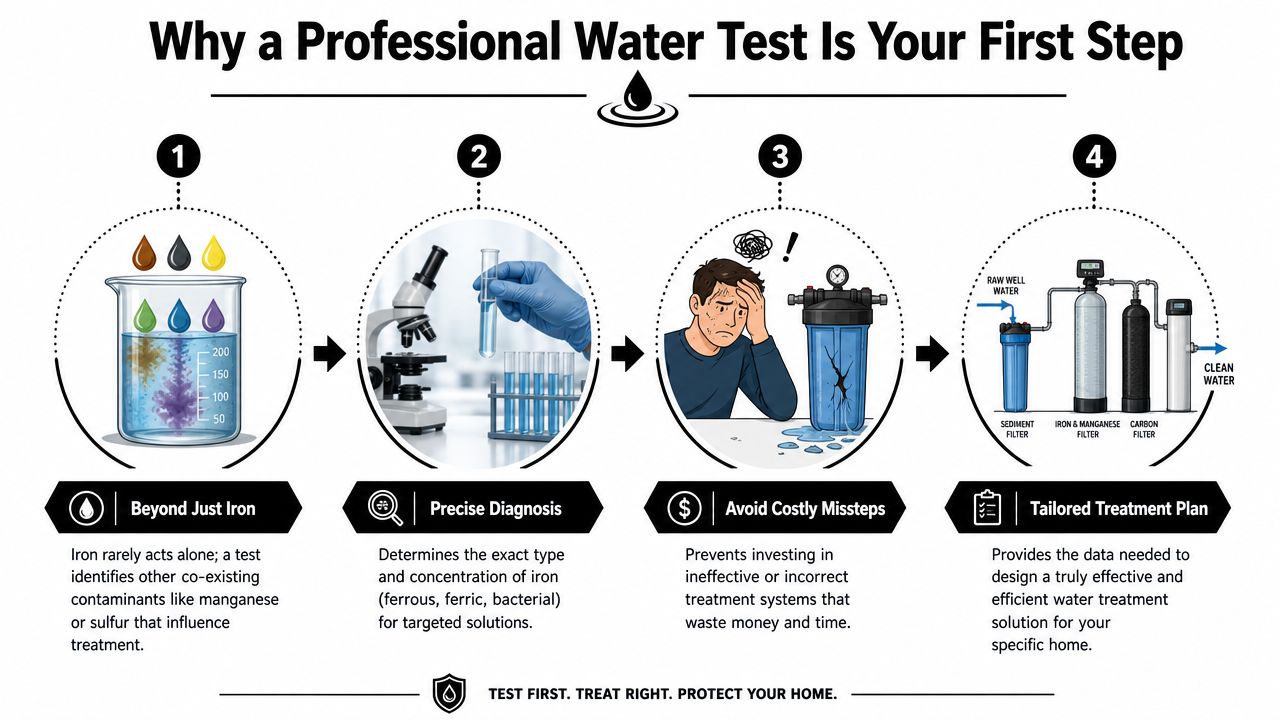
Iron in this part of Florida is rarely a one-number problem. In Wauchula wells, I regularly see iron mixed with hardness, fine sand, sulfur odor, low or borderline pH, and sometimes bacterial slime in the tank or toilet. Two homes on the same road can need different treatment because the well depth, casing condition, and groundwater chemistry are not identical.
The measurement changes the treatment choice
The treatment decision starts with the actual water, not the stain color. Light clear-water iron may be manageable with one approach. Higher iron, mixed iron, or iron combined with sulfur usually pushes the setup toward oxidation and filtration instead.
That distinction matters because some systems look fine on paper and still fail early in the field. A softener can help in the right range, but it is not built to carry every iron load. Specialty media can work well too, but only when the pH, backwash rate, and overall water profile fit that media. A professional test sorts that out before equipment gets installed.
Local water chemistry decides whether the fix lasts
This is the part generic advice misses. Wauchula-area wells often pull from sandy formations where the water can change enough from property to property that copying a neighbor's setup is a gamble.
I have seen one home stay clean with a properly sized iron filter, while the next home needed sediment handling first because fine grit kept fouling the valve and media bed. I have also seen sulfur and iron together make a basic system look defective, when the actual problem was that the treatment train was incomplete.
A good test checks the conditions that change performance:
- Iron type: dissolved, oxidized, bacterial, or a mix
- Iron load: whether the concentration fits a softener, a media filter, or oxidation first
- Related water issues: pH, sulfur odor, hardness, manganese, and sediment
- System sizing: whether one unit is enough or the home needs staged treatment
Testing protects your budget
The expensive mistake in Wauchula is usually not buying too much system. It is buying the wrong one, living with stains for six months, then paying again to rebuild the setup correctly.
A proper test helps prevent that cycle. It also helps homeowners compare whole-home filtration systems for Sebring and nearby Central Florida wells based on actual water conditions instead of sales claims.
A filter that works on one well can fail on the next property because the iron form, pH, sulfur level, and sediment load are different.
Without that information, achieving effective iron removal for Wauchula FL well water becomes trial and error. Trial and error is why stains come back, media fouls early, and homeowners end up buying equipment twice.
Maintaining Your System for Lasting Iron Removal
A system can be correctly chosen and still disappoint if nobody maintains it. Iron treatment isn't a “set it and forget it” part of the house. It needs periodic attention, especially on private wells where conditions can change.
What homeowners need to stay on top of
The maintenance depends on the equipment.
A softener needs salt and occasional cleaning if it's handling iron. An air injection system needs its oxidation and backwash functions working properly. A media filter needs enough backwash to stay open and effective. A chemical oxidation setup needs feed equipment checked and filters serviced on schedule.
Most long-term failures come from one of three things:
- Skipped upkeep: Salt runs empty, injectors clog, or media stops cleaning itself properly.
- Ignored warning signs: The stain slowly returns, pressure drops, or sulfur odor creeps back in.
- Changed water conditions: Seasonal shifts, pump work, or well changes alter what the system is receiving.
Shock chlorination has a role, but it's not the whole answer
If iron bacteria is present, shock chlorination is a common corrective step. Field guidance on iron bacteria treatment describes it as using a high chlorine dose with a 12- to 24-hour contact period, followed by flushing until the chlorine odor dissipates.
That can help restore sanitary conditions and knock back bacterial slime. It is not a permanent iron-removal strategy. If the underlying iron problem stays in the water, the slime and staining often return.
Shock chlorination is a reset tool. It isn't a substitute for a real iron treatment system.
A practical maintenance mindset
If you want the system to keep working year after year, treat maintenance as part of ownership, not as an afterthought.
Pay attention to changes in stain color, taste, odor, and pressure. Keep service records. Replace media and cartridges when performance says it's time, not only when the water becomes obviously bad. If you own rental property, don't wait for a tenant to report orange tubs and ruined laundry before checking the equipment.
That long-view approach is what separates a system that controls iron for years from one that only looked good right after installation.
Take Control of Your Wauchula Well Water Quality Today
Iron problems in Wauchula wells are frustrating because they keep showing up in daily life. You see them in sinks, tubs, toilets, laundry, and appliances. But the actual fix is straightforward once the water is diagnosed correctly.
The pattern is consistent. First, identify the kind of iron problem you're seeing. Then test the water properly. Then choose the treatment that matches the water, not the sales pitch. After that, install it correctly and keep it maintained.
That workflow isn't guesswork. Newater's practitioner guidance on iron removal describes a sound process as identifying the iron form first, then running a lab-quality test, selecting the treatment train, installing it correctly, and verifying performance. It also notes that skipping those steps, especially testing, is a common reason systems fail and staining returns.
If you've been searching for iron removal well water Wauchula FL, that's the main takeaway. There isn't one magic filter for every house. There is a repeatable process that leads to clear water and keeps it that way.
What usually doesn't work is guessing. What does work is matching the equipment to the water and maintaining it like part of the home.
You don't need to keep scrubbing orange stains and hoping the next cartridge or cleaner will finally solve it. A lot of Wauchula well water problems can be corrected permanently with the right treatment plan.
If you're ready to stop chasing stains and get a real answer, schedule a free water test with Florida Water Management. You can also reach the team directly through the contact us page to get your well water evaluated and find out which iron treatment setup fits your home.