

You turn on the kitchen tap for a glass of water, or step into the shower, and that smell hits immediately. Rotten eggs. For a lot of Central Florida homeowners on private wells, that moment is familiar and frustrating. It makes everyday things feel off. Drinking water tastes suspicious, showers are less pleasant, and guests notice it fast.
The good news is that this problem is common, and in most homes it's very treatable once the source is identified correctly. The bad news is that many homeowners spend time on temporary fixes that don't match the actual cause. In Central Florida, that usually means the smell returns.
Table of Contents
- That Unmistakable Rotten Egg Smell in Your Water
- The Science Behind the Sulfur Smell
- How to Diagnose the Source of the Odor
- Common DIY Fixes and Their Limitations
- Choosing the Right Long-Term Treatment System
- Why Central Florida Water Needs Local Expertise
- Your Next Step to Clear and Odor-Free Water
That Unmistakable Rotten Egg Smell in Your Water
Most homeowners first notice it in a routine moment. Morning coffee water smells off. The guest bathroom has an odor after sitting overnight. The hot shower fills the room with a sulfur smell that seems stronger than anything coming from the cold tap.
That reaction is normal. When water smells like sulfur, people usually worry about safety first and equipment second. They want to know what caused it, whether it's dangerous, and whether it can be fixed without replacing half the house plumbing.
In Central Florida, especially in homes served by private wells, this odor usually points to a very specific group of water quality issues. The smell may come from the groundwater itself, from sulfur bacteria somewhere in the well or plumbing, or from the water heater if the odor shows up mainly in hot water.
Practical rule: Don't buy a filter based on smell alone. The same rotten egg odor can come from different sources, and the right fix depends on where that odor starts.
A lot of homeowners can narrow the issue down with a few simple checks at home. After that, a proper water test is what separates a short-term patch from a solution that lasts.
The Science Behind the Sulfur Smell
The rotten egg smell almost always comes from hydrogen sulfide gas, usually written as H₂S. In plain terms, it's a sulfur gas dissolved in water. Once the water reaches your faucet, showerhead, or sink, that gas escapes into the air and your nose picks it up fast.
What creates the odor
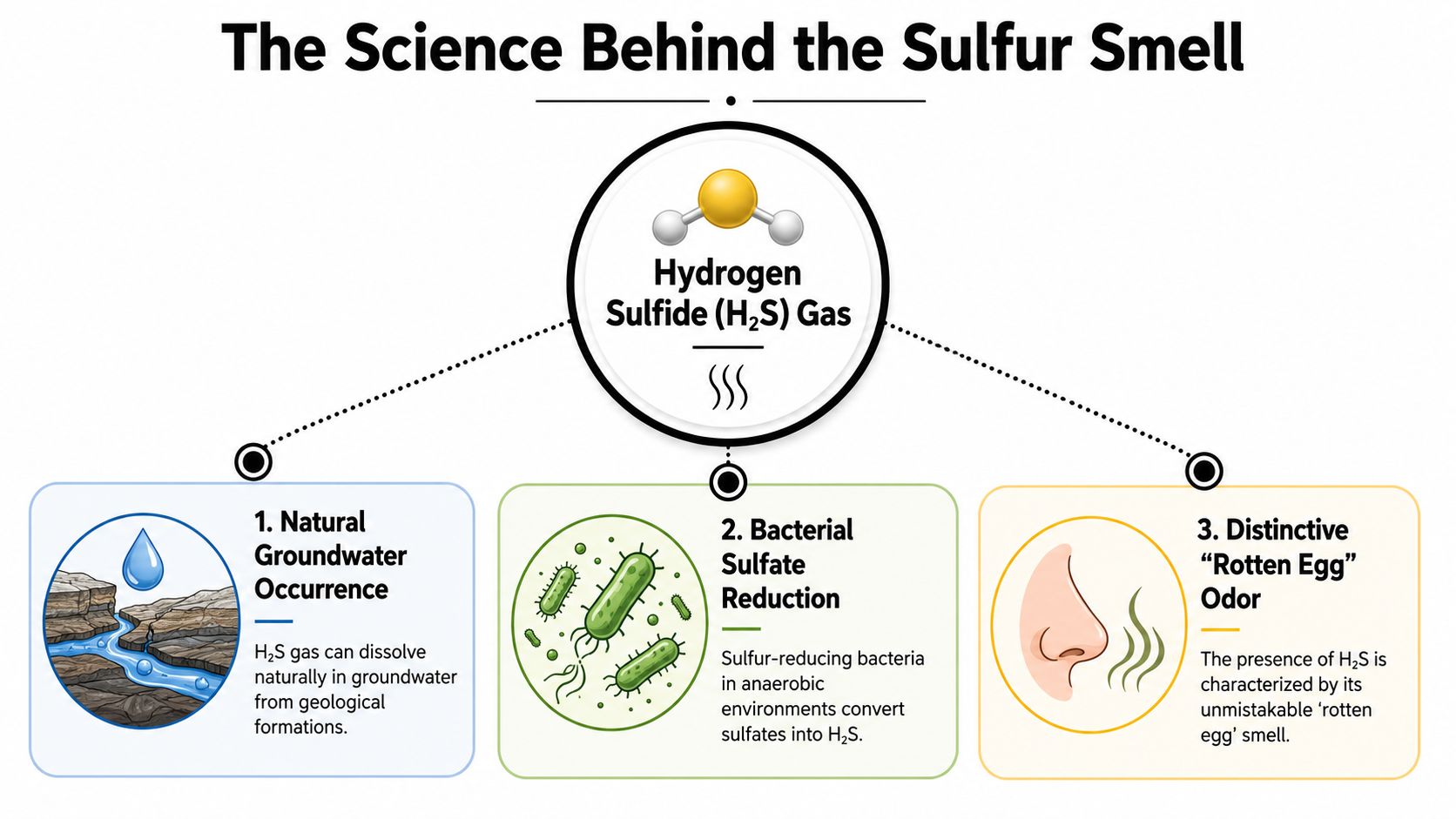
In well systems, the most common cause is sulfate-reducing bacteria. These are naturally occurring bacteria that live in low-oxygen environments such as groundwater, wells, and sections of plumbing. They use sulfur compounds during their normal metabolic process and release hydrogen sulfide as a byproduct. The result is that unmistakable smell.
A sulfur odor can also form inside a water heater. In some systems, the heater's magnesium anode rod reacts with sulfates in the water and helps create hydrogen sulfide gas. That's why some homes only notice the smell from hot water faucets.
Here's the simple version:
- Groundwater source: Sulfur compounds are already present before the water enters the house.
- Bacterial source: Sulfate-reducing bacteria create hydrogen sulfide in the well or plumbing.
- Water heater source: A magnesium anode rod contributes to sulfur odor in hot water.
Why the smell seems worse than the risk
Hydrogen sulfide gets attention because people detect it easily. According to the Western Australia Department of Health guidance on hydrogen sulfide and public health, hydrogen sulfide is detectable at 0.5 to 1.0 mg/L, and the same guidance explains that the EPA treats sulfur as a secondary contaminant, which means it mainly causes aesthetic problems such as odor and taste rather than a direct health threat at typical household levels.
That distinction matters. A strong smell doesn't automatically mean severe danger. It does mean the water is unpleasant to use, and it can signal conditions that deserve correction, especially in a private well.
If the smell is obvious, your nose is doing its job. The next step isn't panic. It's diagnosis.
How to Diagnose the Source of the Odor
Before you choose any treatment, figure out where the smell starts. That saves money and prevents the most common mistake in sulfur odor work. Installing the wrong equipment for the wrong source.
Start with hot water versus cold water
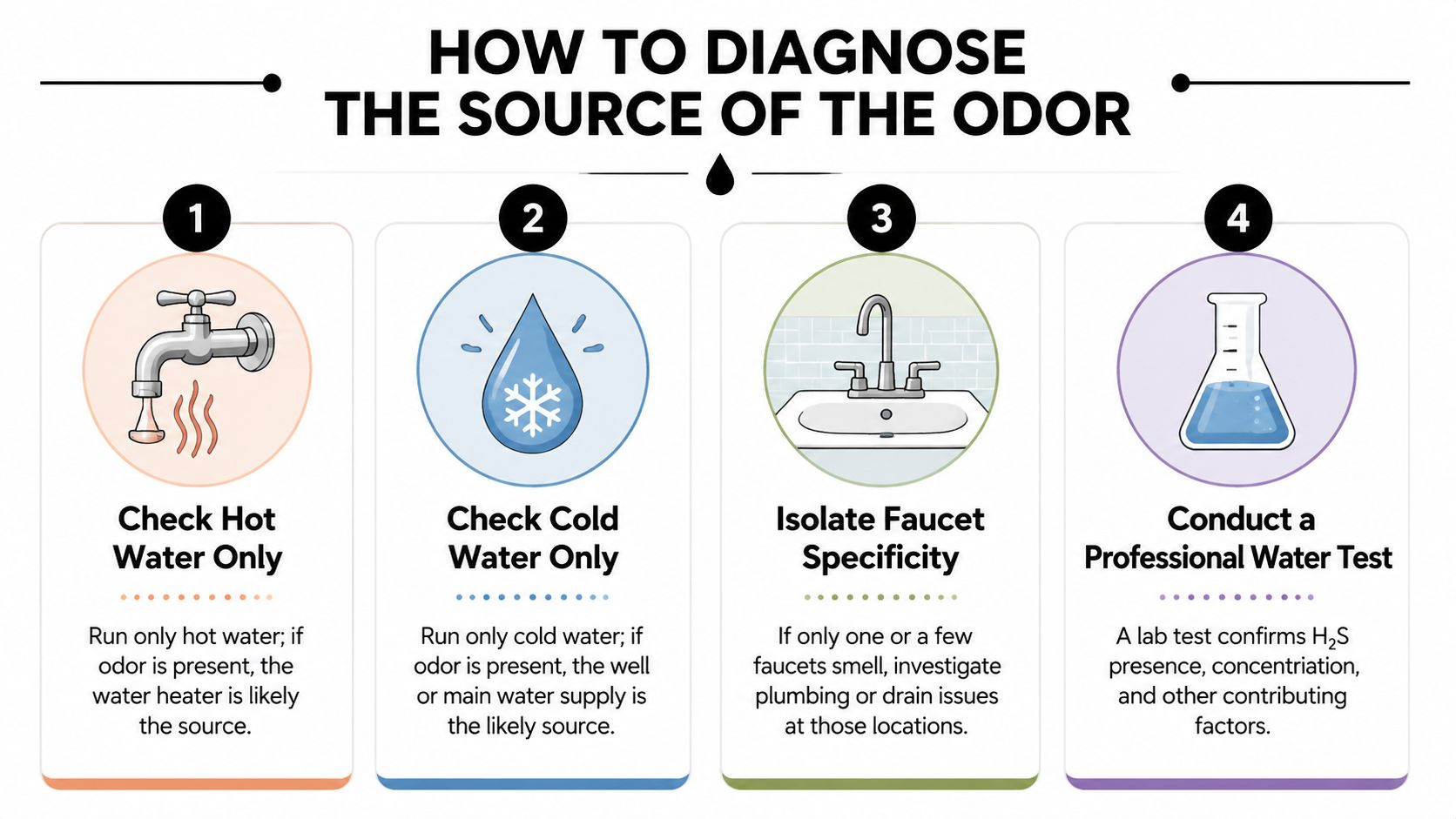
Run a cold faucet and smell the water after it's flowed for a short time. Then do the same with hot water. This one check tells you a lot.
The Florida Department of Health well water odor guidance notes that when sulfur odor is present in both hot and cold water faucets but persists constantly, the problem is likely hydrogen sulfide from the groundwater. The same guidance explains that an odor only in hot water is typically linked to the water heater's magnesium anode rod reacting with sulfates, and that replacing the magnesium anode with an aluminum or zinc alternative can prevent the chemical reaction that generates H₂S gas.
If you want a broader look at treatment paths for private wells, review these well water treatment options after you've done the basic checks.
What the odor pattern usually means
Use this quick table as a field guide:
| Where you smell it | Likely source | Best next step |
|---|---|---|
| Hot water only | Water heater | Inspect anode rod and heater condition |
| Hot and cold, steady odor | Groundwater | Test source water and size whole-house treatment |
| Odor weakens after water runs | Well or plumbing bacteria | Check for bacterial growth and recurring contamination |
| Only one fixture | Local plumbing or drain issue | Isolate that faucet, line, or drain first |
The details matter. If the smell fades after you run water for a while, that often points to bacteria in the well or plumbing rather than a constant sulfur load from the aquifer. If the smell is strongest from hot water, don't start with a whole-house sulfur filter. Start at the heater.
When a local check isn't enough
Home checks are useful, but they don't tell you concentration or what else is in the water. In Central Florida, sulfur often shows up alongside iron, hardness, and other nuisance issues. That combination changes system design.
A proper diagnosis usually includes:
- Source isolation: Determine whether the odor starts in the well, heater, or house plumbing.
- Water chemistry review: Check sulfur levels and look for related issues that affect treatment choice.
- Equipment matching: Size the system to the actual problem, not just the smell.
That's the point where many DIY attempts go sideways. The odor may be sulfur, but the treatment depends on how much is present and where it's being generated.
Common DIY Fixes and Their Limitations
Homeowners usually start with whatever promises the fastest relief. That makes sense. If your water smells like sulfur, you want the smell gone today, not after weeks of testing and equipment decisions.
The trouble is that quick fixes often treat the symptom, not the source.
What homeowners usually try first
For hot-water odor, one common step is to raise the water heater temperature. The AAA Water guidance on sulfur-smelling water explains that when only hot water smells, the issue is often tied to the heater's magnesium anode rod, and that raising the heater temperature to 160°F (71°C) for several hours can eliminate the bacteria. The same guidance notes that chlorination with bleach may also be needed in some cases, followed by flushing.
For well-related odor, many people try shock chlorination. That means introducing a strong chlorine dose to kill sulfur bacteria in the well and plumbing. It can help in the short term, especially when bacterial growth is the main source.
Why the smell often comes back
Shock chlorination has a place, but it's often treated like a permanent cure when it isn't. The 2025 University of Georgia report on rotten-egg well odor found that 68% of well users reporting rotten-egg smells required repeat shock chlorination within one year, and 42% experienced septic system damage due to improper chlorine dosing.
That lines up with what many Central Florida homeowners experience. The smell disappears, then slowly returns. Warm conditions and private well environments make recurring bacterial activity hard to control with a one-time shock.
A one-time chlorine shock can knock the smell down. It usually doesn't change the conditions that let it come back.
There are other limits too:
- Water heater flushing helps sediment, not every sulfur cause. If the anode rod is the driver, flushing alone may not stop recurrence.
- Bleach dosing can create its own problems. Too much chlorine, poor mixing, or poor flushing can damage equipment and upset septic systems.
- Store-bought filters often overload quickly. If sulfur levels are more than very light, the filter media can saturate fast and the smell returns.
DIY work is best used as a diagnostic or temporary measure. If it solves the issue completely, great. If it keeps coming back, the water needs continuous treatment rather than repeated rescue attempts.
Choosing the Right Long-Term Treatment System
Long-term sulfur removal means treating the water consistently as it enters the home. That's why one-off fixes often disappoint. They don't keep working after the initial dose, flush, or cartridge change.
How the main treatment options compare
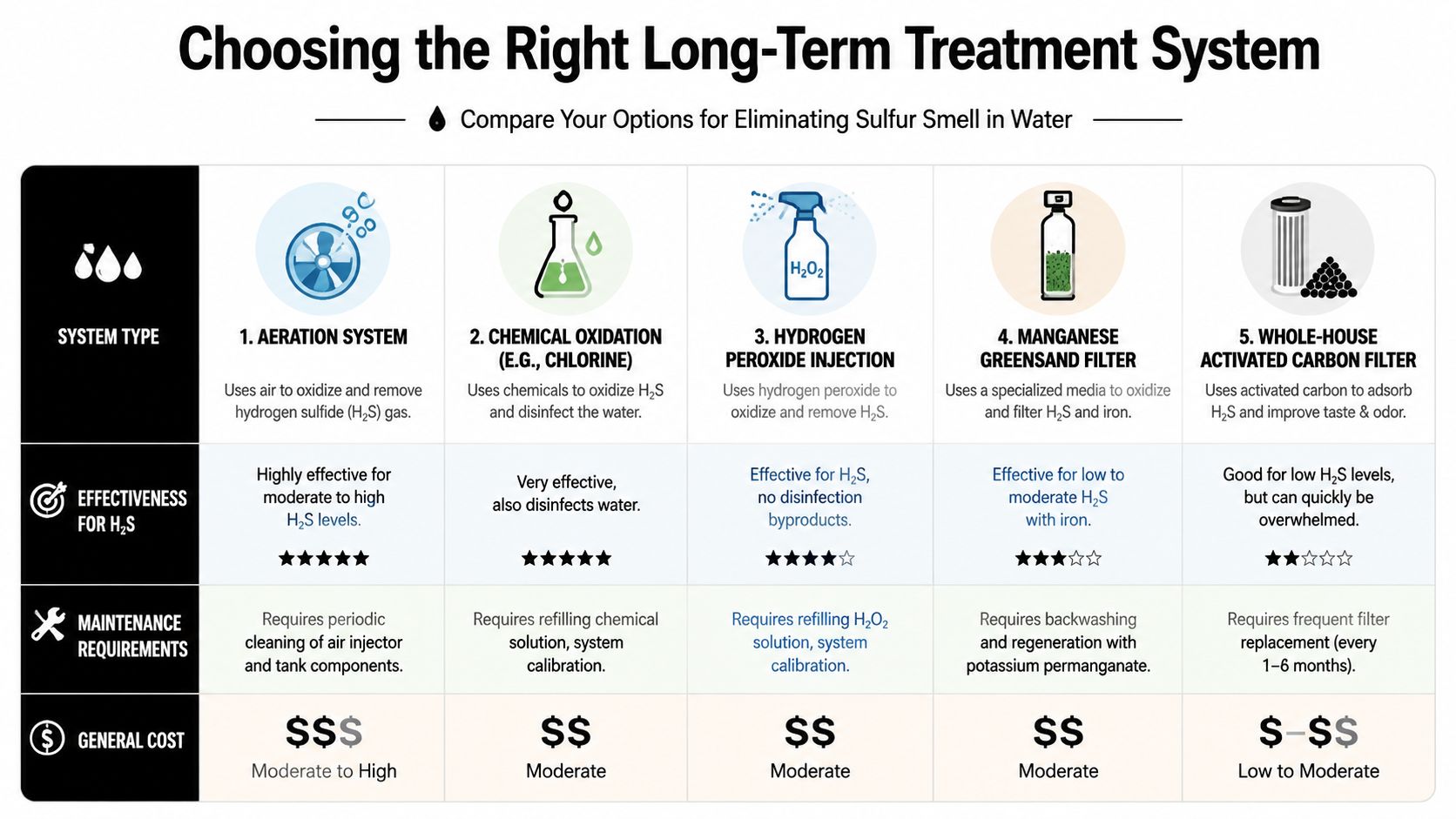
The Culligan summary on sulfur odor in water states that activated carbon filtration is only effective for hydrogen sulfide levels below 1 mg/L. The same source notes that oxidizing media filtration such as manganese greensand can treat levels up to 6 mg/L by converting the gas into solid sulfur that is then filtered out.
That gives homeowners a useful dividing line. Light sulfur odor may respond well to carbon. Stronger sulfur usually needs oxidation.
| System type | Best fit | Main advantage | Main trade-off |
|---|---|---|---|
| Activated carbon | Very low sulfur odor | Simple and effective at low levels | Can saturate quickly if sulfur is stronger |
| Oxidizing media filter | Moderate sulfur | Strong whole-house performance | Needs proper sizing and maintenance |
| Aeration system | Dissolved gas that needs release | Removes odor without relying only on media | System design matters a lot |
| Chemical feed with filtration | Recurring sulfur or bacterial issues | Continuous treatment | Ongoing refill and service needs |
| Point-of-use reverse osmosis | Drinking and cooking water polish | Improves water at one tap | Doesn't replace whole-house sulfur treatment |
A drinking water system can still be part of the solution. If you want cleaner water at the kitchen sink after whole-house pretreatment, a reverse osmosis system for drinking water is often the finishing step rather than the first move.
Why matching the system to the water matters
Not every sulfur problem should be treated the same way. If the smell only comes from hot water, replacing the anode rod may solve it. If sulfur is in the source water, you need treatment at the point of entry. If bacteria are recurring, the treatment strategy may need disinfection plus filtration.
This is where professional system design earns its keep. A sulfur filter selected only for odor can fail if the home also has iron, hardness, pH issues, or bacterial growth. In the field, that's one of the main reasons homeowners say a system “worked at first” and then stopped performing.
A practical selection process looks like this:
- Identify the source first. Heater problem, source-water problem, or plumbing problem.
- Measure the sulfur load. Low odor and high odor don't belong on the same equipment.
- Check the rest of the water profile. Iron, hardness, and other conditions affect media choice and service intervals.
That last point matters in Central Florida more than most online guides admit.
Why Central Florida Water Needs Local Expertise
Central Florida well water has its own personality. Homes in Sebring, Avon Park, Lake Wales, Frostproof, Winter Haven, and nearby areas often deal with a combination of sulfur odor, hardness, iron, and sediment. That mix makes treatment less forgiving than generic internet advice suggests.
Local groundwater creates local treatment problems
Warm conditions and private well environments tend to favor recurring nuisance issues. A homeowner might solve the smell for a little while, then find it creeping back because the original treatment didn't account for local water chemistry, household flow, or equipment compatibility.
That's why a one-size-fits-all approach usually disappoints. A filter that helps one house in another region may underperform here if the water has heavier mineral loading, stronger odor, or multiple contaminants arriving together.
You can see how local system design is handled in this overview of water filtration systems in Sebring, FL. The important point isn't the product category by itself. It's that local water conditions drive the right configuration.
Good sulfur treatment in Central Florida usually isn't one device. It's the right sequence of devices for the actual water.
What a Florida-ready solution actually considers
A local technician doesn't just ask, “Does the water smell?” They ask a better set of questions.
- Where is the odor strongest? Hot only, whole house, or certain fixtures.
- What else is present? Iron, hardness, sediment, or staining can change the design.
- How does the household use water? Family size, flow demand, and plumbing layout affect performance.
- What maintenance will the homeowner realistically keep up with? Some systems need regular service to stay effective.
That practical fit matters more than marketing claims on a box. The system has to work with Florida water, the home's plumbing, and the owner's routine. Otherwise the smell goes away briefly and then returns as a maintenance problem, a sizing problem, or both.
Your Next Step to Clear and Odor-Free Water
If your water smells like sulfur, you don't need to guess your way through it. You can narrow the problem down quickly. Start by checking whether the odor is in hot water only, both hot and cold, or only after water has been sitting. That gives you a strong first clue about whether the source is the heater, the well, or the plumbing.
What to do today
Take these steps in order:
- Test hot water separately. If the smell shows up there most strongly, the water heater moves to the top of the list.
- Run cold water and see whether the smell changes. A steady odor points in a different direction than one that fades.
- Check more than one faucet. House-wide odor and single-fixture odor usually don't come from the same cause.
- Stop buying random filters until the source is confirmed. That's where money gets wasted.
If the odor keeps coming back after flushing, disinfecting, or changing cartridges, that's your sign that the water needs a proper diagnosis.
What to expect from a proper water test

A professional water test should do more than confirm that sulfur is present. It should show what's driving the odor and what else in the water will affect treatment. That's what helps determine whether the solution is a heater repair, oxidizing filtration, aeration, chemical feed, or a combination.
Homeowners usually feel more confident once they see the issue broken into parts. Source. Severity. Best treatment. Maintenance expectations. Once those are clear, the rotten egg smell stops being a mystery and becomes a straightforward water treatment problem with a defined fix.
If you're tired of the odor and want an answer that fits your home, the next step is simple. Get the water tested properly before choosing equipment.
Florida Water Management offers a free water test through the contact page for homeowners and property owners across Central Florida. If your water smells like sulfur, their team can help identify the source, explain the results clearly, and recommend the right long-term solution for your home.