

If you're on a private well in Frostproof, you may already have clues that your water needs attention. Maybe the sinks show iron staining. Maybe the shower has a sulfur smell. Maybe the water looks clear, but you're still not confident using it for drinking, cooking, or filling a baby bottle.
That last concern is the one that matters most. Bacteria and other microorganisms are invisible, and standard filtration by itself doesn't always solve that problem. In Frostproof, well water often brings a mix of sediment, minerals, odors, and microbial risk, which is why sterilization has to be part of the conversation for many homes.
A good system starts with the water you have, not with a generic package. The right setup for one property can be the wrong setup for the next one down the road. If you want real answers, start with a free water test and contamination review so the treatment plan matches your well.
Table of Contents
- Is Your Frostproof Well Water Truly Safe to Drink
- Why Frostproof Homes and Wells Need Sterilization
- Understanding Water Sterilization Technologies
- The Critical Role of UV Pre-Filtration for Well Water
- Our Process for Sizing Your System
- Costs Maintenance and Long-Term Value
- Your Frostproof Water Sterilization Hiring Checklist
Is Your Frostproof Well Water Truly Safe to Drink
A lot of homeowners judge water by what they can notice right away. Taste. Smell. Color. Staining. Those signs matter, but they don't answer the safety question by themselves.
Well water can look fine and still carry microbial contamination. That's the gap many people don't realize until they start asking why the water still isn't dependable after a basic filter has been installed. A cartridge filter may catch debris. It doesn't automatically sterilize the water.
What to pay attention to at home
If you're using a private well in Frostproof, these are the common warning signs that should push you toward testing and a full treatment review:
- Visible staining: Orange or brown marks often point to iron-related issues.
- Odor changes: A sulfur smell usually means the water has more going on than a taste problem.
- Sediment at fixtures: Grit in aerators, tubs, or toilet tanks can interfere with downstream treatment equipment.
- Uncertainty after storms or seasonal change: If the water seems different, it should be checked.
Practical rule: If your water has noticeable odor, staining, or sediment, don't assume a single filter solves the whole problem.
Sterilization is the safety layer that addresses what you can't see. The right method depends on test results, water clarity, and the rest of the treatment train ahead of it. That's why the first step isn't buying equipment. It's getting your water tested so the system matches your well instead of someone else's.
Why Frostproof Homes and Wells Need Sterilization
Frostproof isn't a place where well owners should rely on guesswork. Private well water in Frostproof frequently contains bacteria contamination alongside iron staining, sulfur odors, and sediment buildup, which creates a real need for sterilization as part of safe drinking water treatment, as noted in this Frostproof well water treatment overview.
Municipal customers have a city-managed supply. Private well owners don't. The City of Frostproof utilities department manages municipal water, but households on wells have to address microbial risk on their own with treatment selected for their test results. That changes the decision from optional improvement to basic home protection.
Why local well water needs a different approach
Frostproof properties often deal with more than one issue at a time. A homeowner might call because of rotten-egg odor or staining, but the more serious problem can be the one no one sees. Standard filtration alone can't eliminate invisible microorganisms, which is why sterilization becomes a foundational part of a complete well water plan.
That local overlap matters because treatment has to work as a system:
- Sediment control protects plumbing and helps downstream equipment work properly.
- Iron and odor treatment improves water quality and prevents nuisance issues in the house.
- Sterilization addresses microbial safety that filtration alone may miss.
Clear-looking water isn't the same as microbiologically safe water.
Why a generic package often misses the mark
Some providers talk about sterilization as though every well needs the same equipment. In practice, the right setup depends on what the test shows and how the rest of the water behaves inside the home. A property with heavy sediment needs a different sequence than one with fewer particulate issues. A home with strong odor concerns may need more than a final disinfection stage.
Florida Water Management designs and installs sterilization systems for Central Florida homes and small businesses, including setups intended to control bacteria while also improving clarity, taste, and fixture protection. That kind of customization matters more in Frostproof than in places where owners can rely on a uniform municipal supply.
Understanding Water Sterilization Technologies
Most Frostproof sterilization systems come down to two primary disinfection methods: chlorination and UV light disinfection, and the right choice starts with a thorough water analysis that identifies the contaminants present and their levels, as explained in this Frostproof purification guide.
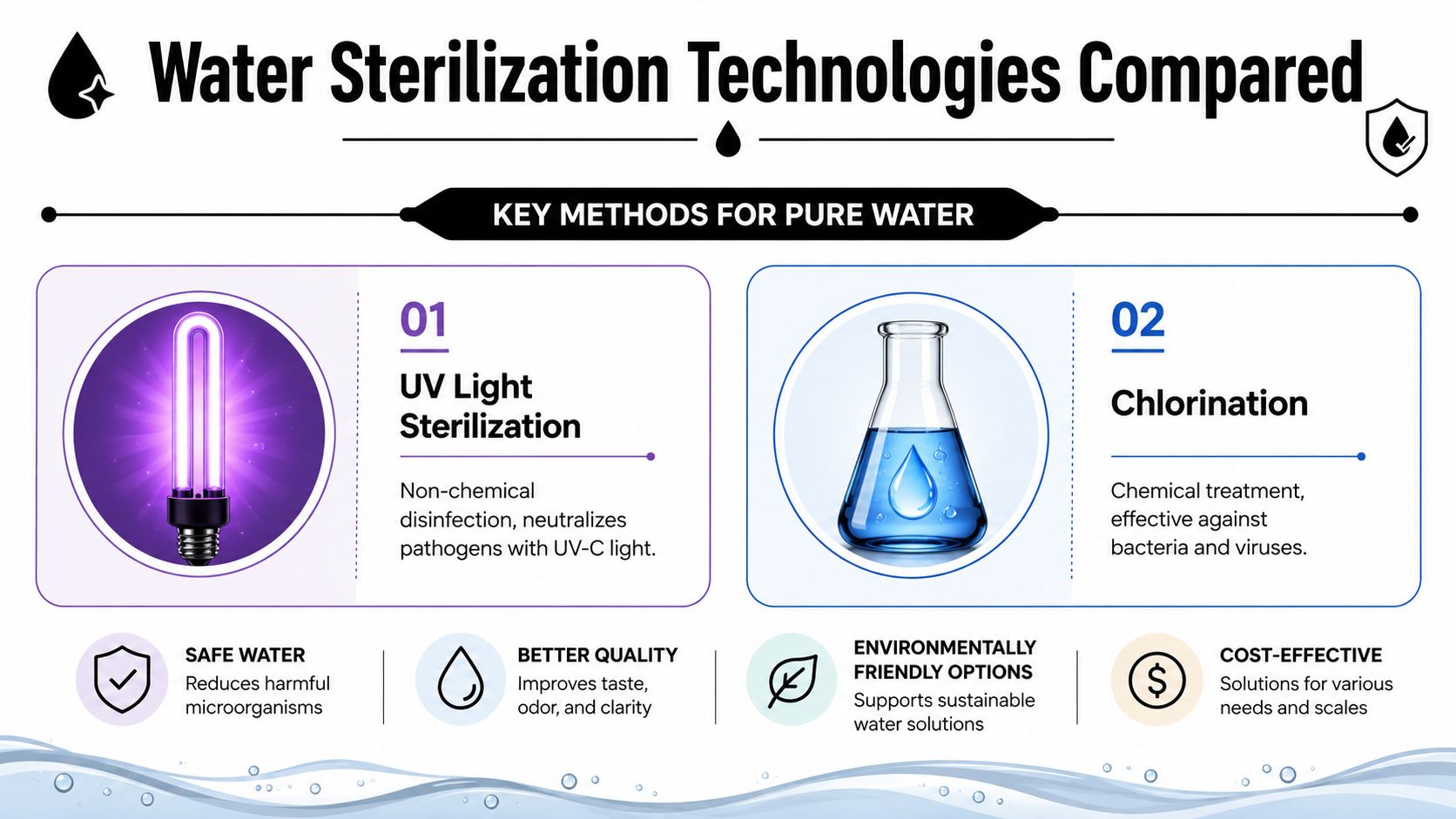
For homeowners, the easier way to think about them is this. Chlorination acts like a disinfectant shield in the water. UV acts like a light-based kill zone at the point of treatment. Both can work. They just solve the problem in different ways.
What chlorination does well
Chlorination is a chemical disinfection method. It has been widely used to eliminate harmful microorganisms, and one reason it stays common is that it can be a practical, cost-conscious option for broad disinfection.
Homeowners often prefer chlorination when they want a familiar treatment approach and don't mind a chemical process being part of the system. It can also make sense where the water profile calls for an approach that treats a wide range of microbial concerns in a proven way.
Chlorination isn't a plug-and-play answer, though. It still has to be matched to the water quality and the rest of the equipment. Feed settings, contact time, follow-up filtration, and maintenance all matter if you want reliable performance.
Where UV fits
UV disinfection is the non-chemical option. It neutralizes bacteria and viruses without changing the water's chemistry. That appeals to many homeowners who want disinfection without adding treatment chemicals to the water itself.
A UV unit also works well as part of a full treatment train when the incoming water has already been cleaned up by the right pre-treatment. If you want a closer look at how whole-home UV systems are typically applied in Florida homes, this guide on UV water sterilization in Lakeland homes gives a useful reference point.
UV can be an excellent finish step. It is not a substitute for proper water preparation.
The main trade-off is that UV depends heavily on water condition. If the water carries sediment, iron, or organic material, those issues can interfere with the light's ability to do its job. That's where many weak recommendations fall apart.
Quick comparison for homeowners
| Method | How It Works | Best For | Maintenance | Chemicals Added |
|---|---|---|---|---|
| Chlorination | Uses a chemical disinfectant to eliminate microorganisms in the water | Homes that need a proven chemical disinfection approach based on water test findings | Ongoing service, monitoring, and replenishment are part of ownership | Yes |
| UV Light | Passes water through a chamber where UV light neutralizes microorganisms | Homes that want non-chemical disinfection and have proper upstream treatment | Routine service and component replacement are required to keep performance on track | No |
| Ozone | Uses oxidizing gas as part of a treatment process | Select specialty applications where system design calls for it | Equipment setup and service are more specialized | No residual chemical added to the water in the same way as chlorination |
Ozone sometimes comes up in conversations about advanced treatment, but in Frostproof residential well work, chlorination and UV are the methods homeowners usually compare first. The better question isn't which technology sounds more advanced. It's which one fits the well, the plumbing, and the water test.
The Critical Role of UV Pre-Filtration for Well Water
A Frostproof homeowner calls because the UV light is on, the water looks clear in a glass, and the family still does not trust it. In many cases, the problem is not the UV unit itself. The problem is what reaches the UV chamber before disinfection starts.
UV works best on water that has already been cleaned up. That point gets missed all the time with private wells in this area. Frostproof well water often carries fine sediment, iron, tannins, and other organic material. Any of those can reduce UV performance by blocking light, coating the quartz sleeve, or giving microorganisms places to hide as they pass through the chamber.
That is why pre-filtration is not an optional extra on many well systems. It is part of making UV worth installing.
Why Frostproof well water needs extra attention before UV
Local well water conditions are rarely one-dimensional. A homeowner may be worried about bacteria, but the same water can also have rust staining, cloudiness after rain, or a tea-colored tint. Those issues matter because UV is a finishing step, not a cleanup step.
If the water entering the sterilizer is still carrying suspended matter, the lamp can be operating normally and the system can still underperform. Homeowners do not always get warned about that. Some installers sell UV as a simple add-on. A better design starts by asking whether the water is clear enough for UV to do its job consistently.
A good way to judge the honesty of a recommendation is simple. If nobody discusses sediment load, iron, sleeve fouling, or upstream filtration, the system design is probably incomplete.
What proper pre-treatment usually includes
The exact setup depends on the water test, but most well-fed UV systems need a few basics ahead of the sterilizer:
- Sediment filtration: This removes sand, silt, and fine particles that can scatter UV light and foul the sleeve.
- Iron treatment when needed: Dissolved or oxidized iron can stain fixtures and interfere with UV reliability. Homeowners dealing with that issue should understand how to remove iron from water before treating UV as the main answer.
- Carbon filtration in the right application: Carbon can help reduce organics and improve water quality ahead of UV, but it has to be selected carefully based on the test results and flow needs.
Filter sizing matters too. A small cartridge may look fine on paper and still create pressure loss or short service life in a busy household. On the other hand, overbuilding a system without a reason just adds cost and maintenance. The right answer is the one that matches the well, the home, and the actual water quality.
As noted earlier, UV disinfection depends on water condition. Guidance from the UV system performance reference also points back to pretreatment and operating conditions, which is exactly why we do not recommend UV in isolation for untreated well water.
One more practical point. Pre-filtration protects more than disinfection performance. It also helps protect the quartz sleeve and lamp from buildup that cuts output and increases service problems. That means fewer surprises, more dependable treatment, and a system that performs closer to the way it was designed to perform.
For Frostproof wells, the honest recommendation is straightforward. Get the water ready first. Then let UV serve as the final barrier.
Our Process for Sizing Your System
A reliable sterilization system starts with diagnosis, not sales talk. The first job is figuring out what's in the water and how the home uses it. After that, the equipment can be sized to match the property instead of forcing the property to fit a preset package.
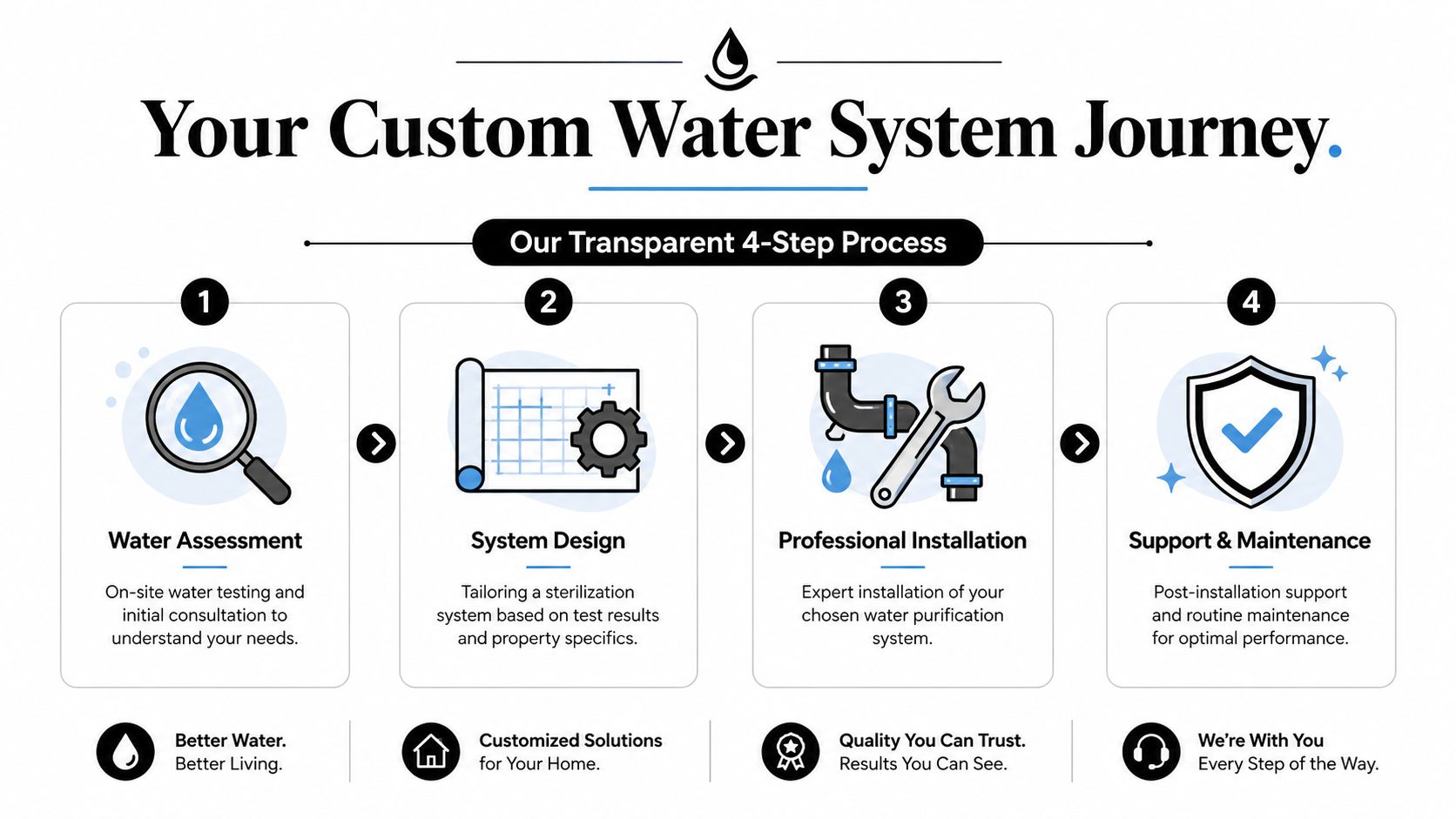
Step one starts with testing
The water test is where everything begins. For a Frostproof well, that means looking at the issues that commonly affect local homes, then checking how those findings interact. Bacteria concerns don't exist in isolation. Neither do sediment, odor, staining, or clarity problems.
A proper assessment answers practical questions such as:
- What contaminants are present: The treatment plan changes if the main issue is microbial risk versus sediment or mineral interference.
- How clear the water is: Some sterilization methods depend on water quality ahead of the final disinfection stage.
- What supporting treatment is needed: A sterilizer may be only one component in the full system.
How the home itself affects the design
The equipment also has to fit the building. A small household with light usage doesn't have the same demand pattern as a larger home with multiple bathrooms, back-to-back showers, and laundry running at the same time. The plumbing layout, well equipment, and point where treatment is installed all shape the final recommendation.
The sizing conversation usually includes these checks:
- Peak household use: The system has to keep up when the home is busiest, not only when one faucet is open.
- Existing treatment equipment: Older filters, softeners, or injection systems may need to be integrated or replaced.
- Service access: Lamps, filters, tanks, and controls need room for maintenance.
- Water quality changes over time: Wells don't always stay static, so the design should allow practical upkeep and adjustment.
A correctly sized system isn't just about treatment quality. It's also about whether the home can use water normally without outrunning the equipment.
That process is why a free water test matters so much. It gives the homeowner something concrete to work from, and it keeps the recommendation tied to evidence instead of assumptions.
Costs Maintenance and Long-Term Value
Most homeowners ask the right question first. What will this cost? The honest answer is that there isn't one fixed number for water sterilization services in Frostproof FL because the final price depends on the water test, the treatment method, and what has to happen before the sterilizer itself can work properly.
Upfront price is only part of the decision
A UV setup and a chlorination setup don't carry the same equipment list or the same service pattern. UV systems typically involve the sterilizer and whatever pre-treatment is required to protect it. Chlorination systems involve chemical feed components and related service needs. If the well has sediment, iron, or odor problems, those issues can add supporting equipment regardless of which disinfection method you choose.
That's why low headline pricing can be misleading. A cheaper recommendation isn't a better value if it leaves out the treatment steps needed for safe, dependable operation.
What creates long-term value
Long-term ownership comes down to maintenance discipline and system fit.
- UV owners should expect periodic service and component replacement so the unit keeps operating as intended.
- Chlorination owners should expect routine replenishment and system checks.
- All well owners should expect follow-up testing and maintenance on pretreatment equipment, because sterilization performance depends on the full treatment train.
The value isn't only in safer drinking water. Good treatment also helps reduce nuisance issues that affect everyday living, such as staining, odor, and the wear that poor water can put on fixtures and plumbing. In a Frostproof well home, the smartest investment is often the one that solves the full water problem instead of the most obvious symptom.
Your Frostproof Water Sterilization Hiring Checklist
When you're comparing providers, don't just ask what unit they install. Ask how they decide it belongs in your home. That one change in the conversation will tell you a lot.
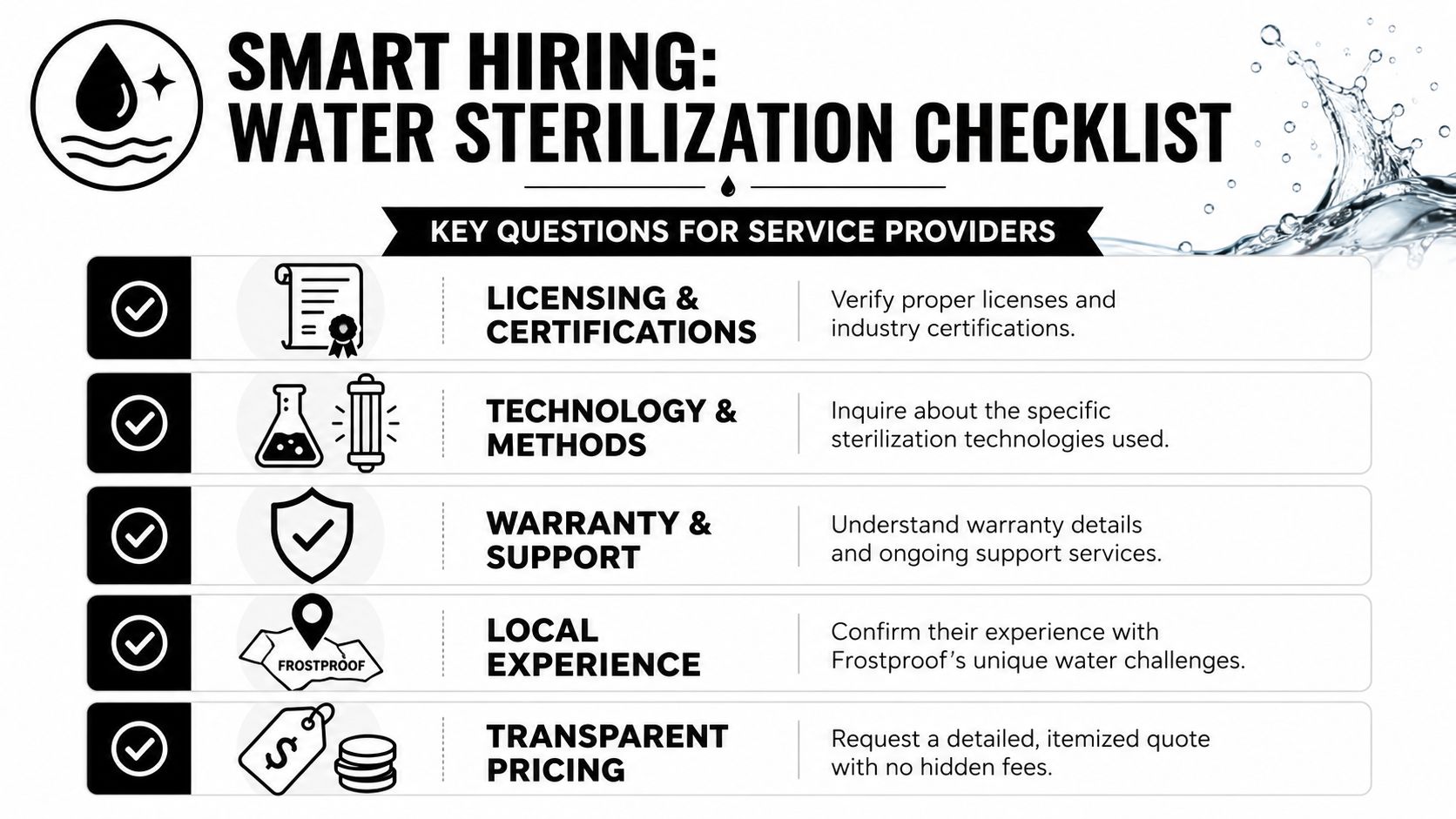
Use this checklist before you hire anyone:
- Ask for a real water test: If the recommendation comes before testing, the process is backwards.
- Ask what happens before UV: If they mention UV, ask what pre-filtration they require for your well water.
- Ask how they size the system: The answer should involve household demand, plumbing layout, and treatment goals.
- Ask who handles maintenance: A sterilization system isn't a set-it-and-forget-it appliance.
- Ask about local well experience: Frostproof water has patterns that generic national scripts often miss.
- Ask for itemized pricing: You should know which parts of the quote cover disinfection, pre-treatment, installation, and ongoing service.
A strong provider should be comfortable answering those questions plainly. If the answers stay vague, or if the company treats every well like the same job, keep looking.
The right company should explain why a system will work in your home, not just what model they want to install.
If you want clear answers about your own well, start with a free water test from Florida Water Management. You'll get a practical look at what's in the water, whether sterilization is needed, and what kind of system makes sense for your property.