

You turn on the shower in Sebring or Winter Haven and catch that familiar pool-like smell. You fill a glass from the kitchen tap and the taste is clean enough to drink, but not pleasant. Then the smaller annoyances start adding up. Skin feels tight after bathing. Hair gets dull. White laundry doesn't stay bright. Coffee never tastes quite right.
That's usually when homeowners start searching for a whole house water filter for chlorine. They want one fix at the main line instead of a patchwork of pitchers, faucet filters, and shower heads.
That approach makes sense in Central Florida, but only if the system is chosen correctly. Chlorine removal is one part chemistry, one part plumbing, and one part maintenance. The smartest first step is to get the water tested so the filter matches the home, the water source, and the way the household uses water. You can schedule a free water test through the Florida Water Management contact page.
Table of Contents
- Your Solution to Chlorine-Treated Water
- Signs You Need a Chlorine Filter in Central Florida
- The Science of Chlorine Removal From Water
- Sizing Your System Correctly For Flow Rate and Capacity
- A Critical Warning Before You Remove Chlorine
- Installation Maintenance and Lifetime Costs
- Get a Professional Assessment for Your Florida Home
Your Solution to Chlorine-Treated Water
You step into the shower after a long Florida day, and the water smells like a pool. The same smell shows up in a glass at the kitchen sink, on clean laundry, and every time the dishwasher runs. At that point, the problem is no longer isolated to drinking water. It is in the water your whole house uses.
A whole-house chlorine filter treats water at the main entry point before it reaches the bathrooms, kitchen, laundry room, and appliances. That approach gives one home-wide fix instead of a patchwork of small filters that only help at a single faucet. For Central Florida homeowners, that usually means better taste and odor, less irritation during bathing, and fewer complaints about chlorinated water throughout the house.
Why homeowners choose whole-house treatment
Pitchers and under-sink filters can help with drinking water, but they do nothing for the shower, washing machine, or the rest of the plumbing system. If chlorine is bothering you in more than one part of the house, the right answer is usually point-of-entry treatment.
That is also the practical route in many city-water homes here. Municipal disinfection is necessary, but many homeowners still want that chlorine reduced before daily use. A properly selected whole-house system can make the water easier to live with at every fixture, as long as the tank size, media, and flow rate match the house.
One mistake I see often is buying equipment based on a product page instead of the actual water and plumbing conditions. In Central Florida, chlorine may be only part of the story. Hardness, sediment, iron, sulfur odor, and fixture count all affect what should be installed and whether a carbon system alone is enough.
Why testing comes first
Testing should happen before equipment selection, not after a disappointing install. The goal is to find out what is in the water, how much water the home uses at peak demand, and whether removing chlorine could create other concerns that need to be addressed in the design.
That last point gets overlooked in generic online advice. Removing chlorine changes more than taste and smell. In a properly designed system, that risk is managed with the right media, sizing, maintenance plan, and installation details. Without that groundwork, homeowners often end up with poor flow, short media life, or a system that never solved the problem.
Signs You Need a Chlorine Filter in Central Florida
You step into the shower after a long day in Lakeland or Winter Haven, and before the water even warms up, you catch that pool-like smell. Then it keeps showing up elsewhere. A glass of water at the sink. Ice in a drink. Towels that never feel quite right. In homes like these, chlorine is often not just a drinking-water complaint. It is a whole-house use issue.

What homeowners usually notice first
On service calls across Central Florida, the first signs are usually practical, not technical:
- Shower discomfort: Skin feels dry, itchy, or tight after bathing.
- Hair texture changes: Hair feels rougher, flatter, or harder to manage.
- Tap water taste and smell: Water has a swimming-pool odor or taste that affects coffee, tea, and ice.
- Laundry issues: Clothes and towels can lose softness faster than expected.
- Kitchen cleanup frustration: Dishes and glassware may look dull, especially if hardness or spotting is part of the problem too.
Those complaints do not always mean chlorine is the only issue. In this area, hardness, sediment, and occasional sulfur or iron can stack on top of it. But when the same chemical smell or taste shows up at multiple fixtures, chlorine moves high on the suspect list.
Why this comes up so often in Central Florida
City water here is disinfected for good reason. Utilities need a residual disinfectant in the distribution system, and in a warm region with long pipe runs, homeowners often notice it more. That is why chlorine taste and odor come up on so many municipal-water service visits.
I also see homeowners chase the wrong fix. They replace the kitchen filter, then the showerhead, then a refrigerator cartridge, and the house still smells like treated water. If the complaint follows you from bathroom to kitchen to laundry room, the problem is usually bigger than a single faucet. A point-of-entry system is often the better fit.
Some homes do well with carbon alone. Others need a setup that accounts for sediment loading, higher demand, or other water conditions at the same time. Homeowners comparing options can start with these whole-home water filtration system types, but the conclusive answer depends on the water test and the home's plumbing demands.
If you notice chlorine every day, the water is already affecting how the house feels to live in.
The less obvious signs homeowners miss
The subtler signs are easy to brush off. Dry hands after washing dishes. A guest asking why the ice tastes odd. Kids who complain about bath water. None of those sound urgent by themselves.
Together, they paint a clearer picture. In Central Florida, that pattern often means the water should be tested before any equipment is chosen. That is the only way to tell whether chlorine is the main issue, or whether hardness, chloramine, sediment, or another local water condition needs to be addressed in the same system.
The Science of Chlorine Removal From Water
A whole-house chlorine filter works by reaction and contact time, not by simple screening. Chlorine is dissolved in the water, so the media has to neutralize it as water passes through the tank. That is why I tell Central Florida homeowners to look past tank size and sales language. The media choice and the way the system is built decide whether the chlorine smell goes away at every fixture.
Why carbon works
Activated carbon is the standard media for chlorine reduction. Its surface area gives chlorine a place to react, which is why carbon has been the go-to option in residential treatment for years. In whole-house systems, you will usually see granular activated carbon, carbon block, or a layered design that uses carbon with other media.
For the homeowner, the result is practical. Good carbon filtration usually improves the taste of drinking water, cuts the pool-like odor in showers, and reduces the chlorine smell that can linger on laundry. In homes with additional treatment equipment, carbon also helps protect downstream components that do not tolerate oxidants well. If you are comparing whole-home water filtration options, carbon is often part of the answer, but it should not be treated as a one-size-fits-all fix.
Why catalytic carbon and KDF matter
Standard activated carbon handles free chlorine well. Catalytic carbon is a modified form of carbon that reacts faster and is often selected when the water needs stronger performance against chloramine or certain organic contaminants. KDF, a copper-zinc media, works differently. It uses a redox reaction to convert free chlorine into chloride ions.
This difference is important; the best whole-house systems often combine media so one layer handles oxidant reduction and another supports broader treatment goals. That combined approach can perform better in real plumbing conditions than a single-media tank, especially in homes with variable flow or more than one water quality issue.
According to Aquasana's product and testing details for dual-media whole-house systems, systems using Catalytic Carbon and Copper-Zinc KDF together can achieve up to 99% reduction of free chlorine over a service life of 1,000,000 gallons, and the same source states the performance is independently tested to NSF/ANSI Standard 42 for aesthetic contaminant reduction.
Chlorine Filter Media Comparison
| Media Type | Best For | Pros | Cons |
|---|---|---|---|
| Activated Carbon | Standard chlorine taste and odor reduction | Proven, widely used, strong chlorine removal performance | Performance drops when media is exhausted |
| Catalytic Carbon | Chloramine and broader chemical reduction needs | Better suited for tougher disinfectant profiles and organics | Must still be sized correctly for flow and contact time |
| KDF | Free chlorine reduction and bacterial inhibition support | Complements carbon well, useful in dual-media systems | Usually works best as part of a combined design, not as a one-media answer |
What works and what doesn't
The right answer depends on the actual disinfectant, the home's flow demand, and how long the water stays in contact with the media. A small tank with good media can still disappoint if water moves through it too fast. A large tank with the wrong media can miss the problem entirely.
That is a common mistake in this area. Central Florida homeowners sometimes assume all municipal disinfectant problems are the same, then buy a basic carbon unit online and expect uniform results. In practice, chlorine removal depends on chemistry and system design, and local water conditions can complicate the job. That is why professionally selected equipment usually performs more consistently than an off-the-shelf kit.
Sizing Your System Correctly For Flow Rate and Capacity
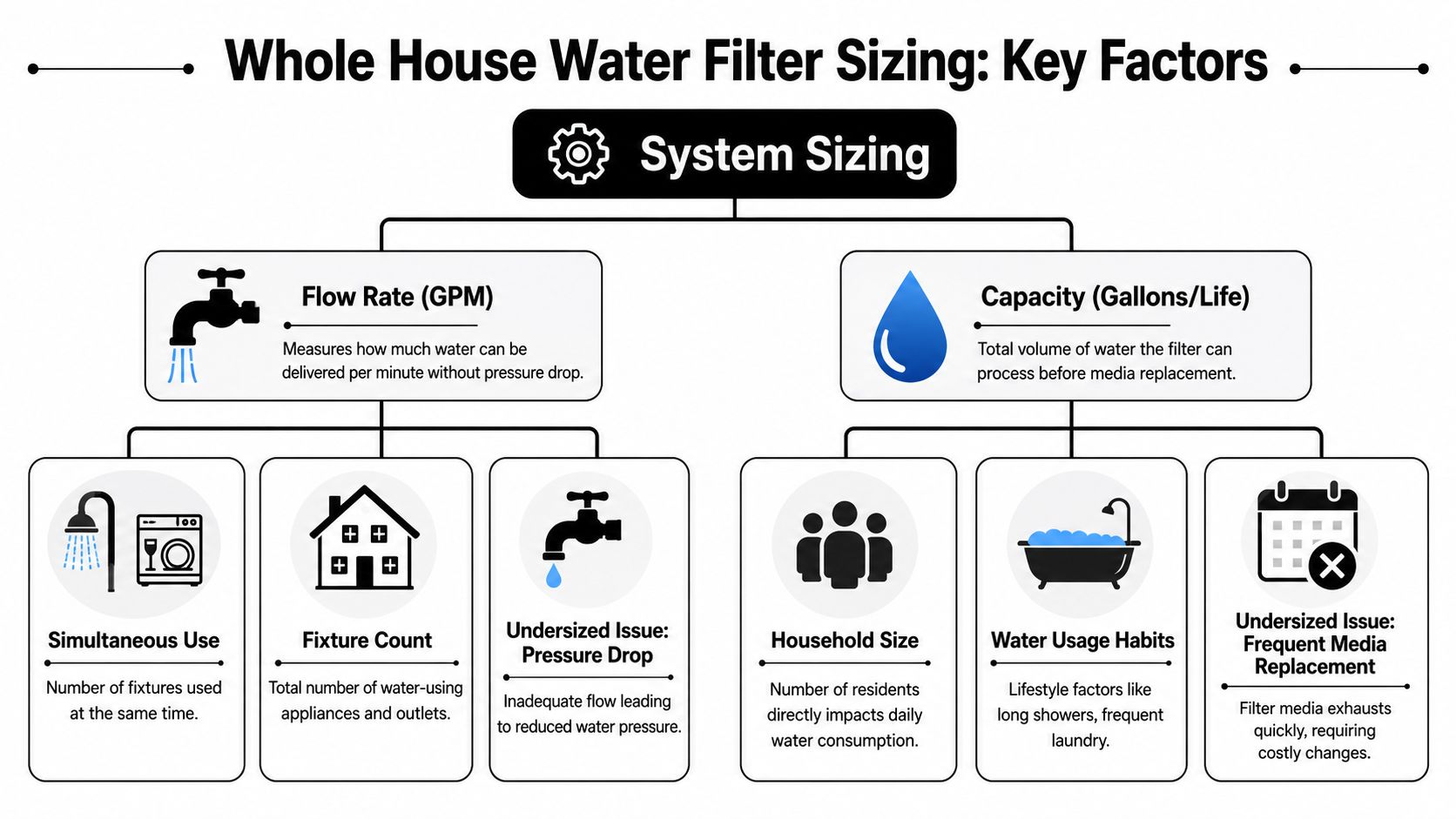
Sizing is where many whole-house chlorine projects go wrong in Central Florida. The unit may be built with good carbon, but if it cannot keep up with the home during peak demand, homeowners feel the problem right away as pressure loss, short media life, or chlorine smell slipping through when several fixtures run at once.
Why undersizing causes frustration
A whole-house filter has to be sized for the busiest part of the day, not a quiet moment at one bathroom sink. In the field, I look at how the house is used. Two showers before school or work. Laundry starting at the same time. Dishwasher running after dinner while someone uses the kitchen faucet. A small system can look fine on a product page and still be a poor fit for that pattern.
That is especially true in larger Florida homes with multiple bathrooms, high-flow shower fixtures, or outdoor use tied into the main line.
Flow rate and capacity both matter. Flow rate tells you whether the system can treat water fast enough without choking down the house. Capacity tells you how long the media can keep doing that job before chlorine reduction starts to fade. If either one is off, the homeowner usually notices it in daily use before they notice it on a test report.
A chlorine filter should match the home's busiest hour, not its quietest minute.
Why micron size gets too much attention
Micron rating is mainly a sediment question. Chlorine removal depends more on having the correct media and enough contact time inside the tank or cartridge.
That trade-off shows up often with cartridge systems. A very tight cartridge can catch fine debris, but it can also add pressure loss. A larger backwashing carbon system usually handles whole-home chlorine treatment better because it gives the water more contact with the media and supports higher household demand. The right choice depends on fixture count, plumbing layout, incoming pressure, and how the home is used.
As explained in this technical discussion of chlorine filter selection, contact time carries more weight than micron size, and media choice still decides whether the system will reduce chlorine effectively.
What to ask before you buy
Bring these questions to any estimate:
- What flow rate will the system support during normal peak use in this house?
- How is media life being estimated based on this family's water use, not a generic marketing number?
- What media is being installed, and why is it the right fit for the disinfectant used by the local utility?
- Will the setup include a bypass and service access so future maintenance does not turn into a plumbing problem?
Those answers separate a properly sized system from a box that happens to contain carbon. In this area, that difference affects comfort, maintenance frequency, and whether the system performs the way the homeowner expects.
A Critical Warning Before You Remove Chlorine
Removing chlorine sounds like an obvious win, and in many ways it is. Better smell, better taste, more comfortable showers, and less chemical exposure throughout the house. But there's a trade-off that most marketing pages skip.
What the CDC warning means in real life
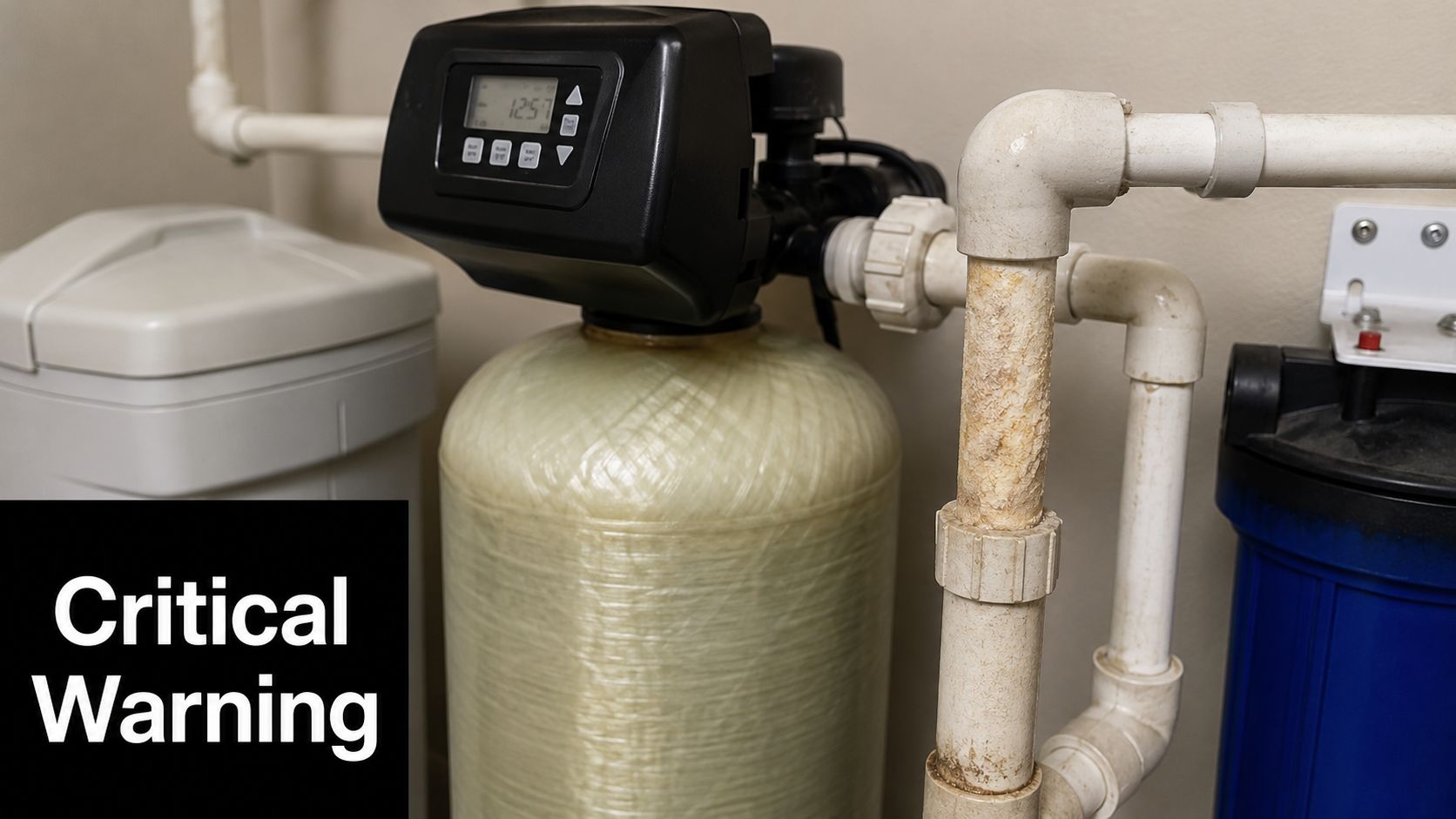
The CDC warns that if you install a whole-home filter that removes disinfectants like chlorine, “more germs may grow in your plumbing”, as stated on the CDC page about choosing home water filters. That warning deserves attention, especially in warm climates where plumbing systems can sit idle during parts of the day or in seasonal homes.
This doesn't mean whole-house chlorine removal is a bad idea. It means it shouldn't be treated like a casual DIY add-on. Once chlorine is removed at the point of entry, the downstream plumbing no longer has the same disinfectant residual moving through it.
That affects how the system should be selected, installed, and maintained.
Removing chlorine improves water quality in one sense, but it also removes part of the water's built-in downstream protection.
How professionals reduce that risk
System design matters more than the sales brochure. A qualified installer should consider the home's plumbing layout, occupancy pattern, maintenance access, and whether the property has any factors that make stagnation more likely. The homeowner also needs a clear service plan, not vague advice to “change filters as needed.”
Practical safeguards usually include:
- Correct placement: The unit needs to be installed where service and monitoring are realistic.
- Planned maintenance: Media can't be left in service indefinitely and expected to perform well.
- Water-use patterns: Seasonal homes, rentals, and low-use properties need extra thought.
- Whole-system thinking: In some homes, point-of-use treatment may make more sense for part of the problem than blanket removal at the entry point.
A cheap online system with no follow-up can remove chlorine and still create a new plumbing problem. A professionally managed setup addresses both sides of the equation.
Installation Maintenance and Lifetime Costs
A chlorine filter that works well on day one can still become an expensive mistake if it is installed in the wrong place or serviced on guesswork. In Central Florida, I see that with undersized tanks, poor bypass setups, and systems squeezed into garage corners where nobody can reach the control head when service is due.
Installation starts with the plumbing, not the brochure. The system has to be tied into the main line with the right valve arrangement, enough clearance for service, and a layout that matches the home's actual demand. A larger family with multiple bathrooms puts very different stress on a chlorine filter than a retired couple in a part-time residence.
What installation usually involves
A proper install usually includes checking the incoming line size, confirming flow rate, selecting the right location, adding a bypass, and testing the system after startup. In many homes, the best spot is near the point where water enters the house, but that is not automatic. Some garages are too tight. Some older homes need replumbing to create service access. Some properties have water heater, loop, or irrigation layouts that need to be separated correctly.
Equipment choice affects cost and upkeep. Backwashing carbon tanks need drain access, electrical power, and enough flow to clean themselves properly. Cartridge systems can cost less up front, but they usually need more frequent hands-on service. If the goal is better drinking water at one sink, a reverse osmosis drinking water system may handle that part of the job without asking the whole house filter to do everything.
What ownership looks like after install
Most of the long-term cost comes after the plumber leaves.
Carbon media gets used up. Prefilters load with sediment. Valves and bypasses need to stay operable. In Central Florida, sediment, hardness, and seasonal occupancy can shorten service life or change the maintenance schedule. A house that sits empty for part of the year needs a different plan than a full-time residence with steady daily use.
Some systems run for years before a major media change. Others need cartridge replacement several times a year. The honest answer depends on water use, chlorine level, sediment load, and the type of equipment installed. Any estimate that ignores those factors is usually too low.
Costs homeowners often underestimate
Homeowners usually budget for the tank and the install. They miss the rest:
- Access and plumbing corrections: Tight spaces, older shutoff valves, and nonstandard piping add labor.
- Prefiltration needs: Sediment ahead of carbon often protects the media and extends service life, but it adds parts and maintenance.
- Media or cartridge replacement: Every chlorine system has a service interval, even long-life units.
- Control valve service: Backwashing systems have moving parts that need periodic attention.
- Overlapping water issues: Hardness, sulfur odor, staining, or scale may need separate treatment beyond chlorine removal.
That is why I do not give flat prices for whole-house chlorine filters without seeing the home. The right budget includes installation, service access, expected maintenance, and the other water problems that show up once the testing is done.
Get a Professional Assessment for Your Florida Home
A homeowner in Central Florida often calls us after living with chlorine for months or years. The shower feels harsh, the water has a pool-like smell, and they are ready to install the biggest carbon tank they can find online. That is usually the point where a professional assessment saves them from buying the wrong system.

A whole-house chlorine filter can make water more pleasant throughout the home. Showers are easier on skin and hair. Drinking water usually tastes and smells better. Fixtures and appliances also benefit from cleaner incoming water. Those results depend on proper media selection, correct sizing, and a plan for the health side of removing disinfectant from the water.
In this area, local conditions change the recommendation. Two homes on municipal water can need different equipment because of sediment load, plumbing layout, peak flow demand, hardness, or part-time occupancy. A generic system picked from a product page often leaves one of those problems untreated, and the homeowner only finds out after the install.
The other issue many articles skip is safety. Once chlorine is reduced, the system needs to be installed and maintained in a way that does not create stagnation, low-use dead spots, or other sanitation concerns. That is one reason we test first, inspect the plumbing, and match the equipment to how the home is used.
If you want a recommendation tied to your water quality and your plumbing, start with a local evaluation. Homeowners can learn more about whole-home filtration service in Sebring and nearby areas and request the next step based on what their water test shows.
If you are dealing with chlorine taste, odor, dry skin after showers, or questions about the safest setup for your home, schedule a free water test with Florida Water Management. You will get a no-obligation assessment based on the house, the water, and the way your family uses it.