

If you're in Lakeland and your water comes from a private well, you've probably had this moment. A hard rain rolls through, the yard stays soggy for days, and you start wondering what's in the water coming out of your kitchen tap. Even when the water looks clear, that doesn't answer the question most homeowners care about: is it safe for my family to drink, cook with, and bathe in?
That's where UV water sterilization enters the conversation. It's one of the cleanest ways to disinfect water at home, especially when microbial contamination is the concern. But in Central Florida, UV usually isn't the whole answer. Lakeland-area water often needs a complete treatment plan that deals with clarity, minerals, and other contaminants before a UV system can do its job reliably.
Table of Contents
- Is Your Lakeland Water Truly Safe to Drink?
- How UV Light Makes Your Water Safe
- When UV Sterilization Is Not Enough for Well Water
- Comparing UV Light to Chemical Disinfection
- UV System Installation Maintenance and Costs
- Your Next Step to Guaranteed Safe Water
- Frequently Asked Questions About UV Water Systems
Is Your Lakeland Water Truly Safe to Drink?
A Lakeland homeowner on a private well can draw a glass of water that looks clear, smells fine, and still have a disinfection problem. That is the part many people miss. Visible issues like staining, sulfur odor, or cloudy water get attention first, but bacteria and other microorganisms do not always announce themselves.
Municipal water and well water come with different risks. City water is treated before it reaches the tap, but some local systems have still raised concern. An independent Lakeland water-quality analysis reported that the Pluris-South Gate Utilities system serving Lakeland had contaminants above health guidelines and assigned the system a D rating. That does not mean every house has the same water. It does mean homeowners have a good reason to verify what is coming into their own plumbing.
Well owners carry more of that responsibility themselves. There is no monthly utility treatment standing between the aquifer and the kitchen sink. Rainfall, flooding, nearby septic activity, well cap issues, pump repairs, and old pressure tanks can all change water conditions.
If water changed after a storm or service call, test it.
That is where UV fits in. Whole-home UV water sterilization systems are designed to disinfect water as it enters the home by disabling bacteria, viruses, and other microorganisms. In the field, I treat UV as a final barrier, not a one-box answer. It works best after the water has already been tested and, if needed, filtered for sediment, iron, or other issues that can interfere with disinfection.
Common Misconceptions About Water Safety
A lot of homeowners start with the symptom they can notice most easily. Bad taste. Rotten egg smell. Orange staining. Those are valid complaints, but they point to a different category of treatment. UV does not remove hardness. It does not filter out iron. It does not fix sulfur odor or dissolved chemicals.
That trade-off matters in Lakeland because many well systems need more than one step. A house may need sediment filtration first, then treatment for iron or sulfur, then UV at the end for microbial protection. The right setup depends on the water test, the flow rate, and how the home uses water day to day.
Florida Water Management provides water testing and system recommendations based on those results. That is the practical starting point if you want to choose equipment that matches the water instead of guessing from symptoms alone.
How UV Light Makes Your Water Safe
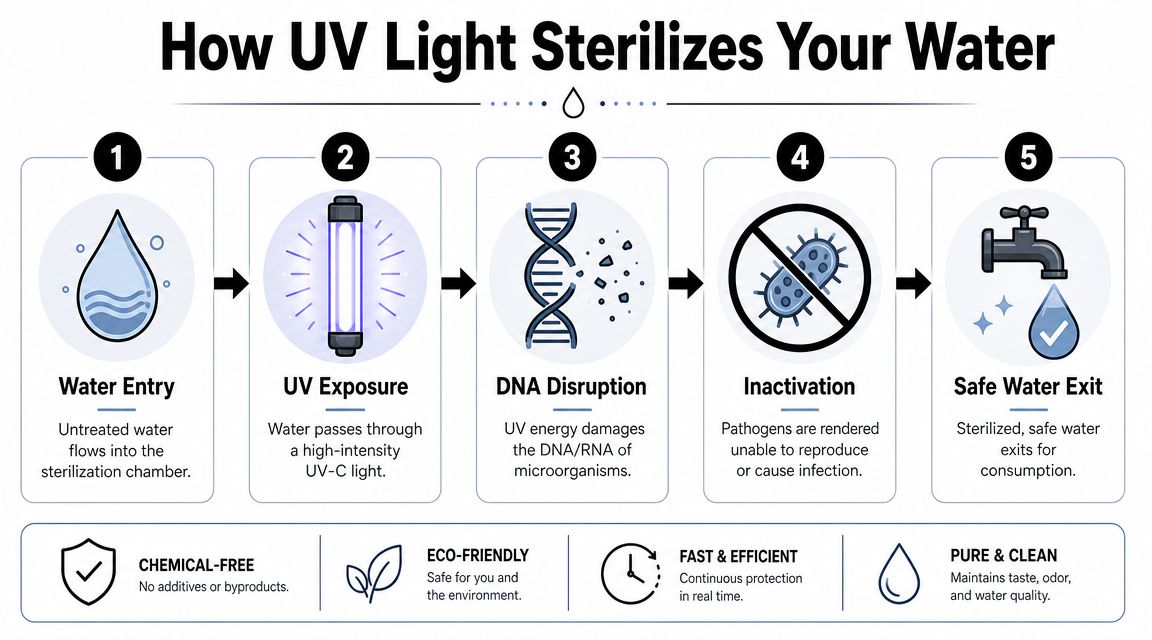
UV disinfection works by exposing water to ultraviolet light inside a sealed chamber. The easiest way to think about it is a microscopic sunburn. The light damages the genetic material of microorganisms, so they can't keep reproducing and causing infection.
That means UV is a disinfection method, not a filter. It doesn't strain particles out of the water. It doesn't soften water. It doesn't remove dissolved minerals or chemical contaminants. What it does well is disable living organisms when the system is sized correctly and the water is in the right condition.
Homeowners comparing options can also look at whole-home water sterilization systems to see how these units fit into a broader treatment setup.
What the UV chamber is actually doing
Inside the unit, water flows through a stainless-steel chamber and passes around a UV lamp. The lamp sits inside a clear quartz sleeve that protects the bulb from direct contact with water while still allowing the UV energy to pass through.
The process is simple in concept:
- Water enters the chamber and moves past the lamp.
- UV-C energy hits microorganisms suspended in the water.
- DNA or RNA is disrupted, which stops those organisms from reproducing.
- The treated water exits the chamber ready for use at the tap.
UV works fast, but only on what the light can reach.
That's the key limitation and the key advantage at the same time. There are no added chemicals in the water from the UV step itself, and there isn't a waiting period in normal operation. But the lamp needs direct exposure to the organisms in the water stream.
What parts make the system work
Most residential UV systems have three core parts:
- The lamp provides the germicidal UV energy.
- The quartz sleeve shields the lamp and has to stay clean enough for light to pass through.
- The flow chamber directs water past the lamp at the intended rate.
A homeowner doesn't need to memorize the engineering, but it helps to understand one practical truth. A UV system isn't judged by how impressive the lamp looks. It's judged by whether the system delivers the needed disinfection under real household flow conditions.
That is why proper sizing, flow control, and maintenance matter so much more than marketing language.
When UV Sterilization Is Not Enough for Well Water
Many Lakeland homeowners are often misled. They hear that UV kills microorganisms and assume one UV unit will solve the entire water problem. For a lot of Central Florida well water, that's not how it works in the field.
If the water is carrying sediment, hardness minerals, iron, manganese, or tannins, the UV light can lose effectiveness before it ever reaches the microbes you're trying to inactivate. In other words, the system may be installed, powered on, and still not be protecting the house the way you think it is.
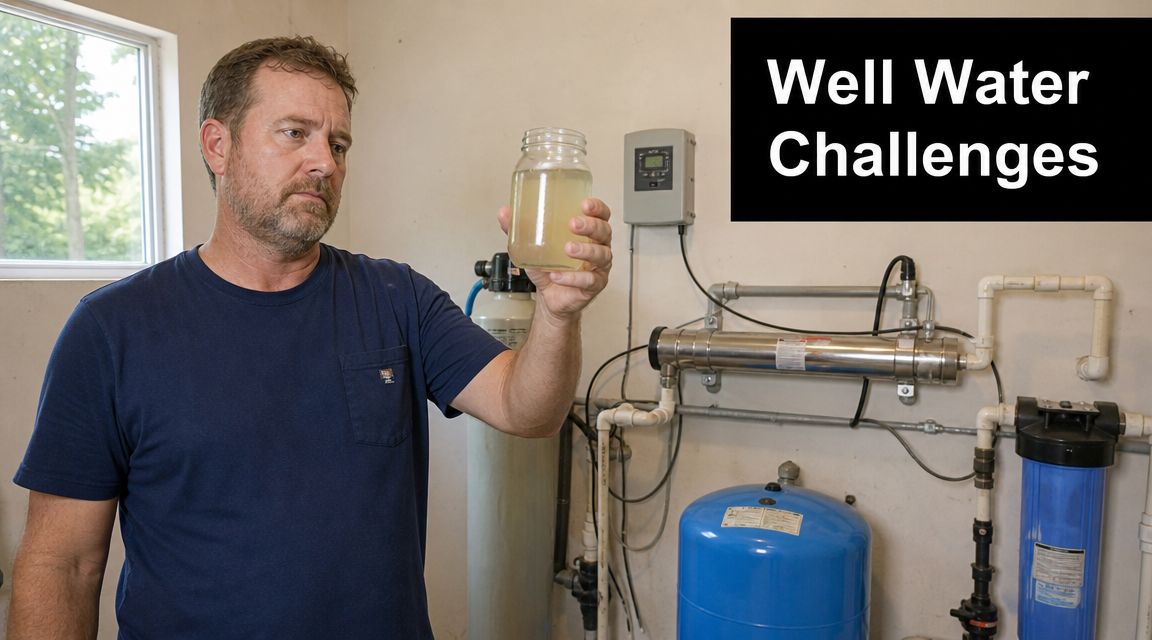
If your home uses a well, it's worth reviewing how well water treatment systems are usually layered before the UV stage is added.
Why clear water matters first
A major buyer's guide says UV disinfection works reliably only when the water is already clear and recommends pretreatment targets of hardness below 7 grains per gallon, iron below 0.3 ppm, and manganese below 0.05 ppm, along with a pre-sediment filter, because cloudiness and mineral scale can shield microbes or coat the quartz sleeve according to this UV system buyer's guide.
That guidance lines up with what technicians see all the time in Florida wells. Fine sediment creates tiny shadows. Iron can stain and foul components. Hardness forms scale on the sleeve. Once that sleeve gets coated, UV transmission drops.
Here are the common failure points:
- Sediment and turbidity block the light path. Microbes can pass through protected by suspended particles.
- Hardness minerals build scale on the quartz sleeve. Less light gets through to the water stream.
- Iron and manganese can foul equipment and reduce system performance over time.
- Tannins and discoloration can interfere with clarity, which weakens the disinfection step.
Field note: A UV unit should be the final disinfecting barrier, not the first attempt to fix dirty water.
What UV does not remove
UV doesn't remove the things many Lakeland homeowners complain about first. It won't take out hard water minerals, iron, sulfur odor, tannins, sediment, or dissolved contaminants. Existing local guidance on UV and well water makes that clear in this overview of ultraviolet sterilization systems.
That matters because a lot of people searching for UV water sterilization in Lakeland, FL aren't only worried about bacteria. They're also dealing with orange staining, rotten egg smell, appliance scale, or cloudy water after heavy rain. Those are different treatment problems.
A reliable well-water setup often includes some combination of:
- Sediment filtration before anything else when particulates are present.
- Softening if hardness is high enough to scale plumbing, fixtures, and the UV sleeve.
- Iron or sulfur treatment if staining or odor is part of the water profile.
- UV at the end as the final microbial safeguard once the water is clear.
The order matters as much as the equipment. If you skip the conditioning steps and jump straight to UV, you can end up with a system that looks advanced but performs poorly.
Comparing UV Light to Chemical Disinfection
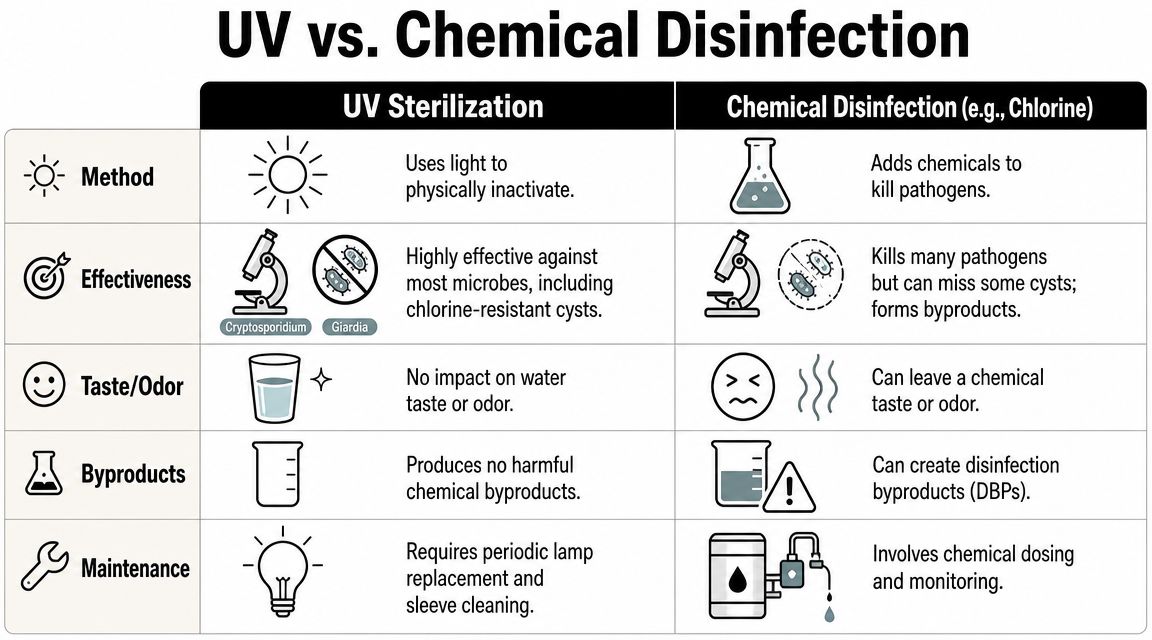
Homeowners usually compare UV against chlorination. Both have a place. The better choice depends on what you're trying to solve, how your water behaves, and how much day-to-day involvement you want.
For residential use, UV is often the cleaner fit when you want disinfection without adding chemicals to household water. Chlorine can still be useful in some situations, especially where a system needs chemical treatment as part of a broader remediation approach.
Where UV has the edge
UV's biggest residential advantage is simple. It disinfects without adding a chemical taste or odor to the water. For families who are sensitive to that swimming-pool smell, that's a big difference.
There's also a local reason some homeowners prefer a non-chemical final barrier. The Lakeland-area utility analysis noted total trihalomethanes among the contaminants exceeding health guidelines in that report discussed earlier. That doesn't turn UV into a cure for every issue, but it does explain why many people want treatment approaches that don't rely on adding more disinfectant chemicals inside the home.
| Feature | UV Sterilization | Chlorine Disinfection |
|---|---|---|
| Method | Uses ultraviolet light to inactivate microorganisms | Uses chemical dosing to disinfect water |
| Taste and odor | Doesn't add chemical taste or smell | Can leave a noticeable chemical character |
| Byproducts in the home treatment step | Doesn't create chemical disinfection byproducts in that step | Can create disinfection byproducts depending on water conditions |
| Homeowner involvement | Focuses on lamp, sleeve, and system upkeep | Requires chemical handling, dosing, and monitoring |
| Limits | Doesn't remove minerals, sediment, or chemicals | Doesn't solve hardness, sediment, or many dissolved contaminant issues by itself |
Where chlorine still has a role
Chlorine has one important advantage in some applications. It can provide a residual disinfecting presence in water after treatment, while UV acts at the chamber itself. That can matter in certain plumbing or storage conditions.
But chlorination usually brings more homeowner management with it. Someone has to store chemicals, keep feed settings correct, and monitor how the system is behaving. For many households, that's more hassle than they want.
Some homes need chlorination. Many homes simply need clean, clear water entering a properly sized UV unit.
The right answer isn't ideological. It's practical. Use the approach that matches the contamination problem and the water chemistry you have.
UV System Installation Maintenance and Costs
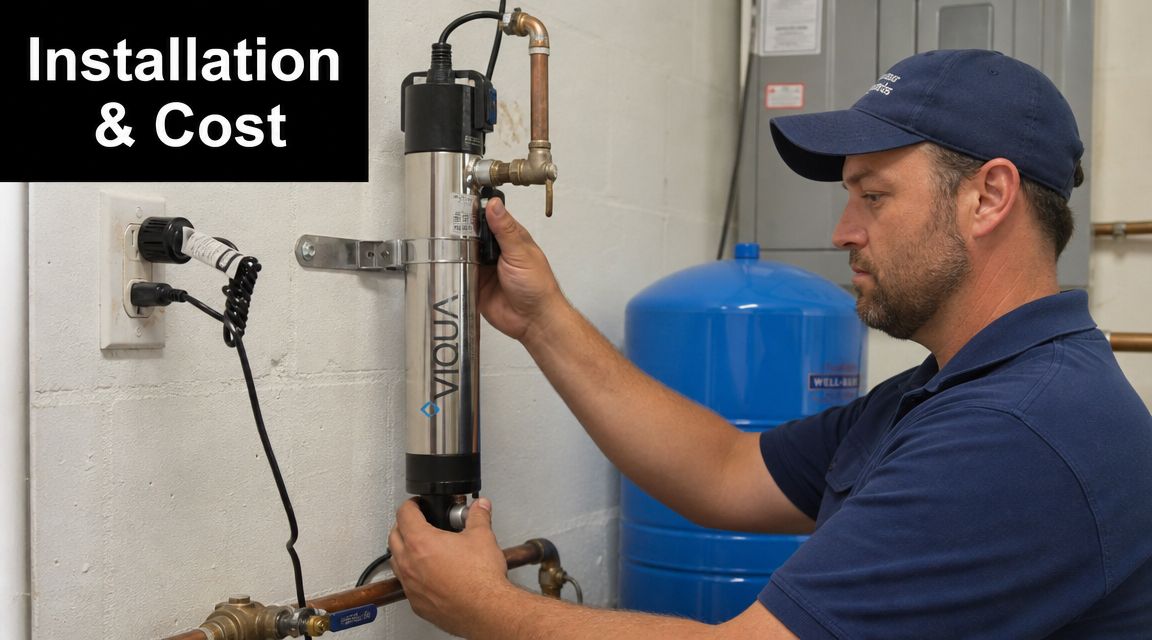
Installation matters more than brand labels or bulb wattage. A UV unit only works when it is placed correctly in the system, sized for the home's flow demand, and kept in service condition. That's where a lot of DIY plans go sideways.
A technically sound residential setup should be designed around dose, flow, and maintenance, not just the lamp itself. Industry guidance cited by PWTAG identifies 30 mJ/cm² as a common residential disinfection dose and recommends post-filtration installation, annual lamp replacement, and monitoring of UV intensity and flow because output drops as lamps age or flow rises according to this UV disinfection specification and maintenance guidance.
If you're trying to budget the full project, this guide to home water filtration system costs helps frame how UV fits into a larger treatment investment.
Where the system should go
In a whole-home layout, UV should normally be installed after pre-filters and other conditioning equipment so the water reaching the chamber is already clear enough for effective light transmission. In many homes, that places the UV unit near the end of the treatment train before water is distributed through the house.
A professional installer will usually look at:
- Actual flow demand in the home, not just pipe size.
- Pretreatment needs such as sediment filtration, softening, or iron reduction.
- Service access so the lamp and sleeve can be maintained without tearing the room apart.
- Power reliability because the lamp has to stay energized to disinfect.
Florida Water Management installs and services UV water sterilization systems as part of broader residential treatment plans in Central Florida, typically pairing UV with the pretreatment a home's water profile requires.
What maintenance actually looks like
UV maintenance isn't hard, but it isn't optional.
Most homeowners should expect these recurring tasks:
- Annual lamp replacement because light intensity declines over time even if the lamp still appears to be on.
- Quartz sleeve inspection and cleaning when scale or fouling is present.
- Filter service upstream so the UV chamber keeps receiving properly conditioned water.
- Performance checks if the system has alarms, monitors, or changes in household flow behavior.
The most common homeowner mistake is assuming a glowing lamp means the system is fully effective. It doesn't. A weak lamp, a scaled sleeve, or excess flow can all reduce delivered dose.
What about cost
The exact price depends on the water conditions, the home's plumbing layout, the target flow rate, and how much pretreatment has to happen before the UV stage. A basic UV addition is one thing. A full well-water package with sediment, softening, iron treatment, and UV is a different project entirely.
That's why cost conversations only become useful after testing. Without that, you're comparing equipment lists, not solutions.
Your Next Step to Guaranteed Safe Water
You turn on the kitchen tap, fill a glass, and the water looks clear. That does not confirm that a private well is free of bacteria or other contamination, and it does not tell you whether UV alone will solve the problem.
For many Lakeland homes, UV is the final disinfection step, not the whole treatment plan. It does an excellent job inactivating microorganisms when the water reaching the chamber is already properly conditioned. It does not remove hardness. It does not filter out iron, sediment, sulfur, or tannins. If those issues are present, they need to be handled first so the UV unit can do its job reliably.
That is why the next step should be based on testing, not guesswork.
EPA drinking water guidance for treatment performance includes specific inactivation targets for organisms such as Giardia and enteric viruses under defined treatment conditions, as outlined in the EPA drinking-water risk-assessment guidance. In real residential well-water work, that same multi-barrier mindset applies. A dependable setup often means correcting clarity and nuisance water problems first, then using UV as the last barrier against microbial risk.
At Florida Water Management, UV systems are typically installed as part of a larger well-water solution built around the home's actual water profile. The right plan starts with a water test, then matches the equipment to the problems found. That keeps homeowners from buying a UV unit for a job that also requires filtration, softening, iron treatment, or sulfur reduction.
Start with the water itself. Test it, identify what needs to be corrected, and build the system from there.
Frequently Asked Questions About UV Water Systems
Does UV change the taste or smell of water
No. UV is a light-based disinfection step, so it doesn't add a chemical taste or odor. If your water smells like sulfur or tastes metallic, that points to separate water issues that need their own treatment.
Will a UV system soften my water
It won't. UV doesn't remove hardness minerals. If your fixtures spot up, your water heater scales, or soap doesn't rinse well, you likely need softening in addition to UV.
Can UV fix cloudy water
No. Cloudy water should be addressed before it reaches the UV chamber. If water clarity is poor, the light can't do its job reliably.
What happens if the power goes out
A UV system needs power to disinfect. If the lamp is off, that disinfection barrier is gone until power returns and the system is operating normally again.
Can I install one myself
Some homeowners can physically mount the equipment, but proper UV performance depends on sizing, flow, placement, pretreatment, and maintenance access. If any of those are wrong, the system may look fine and still underperform.
How do I know if I need UV at all
Test the water first. That's the only dependable way to know whether microbial protection should be part of your treatment plan and what else needs to be corrected before UV is added.
If you want clear answers about your home's water, start with a free water test from Florida Water Management. Once you know whether you're dealing with bacteria risk, hardness, iron, sulfur, sediment, or a combination of issues, it's much easier to choose the right system and avoid spending money on equipment that doesn't match your water.