

You're probably here because something set off an alarm. Maybe you saw another headline about lead in drinking water. Maybe you bought an older house in Sebring, Lake Wales, or Winter Haven and started wondering what's sitting inside the plumbing. Or maybe you're on a private well and you already know your water has other problems, so now you're asking the obvious next question. If I install a whole house water filter for lead, am I protected?
That's the right question. A lot of homeowners assume “whole house” means complete protection. For lead, that assumption gets people in trouble. Lead removal is one of those water treatment topics where the details matter more than the sales language. Device type matters. Certification matters. Your plumbing matters. In Central Florida, hard water, iron, sediment, and sulfur can also affect how well a system performs and how long it lasts.
A good system can absolutely be part of the answer. But the wrong system, or the right system installed in the wrong order, wastes money and leaves risk at the tap.
Table of Contents
- Why Florida Homeowners Are Concerned About Lead in Water
- Whole-House vs Tap Filters Choosing Your First Line of Defense
- How Different Lead Filtration Technologies Actually Work
- Decoding NSF Certifications for Lead Reduction
- System Design for Central Florida's Unique Water Challenges
- Your Next Steps to Guaranteed Lead-Free Water
Why Florida Homeowners Are Concerned About Lead in Water
A homeowner hears “the city water is treated” and assumes the problem ends there. It doesn't. Lead usually isn't the big issue at the source. It becomes a problem after water enters the distribution system and the home, where older service materials, aging solder, and brass plumbing components can introduce it before the water reaches the kitchen glass.
That's why this issue hits both city-water homes and some houses that otherwise seem fine. The water can look clear, smell normal, and still pick up lead somewhere between the street and the faucet. That's especially unsettling for families with kids, older homes, remodeled kitchens with mixed plumbing materials, or rental properties where the plumbing history isn't fully documented.
Where lead usually enters the picture
For most homeowners, the concern comes down to a few practical sources:
- Older plumbing materials: Lead solder and older plumbing connections can contribute contamination as water sits in the lines.
- Brass fixtures and valves: Some fixtures can leach lead into water, especially at the tap where you drink and cook.
- Mixed plumbing systems: Renovations often leave a home with a patchwork of old and new materials, which complicates risk.
- Water sitting in pipes: First-draw water often worries homeowners most because it has had the longest contact with plumbing components.
Practical rule: Don't assume “municipal water” means “no lead risk.” The treatment plant and your kitchen faucet are not the same thing.
Florida homeowners also tend to focus on the contaminants they can notice right away. Rotten egg odor from sulfur. Orange staining from iron. Scale on shower glass from hardness. Lead is different. You usually won't detect it by taste, smell, or appearance, which is exactly why it deserves a more deliberate response.
The right response starts with knowing where the exposure risk is. If the main risk is what your family drinks and cooks with, your first line of defense may not be the same as the system you'd choose to protect showers, laundry, and appliances.
Whole-House vs Tap Filters Choosing Your First Line of Defense
You get your water test back, see lead on the report, and your first instinct is to filter everything. I understand that reaction. But for most Central Florida homes, the first dollar should go to the water you drink, cook with, and mix into baby formula. That means a tap-level system first, then a whole-house system if the rest of your water profile calls for it.
A whole-house filter and a tap filter do different jobs. Treating them like interchangeable lead solutions is how homeowners overspend and still miss the main exposure point.
Water quality guidance centers on NSF/ANSI 53 for lead reduction and NSF/ANSI 58 for reverse osmosis. Those standards show up far more often on point-of-use systems than on whole-house equipment. The practical result is simple. The easiest lead protection to verify is usually installed at a drinking-water tap, not at the main line.
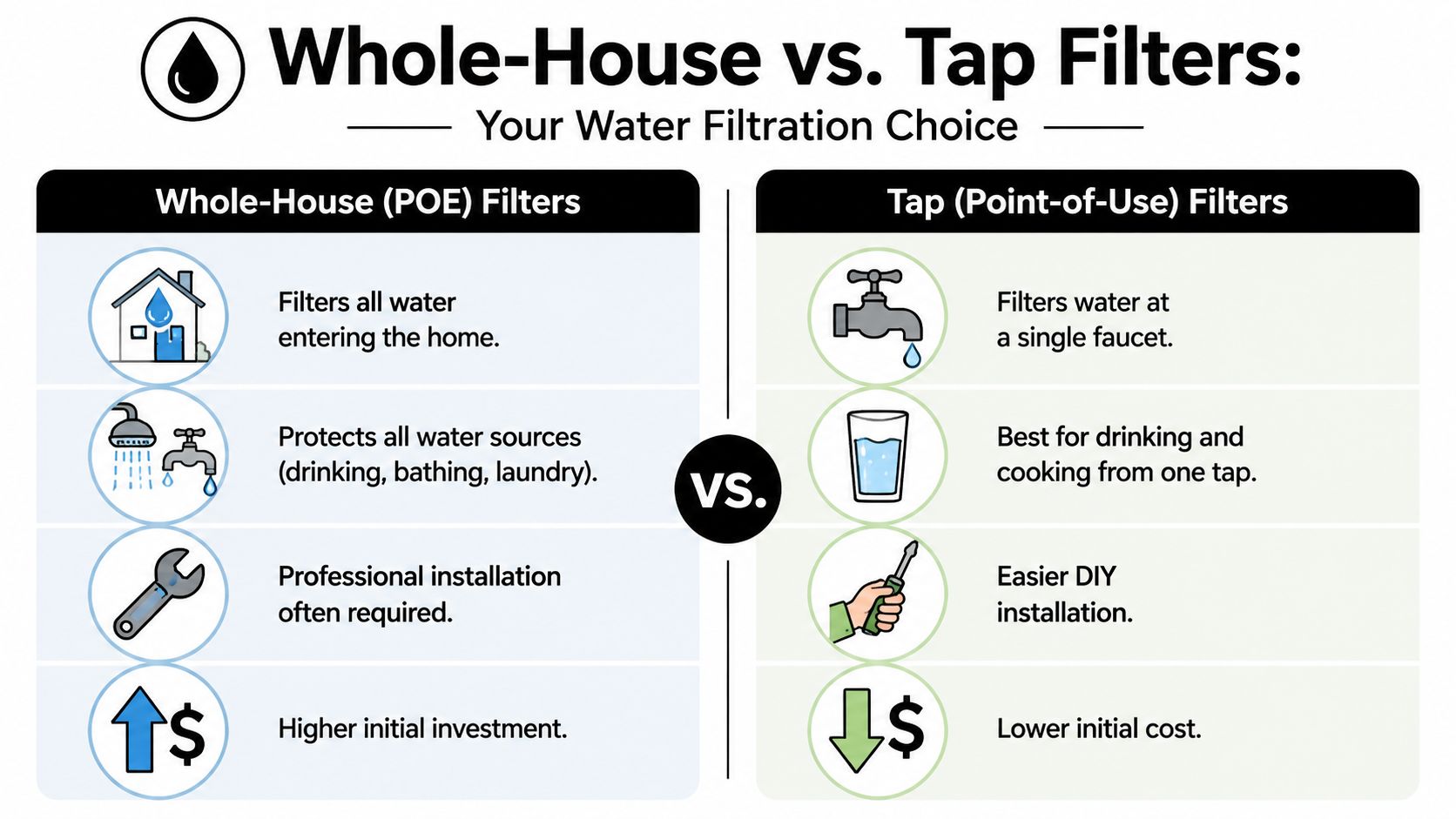
What a whole-house system does well
A whole-house system treats water before it branches off to the showers, toilets, laundry, and kitchen. That matters in Central Florida because lead concern rarely shows up alone. You may also be dealing with hard water scale, iron staining, sediment from a well, sulfur odor, or chlorine from city water.
That changes the buying decision.
If your incoming water is loaded with hardness or iron, a whole-house pre-treatment setup can protect the lead-focused equipment downstream and keep cartridges from plugging up early. Generic lead-filter advice usually skips this point, but Florida water does not. A filter that looks great on paper can lose performance fast if hard water scale or iron fouling is ignored.
A whole-house lead strategy makes sense in these situations:
- You want treated water at every fixture: Bathrooms, utility sinks, and showers matter to you, not just the kitchen.
- Your home has multiple water problems: Lead is one issue, but hardness, iron, sediment, sulfur, or chlorine are also affecting the house.
- You are building a treatment train: Prefiltration, specialty media, and maintenance are part of the plan from day one.
What a tap filter does better for lead
A tap filter stays focused on the water your family consumes. That is where lead risk matters most.
An under-sink unit or a properly sized reverse osmosis system for drinking water gives you direct treatment at the point of use. It is easier to verify, usually easier to maintain, and usually the better value if lead is your main concern.
I recommend this approach often because it matches how exposure happens in real homes. People do not drink from the washing machine line. They drink from the kitchen tap, the fridge dispenser, and the pot-filler if one is connected.
Whole-house treatment sounds like full coverage. For lead, targeted treatment at the drinking tap is usually the better first move.
My recommendation for most Central Florida homes
Start by separating two questions. First, where is lead exposure most likely to affect your family? Second, what other water problems are hard on your plumbing and filtration equipment?
If you are on city water, install a certified tap-level lead filter first. Add whole-house treatment if chlorine, sediment, or scale are also problems.
If you are on a well, do not skip the broader water profile. Iron, manganese, sediment, and hardness can shorten filter life and reduce performance if the system is not staged correctly. In that case, you often need whole-house pretreatment plus a tap-level lead solution.
| Option | Best use | Main strength | Main limitation |
|---|---|---|---|
| Whole-house POE system | Treating incoming water for the whole home | Helps address broad water-quality issues across fixtures and appliances | Lead claims are often less direct than tap-level certifications |
| Tap-level POU filter | Drinking and cooking water | Most direct and easiest-to-verify lead protection | Does not treat showers, laundry, or other outlets |
| Combined approach | Homes with lead concern plus hardness, iron, or sediment issues | Targets lead where you consume water and supports the rest of the house | Costs more and needs better system design |
If you force me to choose one starting point, I choose the drinking tap. Then I build the whole-house side around Central Florida conditions, especially hardness and iron, so the lead solution keeps working instead of getting choked out by the rest of your water.
How Different Lead Filtration Technologies Actually Work
Homeowners get tripped up because every filter brochure sounds the same. “Removes contaminants.” “Improves water quality.” “Advanced media.” None of that tells you what the system is doing with lead.
Lead filtration works best when you understand the mechanism. Different technologies handle different forms of contamination, and that matters because lead in plumbing systems can show up dissolved in water or attached to particles.
The common technologies you'll see
Activated carbon is the technology people know best. Think of it as a treatment medium that can trap certain contaminants while also improving taste and odor. In lead systems, a lead-specific carbon stage can play an important role, but carbon alone isn't the full story in many whole-house designs.
Ion exchange is more specialized for dissolved metals. If carbon is the broad cleanup worker, ion exchange is the stage that goes after dissolved lead more directly. It swaps unwanted ions in the water for others held on the resin media.
Sediment filtration doesn't target dissolved lead by itself, but it still matters. If the water carries grit, rust, or other particulate matter, a sediment prefilter keeps the downstream media from clogging early and losing performance.
Reverse osmosis is usually a tap-level solution, not a whole-house one in normal residential applications. It pushes water through a membrane and is often one of the strongest ways to polish drinking water when lead is the concern.
Why multi-stage design matters
Effective whole-house lead filtration often uses a staged layout instead of one do-it-all cartridge. A typical design includes a 5-micron sediment pre-filter, followed by a lead-specific carbon filter and an ion-exchange stage. That setup matters because the sediment filter protects the media, the carbon helps with chlorine and taste, and the ion-exchange stage targets dissolved lead at the molecular level, as described in this multi-stage whole-house lead system example.
Here's the practical breakdown:
| Technology | Lead Reduction Effectiveness | Also Removes | Typical System Type |
|---|---|---|---|
| Sediment pre-filtration | Supports lead treatment by capturing particulate matter | Sand, grit, rust, visible sediment | Whole-house pre-treatment |
| Activated carbon | Useful when designed and specified for lead reduction | Chlorine, taste, odor | Whole-house and tap-level |
| Ion exchange | Strong for dissolved lead in a properly designed system | Some dissolved metals | Whole-house specialty stage |
| Reverse osmosis | Strong targeted option for drinking water | Broad dissolved contaminant reduction | Point-of-use under-sink system |
What homeowners in Florida usually miss
The media can be good and the system can still fail in practice if your water is rough on equipment. Hardness scale can foul components. Iron can load up media. Sediment can cut flow and shorten cartridge life. Sulfur issues can complicate taste and odor expectations.
That's why the phrase whole house water filter for lead can be misleading. It sounds like one box solves one problem. In the field, lead treatment usually works best when it's part of a sequence. Pre-treatment first. Lead-targeted media second. Drinking-water polishing at the tap if needed.
If a salesperson can't explain what each stage does, they're selling a label, not a treatment plan.
Decoding NSF Certifications for Lead Reduction
If you remember one technical detail from this article, remember this. “Removes lead” is marketing. Certified for lead reduction is what you should verify.
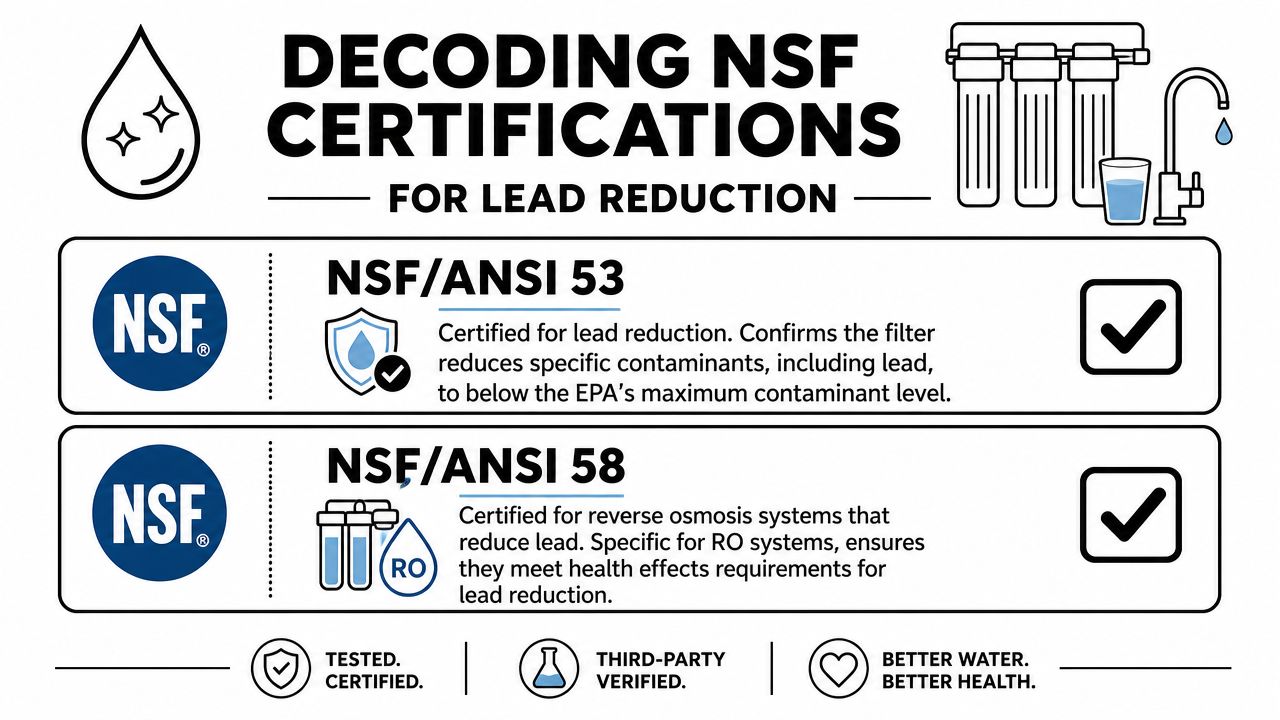
For lead filters, the benchmark that matters most is NSF/ANSI 53. NSF notes that products with this certification have been tested to reduce lead concentrations from 150 ppb down to 10 ppb or less, which gives you a real performance benchmark that uncertified products don't provide. You can verify that standard in the NSF lead reduction listings.
What NSF 53 and NSF 58 actually tell you
These are the two certifications you should care about for lead reduction:
- NSF/ANSI 53: Common for filters certified to reduce lead and other health-related contaminants.
- NSF/ANSI 58: The standard tied to reverse osmosis systems, including those certified for lead reduction.
That doesn't mean every product carrying one of those standards covers every contaminant you care about. It doesn't. One unit may be certified for lead but not for another claim on the brochure. Another may address chlorine well but not have the lead claim you assumed it had.
What to check before you buy
Don't stop at the front label. Check the exact contaminant claim.
Ask these questions:
- Is the unit certified for lead reduction specifically? Not just built with “lead-free” materials.
- Which standard applies? For most lead filter questions, that's NSF/ANSI 53 or NSF/ANSI 58.
- Is the claim tied to the device you're buying, or just a similar model?
- Does the certification match the way you plan to use it? Tap-level and whole-house applications are not interchangeable.
Buyer check: A product can be certified for one contaminant and not certified for another. Never assume a general “heavy metals” claim means proven lead reduction.
A lot of weak buying decisions happen because homeowners see “whole-house,” “lead,” and “premium” on the same page and stop reading. Don't. Certification is the line between verified performance and hopeful marketing.
System Design for Central Florida's Unique Water Challenges
Generic internet advice often misses the mark. In Central Florida, a whole-house lead solution usually isn't one product. It's a system layout.
That matters because the local water problems many homeowners deal with every day can wreck a poorly planned lead setup. Well water often brings iron, sediment, and sulfur into the conversation. Municipal water often brings disinfectant taste, odor, and scale concerns. Hard water is common enough that it should be part of the design discussion from the start.
Why a single filter usually isn't the answer
NSF's consumer guidance makes an important point. There are no whole-house systems certified to reduce lead, and lead reduction certification is typically verified for specific tap-level devices, according to NSF consumer guidance on lead in drinking water.
That doesn't mean whole-house treatment is useless. It means you need to think like a technician, not a shopper. You're not looking for a magic box. You're arranging components so each one handles the job it's good at.
A smart Central Florida layout often includes:
- Sediment control first: If your water carries grit or visible particulate, protect the expensive media downstream.
- Hardness treatment where needed: Scale can reduce efficiency and create maintenance headaches across the system.
- Iron or sulfur treatment when present: Those issues can overload specialty filters and leave homeowners disappointed.
- Tap-level lead protection: If lead exposure is a serious concern, give the drinking tap its own verified barrier.
Well water changes the conversation
If you're on a private well, you need a more customized approach than most city-water homes. Iron, sulfur, and sediment can dominate the design. A lead stage installed without addressing those issues first may foul early, lose flow, or fail to deliver the protection you expected.
That's why homeowners dealing with private wells should look at a broader well water treatment approach for Florida homes instead of trying to bolt a lead cartridge onto an already problematic system.
A better way to think about the problem
Don't ask, “What's the best whole-house water filter for lead?” Ask this instead:
- Where is the lead risk most likely occurring?
- What else is in the water that could interfere with treatment?
- Do I need whole-home conditioning, tap-level lead protection, or both?
- Will the system maintain pressure and flow for the house I live in?
That's how you avoid buying a system that sounds complete but isn't built for Florida water.
Your Next Steps to Guaranteed Lead-Free Water
A Central Florida homeowner installs a whole-house filter, assumes the lead problem is handled, and six months later the water pressure drops, the media is fouled with iron, and the kitchen tap still needs better protection. That happens because lead treatment is often chosen in isolation. In this part of Florida, hardness, iron, sulfur, and sediment decide whether a system keeps working or starts failing early.
Start with the water test. Then build the treatment plan around the actual water and the actual plumbing.
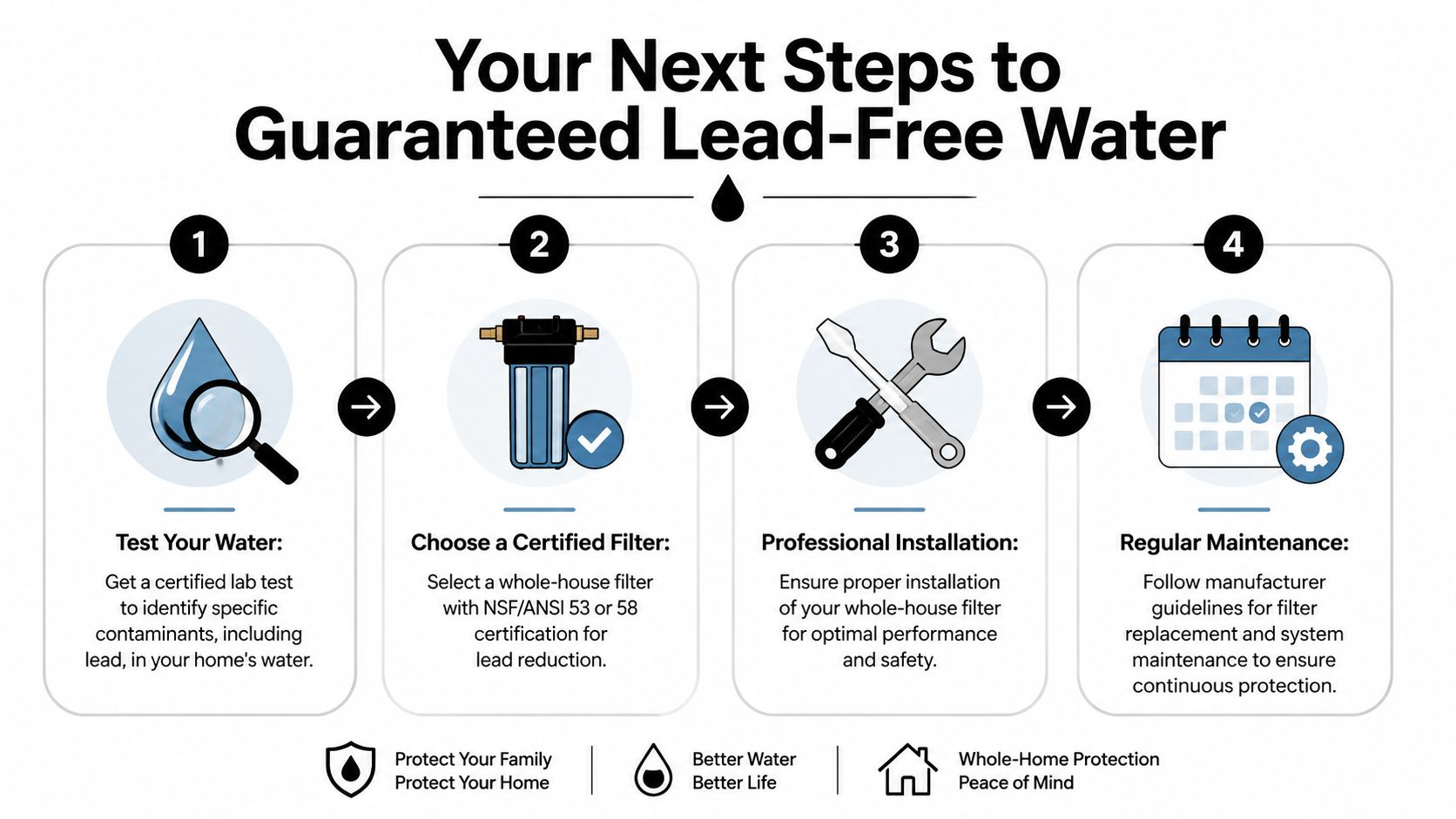
Do these steps in order
- Test both the source and the tap. You need to know whether lead is entering with the water, shedding from plumbing inside the home, or both.
- Identify the Florida problems that affect filter performance. Hardness can scale equipment. Iron and sulfur can foul media. Sediment can choke flow and shorten cartridge life.
- Protect the drinking water first. If lead is confirmed or strongly suspected, put certified protection at the kitchen tap where exposure matters most.
- Add whole-house treatment only where it solves a real house-wide problem. Use it for sediment, iron, sulfur, chlorine, odor, or hardness control. Do not assume a single tank gives the best lead protection at every faucet.
- Maintain the system on schedule. Missed cartridge changes and neglected pretreatment are how good systems stop performing.
My recommendation is straightforward. If you are worried about lead, do not wait for staining, taste, or cloudy water. Lead usually gives you none of those warnings. Test first, then install the right barrier at the point of consumption, and size the rest of the system around your full water profile.
For many Central Florida homes, the right answer is a layered setup. A whole-house system handles the broad water quality issues that are common here. A dedicated drinking water filter handles lead where people consume the water. That approach is easier to maintain, easier to verify, and better suited to homes with hard water or well water that carries iron.
If you want a local example of how that kind of setup is planned, review water filtration system options for Sebring area homes. Then get your water tested before you buy anything.
If you want clear answers instead of guesswork, schedule a free water test with Florida Water Management. Their team can evaluate your water, identify whether lead is the problem, and recommend a treatment plan that fits your plumbing, water source, and Central Florida conditions.