

You see it first on the little things. A drinking glass comes out of the dishwasher with a cloudy film. The shower door never looks fully clean. Soap won't lather the way it should, and your towels feel rough even after a fresh wash. In Central Florida, that pattern usually isn't a cleaning problem. It's a water problem.
I work around this every day in homes across Sebring, Avon Park, Lake Wales, Winter Haven, Frostproof, and nearby areas. City water can be hard. Private well water can be harder to sort out because hardness often shows up alongside iron, manganese, sulfur odor, or sediment. The mistake I see most often is homeowners buying a system based on marketing instead of a water test.
If you want to know how to soften hard water the right way, start with the chemistry, not the label on the box. The right answer depends on what's in your water, how much water your home uses, and whether you need true softening or just scale control.
Table of Contents
- Spotting the Signs of Hard Water in Your Florida Home
- Comparing Your Options Water Softeners vs Conditioners
- Choosing the Right System for Central Florida Homes and Wells
- Installation and Maintenance What to Expect
- Understanding Costs and Long-Term Value
- FAQs and When to Call Florida Water Management
Spotting the Signs of Hard Water in Your Florida Home
A lot of homeowners already know something is off before they ever test the water. They're scrubbing white residue off faucets, replacing a showerhead that keeps clogging, or wondering why shampoo feels harder to rinse out. In rental homes and older Florida properties, I also hear the same complaint about dishware. It comes out spotted no matter what detergent they use.
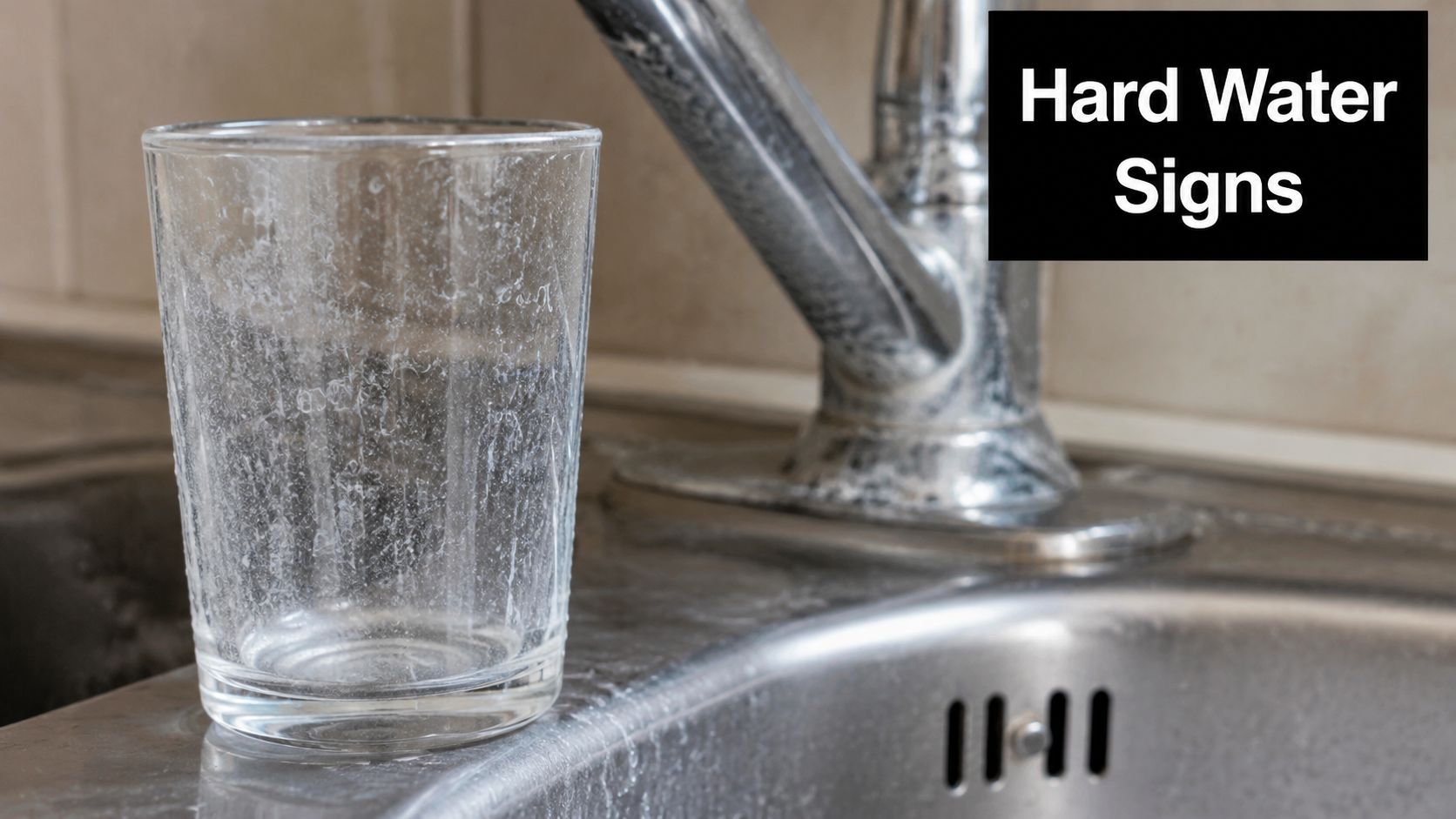
What hard water looks like day to day
Hard water means the water carries high levels of calcium and magnesium. Those dissolved minerals don't look dramatic in a glass, but they show up all over a home once the water is heated, evaporates, or mixes with soap.
Common signs include:
- Cloudy glassware: Mineral residue dries on cups, plates, and dishwasher interiors.
- Soap scum in showers: Soap reacts poorly with hardness minerals and leaves a stubborn film.
- Stiff laundry: Fabric can feel less clean and less soft after washing.
- Dry-feeling skin and hair: Many people notice bathing just feels less comfortable.
- Fixture buildup: White crust forms around faucets, showerheads, and drains.
The reason this matters is simple. These aren't isolated annoyances. They're symptoms of water chemistry that affects the whole plumbing system.
The hardness scale helps put that into context. The U.S. Geological Survey classification, summarized by Consumer Reports on hard water and water softeners, places water over 180 mg/L of calcium carbonate, or 10.5 grains per gallon, in the very hard category. That same summary notes Penn State Extension's guidance that levels above 7.0 gpg are often where homeowners begin noticing significant scaling and soap film.
Practical rule: If you're constantly fighting spots, film, or crusty mineral deposits, stop changing cleaners and test the water.
When the problem is more than cosmetic
The visible signs get your attention, but the expensive problems happen where you can't see them. Scale collects inside water heaters, valves, plumbing fixtures, and water-using appliances. On Central Florida well systems, that can combine with other contaminants and create more maintenance problems than most homeowners expect.
A quick visual check won't tell you whether you need softening, conditioning, filtration, iron treatment, or a combination. That's why a proper water test matters. It gives you an actual hardness reading instead of guesswork.
If you're serious about learning how to soften hard water for the long run, testing is the first step that separates a real fix from a temporary workaround.
Comparing Your Options Water Softeners vs Conditioners
The most confusing part of this market is the language. A lot of products get sold as if they all do the same job. They don't. Some systems remove hardness minerals. Some only try to keep those minerals from forming scale as aggressively. Some are meant only for drinking water at one sink.
What a softener does that a conditioner doesn't
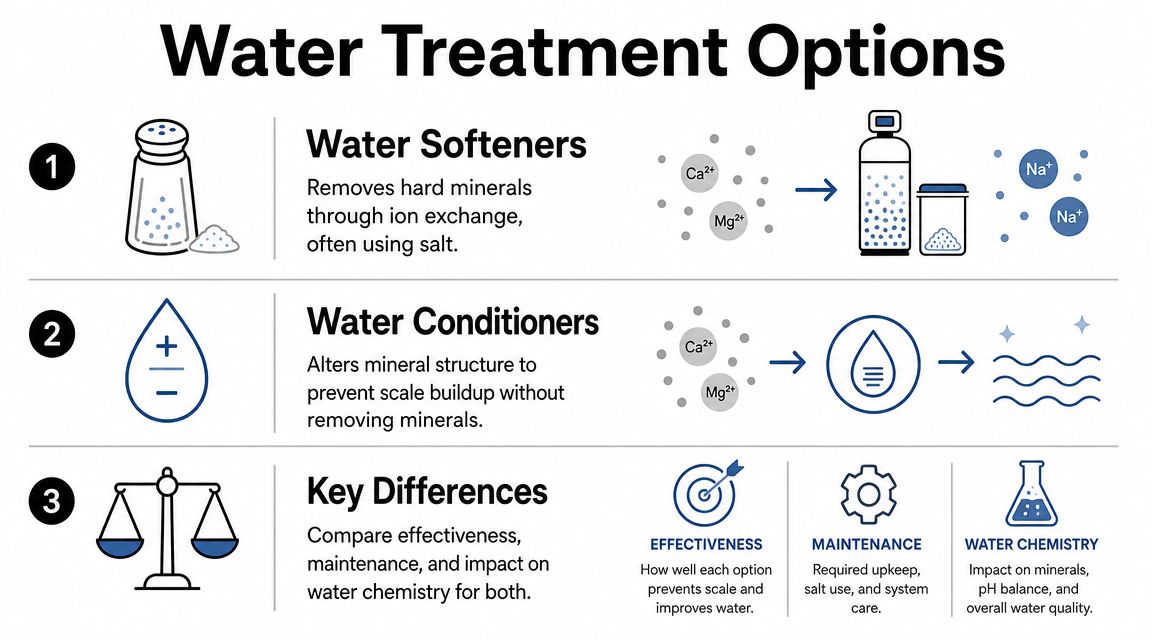
The most important distinction is this. Softening and conditioning are not interchangeable.
The University of Minnesota residential softening guidance points out the exact issue that confuses homeowners. Some residential systems remove calcium and magnesium, while others only inhibit scale formation. Those are different outcomes, and they change water chemistry in different ways.
A traditional salt-based ion-exchange softener is the standard method when the goal is to remove hardness. Water passes through resin beads charged with sodium ions. The resin swaps sodium for calcium and magnesium, which removes the hardness minerals that cause scale and interfere with soap.
A salt-free conditioner doesn't do that mineral removal step. It may help reduce scale attachment, but the calcium and magnesium remain in the water. If your goal is spot reduction, better soap performance, and true hardness removal across the home, that difference matters.
A reverse osmosis system has a different job. It's usually a point-of-use solution for drinking water, not a whole-home hard water answer. If your main concern is kitchen drinking water, an under-sink reverse osmosis system can be a smart add-on. It shouldn't be confused with a whole-home softener.
Conditioners can have a place. They just shouldn't be sold as if they create the same water as ion exchange.
Water Treatment Method Comparison
| Feature | Salt-Based Softener | Salt-Free Conditioner | Reverse Osmosis (POU) |
|---|---|---|---|
| Primary job | Removes hardness minerals | Inhibits scale formation | Improves drinking water at one location |
| Changes hardness reading | Yes | No | Not used as whole-home hardness treatment |
| Helps soap lather better | Yes | Limited | Only at the treated tap |
| Reduces spotting through the home | Yes | Limited and situation-dependent | No, not house-wide |
| Best use case | Whole-home hard water correction | Homeowners focused mainly on scale control | Drinking and cooking water |
The practical decision usually comes down to your goal:
- Choose ion exchange if you want to soften hard water.
- Choose conditioning if you understand you're not removing minerals and your expectations are limited to scale control.
- Choose reverse osmosis for better drinking water at a specific tap, not as a substitute for whole-home softening.
That's the piece a lot of homeowners in Central Florida don't get told clearly enough.
Choosing the Right System for Central Florida Homes and Wells
System selection isn't about picking the most features. It's about matching the equipment to the water and to the house. Central Florida makes that more important because two homes on the same road can have very different water. One may be on municipal supply with hardness and disinfectant taste. The next may be on a private well with hardness, iron, manganese, sulfur odor, and sediment all at once.
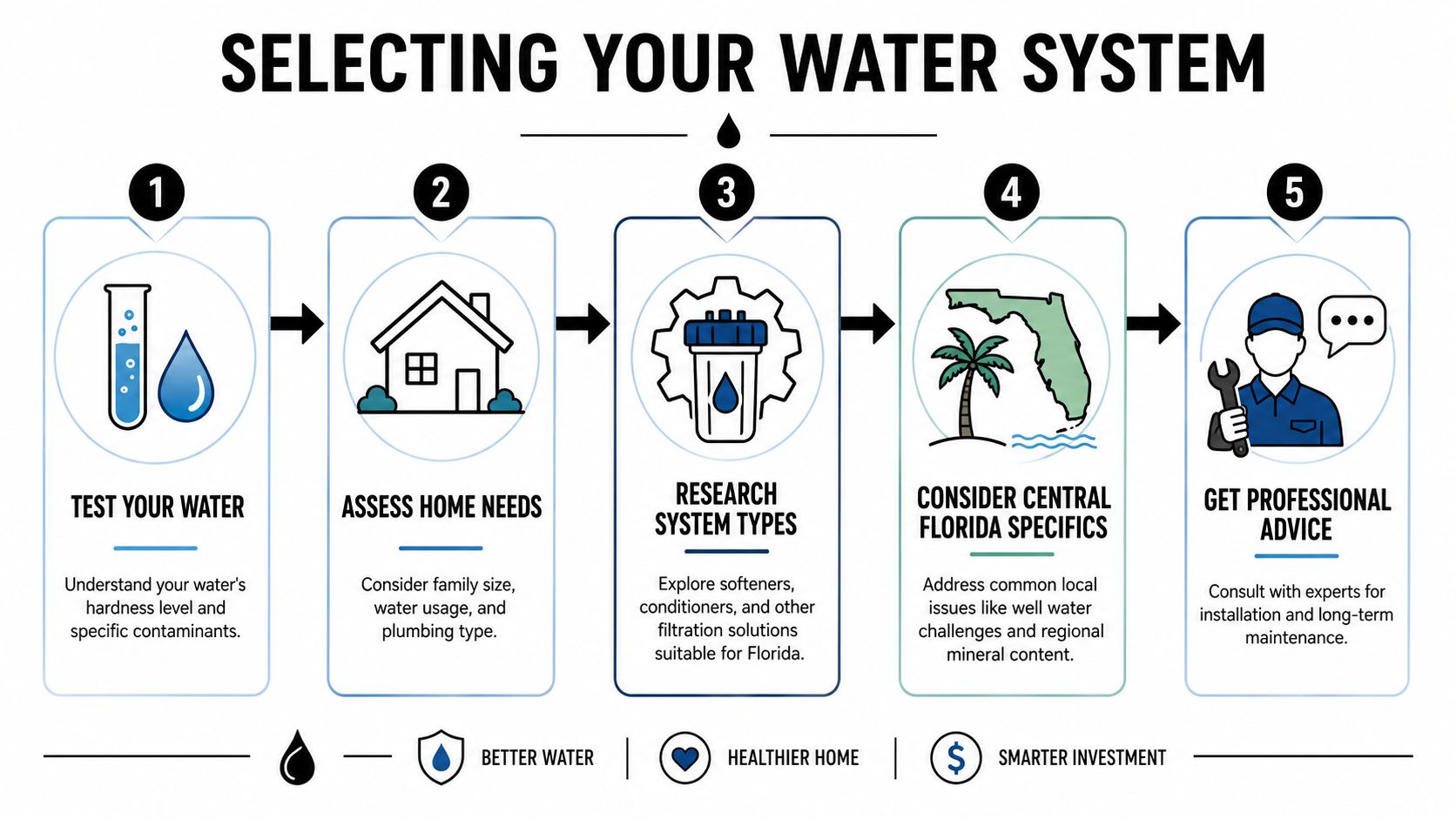
Start with a real water test
If you want a softener that works properly, you need the numbers. The U.S. Department of Energy explains the sizing logic clearly in its guide to purchasing and maintaining a water softener. It notes that water above 7.5 grains per gallon is generally considered hard enough to warrant treatment, and gives a practical sizing example: a home using 225 gallons per day with water hardness of 10 gpg would need a softener capacity of 2,250 grains per day.
That's how professionals size systems. We don't just ask whether the water feels hard. We translate hardness and water use into capacity.
For homeowners, that means checking:
- Measured hardness: This tells you whether you need actual softening.
- Household water use: More people and more fixtures mean more demand.
- Peak flow needs: A home with multiple bathrooms has different demands than a small cottage.
- Water source: City water and well water require different planning.
One practical option in this area is to have Florida Water Management well water treatment services evaluate the water profile first, especially when the property uses a private well and hardness may not be the only issue.
What changes when the home uses a private well
Well water adds another layer. A standard household ion-exchange softener can typically remove iron and manganese up to 10 ppm, but if those contaminants are above 10 ppm, a dedicated iron-removal stage is often needed before the softener, as outlined in Luminor's water softening guidance.
That matters because iron-heavy well water can foul a softener if the equipment is used for a job it wasn't meant to handle.
Here's the decision framework I use in the field:
- Municipal water with hardness only: A properly sized softener may be enough.
- Municipal water with taste or odor issues too: Softening may need to be paired with separate filtration.
- Private well with hardness plus iron or manganese: Test first, then decide whether pretreatment belongs ahead of the softener.
- Private well with staining, odor, or sediment: Don't assume a softener will solve all of it.
A softener is not a catch-all well water machine. If the test says iron is too high, handle that directly before expecting the resin bed to survive.
That's where many Central Florida installations go wrong. The wrong equipment can still run. It just won't solve the problem cleanly or for long.
Installation and Maintenance What to Expect
Most whole-home softeners go near the point where water enters the house. In Central Florida, that often means a garage, utility room, or covered exterior service area. The exact location matters because the system needs proper plumbing access, a way to handle discharge from regeneration, and enough room for service.
What installation day usually involves
A clean installation usually includes tying the unit into the main supply line, adding a bypass valve, checking drain routing, and programming the control settings to match the tested water. In a well-water home, pretreatment equipment may sit ahead of the softener depending on what the water analysis shows.
DIY installation looks simple online, but the mistakes are predictable. I've seen units installed backward, drains tied in poorly, programming left at factory settings, and softeners placed where service becomes a hassle later. The homeowner saves time on day one and loses it for years afterward.
A professional install also helps with two things homeowners often overlook:
- Correct setup: The control head needs to match actual hardness and household demand.
- Service access: Salt loading, inspections, and repairs are easier when the system is placed well from the start.
- Protection of nearby plumbing: A bypass and shutoff plan matters when service is needed.
What routine ownership looks like
Maintenance is usually straightforward if the unit is sized and programmed correctly. For most salt-based systems, the regular task is checking the brine tank and keeping salt at an appropriate level. The resin bed does the work, but it has to regenerate properly to keep exchanging minerals.
Penn State Extension guidance, as summarized earlier, explains the core cycle. The resin captures calcium and magnesium, and a brine flush regenerates the resin so the unit can keep working after the captured minerals are washed away.
You should also expect periodic inspection. A service visit can catch salt bridging, injector fouling, resin issues, drain problems, or settings that no longer match the home's water use.
The easiest softener to live with is the one that was sized right and set up right the first time.
If you're asking how to soften hard water without turning it into another home maintenance headache, that's the answer. Good installation prevents most of the long-term frustration.
Understanding Costs and Long-Term Value
A lot of homeowners focus on the purchase price and stop there. That's understandable, but it's incomplete. Hard water is already costing money when it leaves deposits in fixtures, shortens cleaning cycles, and pushes scale into appliances that use heated water.
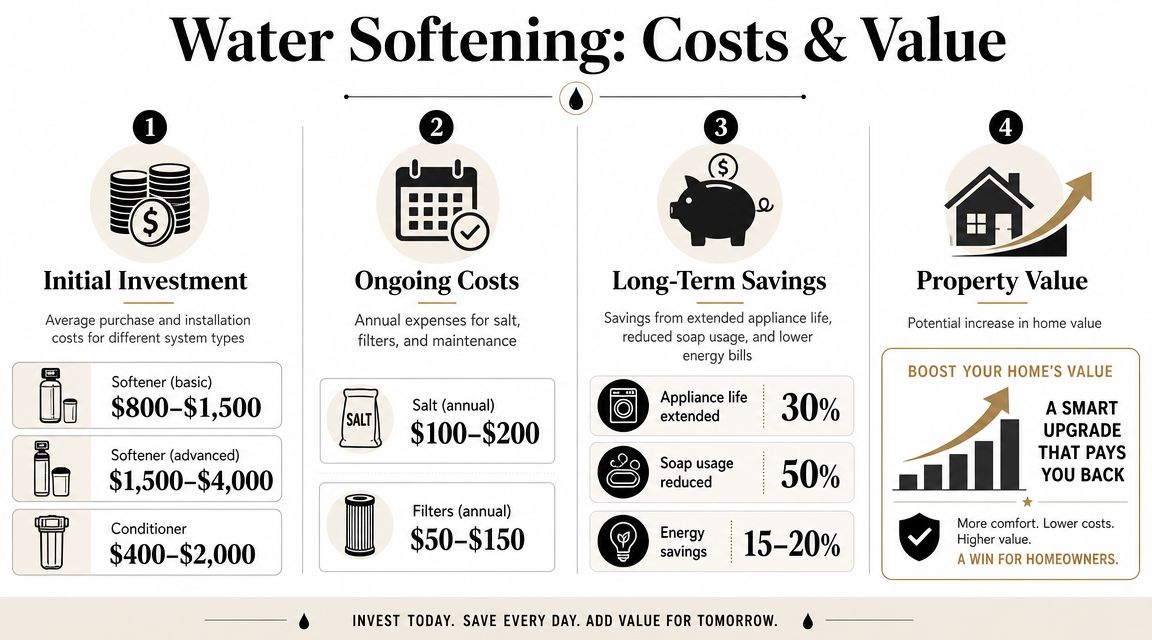
The wrong way to think about cost
I'd be careful with broad online price charts because they often mix different system types, installation assumptions, and regional labor conditions. If you want a grounded breakdown of what affects pricing in this market, review home water filtration system cost factors in terms of equipment type, water profile, and installation scope.
The better question isn't “What's the cheapest box I can buy?”
It's this: What system fits the water and protects the house without creating another problem?
A low-cost system that's undersized, misapplied, or installed without accounting for well-water contaminants often becomes the expensive option later.
Where the value shows up over time
Soft water changes daily use in ways homeowners notice immediately. Soap performs better. Cleaning takes less effort. Fixtures stay cleaner longer. Glassware and shower surfaces usually need less scrubbing because new mineral film isn't building as aggressively.
The longer-term value is less visible but often more important:
- Appliance protection: Water heaters, dishwashers, and washing machines don't have to work against the same mineral load.
- Plumbing protection: Reduced scale means fewer restrictions and less mineral buildup inside fixtures and valves.
- Consistency: Laundry, bathing, and cleaning become more predictable.
- Better system matching: A tested and properly selected setup avoids spending money on equipment that doesn't address the underlying issue.
For Central Florida homeowners, that matters because hard water is rarely a one-week nuisance. It's an ongoing condition. Solving it correctly protects more than dishes and shower doors. It helps preserve the parts of the home you don't want to replace early.
FAQs and When to Call Florida Water Management
Homeowners usually get to this point with a few practical questions left. Most of them come down to whether a shortcut can replace proper treatment, or whether a single device can solve several different water problems at once.
Common questions homeowners ask
Can I just boil the water to soften it?
Only in a very limited sense. Long's EcoWater guidance on softening water notes that boiling can precipitate temporary carbonate hardness so sediment can be separated after cooling, but it does not remove permanent hardness and isn't practical for an entire household water supply.
That makes boiling useful for a small batch in a kettle, not for protecting plumbing, appliances, showers, laundry, and water heaters.
Do vinegar or baking soda soften water?
Not in the way softening is generally understood. Those may help with cleaning or change how something tastes or behaves on a surface, but they don't reliably remove dissolved hardness ions from the home's water supply.
Is a salt-free system enough?
Sometimes, if your expectation is limited to scale inhibition and you understand it isn't removing hardness minerals. If you want the effects most homeowners ask for, such as better soap performance, reduced spotting, and true hardness reduction, you're usually talking about ion exchange.
What if my well water also smells like sulfur or leaves orange stains?
That's exactly why testing matters. Sulfur odor, iron staining, manganese, and sediment can change the treatment plan. A softener may be one part of the solution, but it may not be the first part.
When it makes sense to bring in a professional
Call for help when any of these are true:
- You're on a private well: Hardness may be only one item in the water profile.
- You're comparing salt-based and salt-free systems: The decision should be based on goals and test results, not ads.
- You've had equipment before and it didn't solve the problem: The original diagnosis may have been incomplete.
- You want one long-term answer: A proper test and sizing review usually saves money and frustration.
The biggest takeaway is simple. If you want to know how to soften hard water correctly in Central Florida, don't start with equipment. Start with the water itself.
If you're dealing with hard water, scale, staining, well-water issues, or you're just tired of guessing, schedule a free water test with Florida Water Management. A proper analysis gives you a clear answer on whether you need a softener, conditioner, filtration, or a combination matched to your home.