

You fill a glass from the kitchen tap, and it looks fine. Then the questions start. Why do dishes dry with spots? Why does coffee taste different from one week to the next? Why does water that meets basic standards still leave homeowners in Ruskin wondering what they're drinking?
That uncertainty is common in this part of Florida. Some homes are on municipal water. Others rely on private wells. Both situations can bring their own water headaches, especially when hard water and dissolved contaminants enter the picture. If you're researching reverse osmosis drinking water in Ruskin, FL, you're probably not looking for marketing language. You want a clear answer on whether it works, what it removes, and what it takes to make it last.
The short answer is yes. Reverse osmosis can produce exceptionally clean drinking water. But in Ruskin, the details matter. The membrane, the pre-filters, and the condition of the incoming water all affect whether the system performs well or turns into a maintenance headache.
Table of Contents
- Is Your Ruskin Tap Water Truly as Clean as It Looks
- How Reverse Osmosis Creates Exceptionally Pure Water
- The Specific Water Challenges in Ruskin and Hillsborough County
- Choosing Your System Point of Use vs Whole Home RO
- Installation Maintenance and Typical Costs in Florida
- Why Other Filters Cant Match Reverse Osmosis Protection
- Your Next Step to Pure Water in Ruskin
Is Your Ruskin Tap Water Truly as Clean as It Looks
Clear water isn't always the same thing as clean water. Many homeowners only start digging deeper after they notice a pattern. Maybe the ice tastes off. Maybe bottled water has become a weekly expense. Maybe the sink area keeps showing mineral residue no matter how often you wipe it down.
Ruskin residents also run into a second issue. Water can be legally compliant and still leave you wanting better protection at the tap. In Ruskin, FL, the local water authority is required to meet EPA federal drinking water standards, but a reverse osmosis system is recommended for maximum protection against contaminants regardless of compliance, according to the Ruskin water quality overview.
That distinction matters. Compliance means the water supplier must meet regulatory limits. It doesn't mean every homeowner will like the taste, trust the quality, or want to drink water with the widest possible margin of protection.
What homeowners usually notice first
- Taste changes: Water may taste flat, chemical-like, or mineral-heavy depending on the source and treatment.
- Kitchen clues: Tea kettles, coffee makers, and glassware often reveal what your water is carrying.
- Peace of mind: Families with kids often want more than “meets the standard.” They want stronger filtration at the point where they drink and cook.
Clean-looking water can still carry dissolved substances you can't see, smell, or identify without testing.
If you're unsure what's going on in your home, the smartest first step isn't guessing. It's getting your water checked so you can match the solution to the actual problem. A free water test can tell you whether your main concern is hardness, dissolved solids, taste, or a combination of issues.
How Reverse Osmosis Creates Exceptionally Pure Water
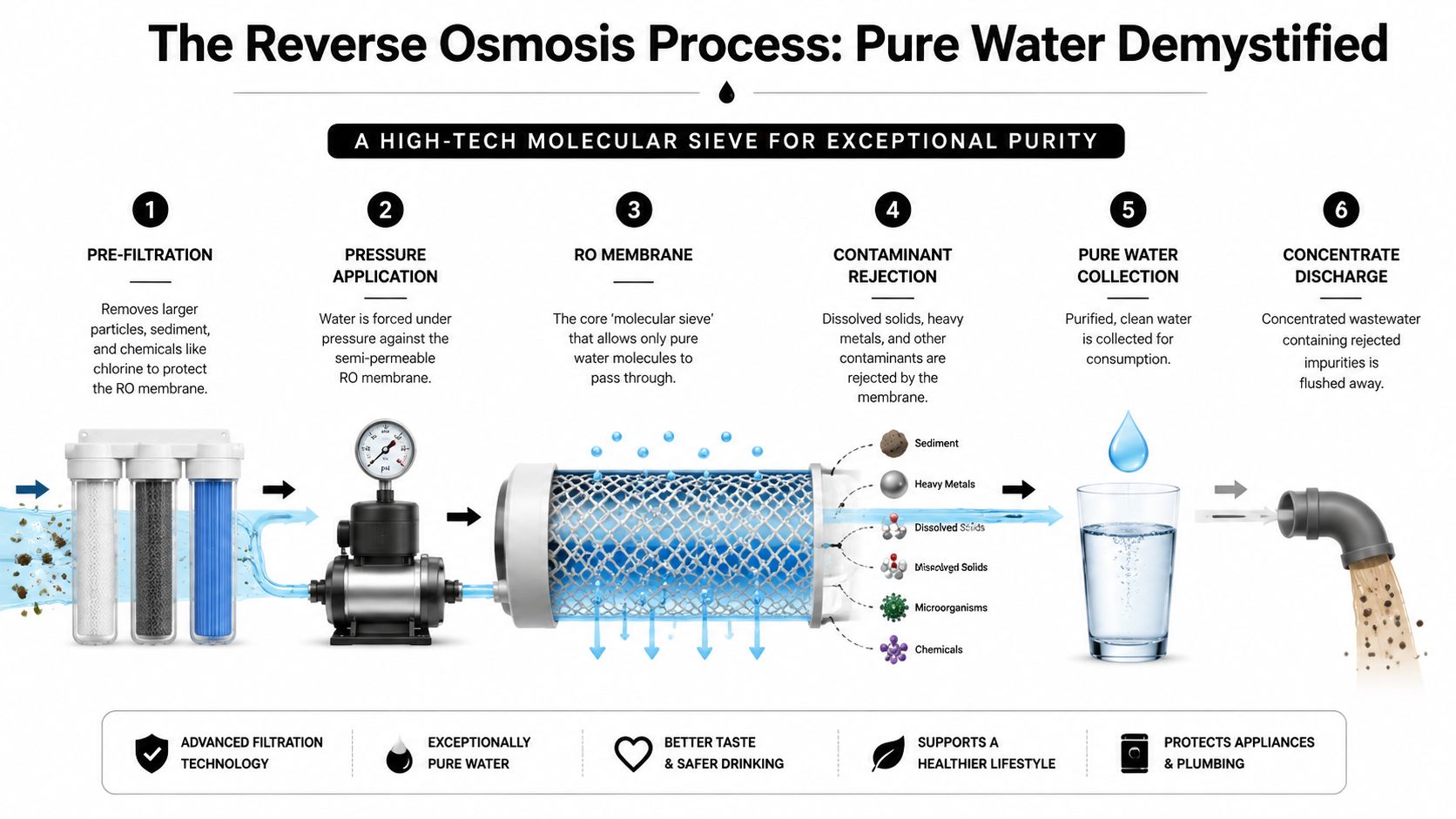
Reverse osmosis works like a high-tech molecular sieve. A basic screen door keeps out bugs. A finer mesh catches smaller debris. An RO membrane works on a completely different level. It separates water at a scale small enough to reject many dissolved contaminants that ordinary filters can't reliably remove.
A properly operating residential RO system removes 95 to 99% of Total Dissolved Solids, including heavy metals like lead and arsenic, inorganic contaminants such as nitrates and fluoride, PFAS, and microplastics, by forcing water through a semipermeable membrane with a pore size of 0.0001 microns, according to this reverse osmosis filtration guide.
What the membrane actually does
Think of the membrane as the checkpoint where the main work happens. Water is pushed against that membrane under pressure. The water molecules pass through. Many unwanted dissolved substances do not.
Here's the process in plain language:
- Pre-filters catch the obvious troublemakers. Sediment and chemicals that would damage the membrane are reduced first.
- Pressure pushes water forward. The system doesn't wait for gravity. It actively forces water toward the membrane.
- The membrane does the separation. This is the heart of the system.
- Clean water is collected. That becomes the water you drink and cook with.
- Rejected contaminants are flushed away. The system sends the concentrated waste stream to the drain.
Why pre-filtration matters first
People often focus on the membrane and skip the setup around it. That's a mistake. The same filtration guide notes that pre-filtration to remove sediment and chlorine is essential because chlorine chemically degrades RO membranes and sediment physically clogs them.
Practical rule: An RO system is only as reliable as the water you send into it.
This is one reason reverse osmosis drinking water in Ruskin, FL needs a local approach rather than a generic online recommendation. A system has to fit the incoming water, not just the kitchen cabinet.
The Specific Water Challenges in Ruskin and Hillsborough County
Ruskin homeowners aren't all dealing with the same water profile. A home connected to municipal water faces one set of issues. A property on a private well may face another. The treatment strategy should reflect that difference.
Municipal water and private well water are different problems
For municipal water, many homeowners are concerned with taste, odor, disinfectant-related issues, and emerging contaminants. PFAS gets a lot of attention for good reason. The EPA has identified reverse osmosis as one of the best available technologies for meeting the new legally enforceable Maximum Contaminant Levels for six PFAS chemicals, and the same Florida industry coverage notes that softening feed water in Central Florida can improve RO efficacy by up to 40% and double membrane lifespan, as explained in this PFAS and RO article focused on Florida water treatment.
Private well owners often face a different mix. Hardness, iron, sulfur odors, sediment, and mineral loading can create visible and practical problems long before anyone thinks about drinking water purity. In those cases, a dedicated drinking water system may still be the right answer at the kitchen sink, but it often works best as part of a broader treatment plan. Homeowners comparing options for private wells can get useful background from this guide to reverse osmosis for well water.
The overlooked step that protects the system
The most common mistake in Central Florida is treating RO like a stand-alone fix. It often isn't.
If the incoming water is hard, that hardness can foul the membrane over time. Calcium and magnesium behave like scale inside a coffee maker. They build up where you don't want them, reduce performance, and shorten service life. That's why pre-treatment matters so much in Ruskin and across Hillsborough County.
A simple way to think about it:
| Water condition | What happens without pre-treatment | Better approach |
|---|---|---|
| Hard water | Membrane scales up and loses efficiency | Soften first, then run RO |
| Sediment | Filters and membrane clog faster | Add sediment protection upstream |
| Chemical exposure | Membrane can degrade | Use proper carbon pre-filtration |
If your feed water is rough on plumbing fixtures, it will usually be rough on an RO membrane too.
That local reality is why one-size-fits-all advice often disappoints homeowners here.
Choosing Your System Point of Use vs Whole Home RO
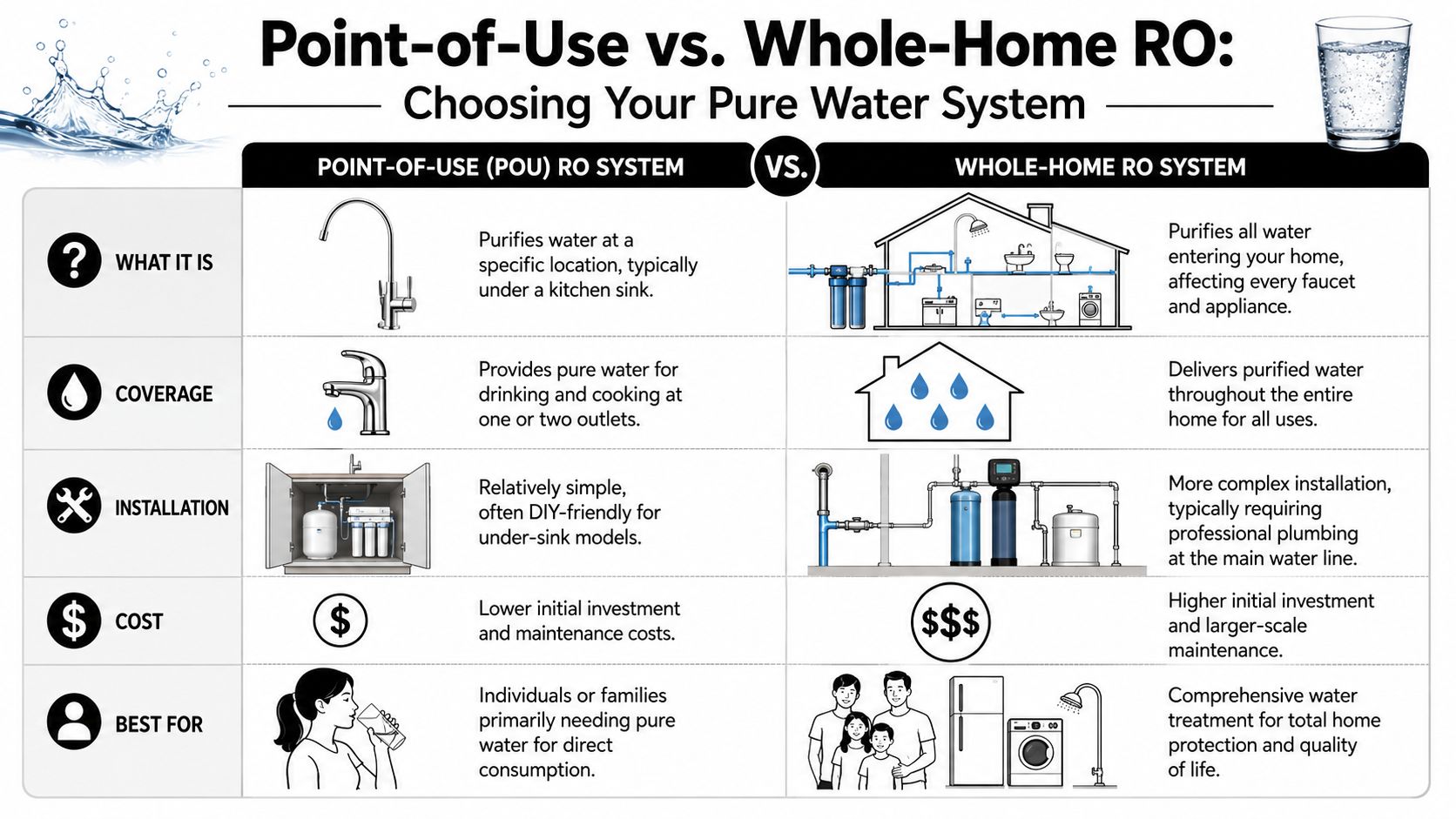
Most Ruskin homeowners choose between two paths. One is a point-of-use system, usually installed under the kitchen sink. The other is a whole-home RO system that treats water entering the house. Both can be effective. They just solve different problems.
For residential use, a 50 GPD rated system is recommended for its balance of performance and cost. These systems must meet ASSE 1086-2020 standards, which require a minimum 75% TDS reduction and a 40% efficiency rating, according to the EPA webinar slides on point-of-use RO performance standards.
When an under-sink system makes sense
An under-sink RO system fits most families who mainly want better water for:
- Drinking: The water you fill glasses and bottles with every day.
- Cooking: Pasta, soup, coffee, tea, baby formula, and ice.
- Targeted improvement: You don't need RO in every shower or toilet line.
This setup usually makes sense when your biggest concern is what goes into your body, not treating every gallon used throughout the home. It also keeps the project smaller and easier to manage.
A good under-sink system can be a strong answer when:
- Your water is safe but unpleasant: Taste and odor bother you.
- You want higher-level filtration: You're looking beyond a pitcher or faucet filter.
- Space matters: The system needs to fit neatly in a kitchen cabinet.
When whole-home RO fits better
Whole-home RO is a different level of treatment. It affects water at every tap, which can appeal to homeowners with severe water quality problems or properties with especially difficult well water. It may also make sense when water quality affects appliances, bathing, laundry, and fixture buildup across the whole house.
This option is more extensive, but it also demands more planning. A whole-home setup usually needs room for tanks and treatment components, and the incoming water often needs conditioning before it reaches the RO system.
Here's a practical comparison:
| System type | Best fit | Main advantage | Tradeoff |
|---|---|---|---|
| Under-sink RO | Most households focused on drinking water | Pure water where you consume it most | Doesn't treat every tap |
| Whole-home RO | Homes with broad, serious water issues | House-wide purification | Larger equipment footprint and more complexity |
Choose based on where the problem shows up. If the concern is drinking and cooking, point-of-use often wins. If the entire house is affected, whole-home treatment deserves a closer look.
Installation Maintenance and Typical Costs in Florida
Cost questions usually come down to three parts. The equipment itself, the installation, and the upkeep. Keeping those separate makes reverse osmosis much easier to evaluate.
For Florida homeowners, under-sink RO units typically range from $300 to $1,000 plus installation, with annual maintenance costing $100 to $400. Whole-house solutions are a larger investment, ranging from $8,000 to $15,000. For most under-sink installations in Hillsborough County, no permit is required, based on Florida pricing and installation information summarized in this overview of reverse osmosis system cost.
What you pay for upfront
Under-sink systems are the lower-commitment option. They're often selected by homeowners who want a dedicated purified water tap without changing the entire house plumbing strategy.
Whole-home RO systems cost more because they do more. They're built to handle all incoming water, and that usually means larger components, more plumbing work, and more attention to pre-treatment.
A simple breakdown looks like this:
- Under-sink RO: Lower equipment cost, smaller installation scope.
- Whole-home RO: Larger investment, broader treatment coverage.
- Pre-treatment equipment: May be necessary depending on hardness, sediment, or chemical conditions.
What maintenance looks like over time
RO systems aren't maintenance-free, but they aren't mysterious either. Most homeowners just need a clear service routine and the right replacement schedule.
The Florida pricing data above also notes that maintenance commonly includes filter replacement and periodic membrane changes. What matters most is consistency. When homeowners delay service, water quality usually drops before they realize it.
A well-maintained RO system tends to be predictable. A neglected one becomes expensive at the worst time.
Before installation, ask these practical questions:
- What pre-treatment does my water need? This is especially important in hard-water areas.
- How easy is filter access? Convenience affects whether service gets done on time.
- Who handles ongoing maintenance? Some homeowners want DIY service. Others prefer scheduled support.
If you're comparing quotes, don't look at purchase price alone. Look at the full ownership picture.
Why Other Filters Cant Match Reverse Osmosis Protection
Pitcher filters and faucet attachments aren't useless. They solve a narrower problem. Many improve taste and reduce chlorine-related issues, which is why people notice an immediate difference after using them.
That's the good news. The limitation is that these simpler filters usually aren't built to handle the same range of dissolved contaminants that reverse osmosis targets. If your goal is basic taste improvement, they may be enough. If your goal is broad contaminant reduction, they usually aren't.
What basic filters do well
A simple carbon filter can be helpful when:
- Taste is the main complaint: Water tastes or smells unpleasant.
- You want convenience: Low cost and easy setup matter most.
- You need a short-term solution: Renting, temporary housing, or a quick improvement.
These options are common because they're easy to buy and easy to use. For many households, they're the first step.
Where RO pulls ahead
Reverse osmosis works at a finer level. It's designed for homeowners who want more than odor control or a better-tasting glass of water. That's why the comparison matters.
For a closer look at the differences in filtration depth and intended use, this guide on reverse osmosis vs filtered water is a useful reference.
Here's the plain-language version:
| Filter type | Best at | Leaves more behind |
|---|---|---|
| Pitcher or faucet filter | Taste and chlorine reduction | Many dissolved substances |
| Reverse osmosis | Broad reduction of dissolved contaminants | Requires more planning and maintenance |
The premium value of RO isn't about gimmicks. It's about scope. When a homeowner wants one of the strongest household options for drinking water purification, reverse osmosis usually sits at the top of the list.
Your Next Step to Pure Water in Ruskin
If you're still unsure whether reverse osmosis is the right fit, that's normal. The right answer depends on your actual water, not a generic recommendation on a product box.
For many homes in Ruskin, RO makes the most sense when the goal is dependable, high-purity drinking water at the kitchen sink. But the local detail that changes everything is pre-treatment. Hard water, sediment, and feed-water conditions affect whether the system stays efficient and lasts.
That's why testing comes first. A proper water test can show whether you need under-sink RO only, upstream softening, or a more complete treatment setup. It also helps you avoid paying for equipment that doesn't match your water profile.
The best water system isn't the biggest one. It's the one built for the water coming into your home.
If you've been dealing with strange taste, mineral spotting, hard water signs, or lingering questions about contaminants, the next move is simple. Get your water tested and get an opinion based on evidence, not guesswork.
Florida Water Management offers professional guidance for homeowners who want answers before they buy. If you want a free water test and a clear recommendation for your home, visit the Florida Water Management contact page and schedule a no-pressure consultation.