

Sediment is solid material that settles out of water, and it can be anything from microscopic clay to boulders. If you're in a Central Florida home and you've noticed sand in a glass, rust in the tub, or a cloudy rinse from the tap, that same basic definition is the one that matters at the kitchen sink.
That's why the word feels so broad and so annoying at the same time. In geology, sediment is part of how landforms and rocks are built. In a home, it's the stuff that can make clean water look dirty, clog plumbing, and leave you wondering whether the problem is a simple filter issue or something deeper in the water source.
Table of Contents
- What Sediment Looks Like in Your Glass
- The Core Definition of Sediment
- Common Types of Sediment Found in Central Florida Homes
- How Sediment Affects Plumbing, Appliances, and Water Quality
- A Real Homeowner Case in Sebring
- Treatment Options That Match the Sediment
- Maintenance Habits and When to Schedule a Free Water Test
What Sediment Looks Like in Your Glass
A homeowner in Sebring fills a clear glass at the kitchen sink, and a faint cloud drifts down to the bottom before the water even reaches the table. On another day, the same family notices a little grit in the shower, a rusty tint in the tub, or a speckled line in the toilet tank. That's usually the moment the definition of sediment stops sounding academic and starts feeling personal.

Practical rule: If particles appear, settle, or leave staining, you're looking at a water issue that deserves a closer look, not just a cosmetic complaint.
For Central Florida homes, that matters whether the water comes from a private well or a municipal line. Some homeowners call it “dirt,” some call it “sand,” and some just say the water “looks off,” but the bigger question is what the material is and where it's coming from. A light film in one glass can point to a very different cause than orange flakes in a bathtub or cloudy water after a storm.
The good news is that you don't need a geology degree to start sorting it out. You only need to notice what it looks like, where it shows up, and whether it keeps returning. The same word can cover a lot of ground, but the home decision usually comes down to whether you're dealing with loose mineral grit, rust, organic debris, or something that needs targeted treatment.
If you've already seen brown or discolored water, this local guide on why well water turns brown is a useful next read, because appearance often tells you more than people realize.
The Core Definition of Sediment
Sediment is solid material that settles out of a fluid and gets deposited somewhere else. In major reference sources, it spans everything from microscopic clay to boulders, which is why the word covers both fine particles in water and much larger material in rivers, beaches, and rock layers. National Geographic describes sediment that way, and the broad idea is simple, material moves, then it settles.
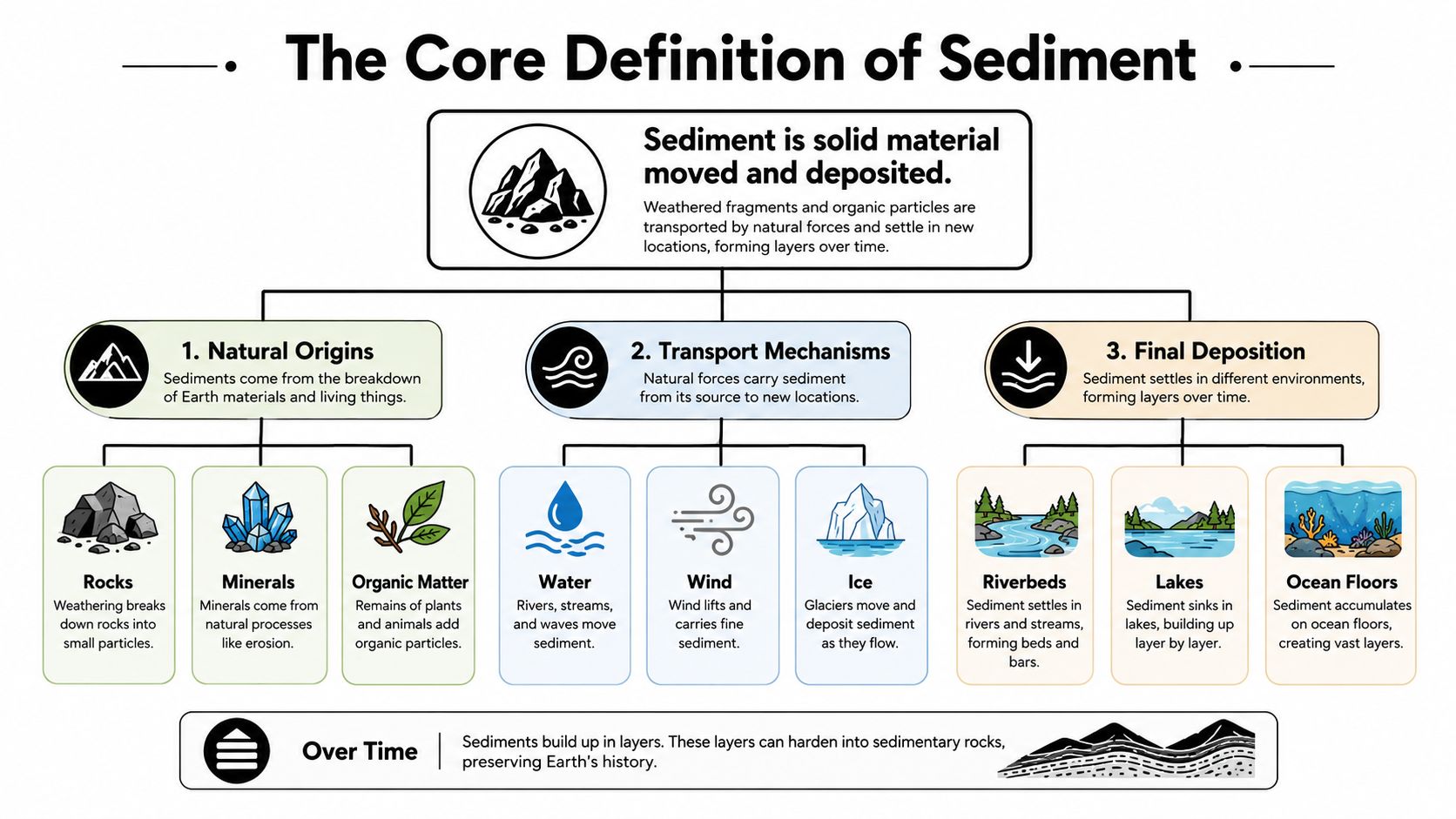
The formal geology version is just as important. Standard reference sources define sediment as any unconsolidated deposit of solid weathered material, and the U.S. EPA describes suspended sediment in water as primarily clay and silt particles smaller than 0.063 mm sediment reference. That size detail matters because tiny particles can stay suspended long enough to cloud water, pass through basic strainers, and settle later in plumbing or fixtures.
Why that definition matters in a house
The term isn't just for riverbanks and rock layers. It also helps homeowners sort out what they're seeing in a glass, because “sediment” can mean loose grit, fine silt, or material carried in water from a well or distribution line. In practice, it's a category, not a single substance.
Sediment is best understood as a process term, not a product term.
That's the part many people miss. The same word can describe a natural deposit on a lake bottom, a layer in a streambed, or the particles that collect in a water heater over time. For homeowners, that broad definition is useful because it explains why a filter, a softener, or a different treatment system may be needed depending on what the particles are.
Sediment also matters because it's the raw material for sedimentary rock, and that makes it a foundational part of Earth science. In a home, though, the useful takeaway is simpler. If something is settling out of your water, it's sediment in the practical sense, and the next step is figuring out whether it's harmless grit or a sign of a bigger water issue.
Common Types of Sediment Found in Central Florida Homes
Central Florida homeowners run into several things that all get called “sediment,” even though they don't behave the same way. Sand from wells, silt from disturbed water, rust from aging plumbing, organic debris after heavy rain, and mineral particles tied to hard water can all show up in a glass or on a fixture. The reason this matters is simple, each type points to a different source and a different fix.
| Common Sediment Types in Central Florida Homes | What It Looks Like | Typical Source | Concern Level |
|---|---|---|---|
| Sand | Visible grains that feel gritty | Well water, disturbed sediment, aging screens | Often a nuisance, sometimes a sign of well issues |
| Silt | Fine cloudiness that settles slowly | Groundwater influence, surface disturbance | Usually a filtration concern |
| Rust or iron particles | Orange, red, or brown flecks or staining | Corroding pipes, iron-rich wells | Often more than a cosmetic issue |
| Organic debris | Specks, flakes, or cloudy residue | Surface-water influence, storm runoff | Needs source review |
| Hard-water related particles | White or chalky residue | Mineral-heavy water | Can signal scale buildup |
| Manganese-related flecks | Dark gray or black specks | Mineral content in water | Often worth testing |
| Sulfur-related residue | Blackish particles with odor concerns | Certain well conditions | Usually needs diagnosis |
Geology sources note that sediment can be a mixture of sand, silt, clay, organic matter, and attached contaminants, so the category is broader than is commonly thought sediment mixture reference. That broad mix helps explain why a homeowner may notice both visible particles and a smell, or both staining and cloudy water, and still be dealing with one water source problem.
What Central Florida conditions add
Local wells, sandy soils, and storm-driven runoff make source identification especially important. A homeowner in Lake Wales may see fine sand after pump cycling, while a Winter Haven household on city water might notice rust-colored particles after a plumbing disturbance. Those are not the same problem, even though both get labeled sediment at the kitchen sink.
For homeowners comparing fixes, the local guide on how to remove iron from water is helpful when orange staining or metallic particles are part of the picture.
Helpful habit: Don't guess from one symptom alone, look at color, texture, odor, and where the residue shows up.
How Sediment Affects Plumbing, Appliances, and Water Quality
Sediment becomes a home problem when it starts moving through the systems you rely on every day. It can collect in faucet aerators, settle in showerheads, and build up in water heaters and plumbing lines over time. That same deposition process is what makes sedimentary layers in nature, and in a house it can mean less efficient equipment and more nuisance calls.
What homeowners usually notice first
Cloudy water often shows up before a mechanical problem does. Laundry can come out dingy, drinking water may look less appealing, and a faucet can start sputtering if particles collect at the screen. Even when the water still tastes fine, visible residue is enough to tell you something is traveling through the system.
The practical issue is abrasion. Fine particles can wear on valves, clog small openings, and shorten the useful life of appliances that depend on clean flow. Water heaters, washing machines, and ice makers are especially vulnerable because they all move water through narrow parts that don't tolerate grit well.
Practical rule: If you're cleaning aerators more often than usual, the source problem probably hasn't gone away.
Sediment and hard water can also show up together. When that happens, homeowners may see a mix of grit, film, and scale, which makes the water look worse and makes appliance maintenance more frustrating. The result is usually not one single dramatic failure, but a steady series of small annoyances that add up.
A quick self-check
- Check faucets and showerheads: If they clog often, particles are moving through the system.
- Look at laundry: Dingy clothes or speckled residue often point to suspended material.
- Watch the water heater area: Recurring sediment there usually means the system is collecting material over time.
- Notice taste and clarity: Water can still be “safe-looking” in a casual sense and still be worth testing if it's cloudy or discolored.
The main point is that sediment is not only a cosmetic issue. It affects how water looks, how appliances run, and how much trust a homeowner has in the tap. That's why a clean definition matters, because once you know what sediment is, you can start asking what it's doing inside the house.
A Real Homeowner Case in Sebring
A Sebring homeowner called after noticing orange tint in the bathtub and specks on laundry. At first glance, it looked like a standard iron problem, and that's a common assumption in this part of Florida. The water seemed otherwise normal, so the family was tempted to just install a basic sediment filter and hope the issue faded.
A free water test changed that plan.
What the test revealed
The water had iron sediment, sand from a deteriorating well screen, and a slight sulfur odor. That combination mattered because one treatment would not solve all three issues. A simple sediment filter could catch loose grit, but it would clog too fast if it had to handle iron particles without any pre-treatment.
So the solution became staged. The home needed a whole-home sediment pre-filter, an oxidation and filtration unit for iron, and a final polishing filter at the tap for drinking water. That sequence addressed the source problem first, then improved the water where the family used it most.
Why the diagnosis mattered
The biggest win was not just cleaner water, it was avoiding guesswork. If the homeowner had installed the wrong system first, the result could have been frustration, repeat service calls, and more money spent in the wrong place. A good test turns a vague complaint into a treatment plan.
If you're wondering whether your own water problem is just sediment or something more specific, a free water test gives you a real starting point instead of a guess.
A test is cheaper than replacing the wrong filter twice.
This kind of case is common in well-water communities because different symptoms can overlap. Orange staining, grit, and odor may show up together, but they rarely share the same fix. When the homeowner gets the diagnosis right, the solution usually makes more sense from day one.
Treatment Options That Match the Sediment
The best treatment depends on what's in the water, not just on whether the water looks dirty. A sediment filter helps with larger particles, a softener addresses dissolved minerals that cause scale, reverse osmosis is better for drinking-water polishing, and iron or sulfur systems are designed for those specific conditions. Staged treatment usually works better than trying to make one device do everything.
| Treatment Option | Best For | What It Handles Well | What It Won't Solve |
|---|---|---|---|
| Sediment filter | Visible grit and larger particles | Sand, silt, some rust flakes | Dissolved minerals, odor, iron chemistry |
| Water softener | Hard-water scale issues | Dissolved calcium and magnesium | Visible sand or heavy particulate load |
| Reverse osmosis | Drinking water at a tap | Fine polishing for point-of-use water | Whole-home particulate problems |
| Iron oxidation and filtration | Iron staining and related particles | Iron-focused treatment | General hard water unless paired with other equipment |
For many Central Florida homes, a standard sediment filter is the first layer, not the only layer. If iron is part of the problem, filtration alone can clog quickly, and if hard water is the bigger issue, a sediment filter won't stop scale from forming. That's why matching the system to the symptom matters so much.
How to think about the choice
If the water is gritty, start with particulate removal. If fixtures are stained orange or brown, iron treatment deserves attention. If the complaint is scale on glass and fixtures, hardness is likely involved. If the family only wants cleaner drinking water, point-of-use reverse osmosis may be the most targeted choice.
For homeowners comparing drinking-water options, this overview of reverse osmosis for well water is a useful reference point.
Best practice: Treat the source problem first, then polish the water where people drink it.
That approach keeps equipment from overworking and makes the solution easier to maintain. It also helps homeowners avoid buying a filter that catches the symptom but not the cause.
Maintenance Habits and When to Schedule a Free Water Test
Simple maintenance goes a long way with sediment. Flush the water heater on a regular schedule, clean faucet aerators when flow drops, and replace basic filter cartridges before they're packed full. Those habits don't solve source water problems, but they do prevent small buildup from becoming a bigger mess.
When DIY stops being enough
Recurring discoloration is a warning sign, especially if it shows up after storms or after the pump cycles. Visible particles in multiple fixtures mean the issue is moving through the whole house, not just one faucet. Staining on laundry or fixtures also tells you the water deserves a closer look.
If you're on a private well and haven't tested in a while, testing is the smart move even when the water still looks acceptable. Wells can change with seasonal weather, plumbing wear, or well screen issues, and the water can look different long before it tastes different.
A simple decision path
- Do basic upkeep first: Clean aerators, flush heaters, and keep filters on schedule.
- Watch for patterns: Repeated clouds, stains, or particles point to a source issue.
- Test when symptoms repeat: Don't keep guessing if the same problem returns.
- Call for a free water test if the water changes suddenly: That's the fastest way to sort out sediment, iron, odor, and hardness concerns.
Sediment is one of those words that sounds simple until it lands in your home. Once you know whether you're dealing with grit, rust, mineral scale, or something else, you can choose a fix that matches the water you're using every day.
If your water is cloudy, stained, or leaving grit behind, schedule a free professional water test with Florida Water Management and get a clear answer before you buy another filter or guess at the wrong fix.