

If your tap water smells like rotten eggs, you're probably noticing it most at the worst times. In the shower, at the kitchen sink, or when the dishwasher fills. That smell is common in private well systems across Central Florida, and it frustrates homeowners because it makes clean water feel dirty even when the issue is fixable.
The good news is simple. Sulfur odor in well water can usually be removed. The bad news is that many people spend money in the wrong place first. They buy a “sulfur filter,” replace random plumbing parts, or install equipment that doesn't match the actual cause.
That's why the first step isn't guessing. It's diagnosis. If you want to know how to remove sulfur from well water without wasting money, start by identifying whether the odor is coming from the well, the plumbing, the water heater, or sulfur bacteria living in the system. After that, the right treatment path becomes much clearer.
For homeowners in Sebring, Avon Park, Lake Wales, Winter Haven, Frostproof, and nearby areas, a free water analysis is the smartest place to begin. You can request one through the Florida Water Management contact page.
Table of Contents
- That Rotten Egg Smell Is Not Something You Have to Live With
- Pinpointing the Source of Sulfur Odors in Your Well
- Understanding Why Your Well Water Smells
- Comparing Sulfur Removal Systems for Your Home
- Special Cases and Professional Advice
- Your Central Florida Sulfur Removal Action Plan
That Rotten Egg Smell Is Not Something You Have to Live With
You turn on the kitchen tap, fill a glass, and catch that rotten egg smell right away. In Central Florida, that usually means more than one thing could be going on. Sulfur odor often shows up with iron, manganese, scale, or bacterial buildup, so guessing at a fix can send you in the wrong direction fast.
Many homeowners first try a small filter, a pour-in product, or a one-time cleaning. Sometimes that knocks the smell down for a little while. Just as often, the odor comes back because sulfur problems do not all start in the same place, and they do not respond to the same treatment.
Practical rule: If you treat sulfur odor before identifying where it starts, you can easily install the wrong equipment.
The best first move is diagnosis. If the smell is only on the hot side, the water heater may be the actual problem. If it shows up in both hot and cold water, the well system, plumbing, or water chemistry needs a closer look. Around here, I also pay attention to iron staining and slime because those clues usually mean a basic sulfur filter will not be enough.
That is why homeowners looking at well water treatment options for Florida homes should start with testing and a simple process of elimination, not equipment first. The homeowner who needs a heater correction should not spend money on a whole-house oxidizing filter. The homeowner with sulfur, iron, and nuisance bacteria usually needs a system built to handle all three.
Bad sulfur advice gets expensive. Correct diagnosis saves money, avoids undersized equipment, and gives you a fix that lasts.
Pinpointing the Source of Sulfur Odors in Your Well
The most important money-saving step is figuring out where the smell begins. Many homeowners jump straight to treatment equipment when the first job is diagnosis.

Start with the hot versus cold test
Go to a sink that you use often. Run cold water only and smell it. Then run hot water only and smell that separately. Don't test mixed water. Keep the two checks distinct.
If the odor is only in hot water, the problem is often in the water heater, not the well itself. Health guidance notes that the fix may be as simple as replacing a magnesium anode rod or raising the heater temperature to 160°F for several hours, and if the odor is limited to hot water, a whole-house sulfur system is unnecessary and wastes money, as outlined by the Minnesota Department of Health guidance on hydrogen sulfide in well water.
If the odor is in both hot and cold water, focus on the well water, the pressure tank, the plumbing system, or sulfur-related contamination entering the house. That's when whole-home treatment may be appropriate, but only after the water is tested.
A homeowner who's dealing with broader well issues can also review common well water treatment options before choosing equipment.
What to look for around the house
The smell test is first. After that, check the pattern.
- Only one faucet smells: The issue may be local to that fixture or branch line.
- Every tap smells: The source is more likely system-wide.
- Hot water smells stronger after the water sits: The heater becomes a stronger suspect.
- There's slimy buildup or recurring odor after cleaning: Bacterial activity becomes more likely.
- You also see iron staining or dark residue: Sulfur may be arriving with other well-water problems.
Don't buy a whole-house sulfur unit until you know whether the odor starts in the heater or in the raw well water.
A home smell test can narrow the problem, but it can't size the solution. Once odor appears in cold water, or you suspect sulfur is mixed with iron, manganese, or bacteria, testing becomes the next practical step. That's especially true in Central Florida, where one contaminant often hides behind another.
Understanding Why Your Well Water Smells
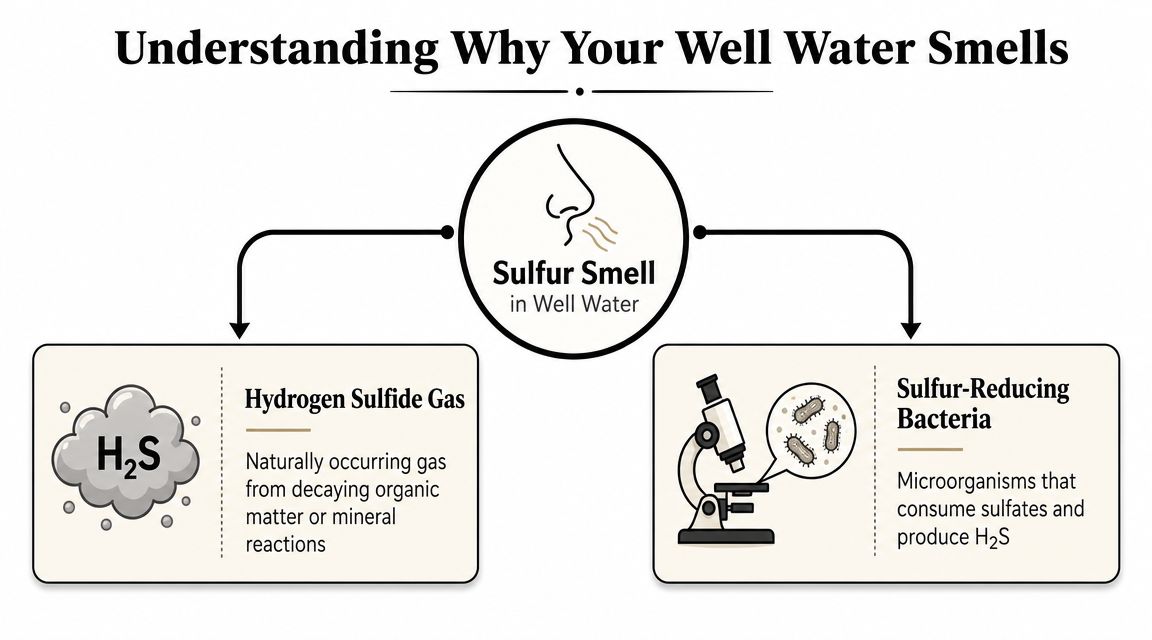
A rotten egg odor does not point to one single problem. In Central Florida, I regularly find two different causes behind the same complaint, and they do not get fixed the same way. That is where homeowners waste money. They buy a sulfur unit before confirming whether they are dealing with dissolved gas, bacterial growth, or sulfur showing up alongside iron and manganese.
Two causes that get mixed together
The first is hydrogen sulfide gas. This is the classic rotten egg smell. It stays dissolved in water until the water is disturbed, warmed, or pressurized and released at a faucet. That is why the odor often seems stronger in the shower or when a sink first turns on.
The second is sulfur-reducing bacteria. That is a biological problem. These organisms can create odor, slime, and buildup inside plumbing, filter housings, pressure tanks, and water heaters. In Florida wells, they also tend to show up with iron bacteria, which makes the cleanup and treatment plan more involved.
| Cause | What it is | What usually helps |
|---|---|---|
| Hydrogen sulfide | A dissolved gas causing odor | Oxidation, aeration, and filtration matched to the water |
| Sulfur bacteria | Living organisms in the system | Disinfection, sanitation, then filtration if needed |
Those are different problems, and they call for different equipment.
Why the cause changes the fix
If the smell is coming from dissolved hydrogen sulfide, the job is usually to oxidize it or release it from the water, then filter out what remains. If bacteria are part of the problem, a filter by itself often leaves the root cause in place. The odor may fade for a while, then come right back because the growth is still inside the system.
That distinction matters even more in Central Florida. A lot of local well water has iron, manganese, and sulfur together. Iron can mask what is really going on. Sulfur can also make an iron problem seem worse than it is. A single “sulfur filter” is not a reliable answer by itself. The right setup has to match the actual water chemistry, the presence or absence of bacteria, and the odor pattern you already found by checking hot water against cold.
If you are testing several water issues at once, it also helps to separate whole-house odor treatment from drinking water treatment. A point-of-use system such as reverse osmosis for drinking water can improve taste at one tap, but it does not solve a sulfur odor problem throughout the house.
The practical takeaway is simple. Identify whether the smell is gas, bacteria, or a mixed water-quality problem before you buy equipment. That step saves a lot of trial and error on Florida wells.
Comparing Sulfur Removal Systems for Your Home
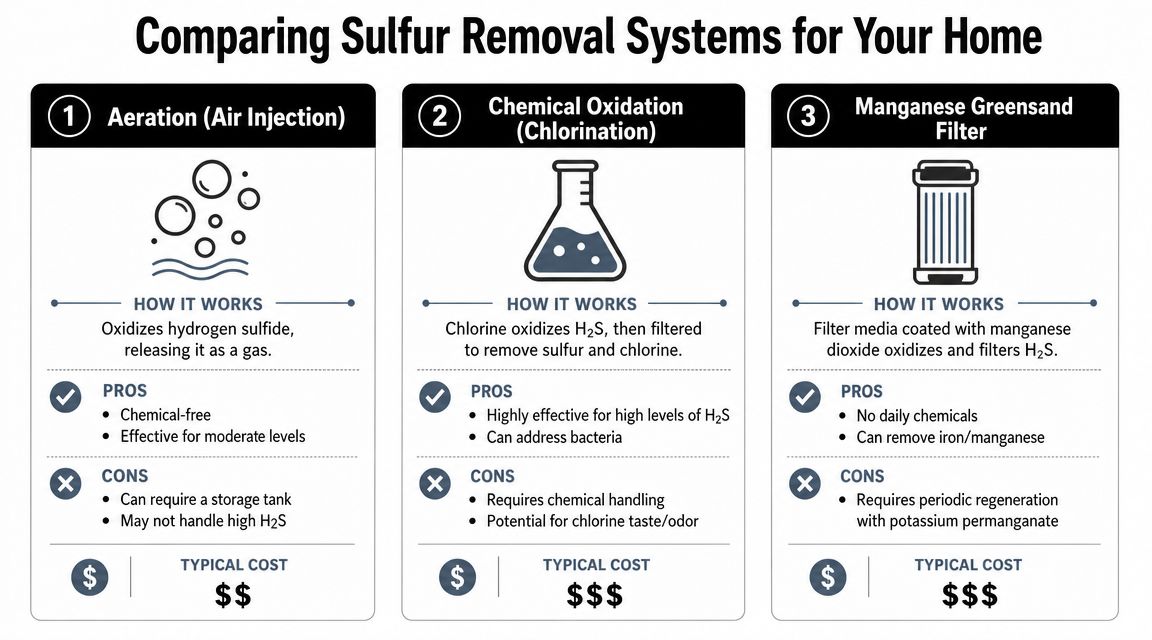
The right sulfur system depends on what is in the water. Around Central Florida, that usually means looking past the smell and choosing equipment that can handle sulfur alongside iron, manganese, or both. I see homeowners get sold a basic sulfur filter all the time, then call a few months later because the odor is back, the toilet stains are worse, or the media is already spent.
Activated carbon for low sulfur odor
Activated carbon works in a narrow lane. It is best for mild sulfur odor, especially where testing shows a light hydrogen sulfide issue and there is not much else competing for the media.
That makes carbon a reasonable option for homes where the smell is noticeable but not strong, and where the water does not also show the usual Florida mix of iron and manganese. Carbon is also useful as a polishing stage after another treatment step.
Use carbon when:
- The odor is mild: You notice it at the tap, but it is not filling the shower or laundry room with smell.
- The lab result supports a light sulfur load: Carbon does better in that range than in heavy-odor situations.
- Another system is doing the heavier work: Carbon can clean up taste and remaining odor after oxidation.
Skip carbon as a stand-alone fix for strong sulfur odor, recurring odor, or water that also leaves rust stains, black staining, or metallic taste. In those cases, carbon usually loads up too fast and does not address the full problem.
Oxidizing filters for sulfur with iron or manganese
This is the category that fits a lot of Central Florida wells. An oxidizing media filter can treat sulfur while also handling iron and manganese, which is often the typical combination in this region.
Media choice matters. Valve sizing matters too. A filter that looks fine on paper can perform poorly if the backwash rate, contact time, or media type does not match the water chemistry.
If your water has rotten egg odor plus orange staining, dark residue, or a bitter metallic taste, this is usually the first system type I compare. It is built for mixed nuisance-water problems, not just odor by itself.
A sulfur odor problem mixed with iron needs a properly matched treatment system. Generic sulfur filters often miss that.
Florida Water Management installs and services sulfur-focused filtration systems as part of broader reverse osmosis and whole-home water treatment options, but the correct setup depends on the water test, the odor pattern, and whether the smell shows up on cold water, hot water, or both.
Aeration and chlorination for heavier sulfur problems
Aeration is a practical option when the main issue is dissolved hydrogen sulfide gas. It exposes water to air so the gas can escape, then a follow-up filter handles what remains. In the right application, it works well.
It is not the best answer for every well.
Once sulfur gets heavier, or bacteria are part of the odor complaint, chlorination is often the more dependable approach. Chlorine oxidizes sulfur and helps control biological growth, which matters when the smell is persistent or keeps returning after simple filtration. A treatment overview from Purdue Extension on hydrogen sulfide options also notes that treatment choice shifts with sulfur concentration and with the presence of iron, manganese, or bacteria.
The correct solution depends on the test result. One home may do well with aeration and filtration. Another needs chemical feed, retention time, and a backwashing filter to finish the job.
A practical comparison
| System | Best fit | Main advantage | Main trade-off |
|---|---|---|---|
| Activated carbon | Mild sulfur odor with otherwise clean water | Simple option for light odor and taste cleanup | Shorter life when sulfur is strong or other contaminants are present |
| Oxidizing media filter | Sulfur with iron or manganese | Treats several nuisance issues in one system | Must be sized and configured to the actual water chemistry |
| Aeration | Dissolved hydrogen sulfide gas | Good gas removal without constant chemical feed in the right application | Less effective for every sulfur level and not ideal for bacterial problems by itself |
| Chlorination with filtration | Strong sulfur odor, recurring odor, or bacterial involvement | Oxidizes sulfur and helps sanitize the water system | Needs proper feed settings, contact time, and follow-up filtration |
Cheap fixes fail fast on Florida wells. A system that matches the full water profile usually costs less than replacing the wrong equipment twice.
Special Cases and Professional Advice
Some sulfur complaints don't start with a permanent treatment unit. They start with cleanup. Others need a combination approach because the odor problem is tied to bacteria, heater conditions, or water that's only being polished at one tap.
When shock chlorination makes sense
Shock chlorination is a sanitation step, not a magic upgrade. It makes sense when sulfur bacteria are active in the well or plumbing and the odor keeps coming back because the system itself is contaminated.
Verified field guidance describes shock chlorination as a standard response to sulfur bacteria, often requiring a 12–24 hour contact period for plumbing disinfection. The same body of guidance also notes that raising a water heater to 160°F (71°C) for several hours can destroy sulfur bacteria, showing that sulfur control may require sanitation and heat, not only filtration, as discussed in this summary of sulfur treatment and disinfection procedures.
That matters because some odors come from biofilm, not just from dissolved gas. If bacteria are living in the well casing, plumbing, or heater, filtration alone can leave the source in place.
What softeners and reverse osmosis can and cannot do
A water softener is not a sulfur-removal device. It may be part of a complete system when hard water is also present, but it doesn't solve hydrogen sulfide odor by itself.
A reverse osmosis system is different. It's useful as a point-of-use finishing step for drinking water. If a home already has whole-house pretreatment, RO can give you cleaner, better-tasting water at the kitchen tap. It is not the main answer for a whole-house sulfur odor problem affecting showers, laundry, and every faucet.
DIY versus professional work
Some tasks are reasonable for a homeowner. Others are not.
- Reasonable DIY work: Basic observation, hot-versus-cold testing, documenting when the smell appears, and replacing simple cartridges if the system is already designed correctly.
- Borderline DIY work: Water-heater troubleshooting, especially if you understand anode rods and safe temperature adjustments.
- Professional work: Oxidizing filters, chlorination feed systems, aeration tanks, control-valve setup, and any diagnosis involving multiple contaminants.
If sulfur odor is mixed with iron, bacteria, or recurring heater issues, the job usually needs system design, not guesswork.
If you need testing, sanitation, installation, or service work, review the available water treatment services in Central Florida before deciding how far to go on your own.
Your Central Florida Sulfur Removal Action Plan
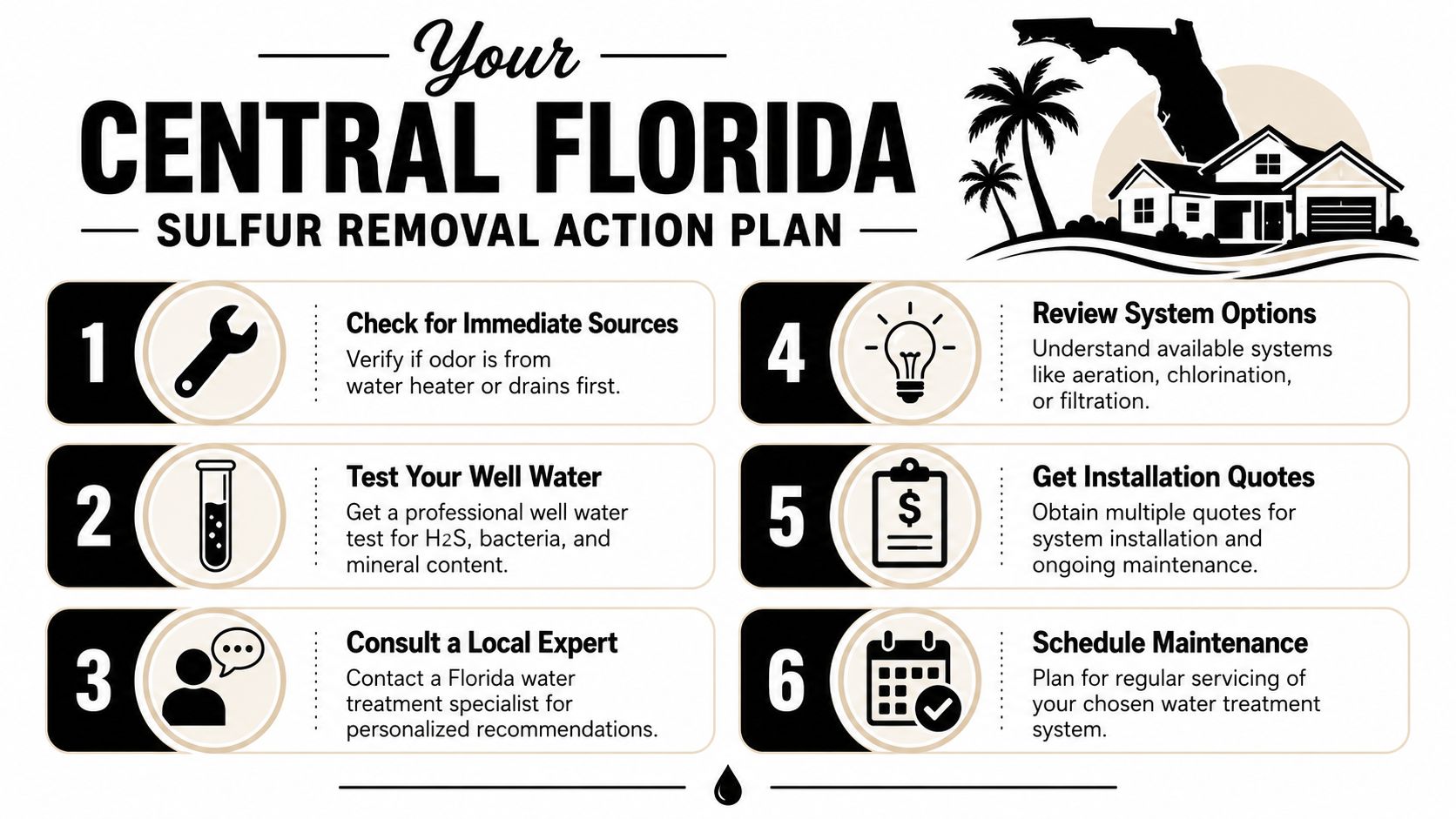
In this part of Florida, sulfur odor problems rarely stay neatly isolated. A house may have sulfur odor, hard water, iron staining, scale buildup, and a water heater that makes the smell worse. That's why the cleanest path is a checklist, not a random purchase.
Your next steps
Check whether the odor is hot water only
If it is, focus on the water heater first. Don't jump to a whole-house sulfur system.Confirm whether cold water smells too
If cold water carries the odor, the well water or system plumbing becomes the primary suspect.Watch for signs of a mixed water problem
Iron staining, dark residue, slime, and recurring odor all point to a treatment choice that has to do more than simple odor control.Protect your plumbing and septic setup during any disinfection work
If you move forward with shock chlorination, follow the procedure carefully and avoid casual dumping of highly chlorinated water where it shouldn't go.Get the water tested before buying equipment
Water testing helps avoid most wasted money. The right sulfur solution depends on what's in the water and where the odor starts.
For homeowners in Sebring, Avon Park, Lake Wales, Winter Haven, Frostproof, and nearby communities, local well conditions matter. Treatment that works in one house may be the wrong fit for another house a few miles away. If you want to know how to remove sulfur from well water permanently, the goal isn't to buy a product first. The goal is to identify the correct treatment path first.
If you're dealing with rotten egg odor in your well water, the simplest next step is to schedule a free water test with Florida Water Management. That gives you a clear starting point before you spend money on filters, heater work, or whole-house equipment.