

You turn on the shower in Avon Park and catch that familiar smell. Maybe it's a sulfur odor. Maybe the sink already has orange or white buildup around the drain. Maybe your dishes come out cloudy, your water heater seems to work too hard, or you've started wondering whether your well water is just “normal Florida water” or something you should fix.
That's where most homeowners start. Not with equipment. With symptoms.
Good well water treatment in Avon Park, FL starts by treating your water like a local groundwater problem, not a shelf product problem. Water in this area needs a closer look, and the right answer usually isn't a single cartridge filter from a hardware store. It's a test, a diagnosis, and a treatment plan that matches what your well contains. If you want clear answers about your own water, schedule a free local water filtration evaluation.
Table of Contents
- Your Guide to Clean Well Water in Avon Park
- Why Avon Park Well Water Needs a Closer Look
- The First Step to a Solution Is a Proper Water Test
- Matching the Right Treatment System to Your Water Issue
- What to Expect When Working with a Water Professional
- Maintaining Your System for Long-Term Pure Water
Your Guide to Clean Well Water in Avon Park
A lot of Avon Park homeowners live with water problems longer than they should. They scrub stains off toilets, replace appliances sooner than expected, and keep buying little add-on filters that never solve the root issue. That usually happens because the water has more than one problem at the same time.
In this area, that isn't surprising. Groundwater conditions often lead to a mix of hardness, sediment, odor, staining minerals, and possible drinking-water concerns. A sulfur smell doesn't automatically mean you need the same fix as your neighbor. White scale on fixtures doesn't tell you whether dissolved metals or microbes are also part of the picture.
Practical rule: If a system recommendation comes before a water analysis, it's a guess.
The good news is that most well water problems are very manageable when the treatment matches the water. Clean, reliable water isn't out of reach. It just takes the right sequence. Test first, size correctly, pretreat where needed, and maintain the equipment after installation.
Why Avon Park Well Water Needs a Closer Look
Avon Park homeowners aren't dealing with random water issues. They're dealing with groundwater conditions that have a pattern, and that pattern matters when you choose treatment equipment.
Groundwater here has its own profile
Avon Park's municipal system draws groundwater from the Floridan Aquifer through seven wells, and the city says it serves about 11,051 residents in South Avon Park. The utility was established in 1886. For nearby private-well owners, that local groundwater context matters because treatment usually needs to be matched to aquifer conditions rather than handled with one generic filter from a store shelf, according to the Avon Park utilities department.
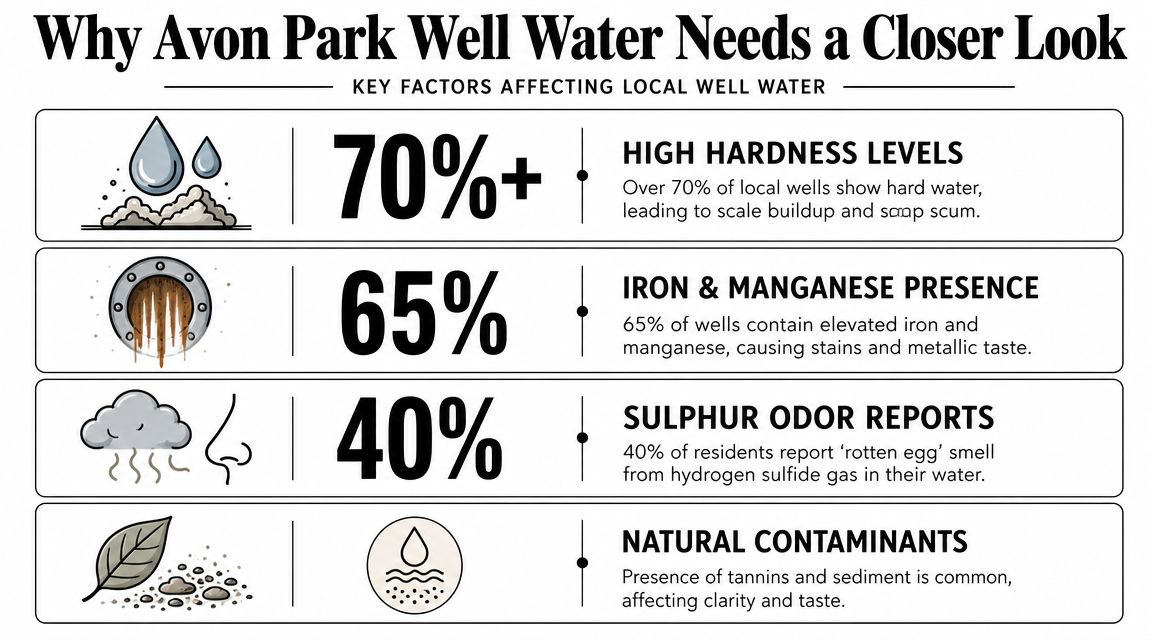
A separate Avon Park water-quality summary says typical families can face $1,130–$1,980 in annual hard-water damage, or $11,300–$19,800 over 10 years, and it identifies contaminants of concern including arsenic, chlorate, hexavalent chromium, combined radium, and total trihalomethanes, with five contaminants exceeding health advocacy guidelines in that report's review of area water data. That's why local treatment often combines softening, filtration, and sometimes drinking-water polishing or disinfection instead of relying on one device to do everything, as described in this Avon Park water quality report and treatment overview.
What that means inside your house
Hard water is the complaint people notice first because it shows up everywhere. You see it on glass, faucet aerators, shower doors, and heating elements. It also chips away at the performance of water heaters, dishwashers, and plumbing fixtures.
Then there are the problems people smell or taste. Sulfur odor, metallic notes, and earthy water can point to very different causes. Sediment can make water look dull or dirty. Iron can stain. Organic matter can affect taste. Microbial risk changes the conversation again because then the issue isn't comfort or cleanup. It's safety.
That's why well water treatment in Avon Park, FL should start with diagnosis, not shopping.
A big-box filter can help one symptom while missing the problem that is most important. If the underlying issue is dissolved minerals, microbes, or a contaminant that needs point-of-use treatment, a simple cartridge won't get you there. If the water has multiple issues, the order of treatment matters too. For homes that need whole-home microbial protection, homeowners often end up looking at systems built around proper pretreatment and water sterilization options for residential use.
The First Step to a Solution Is a Proper Water Test
Most bad system decisions happen before a unit is ever installed. Someone sees stains, smells sulfur, or notices scale and buys what sounds right. Then the odor stays, the staining changes color, or the new system clogs because the pretreatment wasn't right.
That's why the technically correct first step for private wells in the Avon Park area is a full water analysis. Treatment comes second.
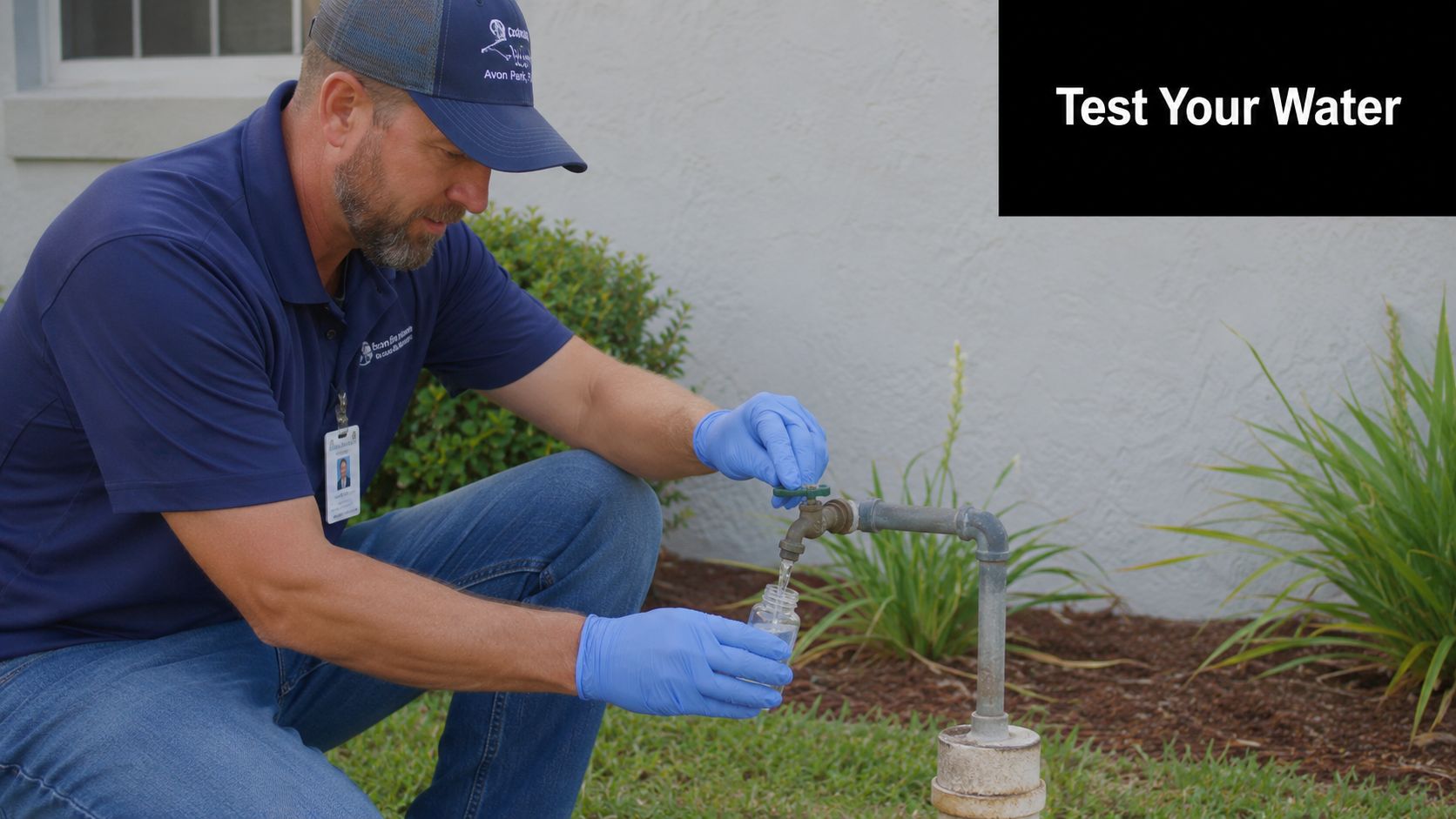
Why guessing costs more than testing
DIY strips have their place, but they don't replace a real evaluation of a private well. A proper test helps separate look-alike problems that need very different solutions. Sulfur odor, for example, can show up alongside sediment, iron, or microbial concerns. Hardness can be present at the same time as dissolved contaminants that need a different stage of treatment.
A source-specific plan may include sediment filtration, activated carbon, reverse osmosis, and chlorination or UV disinfection depending on what turns up in the analysis. Florida DEP guidance summarized in a local Avon Park treatment resource notes that the key is matching the technology to the risk class, and that the main pitfall is skipping testing and installing a generic system that fails to treat dissolved metals, nitrates, or microbes, as explained in this Avon Park well water purification guide.
Water that looks better isn't always water that's been fully treated.
What a real analysis helps uncover
A professional water test gives you a treatment path instead of a sales pitch. It helps determine whether the house needs whole-home treatment, point-of-use drinking water treatment, or both. It also helps size the equipment so you don't end up with a softener that breaks through too early or a membrane that fouls faster than it should.
Look for a provider who explains findings in plain language and tells you what each stage is doing. If you want that kind of starting point, request a free water test through the contact page. It's the fastest way to stop guessing and start solving the actual water problem.
Matching the Right Treatment System to Your Water Issue
The right equipment depends on the problem. That sounds obvious, but a lot of systems get sold as cure-alls when they're really single-purpose tools. A softener handles hardness. It doesn't replace disinfection. Carbon improves taste and odor issues in the right applications. It doesn't stand in for every dissolved contaminant problem.
Problem and solution matrix
| Common Problem | Telltale Sign | Primary Solution | How It Works |
|---|---|---|---|
| Hard water | White scale on fixtures, soap not rinsing well, buildup in heaters | Water softener or scale-control approach matched to test results | Reduces hardness effects that lead to scaling and equipment wear |
| Sediment | Grit in water, dirty filter housings, cloudy water | Sediment filtration | Screens out particulates before they reach downstream equipment |
| Iron or similar staining issues | Orange, brown, or dark staining, metallic taste | Iron-focused filtration with proper pretreatment | Targets staining minerals so they don't pass into household plumbing |
| Sulfur odor | Rotten egg smell, especially at taps or after water sits | Oxidation and filtration, sometimes paired with other stages | Converts odor-causing compounds and removes them before use |
| Drinking-water contaminant concerns | You want cleaner water at the kitchen tap | Reverse osmosis at the point of use | Reduces many dissolved solids and certain metals in drinking water |
| Microbial risk | Well safety concerns, coliform history, seasonal water changes | UV or chlorination with correct pretreatment | Disinfects water when microbial control is needed |
What works and what usually does not
For hard water, the practical goal is protecting plumbing, heaters, and fixtures from scale. If hardness is the dominant issue, softening is usually the backbone of the system. If you mainly want scale prevention and your water profile fits that approach, a conditioner may be part of the discussion, but it shouldn't be positioned as identical to true hardness removal.
For stains and odor, pretreatment matters more than homeowners expect. If sediment or iron is still moving through the line, downstream equipment has to work harder and often fails earlier. Sulfur odor can improve with the right oxidation and filtration setup, but the setup has to match the water chemistry. There isn't a universal sulfur tank that works in every well.
Field note: The sequence matters as much as the equipment. Put the right unit in the wrong order and performance drops fast.
For safer drinking water, reverse osmosis is often the right point-of-use tool when the concern is what people consume at the tap. For whole-home microbial control, UV or chlorination can be appropriate, but only when the water feeding that disinfection stage is clean enough for it to work properly.
Florida Water Management offers filtration, softening, reverse osmosis, and sterilization systems for homes in the area, but the equipment category should always follow the test results, not the other way around.
What to Expect When Working with a Water Professional
A proper service call shouldn't feel like someone walked in with one tank on the truck and decided that's your answer. It should feel more like troubleshooting a mechanical system in your house. Symptoms first. Water test next. Then a recommendation that explains what problem each component solves.
The visit should feel diagnostic not pushy
The first conversation is usually simple. What are you seeing, smelling, tasting, or cleaning constantly? Has the water changed after rain, pump work, or plumbing updates? Are you more worried about bathing water, appliance protection, or drinking water at the sink?
At the appointment, the technician should inspect the setup, sample the water, and look at how the home uses water. Flow rate, plumbing layout, and where treatment needs to happen all affect the final recommendation. A whole-home system and a kitchen drinking-water system solve different problems.
A good proposal is easy to read. It identifies the issue, explains the treatment train, and tells you what maintenance will be required. Installation day should be organized, with clean plumbing work and a walkthrough that shows you what normal operation looks like.
Questions worth asking before you buy
Use these questions with any provider:
- What exactly did the water test show: Ask them to tie each recommendation to a water condition, not a vague promise.
- What does each stage do: Sediment, carbon, softening, RO, and UV all serve different jobs.
- What maintenance will I handle myself: Salt refills, cartridge changes, and visual checks are common homeowner tasks.
- What needs professional service: Media replacement, UV service, calibration, and troubleshooting often belong on a scheduled visit.
- What happens if my water changes: Seasonal shifts and well changes can require adjustments.
If a contractor can't explain why each component is there, the system is probably oversold, undersized, or both.
Maintaining Your System for Long-Term Pure Water
A water treatment system isn't something you install and forget. It's more like an AC system. If it's maintained, it keeps doing its job. If it's ignored, performance slips and homeowners often blame the equipment when the problem is neglected service.
The simple upkeep that matters
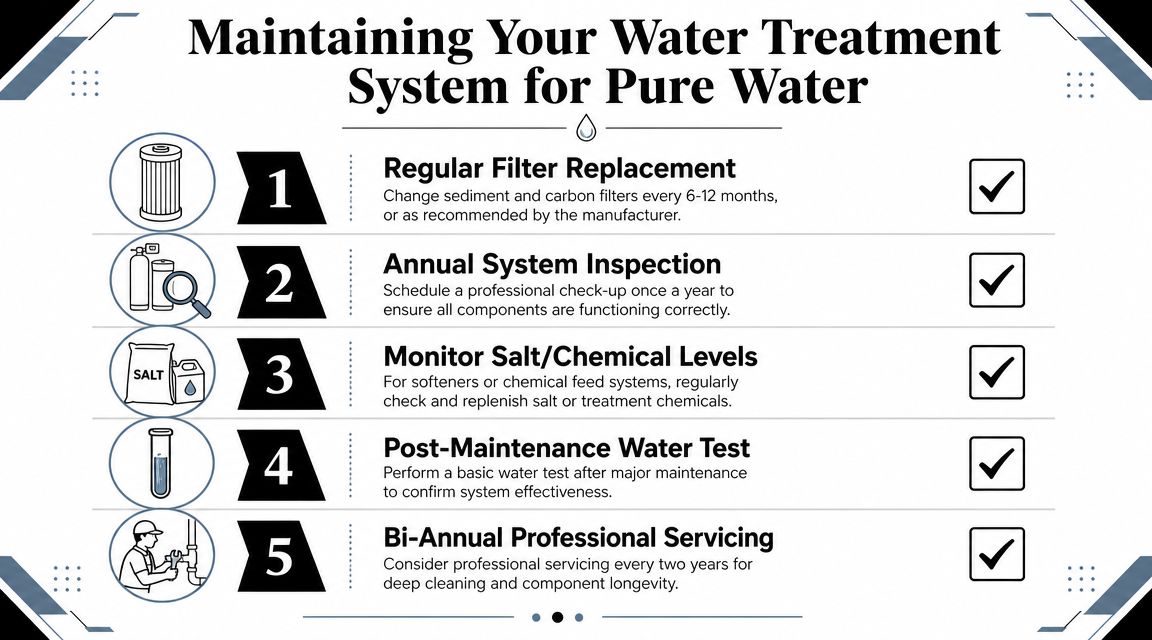
Some tasks are routine and straightforward. If you have a softener, keep up with the salt or other required supplies. If you have filter housings, watch for pressure drop, visible fouling, or cartridge change intervals. If your system treats drinking water at one tap, pay attention to taste changes because they can be an early warning sign.
Homeowners should also keep an eye on changes in the water itself:
- Odor returning: A sulfur smell that comes back usually means a treatment stage needs attention.
- Stains reappearing: Breakthrough on hardness or iron-related problems often shows up on fixtures first.
- Lower flow: Sediment loading, clogged cartridges, or fouled media can cut pressure.
- Taste changes at the kitchen tap: Drinking-water components may be due for service.
Why neglected systems fall behind
In Central Florida well water systems, the most common failure mode is poor pretreatment and lack of maintenance. Sediment or iron can foul UV lamps and RO membranes, while undersized softeners lead to scale breakthrough. A practical field rule is an annual inspection with media or component replacement as needed, because neglected filters and resin beds are the main reason even appropriate systems underperform, according to this Central Florida well water treatment maintenance guide.
That lines up with what technicians see in the field. The technology often isn't the problem. The skipped service is.
If your water has started changing again, or if you're not sure your current setup is still doing what it should, get it checked before a minor performance issue turns into another round of staining, odor, or equipment wear.
If you're dealing with sulfur smell, hard water stains, sediment, or questions about what's really in your well, Florida Water Management can help you start with the right step: a free water test and a clear explanation of what your water needs.