

You turn on the kitchen tap, fill a glass, and notice a faint chlorine smell. Later, you unload the dishwasher and see cloudy spots on the glasses again. Then you look up Bradenton water information online and end up with a stack of terms that don't answer the actual question: what should you do in your house?
That's where most homeowners get stuck. Municipal water can be compliant and still leave you unhappy with taste, odor, spotting, or what's showing up in independent testing. Well water can be even more variable from one property to the next. The right answer usually isn't “buy a filter.” It's match the treatment to the water.
If you're searching for drinking water filtration in Bradenton, FL, start with diagnosis, not guesses. A proper water test tells you whether you need a simple carbon solution, a kitchen reverse osmosis system, a whole-home setup, or a layered approach.
Table of Contents
- Why Bradenton Homeowners Are Talking About Water Quality
- Understanding Your Bradenton Water Profile
- A Homeowner's Guide to Filtration Technologies
- Whole-Home Systems Versus Point-of-Use Filters
- How to Select the Right System for Your Bradenton Home
- Professional Installation and Long-Term Maintenance
- Frequently Asked Questions About Bradenton Water Filtration
Why Bradenton Homeowners Are Talking About Water Quality
In Bradenton, water complaints tend to sound ordinary at first. A shower that smells a little off. Ice that tastes flat. White film on fixtures. Laundry that never seems quite right. These aren't dramatic problems, but they're the kind that wear on people because they happen every day.
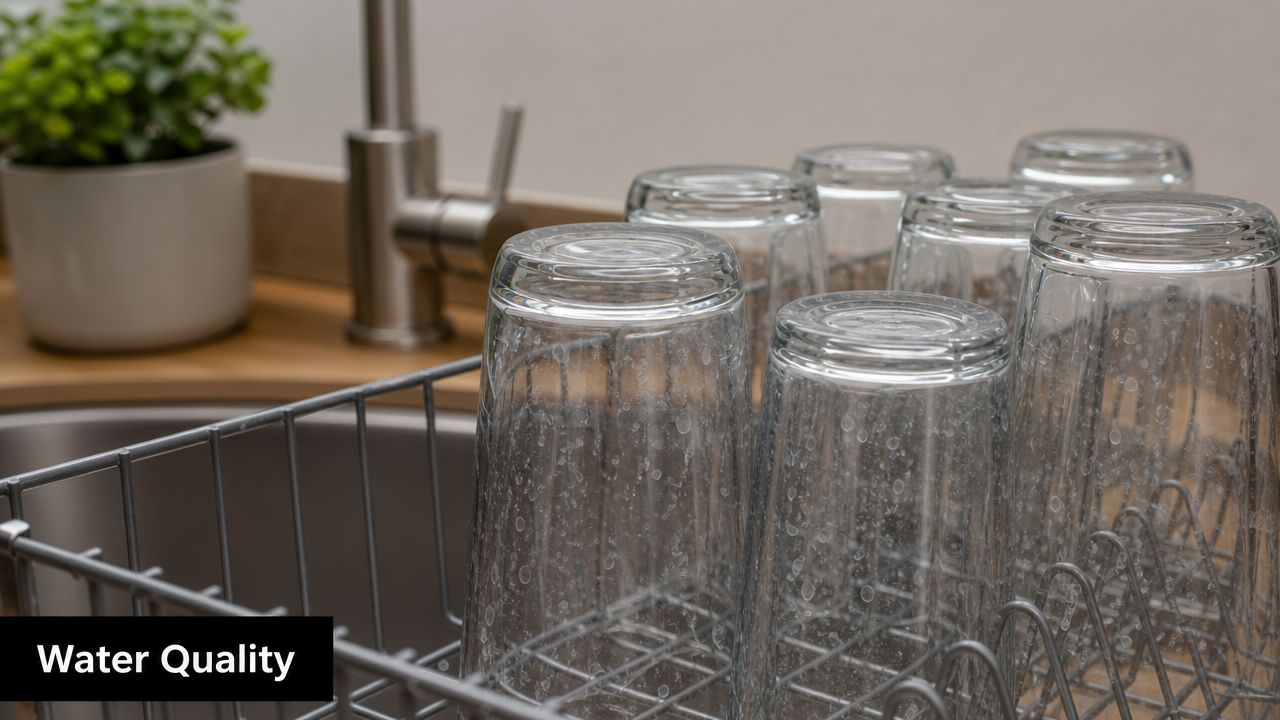
A lot of homeowners assume they're overreacting. They aren't. Water can be legally treated and still be unpleasant to live with. That gap between safe enough and good enough for your home is why filtration stays a live topic in this area.
A local Bradenton water-treatment provider says it has served Bradenton with water filtration and purification systems for over 30 years, which shows this isn't a new fad or a sudden burst of marketing activity. It lines up with long-standing local demand for systems that address chlorine, sulfur odors, sediment, and related water concerns in homes and businesses, as noted by this Bradenton water filtration service page.
Everyday complaints usually point to specific treatment needs
Most households don't need every type of equipment. They need the right equipment.
- Bad taste or smell often points toward carbon-based treatment.
- Spots on dishes and scale around fixtures usually send the conversation toward hardness and whole-home protection.
- Concerns about drinking water quality at the kitchen sink often call for a point-of-use solution with stronger contaminant reduction capability.
- Well-water odor or discoloration usually requires a more customized setup.
Practical rule: Don't choose a system based on the loudest symptom alone. A chlorine smell and a health-related concern are not the same problem, so they shouldn't get the same treatment.
Homeowners usually feel better once they stop trying to decode product labels and start with their own water. That's the useful shift. Instead of asking, “Which filter is best?” ask, “What is this system designed to remove from my water?”
Understanding Your Bradenton Water Profile
A Bradenton homeowner on city water usually notices the problem at the sink or in the shower. The water is technically safe to drink, but it may smell like chlorine, leave mineral spotting, or taste flat enough that bottled water starts showing up in the fridge. A homeowner on a private well often sees a different pattern. One house has sulfur odor, another has orange staining, and a third has grit in the aerators after heavy rain.
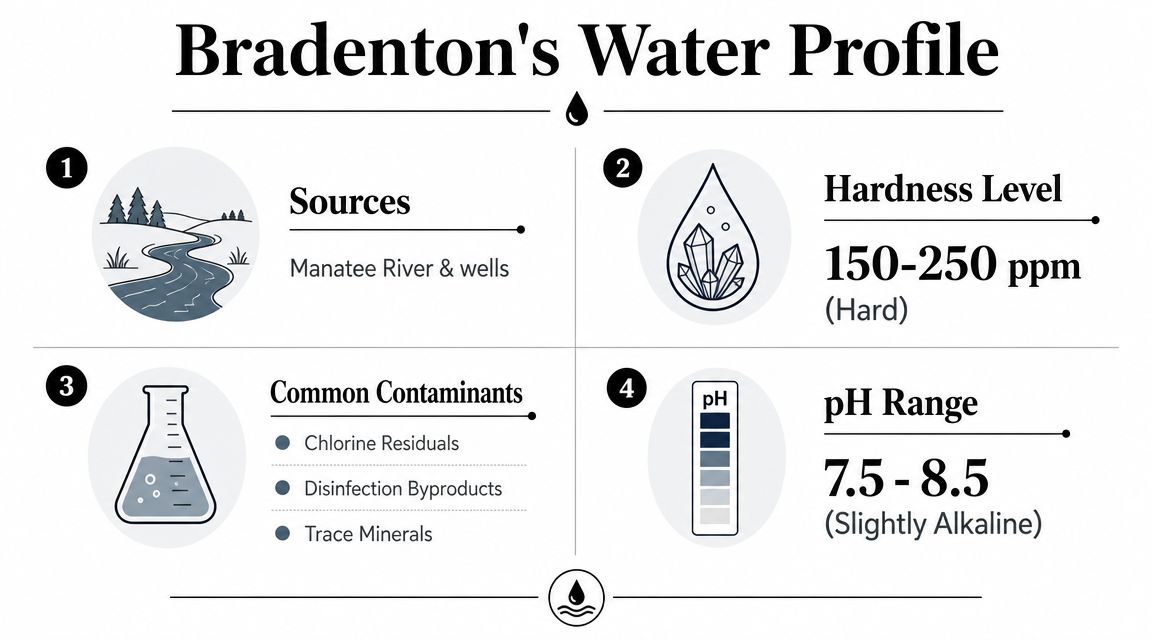
Those differences matter because the right filter depends on the source water, the plumbing inside the home, and the complaint you are trying to solve. In Bradenton, the first useful question is simple. Are you on municipal water or a private well?
City water and why "safe" is not the same as "ideal in your home"
Bradenton's municipal supply is treated and regulated, and the city states on its water services information page that it provides drinking water that meets or surpasses federal standards. That baseline matters. It means homeowners are usually not starting from untreated raw water.
What I explain to homeowners all the time is that compliance and satisfaction are different standards. Water can meet regulatory requirements and still leave you wanting less chlorine taste, less odor, fewer spots on glassware, or an added reduction step at the kitchen tap for drinking and cooking. Those are legitimate reasons to install filtration.
The treatment goal on city water is often narrower than people expect. It is usually not "filter everything." It is "reduce the specific things you notice every day without creating maintenance headaches you do not need."
Private wells need diagnosis first
Well water in the Bradenton area is less predictable. Two homes a few streets apart can need completely different treatment. One may need sulfur reduction and sediment control. Another may need iron treatment and hardness management. Seasonal changes can shift the water enough that a system chosen by guesswork ends up solving only half the problem.
That is why a free water test is not a sales formality. It is the first real diagnostic step. If a homeowner says the water smells bad, I still need to know whether that odor points to sulfur, chlorine from shock treatment, organic material, or a plumbing issue inside the home. The equipment choice changes based on that answer.
If you are on a well, start with actual testing and then compare the results to well water treatment options in Florida that match the source water conditions, not just the symptom.
What the water profile tells you
A Bradenton water profile should answer a few practical questions before anyone talks about equipment:
- Municipal or well source. This determines the likely starting issues.
- Primary complaint. Taste, odor, spotting, staining, scale, or sediment each point in different directions.
- Whole-house problem or drinking-water problem. Shower odor and appliance scale are different from a kitchen sink concern.
- Test results. This confirms whether the issue is nuisance-related, health-related, or both.
That process keeps homeowners from buying too much system for a minor issue, or the wrong system for a serious one. In practice, the best filtration plan in Bradenton usually starts with one clear diagnosis, not a generic package.
A Homeowner's Guide to Filtration Technologies
A lot of confusion comes from expecting one device to solve every water problem. It won't. Different technologies do different jobs, and the best results come from pairing the equipment to the contaminant class.
What each technology actually does
Sediment filtration is the simplest place to start. Think of it as a screen. It catches visible particulate matter before that material moves farther into your plumbing or into more specialized treatment equipment. It's often used as a first stage, not as a complete solution.
Activated carbon works differently. Carbon is the workhorse for taste, odor, chlorine, and some dissolved organics. If the complaint is “my water smells like a pool” or “the tap tastes off,” carbon is often the first technology worth discussing.
Reverse osmosis, or RO, is a membrane-based process. According to this technical overview of water filters, granular media and activated carbon are used for sediment, taste and odor, chlorine, and some dissolved organics, while membrane systems are needed when the target is submicron particles or dissolved inorganics such as nitrate or lead. The same source notes that NSF-certified point-of-use RO units are the strongest technical option for the kitchen tap when the goal is verified reduction of health-related contaminants rather than just taste improvement.
That's the main dividing line homeowners should remember. Carbon improves many aesthetic issues. RO goes further when you want a more rigorous drinking-water solution at a specific faucet. If you want to understand how an under-sink system fits into a home plan, it helps to review reverse osmosis system options.
Water softeners sit in a separate category. They aren't drinking-water purifiers in the same sense as RO. Their job is to address hardness-related problems that show up as scaling, spotting, and wear on fixtures and appliances.
UV systems are also separate. They're used when microbial control is part of the design, which is more common in certain well-water applications than in standard municipal kitchen-tap taste complaints.
Field advice: If a salesperson says one cartridge or one tank handles every issue equally well, slow the conversation down. Real treatment design is more specific than that.
Water Filtration Technology Comparison
| Technology | Primary Target | Best For | Maintenance Needs |
|---|---|---|---|
| Sediment filter | Dirt, sand, visible particulate | Pre-treatment, protecting plumbing and downstream equipment | Periodic cartridge changes |
| Activated carbon | Chlorine, taste, odor, some dissolved organics | Municipal water aesthetic improvement, whole-home or point-of-use use | Media or cartridge replacement |
| Reverse osmosis | Dissolved inorganics and finer contaminant reduction at the tap | Drinking and cooking water at the kitchen sink | Filter changes and membrane service over time |
| Water softener | Hardness minerals | Whole-home scale control and appliance protection | Salt replenishment and routine service |
| UV sterilization | Microbial treatment support | Specific well-water applications | Lamp replacement and ongoing monitoring |
Whole-Home Systems Versus Point-of-Use Filters
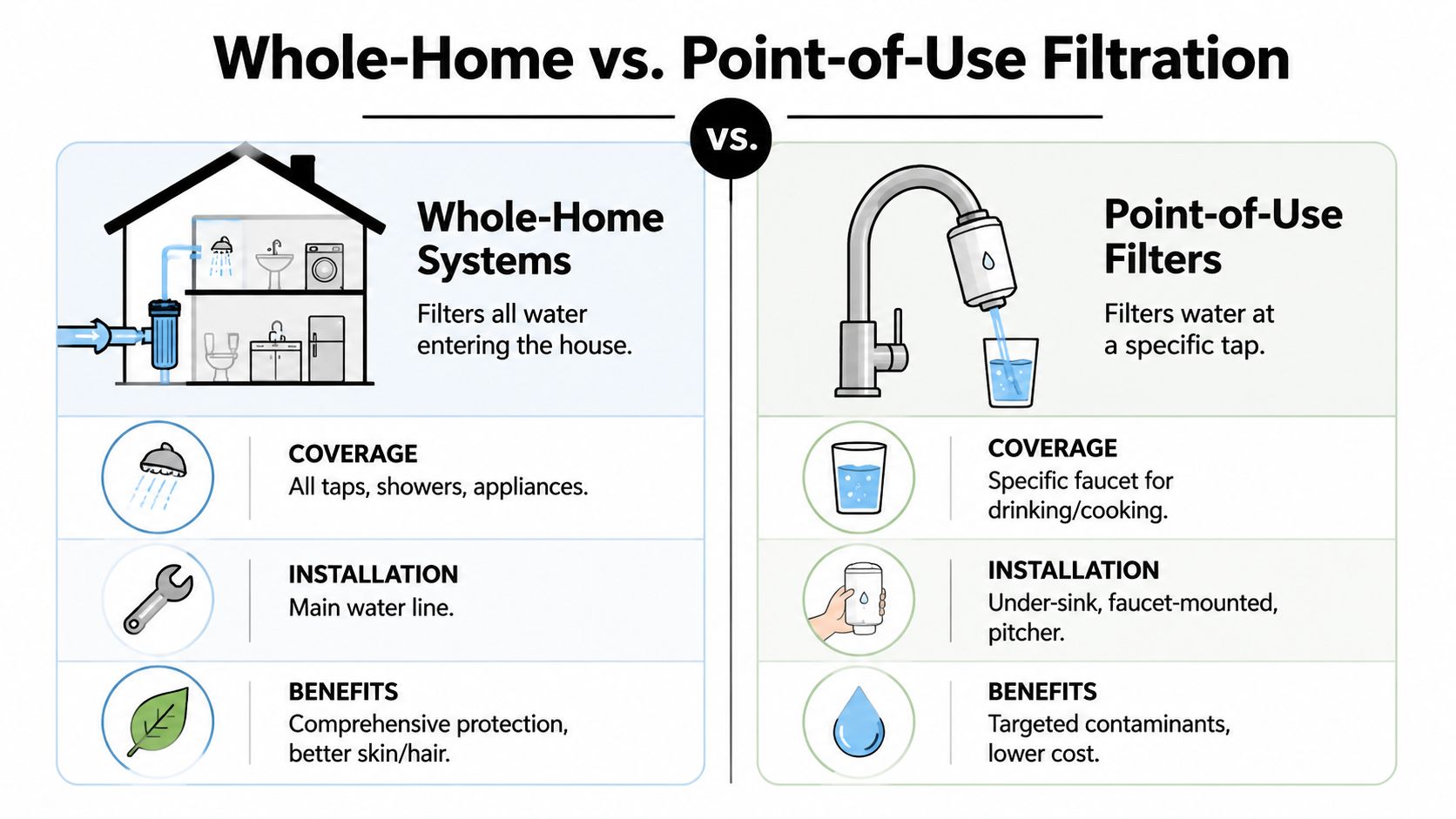
Homeowners usually narrow their options once they answer one simple question. Are you trying to improve all the water in the house, or are you mainly focused on the water you drink and cook with?
When whole-home treatment makes sense
A whole-home system treats water where it enters the house. That means every shower, faucet, toilet, washing machine, dishwasher, and water heater benefits from the treatment design.
This route makes sense when the problem isn't limited to drinking water. If you notice chlorine in the shower, recurring scale on fixtures, staining, sediment, or general water-quality issues throughout the house, point-of-use equipment won't solve the broader problem. You'll still have untreated water moving through plumbing and appliances.
Whole-home treatment is usually about three goals:
- Protecting plumbing and equipment from scale, sediment, or nuisance water conditions
- Improving comfort during bathing, laundry, and cleaning
- Creating consistency at every tap instead of only at one sink
When point-of-use is the smarter move
Point-of-use filtration treats water at one location, usually the kitchen sink. That makes it ideal when your main concern is the water you consume, not every gallon entering the house.
For many Bradenton households, the most sensible drinking water filtration setup is a hybrid. Use whole-home equipment to handle house-wide nuisance issues, then add an under-sink RO unit where drinking and cooking water need stronger contaminant reduction. That approach avoids overbuilding the entire house for a problem that only matters at one faucet.
A simple comparison helps:
| Approach | Main benefit | Limits |
|---|---|---|
| Whole-home system | Treats water throughout the house | May not deliver the same drinking-water refinement as a kitchen RO |
| Point-of-use filter | Targets one tap for drinking and cooking | Leaves showers, appliances, and other fixtures untreated |
| Hybrid setup | Covers both household use and tap-water priorities | Requires coordinated design, not off-the-shelf guesswork |
The mistake I see most often is buying a small kitchen solution for a whole-house problem, or a whole-house system when the concern is only what goes into drinking glasses and coffee makers.
How to Select the Right System for Your Bradenton Home
A Bradenton homeowner usually calls after the water has started affecting daily routines. Glass spots show up faster, the shower feels different, the ice tastes off, or a well system starts acting inconsistently after heavy rain. At that point, the right question is not which filter is popular. The right question is what your water is doing in this house, on this water source.
Start with testing, not product shopping
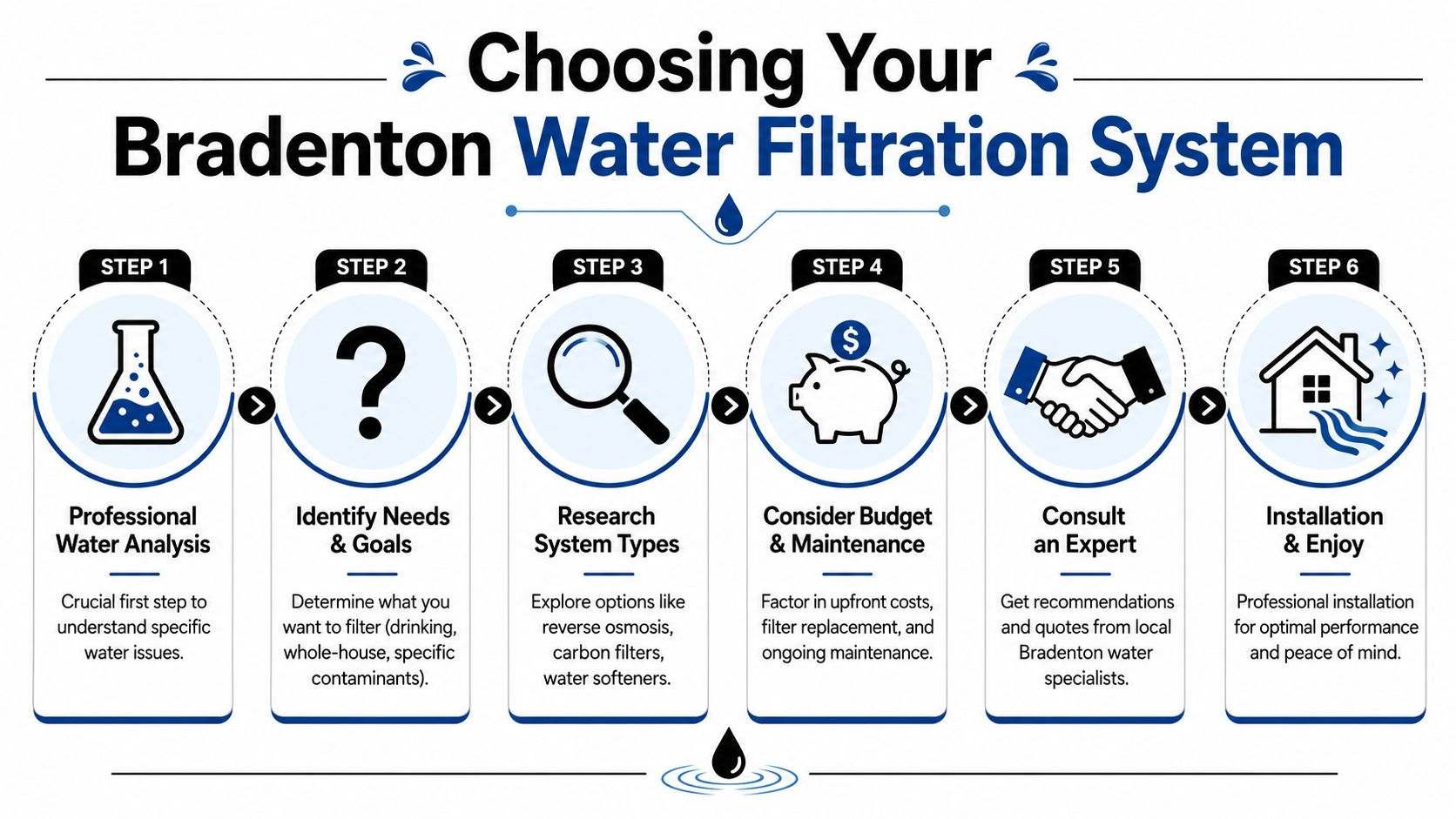
In Bradenton, municipal and well water can create very different treatment needs. City water complaints often center on taste, odor, or chlorine-related concerns. Well water calls are more likely to involve sediment, sulfur odor, iron, hardness, or swings in water quality over time. That is why a free water test matters. It keeps you from buying equipment for the wrong problem.
I see this mistake all the time. A homeowner installs a basic carbon filter because the water tastes bad, but the actual issue at the kitchen sink calls for reverse osmosis. Or they add an under-sink unit while hardness and sediment continue to affect fixtures, appliances, and water heaters throughout the home.
Once the test results are clear, the selection process gets much simpler. Focus on three decisions:
- What needs to be fixed first? Taste, odor, hardness, staining, scale, sediment, or higher-level drinking water reduction.
- Where should treatment happen? At the main line, at one drinking tap, or in a staged setup that does both.
- Who will service it later? Good equipment only stays effective if replacement parts, maintenance, and setup support are realistic for the home.
What to look for in the actual equipment
For Bradenton homes, I tell people to ignore brand-heavy sales language and look at fit. The unit has to match the water condition, the home's flow needs, and the claim it is certified to make.
Florida DEP's water filtration systems guidance is useful here because it separates aesthetic improvement from health-related reduction claims. NSF/ANSI 42 applies to issues such as chlorine taste and odor. NSF/ANSI 53 applies to certain health-related contaminant reduction claims, such as lead or cysts. Those are not interchangeable standards, and homeowners in Bradenton often get shown systems that sound good but are certified for a different purpose than the one they have in mind.
Flow rate matters too. A system can be effective on paper and still be a poor choice if it restricts the home during normal use. That becomes more noticeable in larger households, homes with multiple bathrooms, and any setup where pre-filters, carbon treatment, softening, and drinking-water equipment all need to work together.
Practical shortcut: Ask what the system is certified to reduce, where it should be installed, and what happens to pressure and flow once it is in service.
How to narrow the final choice
The final decision should reflect the water test, not a template.
A kitchen-only concern often points to a point-of-use system, especially when the goal is better drinking and cooking water without treating every gallon entering the home. A chlorine or odor issue throughout the house usually points toward whole-home carbon treatment. Scale, soap inefficiency, and mineral buildup call for a serious look at softening. For many well-water homes in the Bradenton area, the right answer is staged treatment, not one all-purpose box.
Budget still matters, but after the technical match is clear. A lower-priced system that misses the actual problem usually costs more in callbacks, cartridge changes, appliance wear, or replacement. If you are comparing options, this guide to home water filtration system cost factors helps set expectations.
Florida Water Management provides whole-home filtration, softening, reverse osmosis, and sterilization systems for homes and small businesses. That kind of provider should be judged on testing, certification, installation quality, and whether the recommended system matches Bradenton water conditions instead of a one-size-fits-all sales script.
Professional Installation and Long-Term Maintenance
A good system can still underperform if it's installed poorly. Placement, bypass configuration, shutoffs, pre-treatment order, drain connections, and pressure conditions all affect how the equipment behaves in daily use.
Installation affects performance
Professional installation matters because water treatment isn't just about attaching a device to a pipe. The system has to fit the plumbing layout, the household's demand, and the intended treatment sequence. That's especially true when a home combines more than one technology, such as sediment pre-filtration with carbon, softening, or RO.
A rushed install often shows up later as weak flow, nuisance leaks, premature filter loading, or equipment that technically runs but doesn't solve the original complaint.
Maintenance should be predictable
Maintenance shouldn't feel mysterious. It should be a routine part of ownership.
Most residential systems need some combination of cartridge replacement, media service, salt replenishment, lamp replacement, sanitizing, or performance checks over time. The exact schedule depends on the equipment and the water it's treating, which is another reason a custom diagnosis matters at the beginning.
A practical maintenance plan usually includes:
- Scheduled filter changes so drinking-water quality stays consistent
- System inspections to catch pressure, valve, or performance issues early
- Consumable replacement for items like salt or UV lamps where applicable
- Periodic review of water conditions if the home is on a private well
Homeowners do best when maintenance is simple, documented, and tied to the actual system in place.
Frequently Asked Questions About Bradenton Water Filtration
If city water is safe, why do people still filter it
A homeowner can move into a Bradenton house, turn on the tap, and still notice chlorine taste, odor, spotting on fixtures, or scale building up faster than expected. That does not automatically mean the water is unsafe. It usually means the water quality in that home is not matching the homeowner's goals for taste, appliance protection, or drinking water confidence.
City water meets one standard. Daily use inside a specific home is a different question. The right answer depends on what is in the water at that address and what problem you want to solve.
Are pitcher filters enough
Sometimes, for a narrow job.
A pitcher can improve taste for drinking water in some homes, but it does nothing for the shower, water heater, dishwasher, washing machine, or the rest of the plumbing. It also has limited capacity and limited treatment range. If the issue is only mild taste or odor at the kitchen tap, a pitcher may be acceptable. If the goal is stronger contaminant reduction or better-tasting cooking and drinking water every day, an under-sink system usually makes more sense.
What if my home uses a private well
Well water in the Bradenton area needs to be treated case by case. I have seen neighboring properties with very different problems, even when they draw from wells that seem similar on paper. One home may be dealing with sulfur odor and sediment. Another may have staining, hardness, or a different treatment sequence altogether.
That is why guessing causes trouble. Well treatment should start with testing, then match the equipment to the actual water conditions.
How do I get a free water test
Start by requesting a water analysis from Florida Water Management. The test is the first practical step because it separates symptoms from causes. A chlorine smell, scale on faucets, cloudy water, staining, or odd taste can point to very different treatment needs.
Once the water is checked, it becomes much easier to decide whether your home needs a drinking water filter at one tap, a whole-home system, or a combination of both. You can visit Florida Water Management to request your free water test and talk through the results with someone who can explain the trade-offs clearly.