

You notice it first on the little things. The shower door never looks clean for long. Glassware comes out spotted. Soap doesn't lather the way it should, and your skin feels tight after a shower even when you haven't changed products.
That's usually when Sarasota homeowners start searching for a water softener company in Sarasota FL. The trouble is that most pages say the same thing. They tell you hard water is bad, soft water is good, and then they push a box without helping you sort out whether your home needs a softener, a filter, UV, reverse osmosis, or a combination.
A better approach starts with your actual water and your actual house. Sarasota homes on city water face different decisions than properties on private wells. Seasonal occupancy also changes usage patterns, which matters for sizing, maintenance, and service expectations. If you want a system that works for more than the first month, you need local judgment, not generic sales copy.
Table of Contents
- The Hidden Problem in Sarasota's Water
- Your First Step A Professional Water Analysis
- Comparing Water Treatment Systems for Your Home
- How to Choose the Right Water Softener Company in Sarasota
- Decoding Quotes Installation and Warranties
- The True Cost of Ownership Maintenance and Upkeep
- Frequently Asked Questions About Sarasota Water Softeners
The Hidden Problem in Sarasota's Water
A Sarasota homeowner usually doesn't call because of “hardness.” They call because the faucet keeps crusting over, the dishwasher leaves film behind, and cleaning the bathroom feels pointless by the weekend.
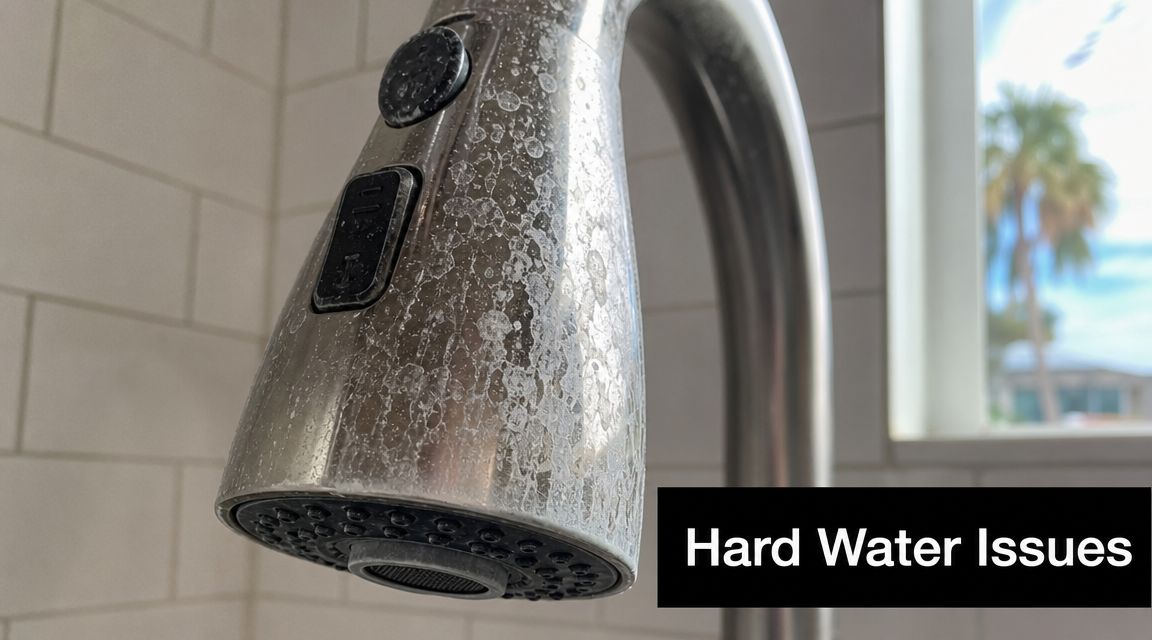
That frustration is real, and it usually has a visible clue. Hard water leaves white calcite deposits on fixtures and glass. Once you've seen it enough, you can spot the pattern quickly in kitchens, showers, and around water-using appliances.
Sarasota's scale makes this a community issue, not just an isolated home problem. One neutral local reference describes the county as covering 725 square miles and serving roughly 390,000 year-round residents, with the population rising to over 476,000 in winter. That seasonal increase of more than 86,000 people puts added demand on water infrastructure and helps explain why reliable water quality stays top of mind for both full-time and seasonal residents, according to this Sarasota County utility overview.
What Sarasota homeowners usually notice first
- On fixtures: White buildup around faucets, showerheads, and glass.
- On skin and hair: A dry feel after bathing and shampoo that seems harder to rinse clean.
- In daily chores: Soap that won't work the way you expect and dishes that still look cloudy after washing.
Hard water problems usually show up as repeated annoyance before they show up as a buying decision.
That's why a thoughtful fix matters more than a fast one. Some homes need straightforward softening. Others need a broader treatment plan because scale is only one piece of the picture. If you're comparing options, it helps to understand how a professional water softening system works in real homes before you commit to equipment.
Your First Step A Professional Water Analysis
The biggest mistake homeowners make is shopping for equipment before they know what's in their water.
A softener solves one category of problem. It does that job well when hardness is the issue. But a softener is not a universal answer, and treating it like one leads to wasted money, wrong equipment, and lingering complaints after installation.
Why test first instead of guessing
University extension guidance summarized by a regional provider makes the key point clearly: a water softener addresses calcium and magnesium, but it does not remove contaminants like bacteria, nitrate, or the sulfur odors common in Florida well water, which require separate treatment. That distinction is especially important for Sarasota-area homes deciding between softening and broader treatment options, as described in this discussion of water treatment and softening for Florida homes.
If you're on city water, the answer might be relatively simple. If you're on a private well, it often isn't. Well water can present a layered problem where hardness is only one symptom alongside odor, staining, sediment, or microbial concerns.
DIY strips miss what actually matters
Store-bought strips can tell you something, but they rarely tell you enough to buy confidently. They don't give most homeowners the full picture needed to choose between:
- A softener only
- A softener plus filtration
- A dedicated drinking water system
- UV or other treatment for well-related concerns
That's where professional analysis changes the conversation. A real test lets the installer size the system correctly, match the treatment method to the water source, and avoid selling a softener for a problem that really needs filtration.
Practical rule: Never buy a whole-house treatment system because a symptom sounds familiar. Buy it because your water test supports the recommendation.
A proper analysis also helps separate city-water priorities from well-water priorities. Municipal users often focus on hardness, taste, odor, and appliance protection. Well owners usually need to think more broadly about nuisance issues and possible health-related treatment needs.
At Florida Water Management, the right starting point is a no-obligation test and consultation, not a guess. If you want a clearer answer on what your home needs, request a professional review through our water filtration consultation page. It's the fastest way to stop shopping blind.
Comparing Water Treatment Systems for Your Home
A Sarasota homeowner on city water and a Sarasota homeowner on a private well can both complain about “bad water” and need two very different setups. That is why system shopping gets confusing fast. The right answer depends on what problem you are solving at the whole-house level, at the kitchen tap, or both.
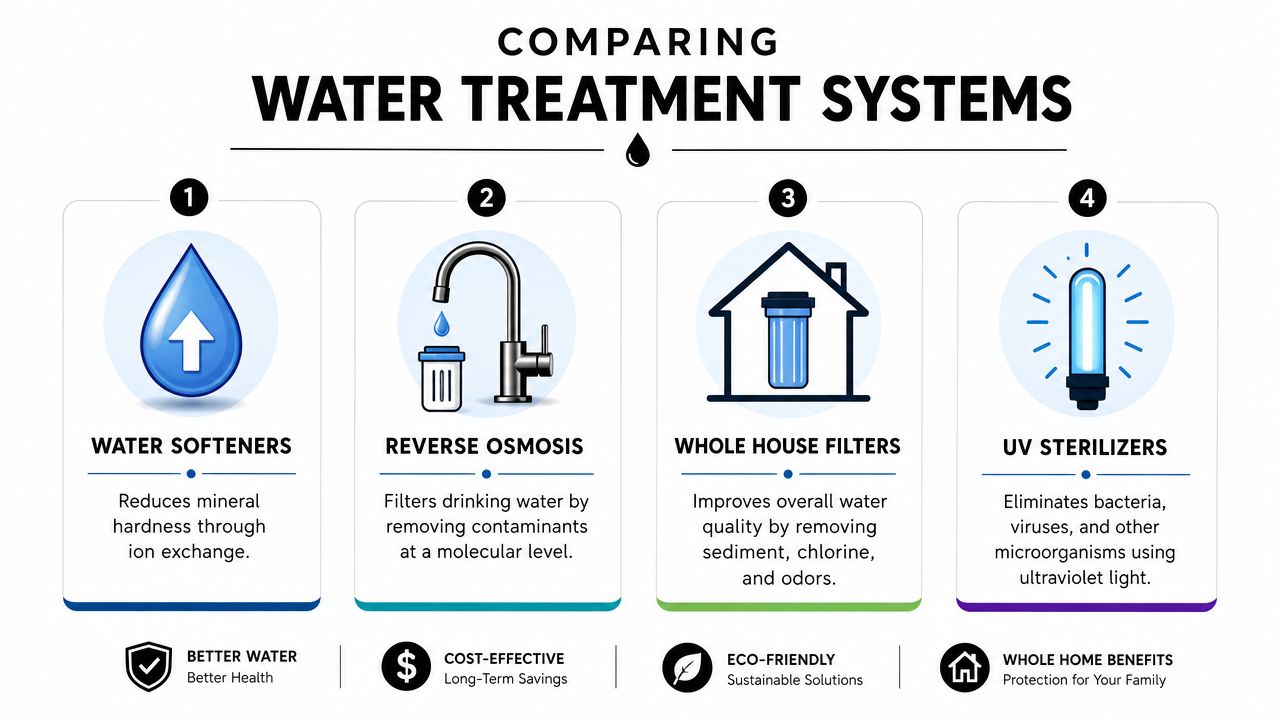
The biggest mistake I see is treating every water device as if it does the same job. It does not. A softener addresses hardness. A filter targets specific contaminants or nuisance issues. Reverse osmosis improves drinking water at one location. UV handles microbial risk in the right well-water applications.
Salt-based softeners
A traditional salt-based water softener removes hardness through ion exchange. Calcium and magnesium trade places with sodium on the resin, which is why these systems are still the standard fix for scale on fixtures, shortened appliance life, and that rough feeling on skin and laundry. If you want a plain-language explanation of the process, this overview of how water softeners work gives a useful baseline.
For many Sarasota homes, this is the core piece of equipment. That is especially true where hardness is the main issue and the homeowner wants to protect water heaters, dishwashers, shower glass, and plumbing fixtures.
Salt-free conditioners and where they fit
Salt-free systems need a clear explanation because they are often marketed as direct replacements for softeners. They are not. They do not remove hardness minerals from the water.
That does not make them useless. Some homeowners prefer them because they do not use salt and have a different maintenance profile. But the trade-off matters. If your goal is to remove hardness and stop mineral buildup as effectively as possible, a salt-free unit usually will not match an ion-exchange softener.
Reverse osmosis, whole-house filters, and UV
These systems solve different problems, and in Sarasota they are often paired with a softener rather than used instead of one.
| System | Best use | What it does not replace |
|---|---|---|
| Reverse osmosis | Improving taste and drinking water quality at a dedicated tap | Whole-house softening |
| Whole-house filter | Sediment, odor, chlorine, or other source-specific water issues depending on the media | Hardness removal |
| UV sterilizer | Microbial treatment for qualifying well-water setups | Sediment filtration or softening |
A layered setup is common for a reason. A well-water home might need sediment filtration plus softening plus UV. A city-water home may need only a softener, or a softener with a carbon filter if chlorine taste or odor is part of the complaint.
The best system is usually a combination, not a single box
Homeowners often ask for the “best” unit. A better question is what each piece of equipment is supposed to fix.
If the water test shows hardness only, a softener may be enough. If the home has sulfur odor, iron staining, tannins, sediment, or bacteria concerns from a private well, softening alone will leave major problems untouched. That is where local experience matters. Sarasota-area water conditions are not uniform from one neighborhood to the next, and they are definitely not the same between municipal and well properties.
Performance matters as much as treatment type
A system can be the right technology and still disappoint if it is sized poorly for the house. In real use, the trouble usually shows up during busy hours. Someone showers, the dishwasher runs, a faucet opens, and the treatment system cannot keep up.
The result is inconsistent performance, pressure complaints, or both. That is one reason I tell homeowners not to compare equipment by brochure features alone. Compare it by what it is designed to treat, how it fits your plumbing, and how your household uses water.
At Florida Water Management, we use the water analysis and the home's usage pattern together. That keeps homeowners from buying a softener for a filtration problem, or a drinking-water system when the primary issue is happening throughout the house.
How to Choose the Right Water Softener Company in Sarasota
A good system installed badly becomes a service call. A modest system sized correctly and supported well usually performs better than homeowners expect.
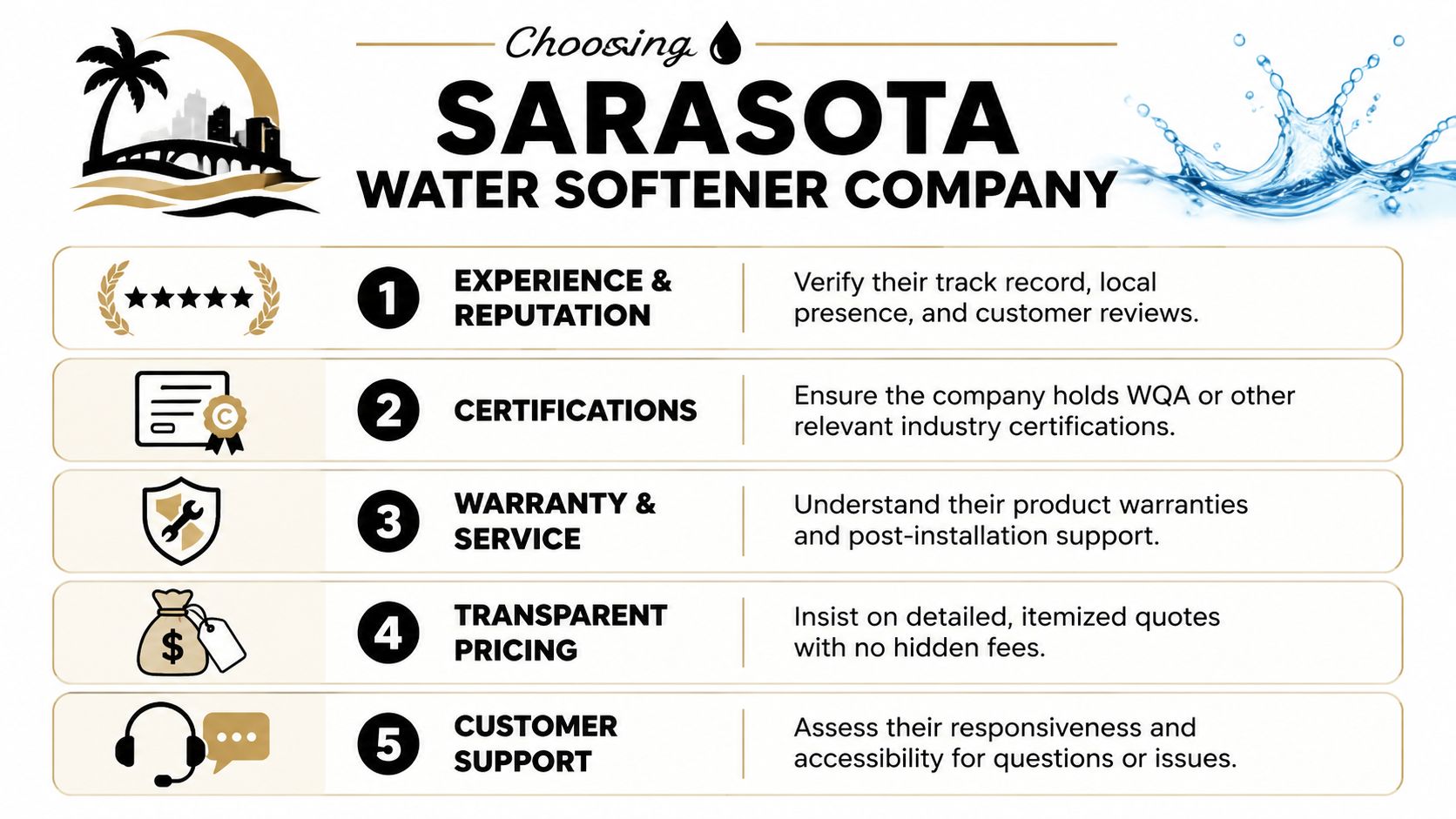
When you're comparing a water softener company in Sarasota FL, don't start with the sales pitch. Start with how the company diagnoses, explains, and supports the work.
What a trustworthy local company should do
- Test before recommending: If a company wants to sell equipment before understanding whether you're on city water or a private well, slow down.
- Explain trade-offs clearly: A reliable provider tells you what a softener will fix, what it won't fix, and when another treatment stage belongs in the system.
- Discuss service after installation: Salt refills, inspections, media changes, and troubleshooting should be part of the conversation early, not after the invoice is paid.
Questions worth asking on the first visit
Some questions tell you more than a brochure ever will.
Ask whether the company works regularly with both municipal and well-water properties. Ask how they size systems for simultaneous fixture use. Ask what support looks like if the house is seasonal, rented, or occupied only part of the year.
Then pay attention to the answers. Strong companies don't dodge specifics. They'll talk about resin capacity, flow demands, maintenance expectations, and when combination treatment makes more sense than a standalone softener.
If the recommendation sounds identical for every house, it probably isn't tailored to yours.
A simple vetting checklist
Use this when comparing local options:
Local water familiarity
The company should understand Sarasota-area water issues in practical terms, not just in marketing language.Clear scope of work
You should know what equipment is being installed, what problem it addresses, and what it does not address.Service commitment
Ask who handles maintenance and future troubleshooting. Some sellers disappear after install day.Quote transparency
Vague pricing creates expensive surprises later.No-pressure communication
Education first. Pressure last.
A company doesn't need the fanciest pitch to be the right fit. It needs sound diagnostics, honest recommendations, and a service model that still works after the honeymoon period of a new install is over.
Decoding Quotes Installation and Warranties
A Sarasota homeowner gets two quotes for what sounds like the same softener. One is a single price on a one-page sheet. The other lists equipment, plumbing work, drain routing, startup, and warranty coverage. The second quote is usually the safer one, even if the price is higher, because you can see what you are paying for.
That matters in Sarasota more than many homeowners expect. City water and well water homes often need different supporting components, and those details should show up in writing. If they do not, the low quote can become the expensive one after installation starts.

What a complete quote should include
A usable quote does more than name a model number. It should tell you what problem the system is designed to solve and what is included to get it working correctly in your home.
Look for these details:
- Treatment setup such as a softener by itself, a softener with sediment prefiltration, or a larger setup for a well-water home
- Installation labor including plumbing connections, drain line, bypass valve, and system startup
- Plumbing corrections or add-ons if the installer needs to reroute lines, add a loop, or upgrade a shutoff
- Programming and commissioning so regeneration settings match the household, not a factory default
- Warranty coverage broken out by parts, labor, and service response
- Permit or code-related work if local requirements apply to the installation
If a quote leaves those items out, ask for a revised version. At Florida Water Management, we prefer that level of clarity because it prevents disputes later and helps homeowners compare companies on real scope, not just sticker price.
Installation day should look organized
A clean installation is not about appearance alone. It affects service access, leak risk, and whether the system is easy to live with.
The installer should confirm final placement, protect nearby surfaces, tie the unit into the plumbing correctly, test the bypass, verify drain routing, and run the system before leaving. You should also get a short walkthrough on salt loading, basic controls, and what normal operation sounds like. If the home is on a well, that walkthrough should cover any related equipment that affects the softener.
Why sizing belongs in the quote discussion
Sizing errors often show up after the crew leaves. The shower pressure drops when another fixture turns on. The unit regenerates too often. Or the system never quite keeps up with the house.
That is why the quote should state how the company sized the equipment. Ask what they used to estimate peak demand, how many bathrooms they counted, and whether they considered irrigation exclusions, guest occupancy, or a seasonal-use pattern. A proper proposal should reflect the house, not a standard package.
Price comparisons also make more sense when you understand the full installation scope and equipment category. If you want a broader benchmark, our guide on what a home water filtration system can cost helps homeowners separate equipment price from installation and long-term value.
Warranty questions that matter
Warranty language deserves a close read. A long parts warranty sounds good, but it does not always mean labor, diagnostics, or travel time are included.
Ask these questions before signing:
- Which components are covered? Tanks, control valves, electronics, and resin may have different terms.
- Is labor covered, and for how long? A parts-only warranty can still leave you paying for service calls.
- Who performs warranty service locally? The seller, a subcontractor, or a manufacturer hotline are very different support models.
- What voids the warranty? Poor maintenance, off-label use, or untreated well-water issues upstream can affect coverage.
A clear quote and a specific warranty usually signal a company that expects to service what it installs. That is the standard you want.
The True Cost of Ownership Maintenance and Upkeep
The purchase price gets the attention. The ownership pattern is what determines whether you'll still be happy with the system later.
In Florida, that's not a small issue. A regional discussion of water-treatment economics notes that buyers are asking broader questions about contaminants such as PFAS and lead, while local content often skips the practical ownership concerns of operating costs, salt logistics, and service frequency. That gap is one reason homeowners should think beyond installation day when comparing treatment options, as noted in this look at water-treatment concerns in Florida homes.
What ongoing ownership usually looks like
For a salt-based softener, the obvious recurring task is keeping salt on hand and loading it consistently. For filtration systems, the recurring task is replacing the right media or cartridges on schedule. For well-water homes with multiple treatment stages, maintenance planning matters even more because one neglected component can affect the rest of the setup.
That doesn't mean the system becomes a burden. It means you should expect regular care, just like any other piece of home equipment that protects plumbing and daily comfort.
Costs that homeowners often forget to ask about
- Consumables: Salt, replacement filters, or other treatment media
- Service visits: Periodic checkups, troubleshooting, and performance verification
- Seasonal management: Adjustments for homes that sit vacant for part of the year
- Long-term parts wear: Components don't last forever, especially in demanding water conditions
Cheap equipment can become expensive ownership if maintenance is hard to source or easy to ignore.
A transparent company will talk through these realities upfront. They won't pretend every system has the same maintenance pattern, because it doesn't. A city-water softener and a private-well treatment package live very different lives.
If you're budgeting for the full picture, this guide to home water filtration costs is a useful place to frame the questions you should ask before buying.
What works best long term
The homeowners who stay happiest usually do three things well:
- They buy after testing, not before.
- They choose equipment sized for how the home is used.
- They keep up with simple maintenance instead of waiting for symptoms to return.
That's the difference between owning treatment equipment and depending on it successfully.
Frequently Asked Questions About Sarasota Water Softeners
Does Sarasota city water still need a softener
It can. City water and well water present different treatment decisions, but municipal supply doesn't automatically mean hardness isn't an issue. If you're seeing scale, spots, and poor soap performance, testing is the only reliable way to decide.
Will a water softener make my water taste salty
Not in the way often feared. A properly selected and functioning softener uses ion exchange to treat hardness. If taste is your main concern, many homeowners pair whole-house treatment with a dedicated drinking-water solution at the kitchen sink.
How long should a quality system last
That depends on the water quality, the equipment type, how well it was sized, and whether it's maintained properly. Good installation and steady service matter as much as the equipment itself.
Can I install a system myself
Some homeowners can handle basic plumbing work, but whole-house treatment is one of those jobs where small mistakes create big headaches. Poor placement, wrong sizing, bad drain setup, and incorrect programming can all reduce performance. Professional installation usually saves time and avoids a lot of trial and error.
Do I need a softener, a filter, UV, or all three
It depends on the water test. Hardness points toward softening. Odor, sediment, or other nuisance issues may call for filtration. Certain well-water concerns may require UV or a more layered treatment approach. One box is not the answer to every water problem.
If you're trying to sort through Sarasota water issues without getting pushed into the wrong equipment, start with a real test. Florida Water Management provides professional water analysis and customized treatment recommendations for homes and small businesses, including properties dealing with hard water, odor, iron, sediment, and well-water concerns. Use the contact page to schedule your free water test and get a recommendation based on your water, not a generic sales script.