

You turn on the shower and the glass starts spotting before the steam clears. Dishes come out of the washer looking cloudy. Towels feel stiff. A glass of tap water has that faint disinfectant smell you can't quite ignore. In Tampa, that mix of nuisance problems is common, whether you're on municipal water or pulling from a private well.
Most homeowners don't need more theory. They need to know what's causing the problem, what kind of system fixes it, and what's a waste of money. Whole home water purification in Tampa, FL makes sense when it's built around the water you have, not a generic box from a shelf. The smartest place to start is a professional water test, because the right answer for chlorine-heavy city water isn't the same as the right answer for a well with iron, sulfur, or bacteria concerns.
Table of Contents
- Your Complete Guide to Whole Home Water Purification in Tampa
- Understanding Tampa's Unique Water Challenges
- Choosing the Right Water Purification System for Your Home
- Proper System Sizing and Professional Installation
- Investment Cost and Return on Investment for Tampa Homeowners
- Questions to Ask Your Water Treatment Contractor
- Your Next Step to Perfect Water in Tampa
Your Complete Guide to Whole Home Water Purification in Tampa
A lot of Tampa homeowners wait too long because the problems seem cosmetic at first. They scrub mineral film off faucets, switch detergents, buy a pitcher filter, and keep going. Then the water heater starts working harder, scale builds up where they can't see it, and the water still doesn't taste right.
That pattern is why whole-home treatment matters. A point-of-use filter at the kitchen sink helps with drinking water, but it does nothing for the shower, laundry, dishwasher, water heater, or the plumbing feeding the rest of the house. If the problem enters at the main line, the most reliable fix starts there too.
What a whole-home approach changes
A proper system treats water before it reaches the fixtures and appliances you rely on every day. That usually means combining technologies instead of expecting one tank or cartridge to solve everything.
Common goals include:
- Reducing hardness issues: Protect pipes, fixtures, water heaters, dishwashers, and washing machines from mineral scale.
- Improving taste and odor: Cut down the chlorine or chloramine smell that makes tap water less appealing.
- Addressing source-specific risks: Handle city-water disinfectants differently than well-water issues like sulfur or iron.
- Creating consistency: Deliver treated water at every tap instead of only at one faucet.
Practical rule: If your complaints involve more than drinking water, you're usually looking at a whole-home problem, not just a kitchen filter problem.
Homeowners searching for whole home water purification Tampa FL options usually aren't shopping for a gadget. They're trying to get control over water quality across the entire property. That means testing first, sizing correctly, and matching equipment to the actual contaminants and conditions in the home.
Understanding Tampa's Unique Water Challenges
Tampa water issues aren't all the same, but one local problem shows up again and again. Tampa, Florida, experiences very hard water with an average total hardness of 11.4 grains per gallon (gpg), which places it in the very hard category and creates a strong case for whole-home softening and filtration to prevent scale and protect plumbing and appliances, according to Leaf Home's Tampa water solutions page.
What hard water does inside a Tampa home
At 11.4 gpg, hard water doesn't stay a minor annoyance for long. It leaves spots on glasses, residue on shower doors, and crust around fixtures. Of greater concern, it lays down scale inside pipes and on heating elements, where homeowners can't easily see it.
That hidden buildup affects the parts of the house that cost the most to replace. Water heaters lose efficiency. Dishwashers and laundry machines deal with added wear. Soap performance drops, so people often use more detergent and still feel like things aren't getting fully clean. If you're dealing with those symptoms, it helps to review dedicated hard water solutions in Tampa FL before choosing equipment.
City water and well water create different problems
For city water homes, hardness is only part of the story. Municipal treatment uses disinfectants, and homeowners often notice them first as taste or odor. That “pool” note in the tap isn't your imagination. Even when water is treated for public safety, it may still be unpleasant for drinking, bathing, and cooking from a comfort standpoint.
For well water homes in the broader Tampa area, the conversation shifts. Iron can stain fixtures and laundry. Sulfur can create a rotten-egg odor. Sediment can foul fixtures and filters. Microbial concerns also make wells a different design challenge than municipal water.
A lot of generic articles miss two Tampa-specific concerns that deserve attention:
- PFAS concerns: Many homeowners now want systems that explicitly address PFAS, sometimes called “forever chemicals,” rather than only chlorine and sediment.
- Hurricane season exposure: Storm conditions can raise concern about sediment, bacteria, and runoff entering the water picture, which is one reason point-of-entry protection matters more than a single faucet filter.
A Tampa water plan should match the source, the contaminants, and the season. What works in a condo on city water may be the wrong setup for a well-fed home outside the urban core.
This is why a one-size-fits-all recommendation usually fails. In Tampa, the water problem is local, specific, and often layered.
Choosing the Right Water Purification System for Your Home
Whole-home treatment is best understood as a layered protection system. One component handles hardness. Another targets disinfectants and chemical tastes. Another may be reserved for drinking water or microbial control. Expecting one device to do all of it usually leads to disappointment.
Think in stages, not single products
Water softeners solve a specific problem. They address hardness minerals that create scale and reduce soap performance. In Tampa, that's often the starting point when the home has visible spotting, stiff laundry, and appliance wear tied to mineral content.
Activated carbon filtration has a different job. For municipal water, this is often the core tool for improving taste and odor while reducing chemical-related concerns. According to a technical sheet for whole-home filtration systems, whole-home granulated activated carbon systems can remove up to 99.6% of chlorine and chloramine and capture VOCs and PFAS at 99% efficiency when properly engineered for those targets, as described in this whole-home GAC technical data sheet.pdf?language=en).
If your main complaint is disinfectant smell from city water, it's worth understanding how a dedicated whole house water filter for chlorine fits into a broader system instead of assuming a softener will solve it.
Reverse osmosis is usually best used at the tap for drinking and cooking water. It's not typically the first answer for treating every gallon entering the house, but it's excellent when a homeowner wants highly refined water at the kitchen sink.
UV sterilization is usually associated with well systems, especially where microbial risk is part of the design equation. It doesn't replace sediment or carbon stages. It complements them.
Iron and sulfur treatment is another specialized category for well water. If the home has staining or odor issues, that needs targeted treatment rather than a generic filter swap.
Comparison of Whole Home Water Treatment Systems
| System Type | Primary Target Contaminant | Best For |
|---|---|---|
| Water softener | Hardness minerals | Homes with scale, water spots, stiff laundry, and appliance buildup |
| Granulated activated carbon filter | Chlorine, chloramine, taste, odor, VOC-related concerns | City water homes that want better water throughout the house |
| Reverse osmosis | Drinking water impurities at the point of use | Homeowners who want highly purified water for cooking and drinking |
| UV sterilizer | Microbial concerns | Well water systems needing an added disinfection stage |
| Iron or sulfur filter | Iron staining or sulfur odor | Private well homes with nuisance metals or smell issues |
What usually works best in Tampa homes
Most Tampa homes don't need a miracle product. They need the right combination.
For city water, a common practical setup is:
- Softener first: Handle the hardness problem that affects plumbing and appliances.
- Carbon stage next: Improve taste and odor while targeting disinfectants and related concerns.
- Optional RO at the kitchen sink: Add a final drinking-water polish where homeowners want it most.
For wells, the system usually gets more customized:
- Sediment prefiltration: Protect downstream equipment.
- Targeted treatment: Address iron, sulfur, or both when present.
- Carbon media: Add broad contaminant reduction where appropriate.
- UV disinfection: Add microbial protection when the water profile calls for it.
The best system isn't the one with the most components. It's the one where each stage has a clear job and the water test justifies it.
That's the difference between equipment that performs for years and equipment that becomes an expensive guess.
Proper System Sizing and Professional Installation
Buying the right equipment is only half the job. A well-designed system can still underperform if it's undersized, plumbed poorly, or installed in the wrong sequence. Such issues often lead to homeowner frustrations.
Why flow rate matters more than most homeowners realize
Flow rate is how much water the system can treat while the house is using it. In real life, that means someone is showering while the dishwasher runs and another faucet turns on. If the treatment setup can't keep up, you'll notice pressure drop, poor performance, or both.
For private wells in the Tampa Bay region, Florida Department of Environmental Protection guidance states that a multi-stage system should be designed to achieve a minimum capacity of 6 gallons per minute, which supports average household use without causing pressure problems or reducing filter effectiveness, as explained by the Florida DEP water filtration systems guidance.
Sizing depends on more than the number of bathrooms. A technician should look at:
- Water source: City water and wells place different demands on equipment.
- Household usage patterns: A family with staggered routines doesn't stress a system the same way as one with heavy simultaneous demand.
- Pressure conditions: Existing plumbing pressure affects how the treatment train performs.
- Contaminant load: Dirtier water can shorten media life and change sizing decisions.
What installation day should look like
A professional install should feel orderly, not improvised. The equipment is typically tied into the main line at a location that allows service access, drainage where needed, and room for maintenance. Good placement matters because filters and media tanks need to be serviced without tearing apart a garage or utility room later.
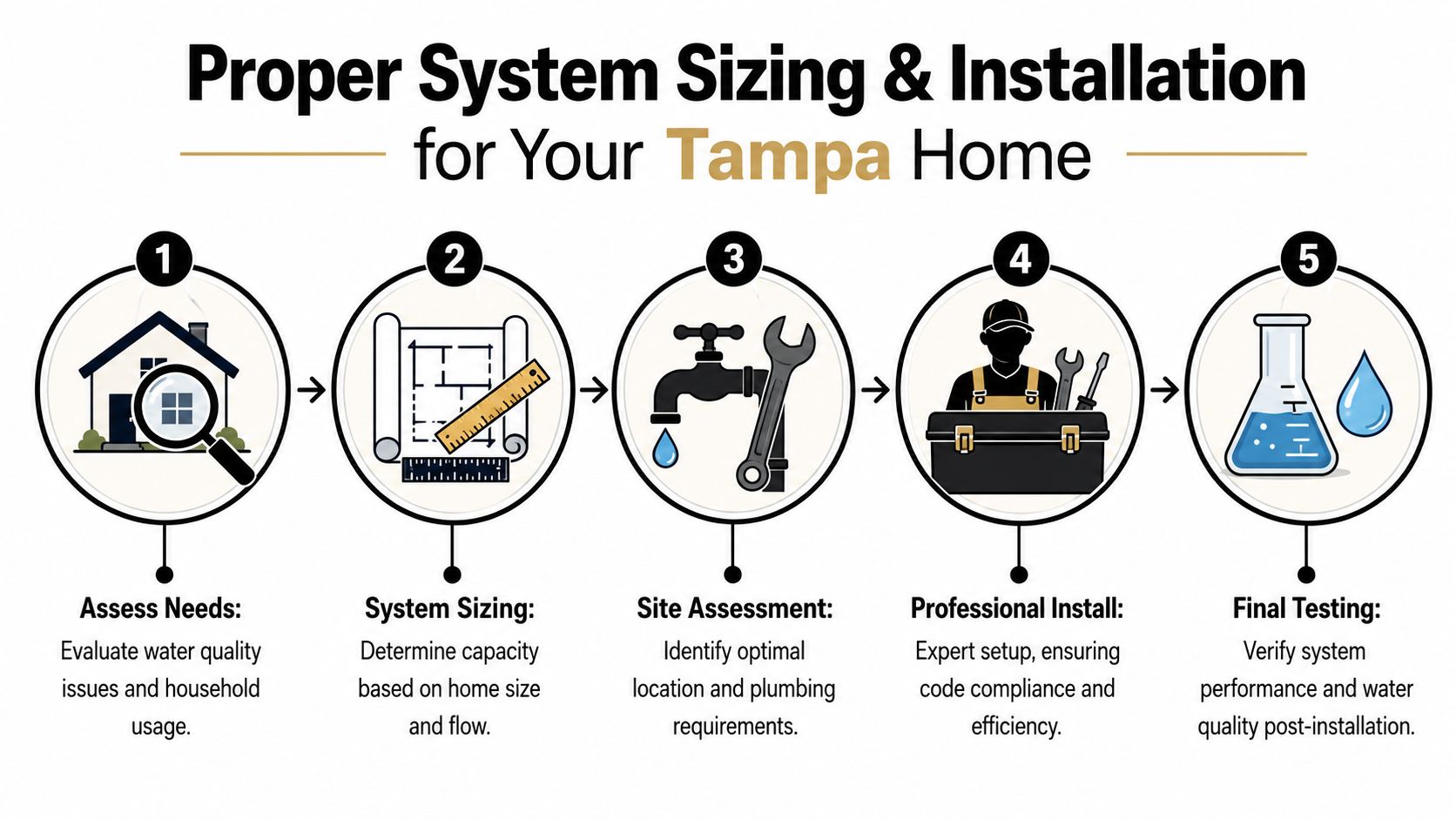
A solid installation process usually includes these checkpoints:
- Water review: Confirm the test results and final equipment selection.
- Site planning: Verify where tanks, housings, shutoffs, and drain connections belong.
- Plumbing integration: Install the system in the correct order so each stage protects the next.
- Startup and flush: Condition media, flush lines, and bring the system online properly.
- Performance check: Confirm water flow, pressure behavior, and expected treatment results.
If an installer talks only about the product and not about flow, placement, service access, and testing, the design conversation isn't finished.
That technical discipline is what separates a durable installation from a system that becomes a service headache.
Investment Cost and Return on Investment for Tampa Homeowners
The price question matters, but the cheapest number on paper often leads to the worst ownership experience. Tampa homeowners see a wide cost range because equipment complexity changes fast once you move beyond a single basic filter.
What drives the price
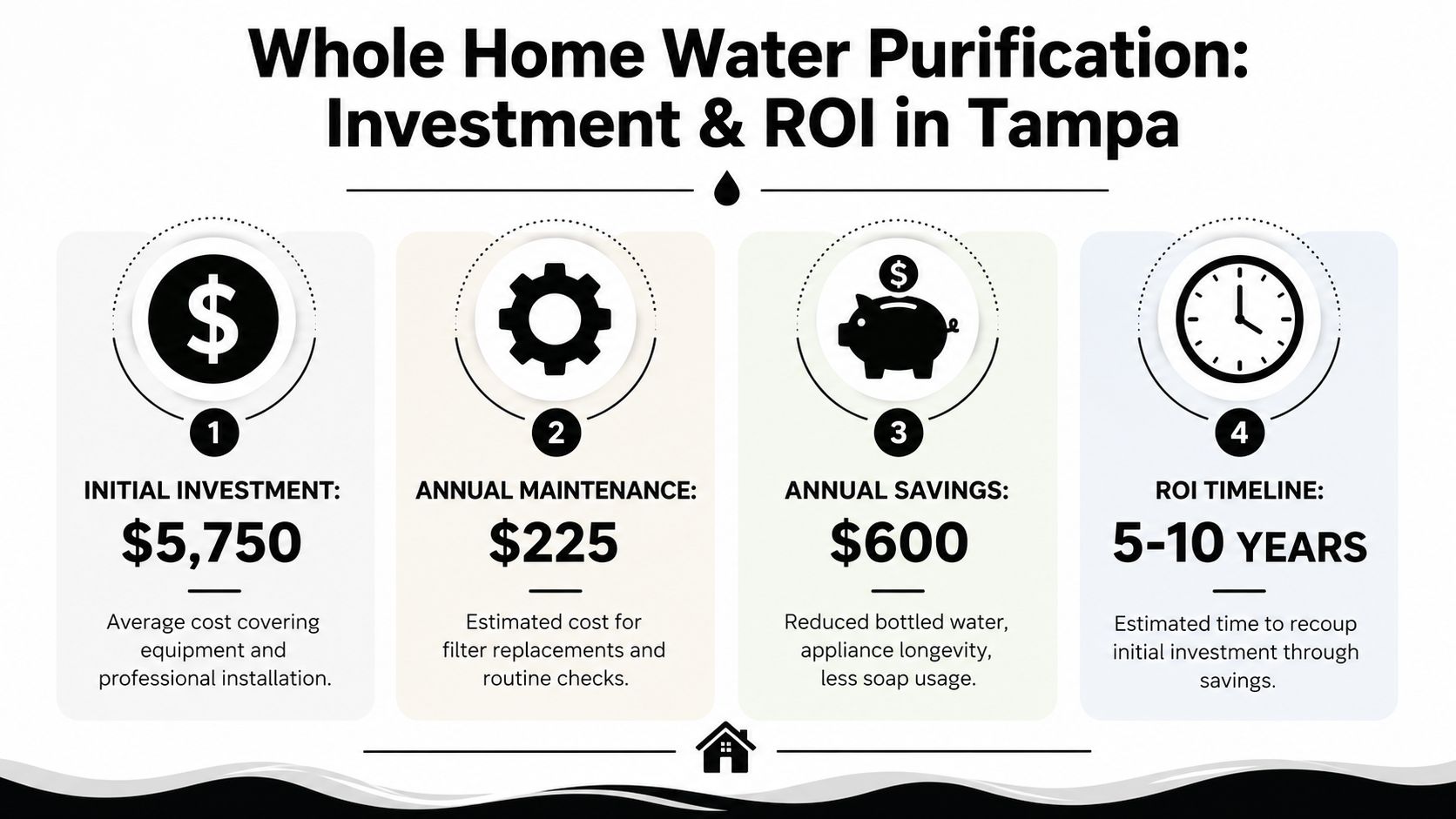
According to Angi's Tampa market cost guide, whole-home water filtration systems can range from $120 for basic units to over $6,000 for more complex systems, and the most common installed setup that includes a softener and carbon filter typically falls between $2,800 and $4,800 in the Tampa area, based on this Tampa whole-house water filtration cost breakdown.
That spread makes sense in practice. A basic unit isn't the same as a system designed to deal with hard water, chemical taste and odor, sediment, and source-specific risks. Add larger capacity, specialized media, or more demanding well-water treatment, and the price moves upward.
If you're comparing treatment options, it helps to understand broader reverse osmosis system cost considerations separately from whole-home equipment so you don't compare unlike systems.
Where the return shows up
Return on investment isn't just about resale value. It shows up in daily operation and avoided wear.
A whole-home system can provide value through:
- Appliance protection: Hardness and sediment are rough on heaters, dishwashers, and laundry equipment.
- Less fixture cleanup: Reducing scale and residue cuts routine scrubbing.
- Better water use experience: Cleaner-feeling bathing water and better-tasting tap water change how the home feels every day.
- Fewer stopgap purchases: Homeowners often stop relying on piecemeal filters once the incoming water is treated correctly.
The smart way to budget for whole home water purification in Tampa FL is to think in terms of total ownership. Upfront cost matters, but so do maintenance simplicity, correct sizing, and whether the system is solving the problems you live with now.
Questions to Ask Your Water Treatment Contractor
A good contractor won't get irritated by detailed questions. In fact, the best companies welcome them because careful homeowners usually end up with better system matches and fewer surprises after installation.
Questions that reveal real expertise
Start with the basics, then move into how they diagnose and design.
Ask questions like these:
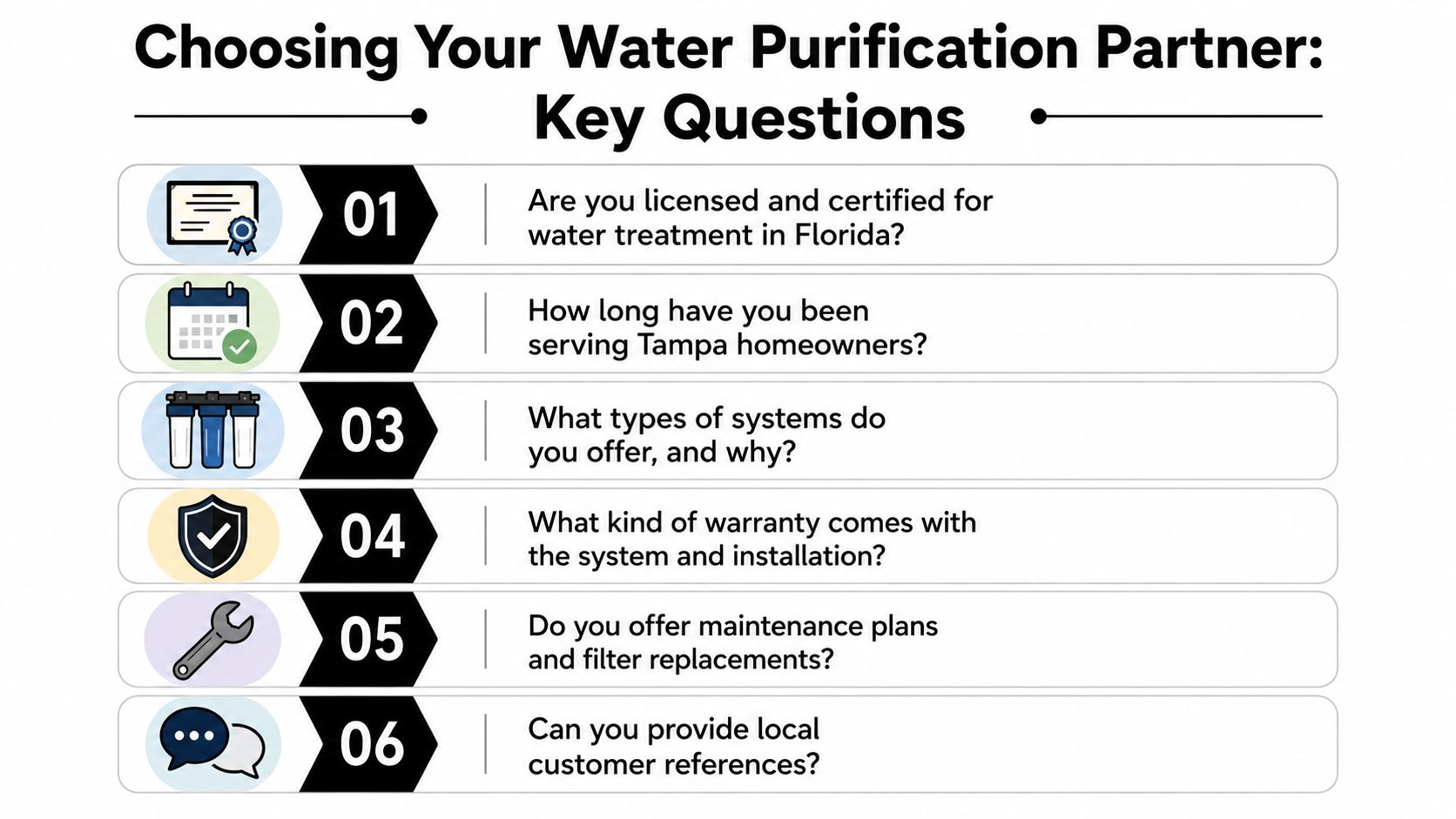
- What did my water test show, and how does that drive the system recommendation? A real professional ties equipment choices to actual water conditions.
- Is this design for city water or well water, and what would change if the source changed? The answer should be specific, not generic.
- What component handles hardness, and what component handles taste, odor, or chemical concerns? This tells you whether the contractor understands staged treatment.
- How will the system affect water pressure and service flow in my house? If they can't explain performance under real use, keep asking.
- What maintenance will I be responsible for? You want a clear service path, not vague promises.
- What warranty applies to equipment and installation labor? Those are not always the same.
Ask the contractor to explain what the system does not do. Honest limitations are a sign you're dealing with someone competent.
How to verify filtration claims
Homeowners often get misled. Product marketing tends to bundle broad claims together, but certification doesn't work that way.
According to NSF guidance, consumers should verify both the NSF/ANSI standard and the specific contaminant claim, because certification for one issue does not automatically mean certification for another. For example, a system may be certified under NSF/ANSI 53 for certain health effects, but you still need to confirm the exact contaminant listed for reduction. That verification process is explained in NSF's consumer article on how to check home water treatment certifications.
That matters even more when Tampa homeowners ask about PFAS. Don't accept “removes everything” as an answer. Ask which certification applies and which contaminant reduction claims are documented for that exact product.
Good contractors also explain the difference between:
- A whole-home filter for incoming water
- A point-of-use device for drinking water
- A softener that manages minerals but doesn't replace filtration
- A UV stage that disinfects but doesn't remove sediment or chemical tastes
If the explanation is clear, limited, and contaminant-specific, you're probably talking to the right team.
Your Next Step to Perfect Water in Tampa
The right answer for Tampa water almost never comes from guessing. Not from a store-bought cartridge, not from a neighbor's recommendation, and not from a sales pitch that skips testing. The water source, the contaminant profile, the plumbing setup, and the household's daily demand all matter.
That's especially true in this area, where homeowners often deal with more than one issue at the same time. Hardness can affect the whole house. City water can bring chlorine or chloramine taste and odor concerns. Wells can add sulfur, iron, sediment, or microbial risk. Some homeowners also want direct answers about PFAS and storm-related water concerns during hurricane season. Those aren't fringe questions in Tampa. They're practical ones.
A proper water test cuts through the noise. It shows what's in the water, which treatment stages make sense, and what you can ignore. That keeps you from overspending on equipment you don't need, or worse, underspending on a system that never had a chance to solve the problem.
If you're looking into whole home water purification in Tampa FL, start with real data from your own home. The most useful first move is a free test and a straight answer about what the water needs.
Get a free water test from Florida Water Management. If you want a personalized recommendation for your home, use the contact us page to schedule your no-obligation water evaluation.